Air Conditioner for an Attic Apartment: How to Choose and Install One in 2026
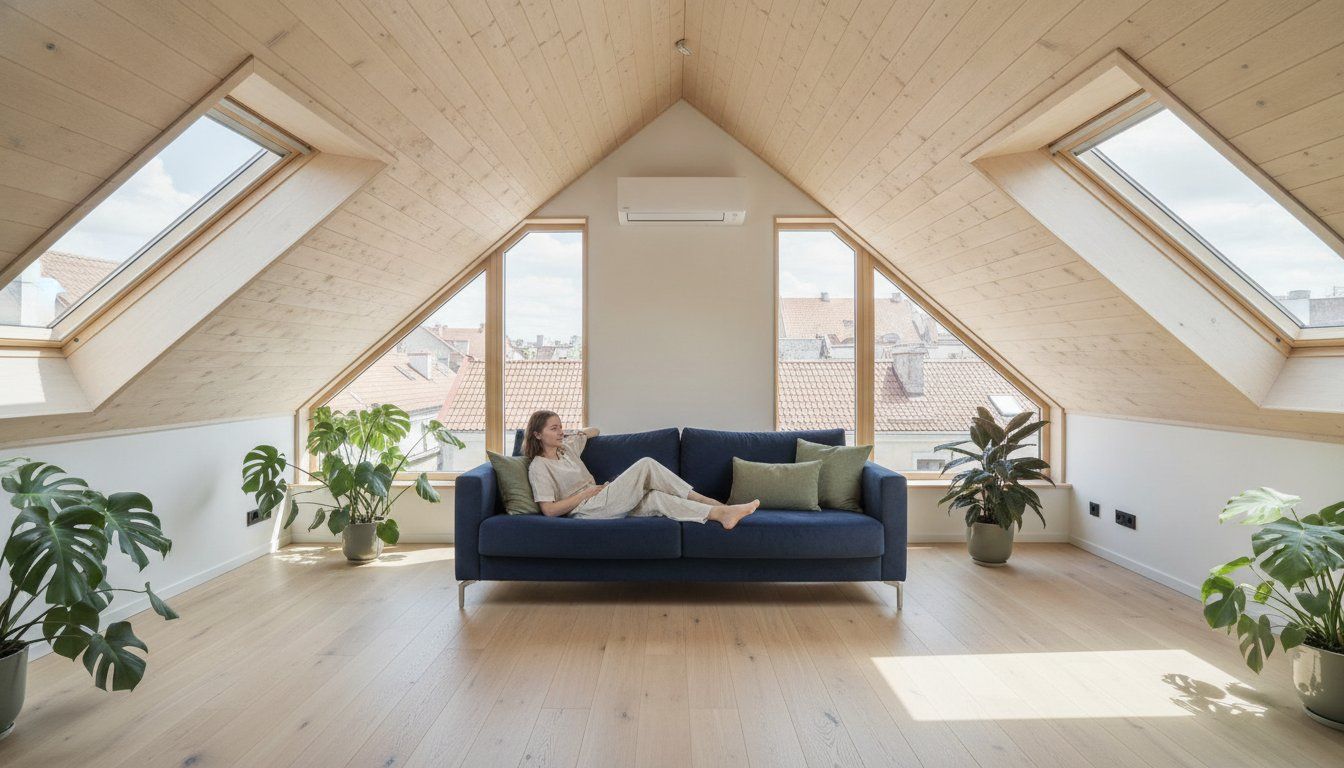
Imagine a sweltering July afternoon when your cosy attic apartment starts to feel like an overheated sauna, and even wide-open windows bring no relief at all. We fully understand this feeling, because for owners of attic spaces, summer often becomes a serious endurance test. Direct solar heat through the roof covering is relentless, and standard solutions often do not work here. Finding the right unit, such as an efficient air conditioner for an attic apartment, is crucial not only for your everyday comfort, but also for healthy sleep and productivity.
In this guide, we will share our experience on how to choose the right cooling solution that can handle the specific heat load while fitting into a limited space and protecting the roof structure. You will learn about the latest 2026 energy-efficiency requirements, smart equipment placement and why professional installation is the key to peace of mind. We will look at practical steps to turn your bedroom under the roof into a cool oasis without worrying about astronomical bills or complicated municipal approval processes.
Why does an attic apartment need a special approach to cooling?
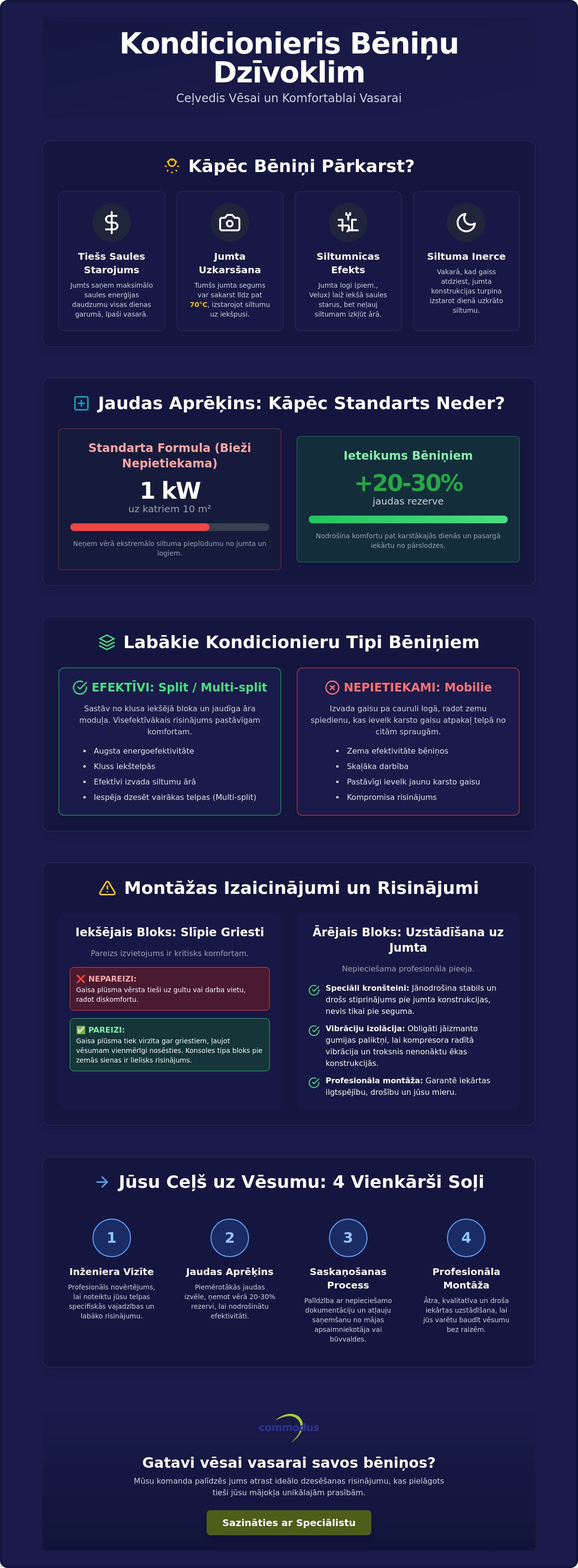
Attic floors are unique, and in summer they often become the heat epicentre of the building. Unlike lower floors, attics receive direct solar radiation all day long through the roof surface. The roof covering, especially if it is dark, can heat up to as much as 70 degrees. This heat inevitably looks for a way inside, even if the insulation is high-quality. Our experience shows that this constant flow of energy is the main reason why standard solutions tend to fail here.
Roof windows, such as popular Velux-type solutions, make the situation even more complicated. They act as amplifiers of the greenhouse effect: sunlight enters the room freely and heats the furniture and floors, while the heat is not released outside. This is where thermal inertia appears. Even late in the evening, when the outdoor air has already cooled down, the roof structure continues to radiate the energy accumulated during the day. For this reason, a air conditioner for an attic apartment must be chosen with particular care. We define attic air conditioning as a system calculated with at least a 20-30% power reserve above the standard norm, to compensate for these specific factors and ensure comfort at night as well.
Heat load calculation: why standard formulas do not work
Many people assume that 1 kW of cooling capacity per every 10 square metres of floor area is enough. In attics, this formula often fails because it does not account for the extreme heat gain from above, so a powerful air conditioner for an attic apartment is critically important. To understand why this is the case, it is worth studying building insulation principles. Several critical factors affect the heat load:
- Insulation thickness and quality: In older buildings, insulation is often settled or insufficient.
- Roof colour: A dark metal roof absorbs significantly more heat than a light-coloured covering.
- Window orientation: South-facing windows create a huge heat load precisely during the hottest part of the day.
To prevent the unit from operating at the limit of its capabilities, we recommend choosing a more powerful solution. For example, AlpicAir air-source heat pumps offer models that are particularly energy-efficient even under heavy loads. The right capacity protects the compressor from premature wear and helps avoid unpleasant surprises in electricity bills. Our team will always help with precise calculations so your home stays cool even on the hottest days.
The best types of air conditioners for attic spaces
When choosing cooling equipment for a room directly under the roof, it is clear that standard solutions will not always be suitable. Split systems are and remain the most effective way to ensure constant comfort. They consist of a quiet indoor unit and a powerful outdoor module that removes heat from the building. If your attic floor is divided into several separate rooms, such as a bedroom and a study, a multi-split system will be the most sensible choice. It allows several indoor units to be connected to one outdoor unit, preserving the aesthetics of the façade and saving space on the roof.
We often see clients initially trying to make do with portable air conditioners. In attics, they are usually insufficient. A portable unit removes warm air through a hose in the window, creating a pressure difference in the room. As a result, hot air from the heated roof structures is drawn in through every gap and ventilation opening. To achieve the best result, energy-efficient cooling tips, which help optimise system operation, will be useful. If you plan to cool several rooms, AlpicAir air-source heat pumps offer flexible multi-split solutions that adapt to your home layout.
Placing indoor units in rooms with sloped ceilings
Sloped ceilings are the biggest installation challenge. If the wall height does not allow a standard wall-mounted unit to be installed, console-type units come to the rescue. Visually, they resemble radiators and are installed on low knee walls. It is critically important to position the air conditioner for an attic apartment so that the cold air flow is not directed straight at the bed or desk. We always recommend using units with smart airflow control, which directs cool air along the ceiling and lets it settle evenly downwards.
Challenges of installing an outdoor unit on the roof
Placing an outdoor unit on a sloped roof requires specific knowledge and special brackets. Simply screwing it to the roof covering is not acceptable; vibration isolation pads must be used so the compressor rumble does not spread through the whole building. You can read more about proper installation in our article on how to choose the best air conditioning solution for a home. Remember that correct roof installation protects both the unit itself and your sense of peace in the long term.
Practical steps: from project to the first cool air
The path to a cool home begins with careful planning. A visit from our engineer is the first and most important step to clarify which air conditioner for an attic apartment will be the most suitable. We assess not only the room volume, but also the specifics of the roof structure and possible routes for communications. At this stage, together we choose the unit capacity, taking into account the previously mentioned 20 to 30 percent reserve, and find the best place for the indoor unit to avoid direct cold airflow towards the resting area.
The approval process often seems intimidating, but it can be handled. If you plan to install the outdoor unit on a façade facing a public outdoor space, approval from the Riga City Council City Development Department will be required. In any case, if you live in an apartment building, consent from more than 50 percent of apartment owners must be obtained, because the façade is shared property. We always recommend arranging these matters in good time to avoid fines or unpleasant conversations with neighbours. This is also important in line with the new 2026 energy-efficiency directives, which require more precise accounting of equipment.
During installation, our technicians pay special attention to condensate drainage. In attics, this is a challenge because gravity drainage is not always possible. In such cases, we install discreet condensate pumps. Once the system is installed, we test it and teach you how to use the smart controls. This lets you prepare a cool room remotely before you return home from work.
Legal aspects and façade aesthetics
Requirements are stricter for historic-centre buildings or cultural monuments, and an outdoor unit often cannot be placed on the street-facing façade. In such cases, we look for alternatives, such as placing the unit in an inner courtyard or on a balcony floor where it is not visible. To ensure not only cooling but also a constant supply of fresh air, a heat recovery ventilation system is an excellent addition to an air conditioner. It will help maintain a healthy microclimate without the need to open windows, which in an attic in summer would only mean more heat entering. If you want to learn more about supplying fresh air, take a look at our ventilation solutions.
Commodus solutions: energy efficiency and durability
At Commodus, we believe that the best solution is the one that does not draw attention to itself with unnecessary noise or unexpected bills. That is why our main recommendation for attic spaces is an air-to-air heat pump. This unit is much more than just an ordinary air conditioner for an attic apartment. It is a two-in-one system that provides pleasant cooling in summer, and at the beginning or end of the heating season serves as an economical heat source. This dual function allows the unit to pay for itself significantly faster, because you save on heating costs in the off-season when the main heating system is not yet needed.
Our experience shows that silence is a priority in attics. That is why we offer AlpicAir air-source heat pumps, which stand out for their particularly low noise levels. This is critically important if the indoor unit is located in the bedroom right above your head. We provide a full service cycle throughout Latvia. This means that our responsibility does not end with installation. We carry out regular maintenance and provide technical support so your system works flawlessly for decades. Our warranty and the availability of our team are your peace of mind, knowing that a knowledgeable technician will still be reachable after several years.
Smart control and energy savings
A modern air conditioner for an attic apartment is unthinkable without smart control. Remote access via smartphone allows you to turn on cooling while you are still on your way home from work or the beach. You no longer have to wait an hour for an overheated room to cool down; you enter a comfortable environment immediately. The new 2026 regulations emphasise the importance of energy efficiency, so we offer only the highest A+++ class units. This efficiency significantly reduces electricity consumption, protecting you from high expenses in the long term. If you want to understand all the advantages of these systems in greater depth, our air-to-air heat pump guide, where we have gathered all the information needed for a well-considered decision, will be useful.
Prepare your home for a comfortable summer today
Cooling an attic apartment is a technical challenge that is best entrusted to experienced professionals. Remember that a correctly chosen air conditioner for an attic apartment requires at least a 20 to 30 percent power reserve and well-considered indoor unit placement. Only this makes it possible to effectively compensate for the heat generated by the roof structure and ensure genuine comfort. By choosing a modern air-to-air heat pump, you gain not only cooling on hot days, but also an economical heating solution for the off-season.
The Commodus team has more than 15 years of experience in the Latvian market. Our certified installation specialists will help find the most energy-efficient solution specifically for your home, taking care of the whole process from project to regular maintenance. Considering the new 2026 energy-efficiency requirements, choosing high-quality equipment is a smart long-term investment in your property value and personal wellbeing.
Apply here for a free consultation and attic apartment inspection! We are ready to help you turn hot attics into a cosy and cool oasis where it is pleasant to spend time in any season.
Frequently asked questions about attic cooling
Can an air conditioner be installed if the attic only has sloped ceilings?
Yes, air conditioners can also be installed in rooms with strongly sloped ceilings by using console-type indoor units. These devices are mounted on low walls near the floor and visually resemble radiators. If the wall height at floor level is at least 60 to 80 centimetres, that is enough to safely install a unit that will provide efficient airflow throughout the room.
How much noise does an outdoor unit create if it is installed on the roof above the bedroom?
A properly installed modern outdoor unit creates minimal noise if special vibration isolation pads are used during installation. The main source of noise is usually not the unit itself, but vibrations that can spread through the building structures. Our specialists always use damping brackets and rubber isolators that prevent sound from reaching the bedroom, preserving complete peace at night.
Is one powerful air conditioner enough for all rooms in an attic apartment?
Usually, one unit is not enough for the whole apartment, because the complex geometry of an attic and partition walls interfere with free air circulation. Even if a very powerful air conditioner for an attic apartment is selected, the room where it is located will be too cold, while distant corners will remain hot. We recommend using a multi-split system that allows several indoor units to be connected to one powerful outdoor module.
Why does an air conditioner in an attic fail to cope on very hot days?
A unit may be unable to cool the room if its capacity has been calculated using the standard formula without taking into account roof covering heat-up and the large window area. In attics, the temperature rises much faster than on lower floors, so it is critically important to plan at least a 20 to 30 percent power reserve. If an air conditioner for an attic apartment is chosen without this reserve, it will operate at maximum power but will not be able to compensate for the constant heat gain from the roof structures.
Is a project required to install an outdoor unit on the roof?
Yes, in most cases approval from the municipality and mandatory neighbour consent are required. If the building is located in Riga and the outdoor unit will be visible from a public outdoor space, a placement solution must be prepared for the City Development Department. In any apartment building, votes from more than 50 percent of apartment owners must be obtained, because the roof and façade belong collectively to all residents of the building.
Comments