Air Conditioner for the Home: A Complete Guide to Selection and Installation in 2026
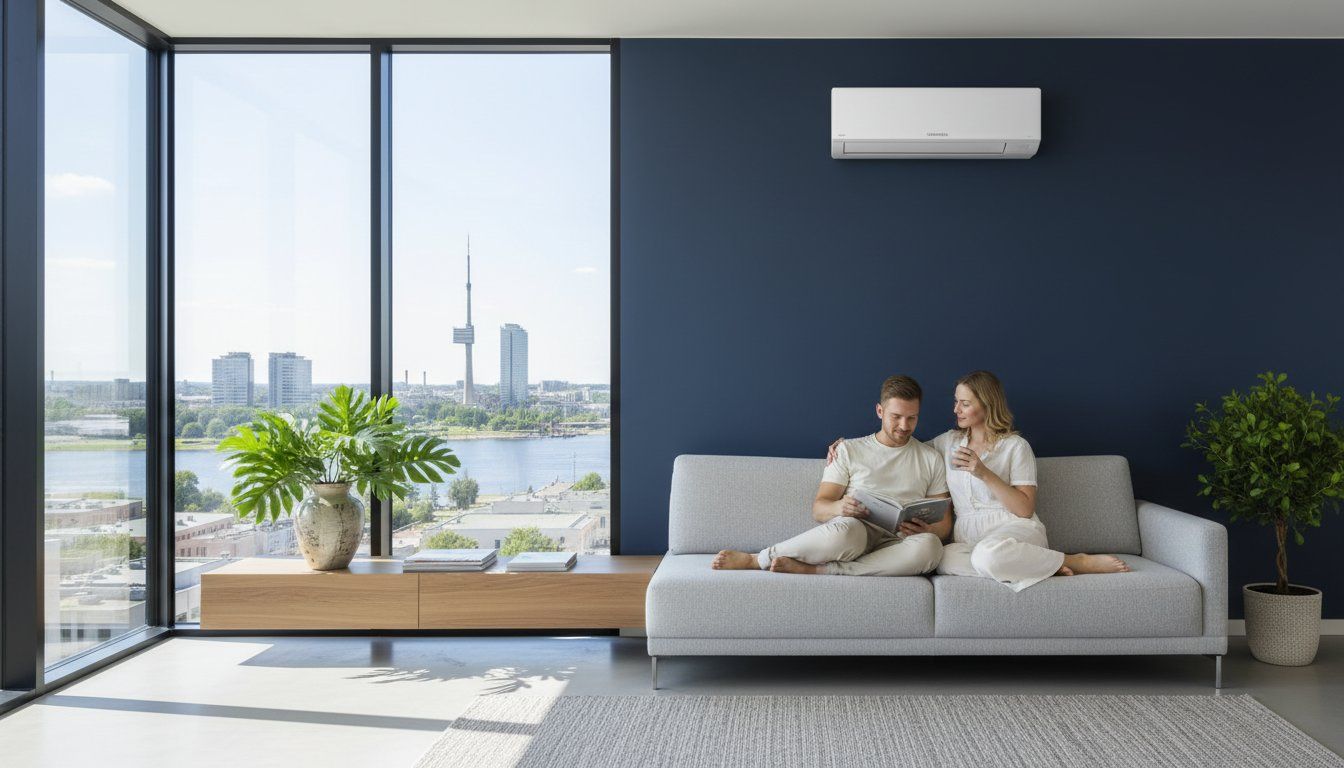
Did you know that choosing the wrong air conditioner can increase your summer bills by more than 30%, while a carefully selected model can save up to 40% on heating costs in autumn? We fully understand that nobody wants to live with a constant hum in the living room or worry about a damaged façade caused by unprofessional installation. You are looking for a solution that works quietly and efficiently, not another appliance that simply wastes money. At Commodus, we see every day how important it is not merely to install equipment, but to create a genuine sense of home and real comfort.
In this guide, we will help you find the most energy-efficient solution for maintaining the perfect indoor climate both during a scorching August and at the beginning of the heating season. Learn about the latest technologies available in 2026, why installation quality is just as important as the unit itself, and how to choose a reliable partner who will not disappear after issuing the first invoice. Together, we will examine everything required to ensure that your investment in comfort pays off through fresh air and peace of mind for many years, while working alongside knowledgeable experts.
Key takeaways
- Learn the difference between split and multi-split systems so that you can select the most suitable solution for your home's layout and appearance.
- Find out how to calculate the required capacity (BTU) accurately, taking into account the room area, window orientation and the building's thermal insulation.
- Choose the most energy-efficient unit, because a modern air conditioner will provide an ideal indoor climate during hot Latvian summers and also assist with heating during the colder seasons.
- Familiarise yourself with Latvian regulations governing equipment approval and learn why professional installation is essential for retaining the manufacturer's warranty.
- Discover how Commodus's individual approach and technologies from leading manufacturers can provide lasting comfort and peace of mind.
What is a modern air conditioner, and why is it needed in Latvia?
Today, what is an air conditioner is no longer answered by describing a device that merely blows cold air. It is an intelligent indoor-climate management centre. In 2026, these units combine three essential functions: efficient cooling, economical heating and air filtration. Latvia's climatic conditions have changed rapidly in recent years. According to meteorological data, summers have become an average of 1.5 degrees warmer over the past decade, while the number of tropical nights, when the temperature does not fall below +20°C, continues to increase. That is why an air conditioner is no longer considered an optional extra, but a necessity for restful and comfortable living at home.
At Commodus, we see every day that customers are looking for more than cool air. Energy efficiency and the unit's ability to adapt to changing weather conditions are equally important. Modern systems can maintain the set temperature precisely while consuming very little electricity. This keeps the home comfortable whether it is a scorching July afternoon or a damp October evening outside.
Air conditioner vs air-to-air heat pump: what is the difference?
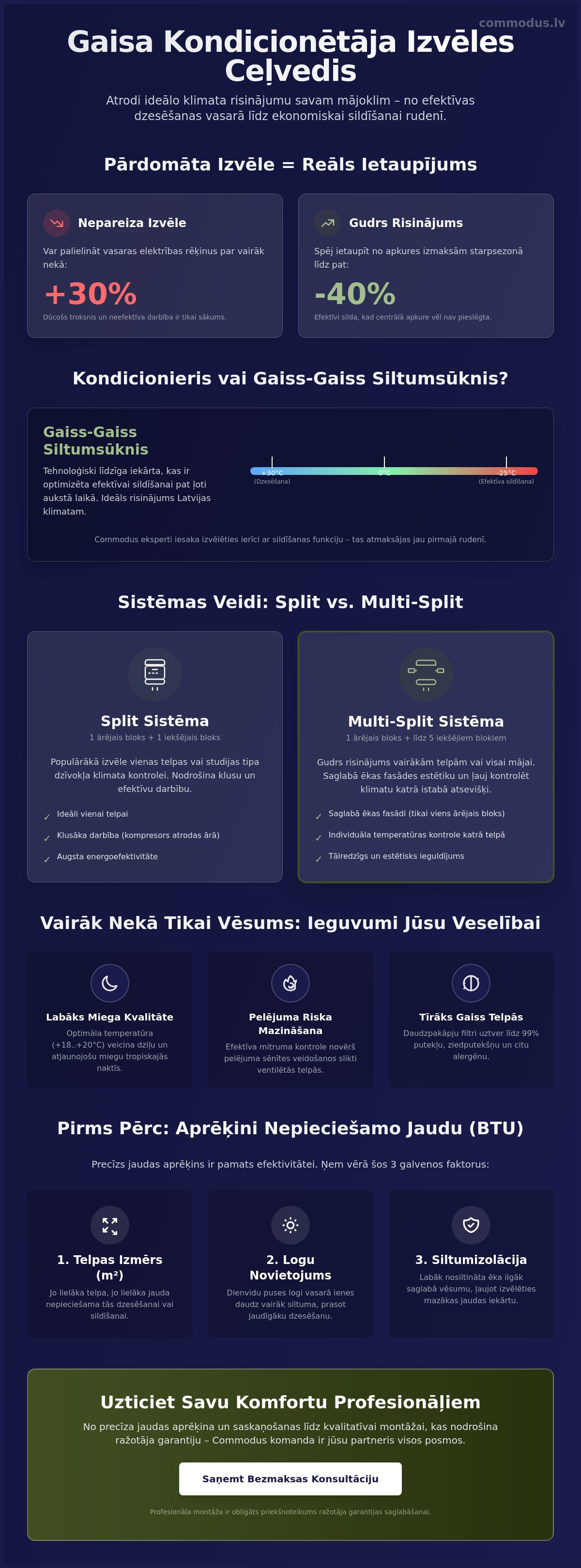
Technically, these devices are almost identical, but the difference lies in their operating range and efficiency at low temperatures. A standard air conditioner is optimised for cooling, whereas an air-to-air heat pump is designed to heat a home efficiently even when the outdoor temperature falls to -25°C. Commodus experts always recommend selecting a unit with a heating function. This choice can produce significant savings at the beginning of the heating season. When central heating has not yet been switched on, the heat pump begins producing heat immediately, creating a comfortable home within minutes.
Key benefits for your comfort and health
Air quality directly affects our well-being and ability to work. Modern air-conditioning systems are equipped with multi-stage filters that capture up to 99% of dust, pollen and other allergens. This is particularly important for families whose members have sensitive airways or allergies.
- Improved sleep quality: An optimal bedroom temperature of +18°C to +20°C allows the body to recover properly during the night.
- Reduced risk of mould: The units effectively control and remove excess moisture, which is the main cause of mould in poorly ventilated rooms.
- Air purification: Built-in ionisers and filters neutralise unpleasant odours and reduce the spread of bacteria, creating a healthier environment for the whole family.
At Commodus, we believe that technology should work for people. By choosing the right unit, you invest not only in comfort but also in long-term health. Our experience shows that a carefully planned system pays for itself during the first heatwave by providing calm and protection from the city's oppressive heat.
Types of air conditioners: which one should you choose for your home?
An air conditioner is no longer an exotic addition but a basic requirement for maintaining a stable indoor climate during Latvia's increasingly changeable summers. The choice between different system types often determines how satisfied you will remain with your purchase five or ten years later. Our experience shows that every home requires an individual approach. Whether it is a compact flat in central Riga or a spacious detached house near the city, the solution should be both efficient and visually attractive.
Split systems — the ideal balance of comfort
Wall-mounted split systems are currently the most popular choice for private homes. These units consist of two parts: an indoor unit that provides cooling and a noisier component positioned outside the building. This makes the system incomparably quieter than portable units. Inverter technology has now become standard. It allows the compressor to operate flexibly rather than repeatedly switching on and off at full capacity. As a result, the room temperature remains stable and electricity bills remain predictable. Modern design is no longer limited to plain plastic boxes. Manufacturers offer elegant models with matt finishes or even fabric elements that become tasteful features of the interior.
When should you choose a multi-split system?
If your home has several rooms, a multi-split system is a smart, forward-looking investment. One powerful outdoor unit can support as many as five indoor units simultaneously. This is especially important if you want to preserve the appearance of the building and avoid covering the façade with unnecessary equipment. The temperature can be adjusted separately in each room. You can maintain warmer conditions in a child's room while enjoying pleasant coolness in the bedroom. Installing such a system across several floors requires precise engineering design. This is where calculating the required capacity becomes essential, ensuring that every square metre is cooled efficiently without overloading the equipment.
- Portable air conditioners: a useful solution for rented properties or summer houses. They can be installed within five minutes without drilling into walls. However, they are generally noisier and occupy floor space.
- Cassette air conditioners: ideal for rooms with high ceilings or spacious living areas. They are installed within the ceiling structure, leaving only a decorative grille visible and distributing airflow in four directions.
- Ducted systems: provide complete visual integration. Air is supplied through discreet ceiling outlets, making them an excellent choice for minimalist interiors and modern offices.
We are ready to manage this project with you, from the initial consultation through to regular equipment maintenance. If you are uncertain which model is best suited to your room layout, explore our available solutions and contact our specialists for a personal consultation.
How do you calculate the required capacity and efficiency?
Choosing the correct capacity is the critical point that determines both your comfort and the size of your monthly bills. At Commodus, we often meet customers who want to choose the most powerful model 'with some reserve', but this strategy can have the opposite effect. If an air conditioner is too powerful for a small room, it reaches the set temperature too quickly and switches off. This frequent starting and stopping, known as short cycling, not only damages the compressor but also prevents the system from dehumidifying the air effectively. The room may feel cool, but the air remains stale and humid.
When choosing equipment for the 2026 season, capacity in kilowatts (kW), rather than outdated BTU figures, should be the main reference point. In a standard situation, the calculation is straightforward: 1 kW of cooling capacity for every 10 square metres of floor area where the ceiling height does not exceed 2.7 metres. However, this is only a starting point because every home's energy efficiency is different. If your living room has large south-facing panoramic windows or is on the top floor directly beneath a heated roof, capacity should be increased by 20% to 30%. In these situations, we work together to find a solution that will remain reliable even on the hottest July afternoons.
Capacity calculation explained simply
To make the calculation easier to understand, consider two contrasting examples. A 2.5 kW air conditioner is ideal for a 25 m² bedroom with standard insulation. By comparison, a 60 m² studio apartment combining the kitchen and living area and containing operating household appliances will require at least 5 or even 6 kW of capacity. The number of people in the room must also be considered: each person emits approximately 0.1 kW of heat. This may appear insignificant, but in offices or large families it can materially alter the total heat load.
Energy efficiency: from A to A+++
Modern energy-efficient air conditioners are rated using SEER (seasonal energy-efficiency ratio for cooling) and SCOP (for heating). The higher these figures, the less electricity the appliance needs to deliver the required cooling. An A+++ unit can save up to 40% of electricity each year compared with a class A model. In the Latvian market, where electricity prices can fluctuate, this difference typically pays for itself within approximately three to four seasons.
- A+++ class: the SEER rating usually exceeds 8.5. This is an investment in long-term peace of mind.
- Smart functions: A built-in Wi-Fi module allows remote temperature control. You can switch on cooling 15 minutes before arriving home instead of running the unit throughout the day in an empty property.
- Inverter technology: in 2026, this is an essential feature that provides smooth operation without sudden power surges.
We believe that a reliable specialist helps you save money even before the purchase is made. For this reason, before making a final decision, we always recommend considering not only the purchase price but also the maintenance costs over the next ten years. A high-quality system is not merely a cooling box mounted on the wall; it provides daily peace of mind and a healthy indoor climate.
Installation and regulations: what every owner should know
Once you have selected the model best suited to your needs, the most responsible stage begins. A high-quality air conditioner is only half of the comfort equation. The other half is technically correct installation. Manufacturers such as Daikin and Mitsubishi Electric clearly state in their warranty conditions that the warranty remains valid only when the appliance is installed by a certified specialist. Our experience shows that approximately 80% of the technical problems encountered by users are caused by unprofessional installation.
DIY attempts to 'save money' often result in a refrigerant leak during the first month or compressor failure after a year. Incorrect connections or insufficient system insulation create unnecessary noise and vibration that disturb both you and your neighbours. Before the installers arrive, the owner should prepare the work area by clearing the wall where the indoor unit will be positioned and ensuring unobstructed access to the installation point on the façade or balcony. This speeds up the process and allows the specialists to concentrate on technical accuracy.
Step by step: the professional installation process
The installer begins by selecting the exact location. The indoor unit must be positioned at least 10 to 15 centimetres below the ceiling to ensure optimal air intake. The most important technical step is evacuating the system. This means completely removing air and moisture from the copper pipework before the refrigerant is released into it. If this step is omitted, moisture can cause corrosion and reduce efficiency by 15% to 20%. Condensate should be discharged using gravity drainage with a downward slope of at least 1 to 2 degrees, preventing water accumulation and unpleasant odours in the room.
Legislation and relations with neighbours
In Latvia, the placement of an air conditioner and its outdoor unit is strictly regulated. If installation is planned in an apartment building, approval is required from the community of apartment owners (50% plus one vote) and the local building authority. The rules are even stricter for historic buildings and city centres, where units are often permitted only on the roof or in an inner courtyard so that the appearance of the façade is not affected.
Noise-level requirements must also be considered. Modern units operate quietly, at around 19–25 dB indoors, but noise from the outdoor unit at night must not exceed the limits established by the municipality. At Commodus, we help customers manage documentation and design so that the approval process does not become an obstacle. We are prepared to work through the process together, ensuring that the new equipment is legal and considerate of neighbouring residents.
To learn more about installation options and the approval process for your home, view the services we offer and receive professional advice.
Commodus solutions: from consultation to long-term maintenance
When it comes to home comfort, an air conditioner is only one part of the overall equation. Commodus understands that every house and apartment is a unique ecosystem. We do not focus on simply selling a box. Our work begins by understanding your daily routine and the specific features of the rooms. Whether it is a sunny living room with large windows or a small attic bedroom, we select a solution that will be quiet and energy efficient. Our range includes only proven products from leading global manufacturers such as Midea and Daikin, ensuring durability and access to the latest technologies.
We provide a complete service cycle throughout Latvia. This means that customers are never left alone with technical questions after installation. Our specialists remain available both during the warranty period and after it has ended, providing fast and professional assistance in every region. Applying for a free consultation is straightforward. We prepare an accurate quotation that includes all costs, allowing you to plan your budget without unexpected surprises.
Why do customers choose Commodus to manage the entire process?
Our team's experience has been built through years of projects, ranging from ordinary apartments to complex industrial facilities. We accept personal responsibility for every unit installed. This means completing the work carefully, protecting your interior and complying with every technical standard. Our pricing policy is completely transparent. You will not face hidden charges for installation materials or additional mountings that are often revealed only midway through a project. Genuine reviews from customers in Kurzeme, Vidzeme, Zemgale and Latgale confirm the quality of our work and the personal approach valued by every homeowner.
The importance of regular maintenance for equipment life
Regular maintenance is essential if an air conditioner is to operate efficiently for many years. Cleaning the filters at least once each season is critical not only for the unit's performance but also for your health. Accumulated dust and moisture can provide a breeding ground for bacteria that you do not want to breathe inside your home. A preventive system inspection before the first major heatwave provides peace of mind throughout the summer. Our specialists check the refrigerant level, drainage system and all electrical connections, preventing potential failures before they occur.
Prepare for the hot season in good time and entrust your home's climate to professionals. Contact the Commodus experts to receive an individual quotation and ensure a comfortable environment in all weather conditions. We are here to help you make the best long-term decision.
Your route to the perfect home climate
A modern home in 2026 is no longer imaginable without intelligent, forward-looking climate-control systems. A correctly selected air conditioner is an investment that repays you through everyday well-being, because it not only cools rooms during scorching summers but also provides energy-efficient heating between seasons. The most important steps towards comfort are an accurate capacity calculation and professional installation that complies with Latvian building regulations and the manufacturer's requirements.
For more than 15 years, the Commodus team has helped people throughout Latvia find the best engineering solutions. We offer a complete service cycle, from project design through to long-term regular maintenance. Our certified installation specialists ensure that the installation process is both fast and of a high standard. We are ready to manage the entire process with you and create a safe, comfortable environment in which every breath feels pleasant. Choose experience and a personal approach that provide peace of mind for many years.
Choose your ideal air conditioner from the Commodus catalogue!
Frequently asked questions
How much electricity does an air conditioner consume each month?
On average, an air conditioner consumes between 70 and 150 kWh of electricity per month when used for approximately five hours each day. The exact figure depends on the unit's energy-efficiency class and the selected temperature difference between indoors and outdoors. Modern A+++ models consume around 30% less energy than older units. This means that your monthly costs will remain predictable and reasonable.
Can an air conditioner be used as the main heating source in winter?
Yes. A modern air conditioner equipped with a heat-pump function can be used as the primary heating source even when the outdoor temperature reaches -25°C. Such systems are particularly effective in Latvia's variable climate because they provide immediate heat. It is important to select a model specifically adapted to northern conditions. This will maintain a comfortable atmosphere and optimal temperature throughout the year without additional heaters.
How often does an air conditioner require professional maintenance?
Professional maintenance should be carried out at least once a year, preferably in spring before the cooling season begins. The technician will check refrigerant pressure, clean the indoor units and disinfect the system to prevent bacterial growth. Homeowners should clean the dust filters every two to four weeks. Regular care can extend the unit's service life by five years and provides clean air for your family.
May an air conditioner be installed in an apartment without approval?
No. In Latvia, installing an air conditioner's outdoor unit on a building façade must be approved by the local building authority. You must prepare the required simplified façade-renovation documentation and obtain the consent of 51% of the apartment owners. Approval is often required even when the unit is placed on the balcony floor in order to avoid penalties. Proper documentation provides peace of mind and assurance that neighbours will have no legitimate objections to your installation.
What is the difference between a cheap and an expensive air conditioner?
The principal differences are operating noise, energy efficiency and the quality of air filtration. More expensive units operate almost silently, reaching sound levels of only 19 dB, while cheaper models may disturb sleep with a hum of 26 dB or more. Premium brands use more advanced inverters that maintain temperature more accurately and consume less electricity. Investing in a high-quality unit provides a longer warranty and reduces the risk of unexpected repairs.
Does an air conditioner dry the indoor air, and is this harmful?
Yes. During cooling, an air conditioner naturally reduces indoor humidity because condensate is discharged outside. The optimal relative humidity for health is between 40% and 60%, and an air conditioner helps achieve this level on hot, humid days. If the air becomes excessively dry, it can irritate the mucous membranes, so the unit should be used sensibly. Modern technology allows humidity to be controlled, creating a pleasant and healthy indoor climate without extremes.
How long does a standard air-conditioner installation take?
A standard installation involving one indoor and one outdoor unit usually takes between three and five hours. During this time, the installers drill the necessary openings, route the services, mount the units and evacuate the system. More complex solutions requiring a lift or long pipe runs can take an entire day. Our team works efficiently so that you can enjoy cool air by the evening of the same day.
What is the optimum temperature setting for health and energy savings?
For health and energy efficiency, the optimum indoor temperature in summer is between 22°C and 24°C. Specialists recommend maintaining no more than a seven-degree difference between outdoor and indoor temperatures to protect the body from thermal shock. Every additional degree of cooling increases electricity consumption by approximately 6%. A sensible temperature setting helps you remain alert and avoid summer colds.
Comments