Air-to-Air Heat Pump: A Complete Guide and Comparison for 2026

Do you really believe that a unit which often costs less than a new sofa can keep a home warm even when the thermometer outside shows -25°C? At Commodus, we encounter this question every day because we understand that nobody wants to waste money or feel cold in their own home. You will probably agree that heating bills have become one of the biggest household challenges in recent years, while choosing between countless models can create unnecessary headaches. This is precisely why a high-quality air-to-air heat pump is becoming an increasingly popular choice for people seeking a quick and efficient solution without complex construction work.
In this article, we will explain clearly how this technology can reduce your heating costs by an average of 40% and provide an ideal indoor climate throughout the year. We have compiled the latest 2026 data and model comparisons to help you choose the right unit, one that will not let you down even during severe frost. We will examine how we can work together towards better energy efficiency, allowing one compact unit to combine heating and cooling, make everyday life considerably easier and provide long-term peace of mind.
Key takeaways
- Learn why air-to-air technology is ideally suited to Latvia's variable climate, providing comfort during both severe frost and hot summer days.
- Compare the required investment and level of comfort offered by different heating methods so that you can make the most suitable decision for your home and budget.
- Find out how SCOP and SEER values help predict your bills and why an air-to-air heat pump is one of the most effective tools for saving energy.
- Prepare for the installation process by learning how to select the most suitable locations for the units and how long professional installation normally takes.
- Discover how Commodus's individual approach and expert knowledge help move your project towards a warmer, more energy-efficient home in the long term.
What is an air-to-air heat pump and why is it popular in Latvia?
Latvia's changeable weather, with sunshine in the morning and sharp frost in the evening, requires flexible heating solutions that respond quickly. This is where an air-to-air heat pump comes into its own. In 2026, it has become one of the most sought-after options for both new homes and renovated city flats. Unlike traditional boilers, the unit does not generate heat itself but transfers it from the outdoor environment into the rooms. What is an air-source heat pump? In essence, it is a technology capable of finding and using heat energy in the air even when the temperature has fallen well below zero.
Many users still ask whether the unit is merely an ordinary air conditioner. Although they look similar, the difference is significant. A standard air conditioner is optimised for cooling, whereas a heat pump is designed to operate in harsh winter conditions. It is equipped with crankcase heating and an intelligent defrosting system that prevents the outdoor unit from freezing at -20°C or below. A common myth is that the system will stop operating during severe frost. In reality, the latest models provide reliable heating even at -25°C. Although their efficiency falls in such conditions, they remain more energy-efficient than conventional electric radiators.
How a heat pump works in simple terms
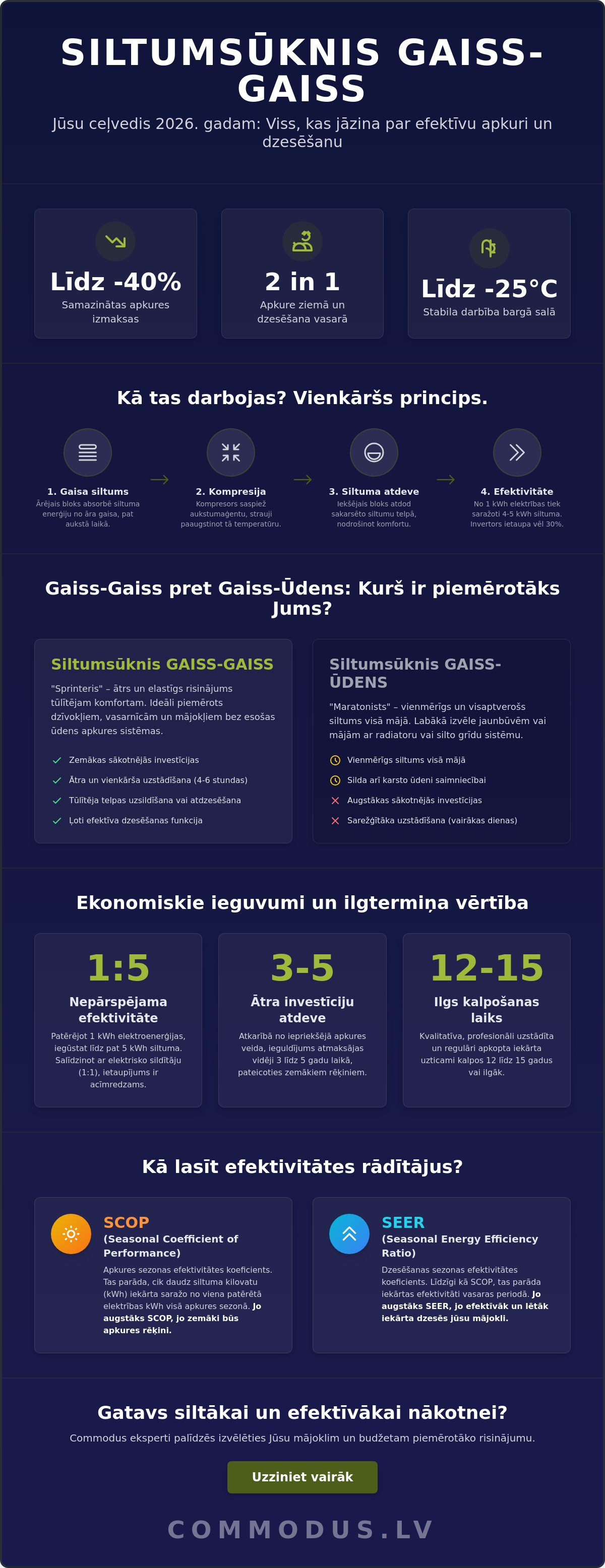
Imagine a refrigerator operating in reverse. The heart of the system is the refrigerant circulating between the outdoor and indoor units. It absorbs heat from the outdoor air in the evaporator. The compressor then compresses this energy, causing the temperature to rise sharply. Inside the building, the condenser releases the heat into the room through a fan. Inverter technology plays a decisive role in modern systems. Instead of repeatedly switching the motor on and off, it adjusts output smoothly to match the actual heating demand. This not only extends the unit's service life but can also reduce electricity bills by approximately 30% compared with older on/off models.
Financial benefits and energy efficiency
Efficiency is the main argument in favour of this solution. Under average Latvian conditions, 1 kW of electricity can produce 4 to 5 kW of heat output. Compared with electric heaters, whose ratio is 1:1, the savings are clear. Although firewood or briquette heating can still be inexpensive, it requires physical labour, storage space for fuel and constant attention. At Commodus, we believe that technology should make everyday life easier. Our experience shows that heating becomes much simpler when an automated system takes care of the work.
- Return on investment: Typically 3 to 5 years, depending on the previous heating method.
- Service life: A high-quality unit that is serviced regularly can operate reliably for 12 to 15 years.
- Multifunctionality: One investment provides warmth in winter and pleasant cooling during summer heat.
By choosing an air-to-air heat pump homeowners gain independence from fluctuations in fossil-fuel prices and significantly reduce their household carbon footprint. Market trends for 2026 show that this technology is becoming a standard solution rather than an exclusive extra.
Air-to-air versus air-to-water: Which heat pump is more suitable for you?
Choosing between these two systems is often the greatest challenge when planning home heating. The difference lies not only in the technology but also in how you intend to use the space and how much you are prepared to invest initially. Although both systems draw energy from outdoor air, they distribute it in completely different ways. An air-to-water system is like a marathon runner, heating the whole house slowly and evenly through underfloor heating, whereas an air-to-air heat pump is a sprinter that responds immediately.
In terms of investment, an air-to-air solution is considerably easier on the budget. Standard installation takes approximately 4 to 6 hours and requires no complex construction work. By contrast, installing an air-to-water system can take several days and requires pipework, manifolds, radiators or underfloor heating. If your aim is a quick result without major reconstruction, an air-to-air model is the logical choice. This is particularly relevant in renovation projects, where every additional opening in a wall means more expense and dust.
Cooling is one area in which the air-to-air heat pump is the undisputed leader. Latvia's 2024 summer heatwaves, when temperatures remained above +30°C for extended periods, demonstrated that cooling is no longer a luxury. An air-to-air system operates as an efficient air conditioner and can lower the room temperature within minutes. Cooling through the floor with an air-to-water system is considerably slower and requires precise control to prevent condensation on the floor covering.
When should you choose an air-to-air system?
This solution is ideal when you require flexibility and efficiency in specific zones. We recommend it in the following situations:
- Flats and holiday homes: Where there is no space for large heating assemblies or a boiler room.
- Open-plan homes: One powerful indoor unit can heat a large living area.
- As supplementary heating: When you already have a wood-burning stove or pellet boiler but want greater comfort in the mornings or during the transitional seasons.
- To reduce costs: It allows you to heat only the rooms you actually use instead of the entire building at once.
When is an air-to-water heat pump the better choice?
If your priority is maximum comfort and a complete heating solution, air-to-water will be more suitable. It is the right choice when:
- You are building a new home: Underfloor heating can be included in the design from the outset, providing the most even heat distribution.
- You require domestic hot water: One unit can provide heating and hot water for showers and baths for the entire family.
- There are many rooms: If the house contains numerous small, enclosed rooms that cannot be reached effectively by airflow from one indoor unit.
At Commodus, we believe that there is no single 'correct' solution for everyone; there is only the solution best suited to your circumstances. We work alongside every customer so that they can feel confident in their decision. If you are still unsure which option is most efficient for your floor area, our website includes a convenient heating calculator that can provide greater clarity within a few minutes.
Efficiency indicators and operation during extreme frost
Heat pump efficiency is not merely an abstract figure on a technical data sheet; it directly affects your monthly expenditure for the next ten years. When selecting a unit, you will commonly encounter two main indicators: SEER for cooling and SCOP for heating. These coefficients show how many kilowatt-hours of heating or cooling the unit produces from one kilowatt-hour of grid electricity. If you plan to install a new system in 2026, aim for models with a SCOP of at least 4.6. This means that, over an average season, you will receive more than four times as much energy as you pay for in electricity.
Selecting the correct capacity is a precise engineering task, not a guess. A standard calculation for the Latvian climate allows approximately 1 kW of output for every 10 square metres in a well-insulated home. In older buildings with poorer energy performance, this requirement may increase by 25% or more. If an air-to-air heat pump is undersized, it will run at maximum load during severe frost, increasing noise and electricity consumption while accelerating compressor wear.
Why is SCOP more important than nominal capacity?
Nominal capacity shows only what a unit can deliver under one set of conditions, whereas SCOP, the Seasonal Coefficient of Performance, reflects actual performance across the entire heating season. In Latvia's climate zone, where temperatures range from above zero to deep frost, seasonal efficiency is decisive. A+++ class units pay for themselves over the long term even when their purchase price is 15% higher than that of A+ models. Our experience at Commodus shows that cheaper units can lose efficiency so rapidly at -20°C that their consumption approaches that of ordinary electric heaters. By choosing a higher efficiency class, you invest in stability and peace of mind rather than merely purchasing equipment.
Additional functions that improve quality of life
A modern air-to-air heat pump is no longer merely a heater; it is an intelligent climate-control centre. Wi-Fi control is now standard and allows you to reduce the temperature by 2–3°C while you are at work and restore warmth remotely an hour before returning home. For owners of holiday homes and garden houses, the +8°C or +10°C maintenance function is particularly important. It protects the building from freezing and moisture accumulation without wasting energy while it is unoccupied.
- Air filtration: HEPA filters and ionisers in 2026 models can capture up to 99.9% of dust mites, pollen and even bacteria, which is particularly important for allergy sufferers.
- Noise level: Units suitable for bedrooms operate at 19–21 dB(A), which is quieter than leaves rustling in the wind.
- Intelligent airflow: Sensors can detect where a person is located in the room and direct the airflow away from them, preventing an uncomfortable draught.
A high-quality system operates unobtrusively but effectively. We help every customer find the right balance between technology and budget so that we can move towards greater energy efficiency together. Ultimately, a correctly selected heat pump is like a good partner: reliable, quiet and always ready to work, regardless of how cold it is outside.
Planning and installation: What should you expect from the process?
Once you have selected the ideal model, the practical stage begins and theory meets reality. Many customers initially worry about dust or their home becoming a building site for several days. In reality, standard installation takes 4 to 6 hours. Our specialists use professional dust extractors and diamond drills, so after the work is completed the room contains pleasant warmth rather than piles of debris. It is important to remember that an air-to-air heat pump is not merely an appliance; it is a system whose efficiency depends significantly on correct installation.
Self-installation may appear tempting as a way to save money, but it is the surest route to losing the warranty. Manufacturers require the work to be carried out by certified specialists who understand refrigerants and electrical connections. If the system is not vacuumed correctly, moisture remains inside and can irreversibly damage the compressor after two or three years. This is an expensive risk, and we recommend avoiding it by entrusting the work to professionals who will support you through the entire process.
Step by step towards a warm home
The process begins with a site survey. We do not rely on guesswork but calculate capacity precisely, taking account of room volume and thermal insulation. The next stage is installing the pipework that connects the two units. Particular attention is paid to vacuuming, which ensures the cleanliness and long service life of the system. Once installation is complete, we test the unit in different modes and show you how to use the remote control or mobile application so that the technology serves your comfort.
Common mistakes when installing an air-to-air heat pump
One of the most common mistakes is selecting the wrong capacity. If the unit is too small, it will operate at its limit and consume 20–30% more electricity than necessary. The location of the outdoor unit is equally important. In Latvian conditions, it should be installed at least 30–50 cm above the ground so that it is not buried in snow and the condensate outlet does not freeze. The indoor unit should never be installed directly above a sofa or bed, as even a gentle airflow may cause long-term discomfort.
Regular maintenance is another cornerstone of reliable operation. We recommend cleaning the indoor filters at least once a month, which takes only five minutes. Once a year, a technician should check the pressure and clean dust and fluff from the outdoor heat exchanger. This will ensure that your air-to-air heat pump continues to operate at maximum efficiency even after ten years.
To ensure maximum efficiency and safety, choose professional heat pump installation by experienced specialists.
Commodus – your trusted partner on the path to energy efficiency
When choosing the most suitable heating system, it is important not to feel overwhelmed by technical specifications and manufacturers' promises. For more than 15 years, Commodus has helped people throughout Latvia create warmth and comfort in their homes. We do more than sell equipment; we work alongside you. This means that we remain involved from the first telephone conversation until the system is commissioned and begins heating your rooms. Our approach is based on partnership, where the customer is not merely an order number but an equal participant in the project.
Every home is unique, so there is no universal solution. A small flat in central Riga and a spacious detached house near Riga require different air-to-air heat pumps to achieve maximum efficiency. Our engineers perform precise calculations by analysing the building's heat losses and your daily habits. We offer a broad range of equipment from leading global manufacturers that has been tested specifically in our variable northern climate.
Commodus provides a complete service cycle. You do not need to spend time finding a designer, an installer and later a separate maintenance technician. We take full responsibility for the entire process, including design, professional installation and regular warranty servicing. Our aim is to give you confidence that your investment will be durable and operate reliably for many years.
Why choose us?
Our more than 15 years of experience in the Latvian market is our greatest asset. During this time, we have learned every detail of the local climate and know which units remain dependable during the coldest winter nights. We have certified installation specialists in every region of Latvia, ensuring fast and high-quality work regardless of your location. If technical questions arise, our responsive support team and extensive spare-parts stock provide prompt assistance. We believe that personal attention and genuine responsiveness are just as important as technical competence.
State support and access to funding
In 2026, improving energy efficiency remains a national priority, and several support programmes are available to residents. We actively help our customers prepare the documents required for EKII, the Emissions Trading Auction Instrument, or Altum programmes. This can provide substantial co-financing and significantly reduce the initial investment. If you plan to install a new air-to-air heat pump, we will carry out the necessary calculations and help you navigate the administrative requirements so that you can obtain the maximum available support.
Contact Commodus experts and receive a free consultation!
Start saving and enjoying greater comfort in your home today
Choosing a heating solution in 2026 requires foresight and reliable equipment that will not fail during the coldest winter nights. A correctly selected air-to-air heat pump has become one of the smartest investments for Latvian homes because it provides high energy efficiency and a pleasant climate throughout the year. We understand that technical parameters can appear complicated. That is why our team is ready to provide clear advice and an individual approach to every project, regardless of the building's size or location.
Commodus is an official representative of Midea and other leading global brands, providing access to the latest technology and a complete service warranty. Our experience includes more than 10,000 installed units throughout Latvia, demonstrating our stability and the long-term trust of our customers. We do not merely sell equipment; we also provide regular servicing so that you can enjoy peace of mind for many years. Our specialists are ready to work alongside you to create a safe and warm environment for your family and home.
Apply for a free consultation and receive an offer
Take the first step towards lower bills and modern heating in your home today.
Frequently asked questions about air-to-air heat pumps
Can an air-to-air heat pump be the sole source of heating in winter?
Yes, a modern air-to-air heat pump can serve as the sole source of heating in a well-insulated home at outdoor temperatures as low as -25°C or -30°C. The latest models retain 100% heating capacity even at -15°C, although in older buildings with poorer insulation we recommend retaining an additional heat source, such as a stove or electric heater, for exceptionally cold winter nights. This provides peace of mind and guarantees comfort in all weather conditions.
How much electricity does an air-to-air heat pump use each month?
For an area of 50 square metres, an air-to-air heat pump typically consumes 200 to 450 kWh of electricity per month during winter. The exact consumption depends on the building's energy-efficiency class and the selected indoor temperature. Our experience shows that replacing old electric radiators can reduce bills by 60–70%, because the unit can produce an average of 3 to 5 kWh of heat from 1 kWh of electricity.
Will neighbours complain about noise from the outdoor heat pump unit?
The outdoor unit of a high-quality heat pump operates quietly and normally causes no disturbance to neighbours, with a sound level of approximately 45 to 55 decibels. This is comparable to moderate conversation or rainfall. To prevent unnecessary vibration, we always use dedicated anti-vibration mounts and recommend that the unit is not positioned directly opposite a neighbour's bedroom window. Correct installation is the key to quiet operation and good neighbourly relations.
How often does a heat pump require technical maintenance?
Professional maintenance should be carried out once a year, preferably before the heating season begins. During servicing, the technician checks refrigerant pressure and electrical connections and cleans the heat exchangers. The user should clean the dust filters in the indoor unit once a month, which takes only a few minutes using a vacuum cleaner or by rinsing them under water. Regular maintenance can extend the unit's service life by 5 to 8 years.
Does an air-to-air heat pump dry the indoor air?
An air-to-air heat pump removes moisture only when operating in cooling mode during summer, when water condenses on the indoor heat exchanger. In heating mode, the unit does not remove moisture from the room, although relative humidity naturally decreases as the air temperature rises. If the air feels too dry, we recommend using a humidifier or simply ventilating the rooms regularly to maintain a healthy relative humidity of 40–60%.
What is the difference between an inexpensive air conditioner and a more expensive heat pump?
The main difference is the ability to produce heat efficiently at low outdoor temperatures. An inexpensive air conditioner is designed primarily for cooling and may lose efficiency at only -5°C, whereas a specialised air-to-air heat pump is equipped with crankcase heating and a more powerful compressor for operation down to -25°C. The investment in a more expensive unit usually pays for itself within 3 to 4 years through lower electricity consumption and reliable operation during Latvian winters.
Can I install the heat pump myself to save money?
Self-installation is not permitted because working with refrigerants requires a certified specialist with the appropriate licence. Incorrect installation may cause refrigerant leakage or compressor damage and will immediately invalidate the manufacturer's warranty. Entrust installation to professionals equipped with vacuum pumps and specialist measuring instruments. This ensures safety and long-term reliability without unnecessary stress.
What is the maximum distance between the indoor and outdoor units?
For most domestic models, the maximum distance between the units is 15 to 25 metres. However, every additional metre and bend in the pipework slightly reduces overall system efficiency. An optimum distance is up to 5 or 7 metres, allowing the unit to operate at full capacity without unnecessary losses. If a longer route is planned, a technician must be consulted to determine whether additional refrigerant is required.
Comments