Air-to-Air Heat Pumps: A Complete Guide to Efficient Heating and Cooling in 2026
Are you still maintaining two separate systems for heating and cooling, when one modern unit can do both jobs more efficiently? We understand that Latvia's unpredictable winters and increasingly hot summers drive the search for solutions that do not empty the wallet. Nobody wants to overpay for warmth when it is minus 20 degrees outside, or suffer sleepless nights in the July heat.
This guide will help you understand why in 2026 air-to-air heat pumps have become the primary choice for thousands of households across the country. We promise to provide clear and practical information about how to choose the most suitable output and what installation will provide the greatest return in your home. Together we will go through all the steps so you can enjoy a perfect climate and reduce heating costs by as much as 45% compared to ordinary electric heaters. Our team is ready to tackle this challenge together with you, from technical parameters all the way to smartphone app configuration, ensuring peace of mind in the long term.
Key Takeaways
- Find out how air-to-air heat pumps efficiently convert outdoor air energy into warmth or coolness, providing a pleasant microclimate in the home in any season.
- Discover how to correctly interpret SCOP and SEER ratings to choose the most energy-efficient solution and significantly reduce monthly electricity bills.
- Discover the main advantages of this system, including low installation costs and the ability to create modern heating without building radiators or underfloor heating.
- Obtain practical advice on calculating unit output and the optimal placement of the indoor unit to ensure even airflow throughout all rooms.
- Find out how to successfully apply for Altum or EKII state support programmes to recover part of the investment and make the system purchase even more advantageous.
What is an Air-to-Air Heat Pump and How Does it Differ From an Air Conditioner?
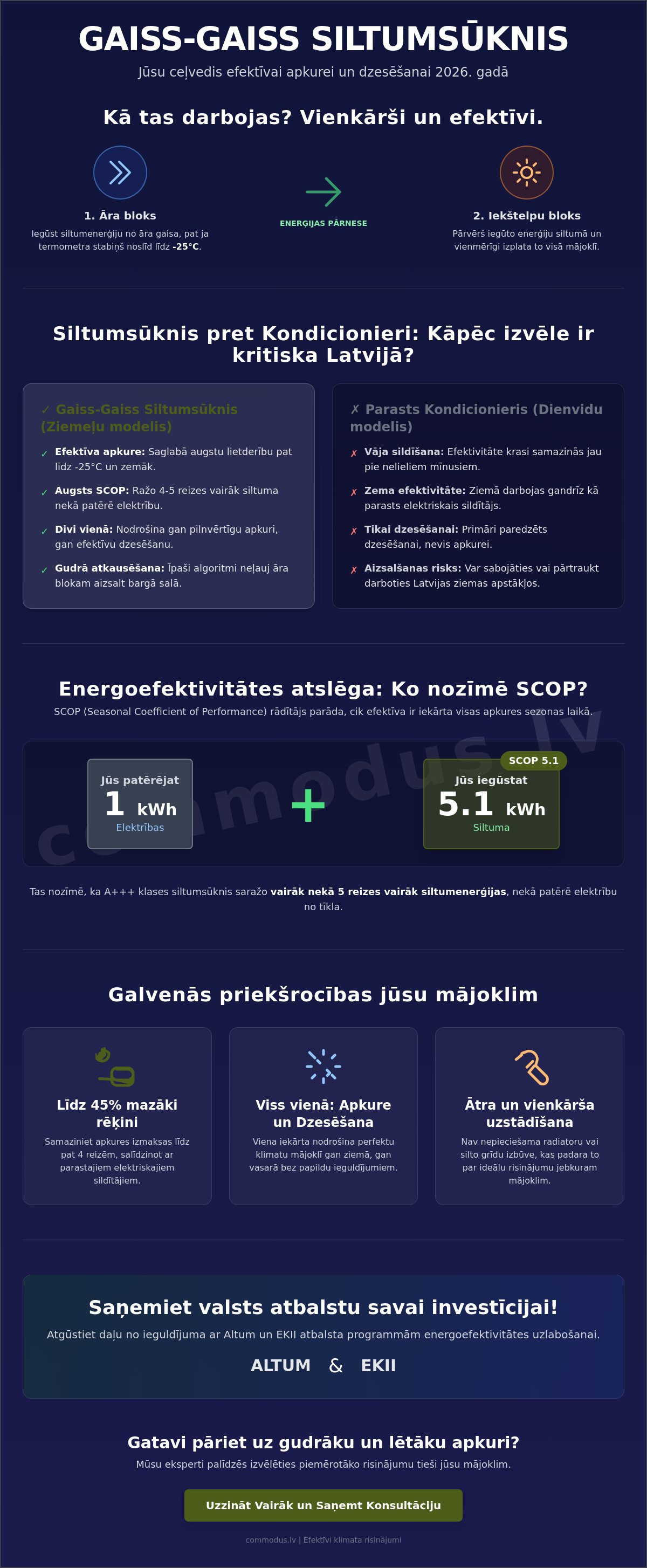
Many homeowners in Latvia often ask whether air-to-air heat pumps are the same as ordinary air conditioners. Although the units look visually identical, their technological content differs significantly. At its core, this unit is a device that extracts thermal energy from outdoor air and channels it into rooms through the indoor unit. Even when it is below zero outside, air contains energy that the heat pump can "collect" and convert into comfortable warmth.
To better understand the process, it is worth finding out what a heat pump is and how it works. The heart of the unit is a compressor and refrigerant that circulates between the outdoor and indoor units. While an ordinary air conditioner is optimised for cooling and can only heat at minor frosts, modern air-to-air heat pumps are designed as fully-fledged heating systems. They maintain high efficiency even when the thermometer drops to -25°C or lower, which is critically important in Latvia's variable weather conditions.
In the Latvian market these terms are often confused, because historically the first units arrived here from Southern Europe, where they were used exclusively for cooling. When purchasing a unit in 2026, it is important not to fall into the trap of the cheapest models. If the device is not certified for operation in northern conditions, it will simply stop working or even break down at the first serious frost. Our team always emphasises that the choice must be based on the technical specification, not just the visual resemblance.
Nordic Specification: Why is it Critical in Latvia?
Nordic specification or "Nordic" marking means that the unit is equipped with a crankcase heater and special outdoor unit defrost algorithms. Without these elements, the outdoor unit quickly freezes in winter, turning into a block of ice. Professional units have an increased compressor power reserve that allows stable operation in extreme conditions. Cheap southern European models often "freeze up" in a Latvian winter because they lack the power and intelligent control system to free themselves from the ice created by condensate.
One System for Two Functions: Heating and Cooling
One of the greatest advantages of this system is the reversible cycle. With the press of a button, the unit reverses its direction of operation, switching from heating mode to cooling. This provides comfort in all seasons, from spring frosts when the central heating is already switched off to summer heat when rooms need coolness. Choosing such a solution creates a significant saving on additional equipment, as there is no need to buy a separate air conditioner and electric heaters.
Practical tip: Check the unit's COP (coefficient of performance) specifically at low temperatures. A quality unit at -15°C will still be able to produce more than 2 kW of heat for every 1 kW of electricity consumed.
Energy Efficiency and SCOP/SEER Ratings: What Do They Mean for Your Wallet?
When choosing a heating system, the figures in technical data sheets often seem like dry theory. In reality, they directly determine whether your monthly electricity bill will be €60 or €160. SCOP (Seasonal Coefficient of Performance) is the seasonal efficiency coefficient that characterises the device's efficiency throughout the entire heating season. If the chosen air-to-air heat pumps boast a SCOP of 5.1, it means that on average you get 5.1 kW of thermal energy from every kilowatt of electricity consumed. The SEER rating relates to the cooling mode in summer. On Latvia's sweltering July afternoons, a high SEER rating ensures pleasant coolness without wasting resources.
Energy efficiency classes such as A++ or A+++ are not just a marketing trick. A+++ class units are usually 15% to 22% more efficient than A++ models. This difference becomes particularly noticeable in the long term, when the heating season in Latvia lasts six or even seven months. Inverter technology is the main driver in this process. Instead of the compressor constantly switching on and off at full power, it works smoothly, adjusting its speed to the actual heat requirement. This is similar to driving a car on cruise control, avoiding unnecessary fuel consumption during sharp acceleration.
How to Calculate Air-to-Air Heat Pump Consumption?
Compared to ordinary electric convectors, the savings are obvious. A convector works at a 1:1 ratio, meaning whatever kilowatts it takes from the grid, it returns as heat. Modern air-to-air heat pumps provide a ratio of 1:4 or even 1:5. This means four times lower costs for each heated square metre. It should be noted that as it gets colder outside, efficiency drops slightly. When planning the transition to this type of heating, it is worth remembering that state support for heat pumps is available, which significantly reduces the initial investment and accelerates the system's payback period.
Latvia's Climate Challenges: Humidity and Frost
When looking at unit parameters, it is critically important to pay attention to the SCOP rating specifically for the northern ("Cold" or "Northern") zone. European average figures measured in warmer climates can be misleading in Latvian conditions. The myth that a heat pump no longer heats at -25°C no longer withstands scrutiny in modern times. Quality units continue to produce heat even in severe frost, although their efficiency in such moments approaches a ratio of 1:2. In our work we see that correctly chosen output and quality installation are the foundation of peace of mind even on the coldest January nights. To precisely understand which model will best suit your home, our heating calculator will help you carry out the necessary calculations in a few clicks.
Advantages of Air-to-Air Heat Pumps and Comparison With Other Systems
Air-to-air heat pumps stand out because they are ready for operation within a few hours. You do not need to invest thousands of euros in building radiators or underfloor heating, which is usually the biggest obstacle when renovating older buildings. This makes this solution the most financially accessible option on the market. On average, installing a quality unit takes one working day, and this is a significant saving in both time and money. We at the Commodus team often say that this is the system for those who value efficiency without unnecessary fuss.
The system's greatest advantage is its response speed. While an air-to-water system needs time to heat water and then the room, an air-to-air unit starts blowing warm air immediately. Temperature changes in the room are already noticeable after 15 to 20 minutes. Precise temperature control allows you to set the desired warmth with one-degree precision. This is particularly important in Latvia's variable weather conditions, when the morning starts with below-zero temperatures but the afternoon sun is already warming the windows.
Air-to-Air vs Air-to-Water: Which to Choose?
The choice between these two systems depends on your home's specifics and lifestyle. An air-to-air system is unrivalled in small apartments, summer houses and homes with an open-plan layout. It is an ideal complement to traditional wood heating. When you are at work or travelling, the heat pump maintains a base temperature, preventing the house from cooling down. On returning home, you do not have to start the evening in a jacket in cold rooms.
The return on investment (ROI) for such a system is one of the fastest in the industry. Although state support for heat pump purchase is often associated with more expensive systems, this investment also pays off within a few seasons through lower electricity bills. More precise information about current programmes and conditions can be found on the Ministry of Climate and Energy's website, which will help you make a considered decision about improving your home's energy efficiency.
Health and Air Quality
Modern air-to-air heat pumps are not just heaters or coolers. They function as sophisticated air purification centres in your home. Built-in HEPA and carbon filters effectively trap dust, pet hair and even microscopic pollen. This is a huge relief for people with allergies or asthma, especially during the spring flowering season. The ionisation function helps neutralise bacteria and unpleasant odours, creating a freshness sensation that improves sleep quality and general wellbeing.
Another important aspect is humidity control. In Latvia's autumn and spring, excess moisture often accumulates in rooms, which is the main cause of mould. A heat pump effectively acts as an air dehumidifier, maintaining an optimal humidity level. This protects your home's structures and furniture from damage while providing a healthy environment. This versatility makes the unit a reliable partner that helps maintain comfort in any season.
How to Choose and Install an Air-to-Air Heat Pump?
Choosing an appropriate unit means finding a precise balance between the building's technical condition and your comfort requirements. The first and most important step is calculating the actual heat losses. If the home was built to post-2020 energy efficiency standards, a 100 square metre area usually makes do with a 4.5 kW output unit. On the other hand, for older, uninsulated brick homes this requirement can double to ensure warmth even at minus 20 degrees.
The brand choice in the Latvian market is wide, but we recommend sticking to proven values that will not let you down in the harshest weather conditions. Midea offers an excellent price-to-output ratio, which is a popular choice for summer houses and city apartments. Bosch stands out for German engineering precision and particularly quiet operation; this is important in densely built private home areas where the neighbours' peace is a priority. Air-to-air heat pumps serve best when the indoor unit is placed where airflow is not blocked by furniture or partition walls, allowing warmth to evenly fill the entire room volume.
In installing the outdoor unit, vibration dampening plays a critical role. Quality rubber shock absorbers and stable attachment to the foundation or load-bearing wall prevent unnecessary noise indoors. The condensate issue must also be taken into account. In Latvian winters, one unit can produce up to 10 litres of water per day, so proper drainage or a heated drip tray is necessary to prevent dangerous ice formation at the building's foundation.
Step by Step: From Consultation to First Switch-On
The entire process begins with a site inspection at which our specialists personally assess wall materials and electrical installation capacity. The actual air-to-air heat pump installation usually takes 4 to 6 hours. During this time, pipework is built, the system is vacuumed and the units are connected. At the end we not only switch on the unit but also help configure the smartphone app so that you can regulate your home's temperature while still on the way home from work.
Most Common Mistakes in Self-Selection
- Insufficient output: Choosing a weaker model to save a few hundred euros means the unit will operate at maximum power, increasing the electricity bill and shortening the compressor's life by at least 30%.
- Incorrect placement: Installing the indoor unit directly opposite a sofa or bed creates an unpleasant draught effect that quickly leads to the unit being switched off.
- Loss of warranty: Installation without a certified technician usually means immediate loss of the manufacturer's warranty, which becomes an expensive lesson at the first serious technical problem.
If you want to precisely calculate what output your home needs, use our air-to-air heat pump selection tool and receive a professional consultation.
Investment, State Support and Long-Term Maintenance
Investing in a new heating system is one of the most significant decisions in home improvement. In 2026, quality air-to-air heat pumps together with professional installation average from €1,100 to €3,200 on the Latvian market. The precise cost is determined by the unit's output, its energy efficiency class and the additional functions offered by the manufacturer, such as remote control or a particularly quiet operating mode. Standard installation usually takes 4 to 6 hours and costs approximately €250 to €450, depending on the required pipework length and wall material.
The Commodus team considers this one of the faster-paying solutions, as savings on heating bills are noticeable already in the first month. Furthermore, by choosing a proven brand, you gain not only winter warmth but also effective summer cooling, which in today's variable weather conditions is becoming a standard rather than a luxury.
How to Apply for State Co-Financing in 2026?
In 2026, the Altum and EKII support programmes are still available, targeting the replacement of fossil fuel heating equipment. This means that by replacing an old wood or coal boiler, you can recover up to 50% of the total investment. To apply, the building must be commissioned and the chosen unit must meet high energy efficiency requirements, confirmed by the manufacturer's certificate.
Step-by-step guide to the application:
- Prepare the building's land register extract and information about the existing heating type.
- Choose a unit with a SCOP rating above 4.6 to qualify for maximum support.
- Submit the application electronically through the state services portal before work begins.
We, Commodus experts, help clients avoid getting lost in bureaucratic labyrinths. We help prepare the necessary technical documentation and together tackle this challenge so that you receive support without unnecessary stress.
Maintenance to Keep the System Running for 15+ Years
For air-to-air heat pumps to operate flawlessly and their service life to exceed 15 years, regular supervision is important. You can carry out the simpler maintenance yourself. Every 2 to 4 weeks the indoor unit's dust filters need cleaning. This takes only 10 minutes but significantly improves airflow and reduces electricity consumption by approximately 5% to 10%.
However, once a year a professional inspection is necessary. Commodus service technicians check the refrigerant pressure in the system, clean the heat exchangers with special antibacterial agents and verify the safety of electrical connections. If you notice the unit starting to operate more loudly, an unpleasant odour appears, or the electricity bill suddenly increases, these are the first signals that repair or in-depth maintenance is needed.
Our after-sales service covers all of Latvia, providing peace of mind and confidence that any technical hitch will be resolved promptly. We are not just sellers; we are your partners in ensuring home comfort for the long term.
Start Enjoying Home Comfort and Energy Efficiency Today
When choosing a modern heating solution in 2026, the key is finding the right balance between initial investment and monthly costs. High SCOP and SEER ratings guarantee that your investment will pay off within a few years, especially when using current state support programmes for improving energy efficiency. We, the Commodus team, have been helping Latvian residents tackle this energy efficiency challenge together since 2010, providing a full service cycle from project development to regular maintenance. Certified installation specialists will install the units professionally so that they serve safely and efficiently for many years.
As the official representative of Midea and other leading global brands in Latvia, we offer only proven values suited to our climate. Quality air-to-air heat pumps are a smart investment that combines pleasant cooling in hot summers and economical heating on cold winter days. This is a solution that provides peace of mind and allows you to control costs regardless of fluctuations in the energy market. Our experience shows that making the right choice today means significant savings tomorrow.
Choose your air-to-air heat pump in the Commodus online store and join thousands of satisfied customers throughout Latvia. We are here to help find the most suitable solution for your home's specific needs, ensuring warmth and cosiness every day.
Frequently Asked Questions About Air-to-Air Heat Pumps
Can an Air-to-Air Heat Pump Be the Only Heating Source in Latvia?
Yes, this unit can serve as the only heating source in well-insulated homes or small apartments if you choose a model suitable for northern climate. Modern units heat efficiently even at -30°C outdoor temperature, ensuring warmth throughout winter. However, in larger buildings we recommend combining it with an additional heat source to maintain maximum comfort and energy efficiency in extreme frosts.
How Loud is the Heat Pump's Indoor and Outdoor Unit?
The indoor unit operates very quietly, producing only 19 to 21 decibels of sound, comparable to a quiet whisper. The outdoor unit is somewhat louder, usually reaching 45 to 60 decibels, so we plan its placement further from bedroom windows. Our team always helps find the best location so that the unit's operation does not disturb either you or your neighbours.
What is the Difference Between a Cheap Air Conditioner and an Expensive Heat Pump?
The main difference is the unit's ability to operate at large minus temperatures, as a cheap air conditioner stops heating already at -5 degrees. Quality air-to-air heat pumps are equipped with a crankcase heater and an intelligent defrost system that allows heat to be produced in severe winter. By choosing a more expensive device, you get a higher COP rating that directly reduces your monthly electricity bills.
Does a Heat Pump Require Special Electrical Installation?
Most standard-output models make do with a regular 230V single-phase connection and a 16-ampere fuse. However, we recommend running a separate line directly to the heat pump to avoid electrical network overload when the kettle or washing machine is running at the same time. Safety comes first, so our specialists always assess your existing electrical installation's condition and capacity before installation.
How Much Electricity Does an Air-to-Air Heat Pump Consume Monthly?
On average, for a well-insulated 50 square metre space, the heat pump consumes from 150 to 300 kilowatt-hours of electricity in winter months. The precise consumption depends on the building's thermal performance and the set indoor temperature, so each case is individual. Using our website's heating calculator, you can get a more accurate forecast for your home before making the final purchase decision.
Can I Install an Air-to-Air Heat Pump in an Apartment?
Yes, installation in an apartment is possible, but first approval from the building manager or co-owners is necessary. Air-to-air heat pumps are an excellent solution for city homes, as they do not take up much space and provide both autumn warmth and summer coolness. We will help prepare the necessary technical information to make the approval process as simple and smooth as possible.
How to Care for a Heat Pump to Prevent Loss of Efficiency?
The indoor unit's dust filters should be cleaned every 2 to 4 weeks, which you can easily do yourself under running water. Once a year a professional maintenance visit is mandatory, during which a technician cleans the heat exchanger and checks the refrigerant pressure in the system. Regular care ensures that the unit operates at full power without consuming excess energy, maintaining fresh air in your home.
What is the Average Service Life of an Air-to-Air Heat Pump?
A properly maintained and regularly serviced heat pump will reliably serve for 12 to 15 years. The service life is significantly influenced by correct model selection according to room area and quality installation carried out by certified specialists. We believe that long-term cooperation and quality service are the key to your peace of mind, which is why we are by your side throughout the unit's entire lifespan.
Comments