Centralized or decentralized ventilation: which solution is right for your home?
Did you know that placing new windows that supposedly promised warmth is often the first step to mold and strident air? We often hear this story from customers who, after warming the house, find themselves in a peculiar thermal effect, where oxygen is lacking and the corners of walls begin to humid. The choice whether centralised or decentralised ventilation is more appropriate is not just a technical decision, it is a significant contribution to your health and peace of mind in the long term.
We fully understand your concerns about the noise caused by the equipment or the maintenance of air ducts, because no one wants to complicate their daily lives with time-consuming processes. In this article, find out the main differences between centralised and decentralised ventilation to choose the most energy-efficient solution for your home and health. We will give a clear insight into both options, helping to understand how recuperation reduces heating bills and provides a pleasant microclimate without a hole, regardless of whether you plan new construction or perform repairs in an existing apartment.
What is centralised and decentralised ventilation?
The choice between different types of air exchanges often starts with a simple question: Will my home fit better with one large machine or several small machines? To be clear on this, which is ventilation In today's understanding, starting with the fact that both solutions pursue the same objective. They provide a continuous flow of fresh oxygen without losing the precious heat through open windows. The main difference between: centralised or decentralised ventilation, lies precisely in the construction of the system and the size of the works it requires.
Today both systems necessarily include a recovery function. This means that heat from the air to be removed from the room is not simply blown into the atmosphere. Instead it is returned to the incoming fresh air. As a result, you get a room in which it is always easy to breathe, there is no excessive moisture and, above all, there is no unpleasant broach that usually arises when trying to vent the house on its own.
Central recuperation: How does it work?
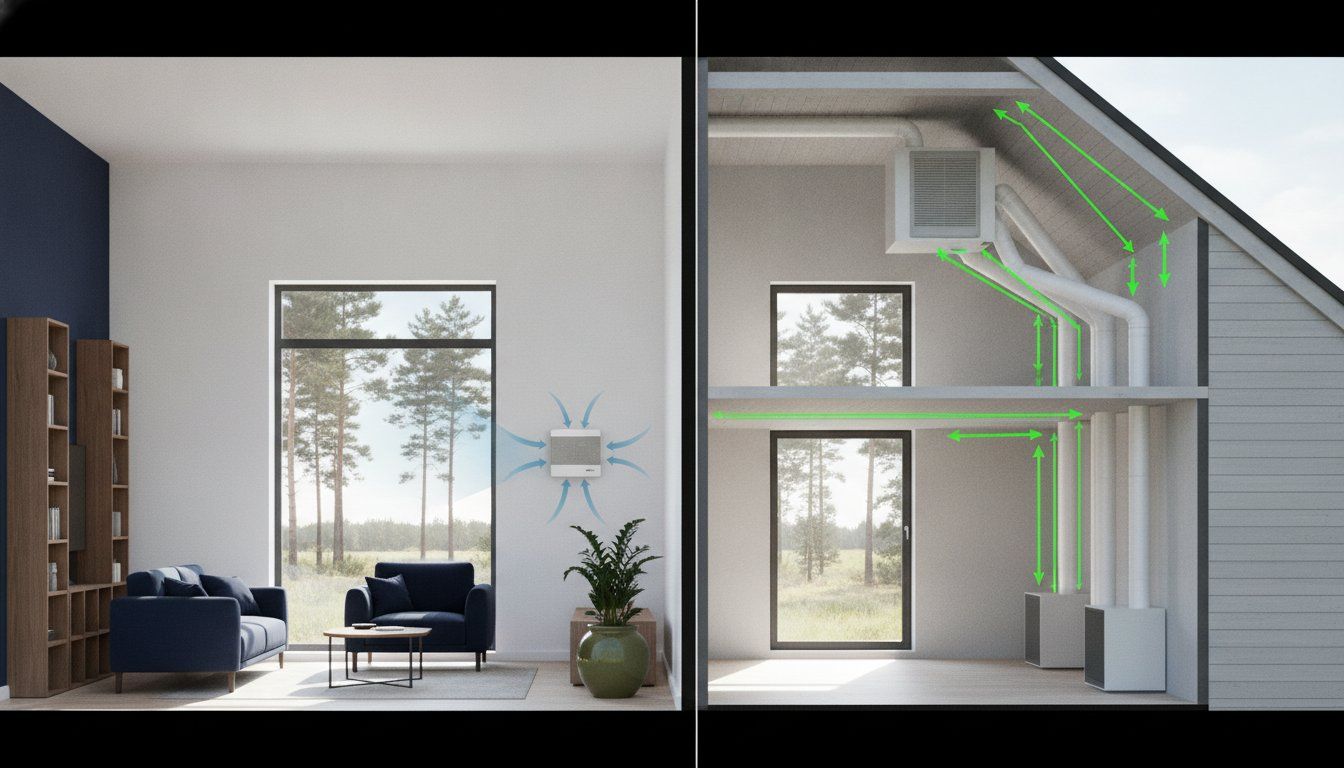
This system is comparable to the lungs of the building. Its heart is one powerful machine, usually installed in an auxiliary room, attic, or in a boiler house, so that its operation does not interfere with the peace of the household. A network of air - ducts, or mains, flowed out of the house. The system is smartly designed so that the air always flows in the right direction. Fresh air is added to clean areas, such as bedrooms and living room. The "clean" and wet air are collected from the kitchen, bathroom and toilet, ensuring that smells and vapours do not spread throughout the house.
Decentralised installations or mini recuperators
If repair is already completed and removal of air pipes is no longer possible, help comes local ventilation. These machines, called mini recuperators, are installed directly in the outer space. They are based on a cyclical process using a ceramic heat exchanger. For about 70 seconds, the machine blows air out, warming up the ceramic element. Then the cycle changes, and the machine begins to draw in fresh outdoor air, which is already pleasantly tied when passing through the heat exchanger. It is an ideal solution for renovated apartments or separate rooms where it is necessary to quickly and efficiently prevent moisture accumulation.
Comparison: Centralised against decentralised ventilation
When choosing which system will be more appropriate, start with the real situation on the site. Centralised or decentralised ventilation differences not only in costs, but also in how much space they occupy and how loud they work. If you build a new house, the central system is the modern standard, but local solutions for apartment owners are often the only practical choice.
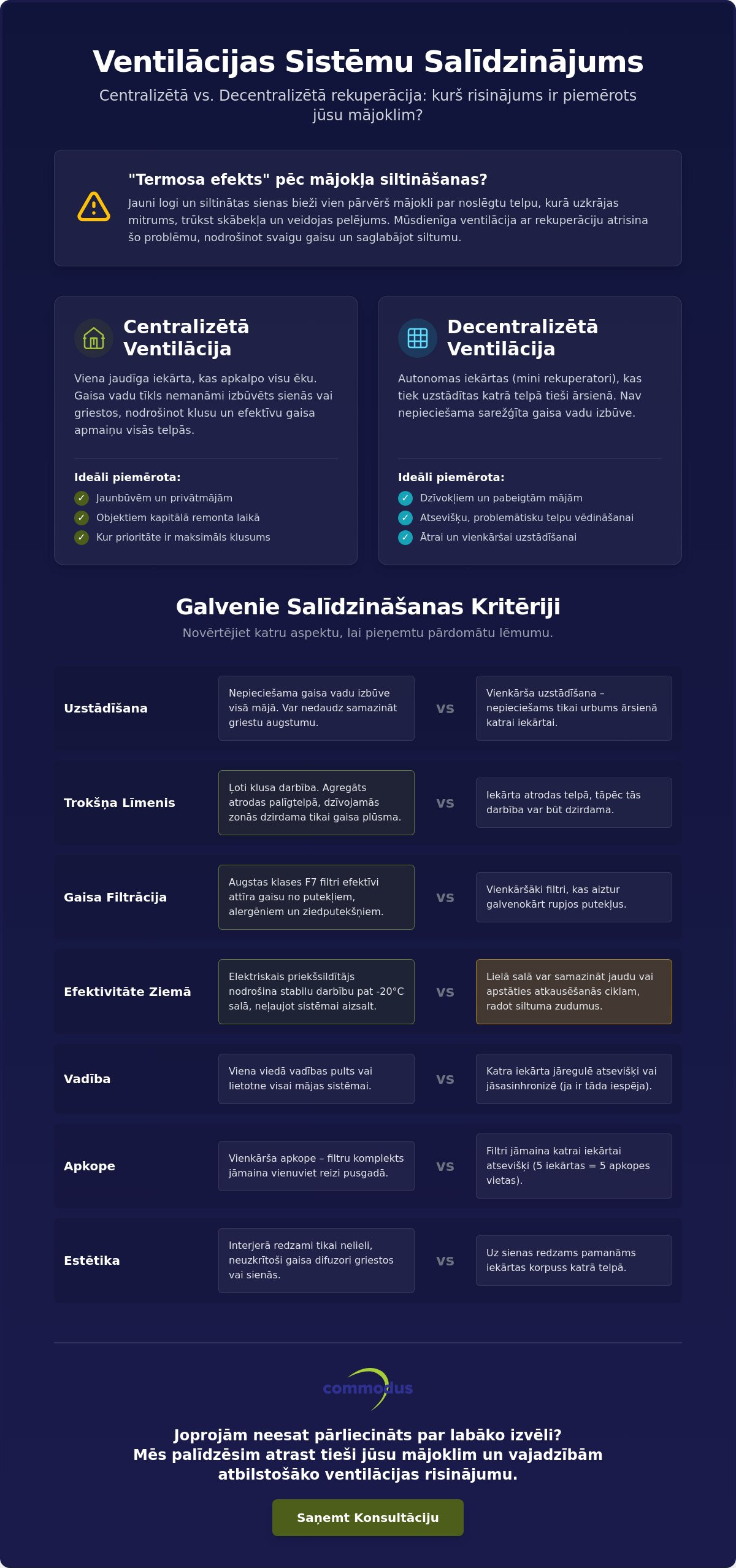
- Installation: The central system needs air ducts throughout the house, the local only exact hole in the wall.
- Noise: The unit in the attic or in the auxiliary room means in the quiet rooms, while the wall equipment is located directly in the room.
- Air: The F7 filters of the central system purify the air better than the small filters of local equipment, holding even pollen.
- Management: One smart panel for the whole house against the need to regulate or synchronize each room separately.
Exploring different ways Types of ventilation systems, you see, everyone has a place. Our experience shows that customers most appreciate the lack of awareness of the system on a daily basis and that the air is always fresh without undue effort.
Energy efficiency and heat recovery
In the harsh winters of Latvia, when the temperature falls to -20°C, significant differences appear. Central systems are usually equipped with electric preheaters. They protect the heat exchanger from freezing, maintaining continuous air exchange. Local mini recuperators on a large island can work with less power or even temporarily stop to thaw the ceramic element. This has a direct impact on your heating bill, as each lost heat percentage means more energy consumed for space heating.
Aesthetics and spatial planning
Visual aspects are important for many customers. In the case of the central system, only small air diffusers at the ceiling are visible. They can be easily adapted to any interior. However, hiding air ducts can reduce the ceiling by 10 to 15 cm. Decentralised installations occupy a wall space and their decorative panels are noticeable. However, they do not require any changes to the construction of the ceiling. If you are not sure about the best choice, our specialists will help you find the most suitable for your home ventilation solution.
Which system to choose for your home or apartment?
The decision on which system is better most often depends on the current state of the building. In new constructions engineers almost always recommend a centralised solution, as it allows to fully control air flows and hide all communications already during the construction phase. In renovation projects, where capital repairs are not planned, the local installation is the only logical way to ensure fresh air without damaging the existing finish and without losing the ceiling height.
In serial apartments, mini recuperators are a real rescue. They effectively fight with "blowing" on the windows and suffocating air in the bedrooms after old natural ventilation has stopped working. Professional comparison of centralised and decentralised ventilation shows that choice is influenced not only by the technical possibilities, but also by how much effort you are ready to devote to daily maintenance of the system.
- Maintenance: The central system has one set of filters to be changed every six months in one place, usually in an auxiliary room.
- Local filters: In the decentralised system, each unit has its own filter. If there are five appliances in the house, you will have to go to each one to carry out maintenance.
Decision criteria
It is important to see a common picture in budget planning. Although one local unit seems to be cheaper, in a large house with many rooms their total cost may exceed the price of the central unit. The cut-off is usually between three and four spaces. If the housing is larger, centralised or decentralised ventilation should be assessed not only at the purchase price, but also at the long-term energy efficiency benefits and convenience of system management.
The role of professional consultation
There is no point simply buying expensive equipment if the air flows are not correctly calculated. Only the precise project guarantees that smells will disappear in the kitchen, but there will be no unnecessary noise in the bedroom. Learn more about ventilation solutions KommodusTo understand what project is needed specifically for your home. Our team will help to make the necessary calculations to make your investment pay off with peace of mind and excellent air quality every day.
Integrating ventilation with modern heating systems
The energy efficiency of a modern home cannot be achieved with one separate machine, it is team work between heating and air exchange. Whether your choice is centralised or decentralised ventilation, its integration with the heat pump is crucial. The recuperation system acts as a shield that prevents heat from passing away, thereby significantly reducing the heat pump load. When the compressor does not have to work with maximum power to compensate for heat losses from open windows, the life of the machine will be extended and the bills reduced.
Smart home solutions make this cooperation even simpler. You don't have to be an engineer to manage the climate in your home. Modern systems allow controlling both temperature and air freshness from one app's phone. Ventilation is no longer a choice but a technical necessity. It prevents the accumulation of moisture and provides a healthy environment, which we call Commodus a real home.
Heat pump and recuperation: Perfect pair
Quality air exchange directly affects how efficiently your heating system will work. If the air in the rooms is too wet, the heat pump needs more energy to maintain a comfortable temperature. Properly scheduled heat pump and ventilation synergy ensures that the house breathes simultaneously with its heating cycles. This creates a stable microclimate, which does not have a sharp temperature fluctuation and unpleasant aroma.
Why entrust the installation of Commodus experts?
Our experience shows that even the best machine will not work properly if the assembly is lax. Commodus team provides full-cycle service throughout Latvia, from precise design to regular maintenance. We are not trying to sell the most expensive solution, but the most appropriate one for your situation. Whether it is one mini recuperator in the city apartment or a complex central system in a large private house, we treat each project with the master's responsibility and personal attitude.
Apply for consultation and get your ventilation project! We will ensure that your home always has fresh air and a warm atmosphere of peace in the long term.
Choose the most suitable air exchange solution for your home
There is no single right answer for everyone, because every home is unique. Centralised system provides maximum silence and excellent filtration in new buildings, while local recuperators are the fastest way to fresh air in renovated apartments. The main thing is to remember that any of these systems significantly reduces heat losses and creates a healthier environment for your family, eliminating the risk of mold and suffocating air in everyday life.
Choice whether it is more appropriate centralised or decentralised ventilation, gets much easier if you have an experienced partner next to you. With more than 15 years of experience in the engineering system market we offer a full service cycle. Our certified assembly specialists will take care of everything, from precise design to regular maintenance. We offer energy-efficient solutions tailored to the climate of Latvia that provide peace of mind and comfort in the long term.
Contact Kommodus specialists and find the best ventilation solution!
We are here to help you breathe easier and enjoy true house comfort every day.
Frequently asked questions about ventilation solutions
Is decentralised ventilation loud and will it interfere with sleep?
Today's decentralised equipment is designed to operate almost deafly in night mode. The noise level in this mode shall normally not exceed 20 decibels, which are less than a whisper or leaf chabin. When properly installed and adjusted, the equipment does not interfere with even the most sensitive sleep, ensuring smooth air flow without excessive background noise.
How often should air ducts be cleaned in the centralised system?
In a centralised system, the cleaning of conductors is usually required every 5 to 10 years, provided that all maintenance rules are complied with. The main prerequisite for clean air ducts is a regular change of filters every six months. If the filters are qualitative and are changed in time, dust accumulation in the ducts is minimal, and the system serves for years without further intervention.
Can I install a mini recuperator without the help of a master?
Self-proper installation is not recommended, as the process requires specific diamond drilling through the exterior wall and precise wiring connection. Incorrectly formed borehole or insufficient heat insulation around the body of the device can result in a hole or even moisture accumulation in the wall. Our certified assembly specialists perform this work quickly and with a guarantee, protecting your home from damage.
What is the approximate monthly electricity consumption of the ventilation system?
Modern ventilation consumes surprisingly little energy, often no more than one LED bulb. The average system capacity is between 20 and 60 watts per hour, depending on the selected operating mode. When assessing whether centralised or decentralised ventilation is more appropriate, both systems are very economical and only a few euros are added to the monthly bill.
Is the ventilation system fully capable of replacing the air conditioning in summer?
The ventilation system does not replace air conditioning, as its main task is air exchange, not active cooling. The recuperation function in summer helps not to let outdoor heat in the rooms, keeping the internal coolness longer, however, it cannot lower the temperature in the room by several degrees. To achieve maximum comfort on hot days, we recommend combining ventilation with air conditioning or heat pump in cooling mode.
Comments