Air-to-Water Heat Pump: A Complete Guide to Efficient Heating in Latvia in 2026
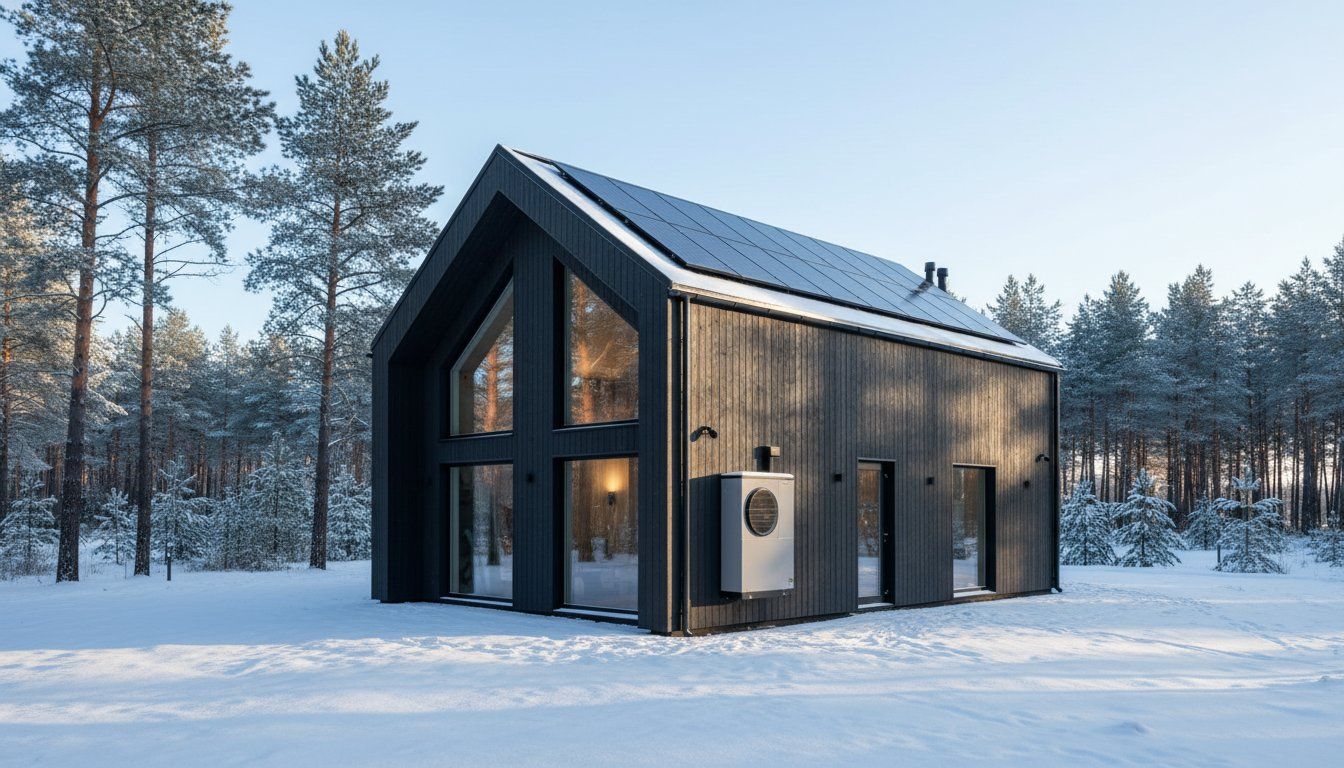
Did you know that the number of heat pump installations in Latvia has increased by more than 40% over the past three years? This trend is no coincidence, as every homeowner wants to stop struggling with unpredictable heating bills and regain control of their time. A modern air-to-water heat pump is no longer merely an expensive technological novelty; it is a practical and reliable solution that allows you to forget about splitting firewood or depending on fluctuations in natural-gas prices. At Commodus, we see every day how this choice changes people's lives, providing much-needed peace of mind and warmth even on the coldest winter nights.
We fully understand your concerns about high costs and complicated state-support requirements, which can often seem like an insurmountable obstacle. We have therefore gathered all the essential information to explain how to choose the most efficient unit and obtain the maximum available state co-financing for improving your home in 2026. This article takes you through the entire process, from technical specifications to the complete energy independence offered by combining the system with solar panels. We are ready to work alongside you so that the result is safe, warm and financially worthwhile in the long term.
Key takeaways
- Understand why an air-to-water heat pump is the optimum solution for the Latvian climate, combining low operating costs with a high level of comfort.
- Learn how the thermodynamic cycle converts outdoor air efficiently into comfortable heat for your underfloor-heating system and domestic hot water.
- Discover the main criteria for selecting the correct unit capacity and cylinder volume on the basis of your home's actual heat loss.
- Obtain up-to-date information about state-support programmes (EKII and Altum) in 2026, which can significantly reduce your initial investment.
- Find out why a full-service approach and professional installation are the keys to safe and efficient long-term operation of the heating system.
What is an air-to-water heat pump and why is it the best solution for Latvian homes?
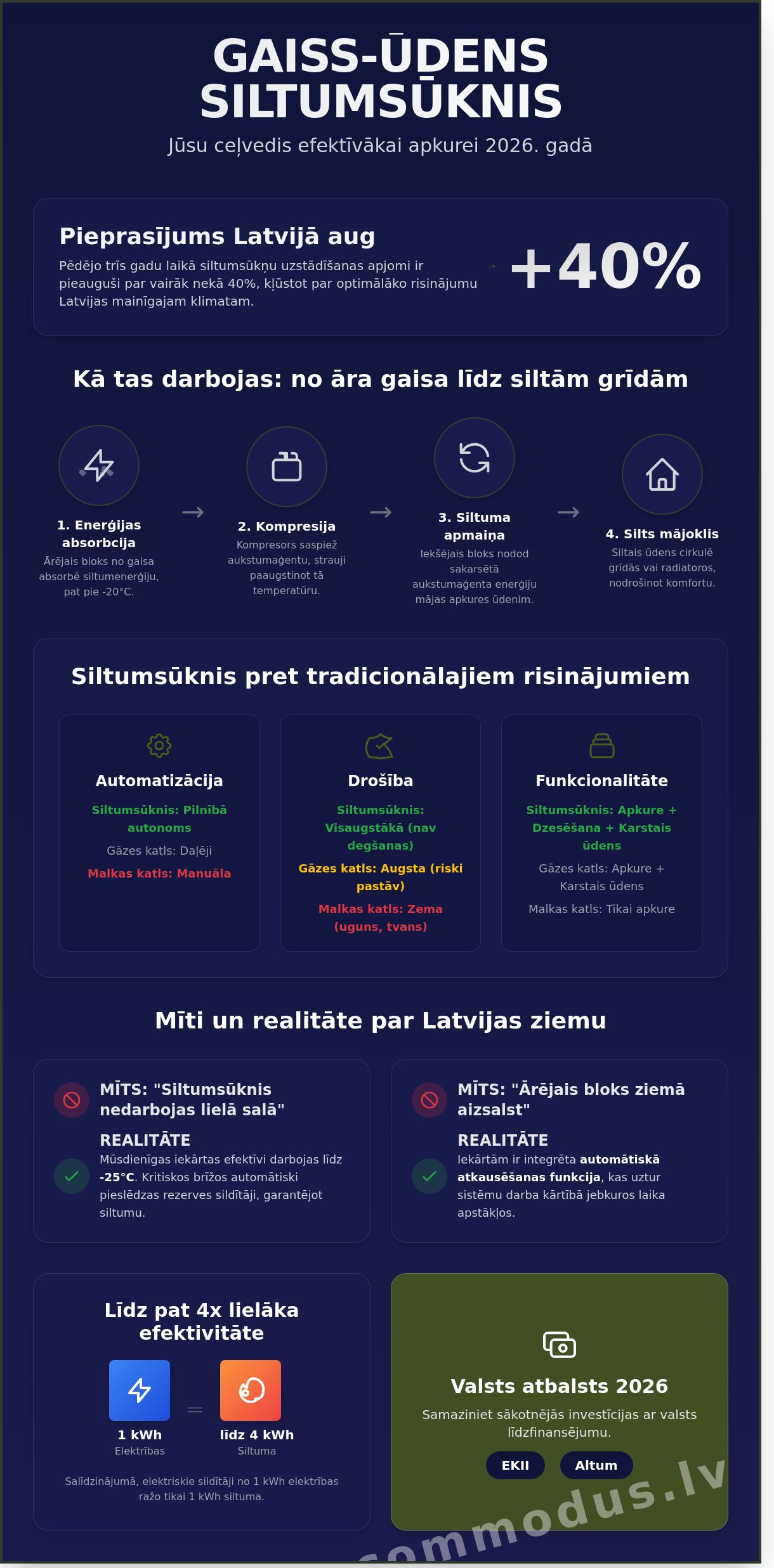
An air-to-water heat pump is an intelligent heating system that converts thermal energy from the surrounding environment into heat for the home. Unlike conventional boilers, the unit does not generate heat itself but transfers it efficiently. How a heat pump works is best explained by the principles of thermodynamics: the outdoor unit absorbs energy from the outside air even when the temperature is below zero and, with the aid of refrigerant, transfers it to the indoor heat exchanger, which heats the water in the heating system. This environmentally responsible process can provide up to 4 kilowatt-hours of heat for every kilowatt-hour of electricity consumed.
This technology has become the most sought-after option in Latvia because it offers an excellent balance between installation costs and long-term benefits. Compared with ground-source heat pumps, air-to-water systems do not require expensive and complex excavation work or boreholes, which significantly reduces the initial investment. At Commodus, we have seen how this solution enables customers to switch quickly and without unnecessary stress to modern heating, regardless of whether the house is in a city centre or a rural property. By selecting this technology, you can reduce CO2 emissions by approximately 75% compared with diesel or coal heating, helping to achieve the objectives of the European Green Deal by 2030.
Technological development over the past five years has made these units particularly suitable for northern climates. A modern air-to-water heat pump is equipped with intelligent controls that adapt to Latvia's changing weather, ensuring maximum efficiency in both damp autumn conditions and severe frost.
Why choose a heat pump instead of a gas or wood-burning boiler?
The principal benefit is complete process automation. You can forget about stacking and splitting firewood or cleaning ash every day, all of which requires physical effort and time. A heat pump operates autonomously, allowing you to spend time with your family or on hobbies instead of managing the heating system every evening. Safety is equally important: there is no open flame in the home, no risk of explosive gas leaks and no carbon-monoxide hazard. The system is also multifunctional. It provides comfortable warmth in winter, prepares domestic hot water efficiently and can cool rooms during the hottest summer months, eliminating the need to install separate air conditioners.
Heat pumps and Latvian winters: myths versus reality
Many homeowners still worry about whether the system can operate in severe frost. Modern premium units remain effective at temperatures of -25°C and below. There is no need to fear the outdoor unit freezing, as the system includes an automatic defrost function that keeps the equipment operational in all conditions. At critical temperatures below the manufacturer's specified limit, integrated backup electric heaters activate automatically. This guarantees warmth even on the coldest January nights and provides long-term peace of mind and comfort.
How an air-to-water heat pump works: From outdoor air to warm floors
A heat pump does not burn wood or gas to create heat. It simply transfers heat from outside into the building. An air-to-water heat pump uses a thermodynamic cycle in which refrigerant plays the central role. The outdoor unit draws in ambient air, and even at -20°C it contains enough energy to evaporate the refrigerant. The vapour enters the compressor, where its temperature rises rapidly as the pressure increases. In the indoor unit, the heat exchanger transfers this energy to water, which then circulates through the underfloor-heating system or radiators to maintain a comfortable indoor climate.
- Outdoor unit: Located outside the house, it contains the fan, evaporator and compressor. Its purpose is to capture energy from the air and prepare it for further processing.
- Indoor unit: A compact indoor assembly that transfers heat to the home's heating system and prepares domestic hot water for the bathroom and kitchen.
- Heat exchanger: The critical point where the heat from the refrigerant meets the water in the heating system, allowing energy to be transferred efficiently without the two fluids mixing.
Efficiency indicators: COP and SCOP explained
When choosing a unit, you will encounter two important abbreviations. COP, or Coefficient of Performance, indicates instantaneous efficiency at a specific temperature. A COP of 4.0 means that electricity costing EUR 1 produces heat worth EUR 4. In Latvia's variable weather conditions, SCOP is a more accurate indicator for investment planning. It shows average seasonal efficiency across the entire heating period. Modern heat pump efficiency enables SCOP values above 4.5, approximately 20% better than units manufactured ten years ago.
Inverter technology: why is it important?
Older units operated according to a simple principle: either at full output or switched off. This caused unnecessary electricity consumption and accelerated compressor wear. Modern inverter technology allows a heat pump to operate at variable output and adapt to actual demand. When the outdoor temperature is around zero, the unit does not run at full power but quietly maintains the required temperature. This reduces noise by approximately 10 decibels and extends system life by several years. At Commodus, we recommend this solution to anyone wishing to avoid unnecessary costs and enjoy a quiet outdoor environment.
Underfloor heating is the ideal partner for this system. Because it requires cooler water, around 30–35°C, than radiators, the heat pump operates under a lower load. This combination can save up to an additional 15% of energy compared with conventional radiators. If you are planning to modernise your home's heating, you can use our heating calculator to obtain a clearer picture of the expected benefits. We will help guide your energy-efficiency project in the right direction so that you can feel confident about every cent invested.
Main criteria for choosing a heat pump: Capacity, type and manufacturer
There is no point relying on guesswork when choosing equipment because every house is unique. The first and most important step is an accurate calculation of the home's heat loss. If the selected capacity is too low, the unit will not provide sufficient comfort on the coldest January nights. Conversely, an oversized air-to-water heat pump will switch on and off frequently, unnecessarily wearing the compressor and increasing the electricity bill. For new buildings in the Latvian climate, calculations typically use approximately 40–50 W per square metre, although this figure may double for older properties.
The required domestic-hot-water cylinder volume depends on the number of residents and their habits. A family of four that regularly uses a bath will generally need a cylinder of at least 200–300 litres. Noise is a critical consideration when selecting the equipment location. Modern units operate at approximately 35–50 dB, similar to a quiet conversation, but the outdoor unit should not be installed directly beneath a bedroom window or close to a neighbour's boundary. Smartphone control is no longer a luxury but a practical necessity. It allows you to reduce the temperature while you are away and monitor consumption in real time. When planning the investment, it is useful to know that state support for heat pump installation is available and can significantly reduce the initial cost.
Monobloc or split system: which should you choose?
The main advantage of a monobloc system is simplicity. All components are contained in a single outdoor unit, saving indoor space and reducing installation time. A split system, by contrast, consists of two sections connected by refrigerant pipes. This design offers greater protection against freezing during a prolonged power outage because water circulates only indoors. Monobloc units are often slightly less expensive to purchase, while split systems provide greater flexibility in positioning.
Leading manufacturers available from Commodus
At Commodus, we work only with proven equipment so that we can advance towards a sustainable future together with our customers. Mitsubishi Electric is a Japanese technology leader whose Zubadan series retains full heating capacity even at -15°C. Daikin is recognised for innovation and exceptionally high energy efficiency, helping to minimise operating costs. Swedish manufacturer CTC brings more than 90 years of experience and produces solutions specifically adapted to harsh northern weather, with intuitive controls.
- Mitsubishi Electric: Technological stability and durability.
- Daikin: Excellent COP performance and quiet operation.
- CTC: Robust design and Nordic quality.
Installation process and state support (EKII, Altum) in 2026
High-quality installation of an air-to-water heat pump begins not with a screwdriver but with accurate calculations and engineering design. In 2026, with stricter energy-efficiency requirements, correct system balancing determines whether heating bills genuinely fall by the expected amount. At Commodus, we treat every house as a unique system. We therefore begin with a detailed property survey to assess the building's thermal performance and existing heating installation.
Once the design has been prepared, technical implementation begins. This includes installing the refrigerant lines, fitting the equipment and connecting it to the building's engineering services. The most important stage is configuring the automation. Our specialists do more than connect wires: they configure the system to respond to outdoor-temperature fluctuations and achieve the maximum Coefficient of Performance. When installation is complete, we do not leave until the customer understands how to use the new technology.
Step by step towards a new heating system
The process is clear and transparent. It begins with a consultation during which the most suitable model is selected together with a Commodus expert. We help determine whether a monobloc or split-system air-to-water heat pump is more suitable for your situation. Preparation includes constructing a stable base for the outdoor unit and providing a safe electrical connection. The final steps are commissioning the system and training the user so that you can feel secure about the warmth of your home.
- Property survey and heat-loss calculation;
- Preparation of the base and installation of the outdoor unit;
- Connection of the indoor unit and hydraulic assembly;
- Filling, venting and pressure testing the system;
- Configuration of final settings according to the customer's comfort requirements.
State-support programmes in Latvia
In 2026, substantial state co-financing remains available to Latvian residents and can cover up to 50% of the equipment purchase cost. The EKII programme focuses on replacing fossil-fuel boilers with more environmentally responsible solutions, while Altum support aims to improve the overall energy efficiency of detached houses. These programmes offer an excellent opportunity to reduce the initial investment and make the transition to modern heating financially attractive.
Applications require specific documentation, including installation by certified specialists and equipment certificates. Commodus provides a complete documentation package that meets the requirements of government agencies. We understand every stage of the process and help customers prepare everything required so that obtaining support is as straightforward and rapid as possible. We remain your partner until the approved funding has been paid into your account.
Would you like to know how much support your project may receive? View our range and book a consultation so that we can find the most efficient solution for your home together.
Commodus experience: A complete service cycle from design to maintenance
When selecting a heating system, experience is more than a number on paper. The Commodus team has worked daily with a wide variety of projects throughout Latvia for 15 years. We have installed hundreds of systems, ranging from compact 60 m² detached houses to large industrial buildings and warehouse complexes. This means we have encountered a broad range of technical challenges and know how to solve them before they become real problems for the user. Our specialists understand every detail required for a high-quality air-to-water heat pump and its integration into an existing or new heating system.
Our approach is personal and honest. We do not regard a customer as simply another order number. Commodus is built around working together with the customer. This means accepting full responsibility for the process and helping to select the solution that corresponds precisely to the building's heat loss and the family's habits. We provide warranty and post-warranty service throughout Latvia, so assistance is available regardless of your location.
Why is regular maintenance critically important?
Even the most advanced equipment requires regular care to operate at maximum efficiency. Annual servicing is not merely a formality but an investment in system longevity. Cleaning the filters ensures unrestricted airflow, while checking refrigerant pressure confirms that the system is operating in its most efficient mode. Our experience shows that timely diagnostics can prevent expensive repairs that might otherwise arise after several years of intensive use. An optimised air-to-water heat pump consumes less electricity, which is directly reflected in lower monthly bills.
- Maintaining system efficiency and optimising energy consumption.
- Checking moving components and electrical connections for safety.
- Extending equipment service life to 20 years or longer.
More than heat pumps
We offer integrated energy-efficiency solutions that work in synergy. A modern home is inconceivable without intelligent use of resources. By combining a heat pump with solar panels, you can generate electricity for self-consumption and make heating almost free during sunny months. Commodus provides the complete construction of the heating system, from underfloor heating and radiator installation to complex control assemblies. We are your single provider for everything associated with warmth and comfort in your home.
Contact Commodus experts and receive a free consultation!
Warmth and peace of mind in your home begin with a considered choice
A modern heating system is no longer merely a technical solution; it is a long-term investment in your family's comfort and Latvia's energy independence. The year 2026 marks the point at which an air-to-water heat pump becomes the natural standard for efficiency, particularly when using the available EKII or Altum state support. These programmes significantly reduce initial costs and make the transition to green energy financially attractive for every household.
For more than 15 years, the Commodus team has helped Latvian residents move towards efficient heating by providing a complete service cycle from the first design drawing to regular maintenance. Our certified installation specialists and designers work from branches throughout Latvia, ensuring that professional advice and practical assistance are always close at hand. We believe every home deserves an individual approach rather than a standardised solution.
Do not postpone the decision until the next heating season, when demand and waiting times increase. Contact us so that we can find the most suitable solution for your home together. Receive a free heating-cost calculation and consultation from our knowledgeable experts. Together, we will create a warm and secure environment that is pleasant to return to every day.
Frequently asked questions about heat pumps
Is an air-to-water heat pump sufficient as the sole heating source in Latvia?
Yes. A modern air-to-water heat pump is fully capable of serving as the sole heating source in Latvia's climate. Units are designed to operate efficiently at temperatures down to -25°C, and at critical moments they automatically activate the built-in electric heating element. Our experience shows that correctly calculated capacity allows homeowners to forget about splitting firewood or handling pellets even on the coldest January nights.
How much electricity does an air-to-water heat pump consume per month?
Electricity consumption depends directly on the building's thermal performance, but in an average 150 m² house it ranges from 400 to 800 kWh during winter months. The precise consumption of an air-to-water heat pump varies according to the outdoor temperature and your chosen indoor comfort level. If the house is well insulated, the bills can be pleasantly low compared with direct electric heating or diesel fuel.
What is the average service life of an air-to-water heat pump?
The average service life of an air-to-water heat pump is 15 to 25 years when regular technical maintenance is carried out. The compressor is the most important component, and professional installation together with a correctly adjusted heating system significantly extends its life. We will work with you to ensure the unit operates for as long as possible through annual inspections and any necessary system improvements.
Is the heat pump's outdoor unit too noisy for neighbours?
Modern outdoor units operate very quietly, producing approximately 35–50 decibels, comparable with moderate rainfall or a quiet conversation. Latvian regulations set strict permitted noise limits at property boundaries, and high-quality units comply with these requirements with a comfortable margin. A correctly selected installation location and purpose-designed anti-vibration mounts ensure that neighbours are unlikely even to notice the new heating system.
How long does it take for investment in a heat pump to pay back?
Investment in a heat pump typically pays back within 5 to 10 years, depending on the previous heating method and available state support. When switching from more expensive energy sources, the reduction in monthly costs is noticeable from the first heating month. Current support programmes can shorten the payback period by several additional years, making this a very sound long-term investment.
Can I install a heat pump if my home has radiators rather than underfloor heating?
A heat pump can also be installed in a home with radiators, although system efficiency will be slightly lower than with underfloor heating. In these situations, we recommend larger radiators or purpose-designed low-temperature radiators so that the system can operate in its optimum mode. This allows the heat pump to heat the water to a lower temperature, directly reducing the monthly electricity bill.
What electrical-supply requirements apply when connecting a heat pump?
The principal requirement is a stable three-phase electrical connection with adequate capacity; 16 A or 20 A circuit protection is generally sufficient. Before installation, the condition of the existing electrical system should be checked to prevent overload when the unit's supplementary heating elements operate. Our specialists will assess your home's electrical installation and recommend any improvements needed for safe and uninterrupted operation of the air-to-water heat pump.
Is state support also available when replacing a gas boiler with a heat pump?
Yes. State support from Altum or the Environmental Investment Fund is also available when a gas boiler is replaced with an efficient heat pump. These programmes may cover up to 50% of the equipment purchase cost, subject to specified limits that are generally around EUR 4,400. This is an excellent opportunity to reduce the initial cost substantially and achieve energy independence in your home more quickly.
Comments