Air-to-Water Heat Pump Operating Principle: How Does It Heat a Home?

Imagine a January morning in 2024 when the thermometer outside reads minus 20 degrees, yet your home remains pleasantly warm without carrying firewood or waiting for enormous bills. At Commodus, we see every day that many homeowners have understandable concerns about high heating costs and doubts about whether modern equipment can genuinely cope with Latvia's harsh winters. This is entirely understandable, because no one wants to risk the system freezing or operating inefficiently precisely when heat is needed most.
In this article, we will explain clearly and without complicated terminology how an air-to-water heat pump works and how it converts outdoor air into useful energy, providing efficient heating even on the coldest days. We will examine every stage of heat extraction, dispel myths about operation in severe frost and provide practical guidance on selecting the correct capacity for your project. Our aim is to help you make a well-considered decision so that together we can move towards a more energy-efficient and warmer future in which comfort goes hand in hand with savings.
Key takeaways
- Understand how a heat pump “finds” heat in outdoor air and why transferring energy is more efficient than burning conventional fuels.
- Learn how the air-to-water heat pump operating principle and how the thermodynamic cycle heats a home even during severe frost.
- Find out what COP and SCOP values mean and how they help you calculate the real efficiency of the heating system throughout the entire season.
- Compare the differences between monobloc and split systems so that you can make an informed decision about the most suitable type of unit for your home.
- Learn why an accurate capacity calculation and professional selection of the installation location are critical to ensuring flawless and economical system operation.
What is an air-to-water heat pump and how does it “find” heat?
A heat pump is not simply another heating appliance; it is an intelligent engineering achievement that changes how we think about heating a home. In essence, an air-to-water heat pump absorbs thermal energy from the surrounding air and transfers it to the home's water-based heating system, such as underfloor heating or radiators. To understand the fundamentals of this technology, it is useful to learn what a heat pump is and why it differs fundamentally from conventional solutions. Unlike wood-burning or gas boilers, nothing is burned here. There is no flame, no smoke and no need for a chimney. Instead, energy is transferred, with electricity used only to “move” heat from outside to inside.
Many people wonder why air still contains thermal energy even at -25°C. The answer lies in physics. Heat disappears only at absolute zero, or -273.15°C. Compared with that point, even Latvia's harshest winter is sufficiently “warm” for a modern refrigerant to extract energy from it. The ability of contemporary units to capture this small amount of heat and use a compressor to convert it into useful warmth for your home is remarkable. It is precisely this air-to-water heat pump operating principle that enables high efficiency and makes the technology a leading choice for energy-efficient homes.
Heat pumps versus conventional heating methods
Wood-burning and pellet boilers are gradually losing the efficiency contest because they require constant human involvement and dedicated storage space for fuel. Compared with air-to-air heat pumps, which blow warm air directly into a room, air-to-water systems provide a much higher level of comfort and distribute heat evenly through the floors. At Commodus, we often say that this choice is about personal freedom. Environmental impact is another important factor. Reducing CO2 emissions by switching from fossil fuels to a heat pump helps achieve sustainability goals without sacrificing peace of mind or warmth.
Why has this technology become the standard in 2026?
The technological leap of recent years has been impressive. In 2026, heat pumps are no longer unusual; they are a logical choice for any new-build or renovation project. The latest generation of units retains a high coefficient of performance even at extremely low temperatures, which used to be the greatest obstacle. State-support programmes administered by the Environmental Investment Fund and Altum have strongly accelerated adoption of this technology by making the initial investment more affordable. User feedback confirms that switching to fully automated heating is one of the best decisions they have made when improving their homes. There is no need to clean ash or worry about chimneys, and everything can be controlled through a smartphone app.
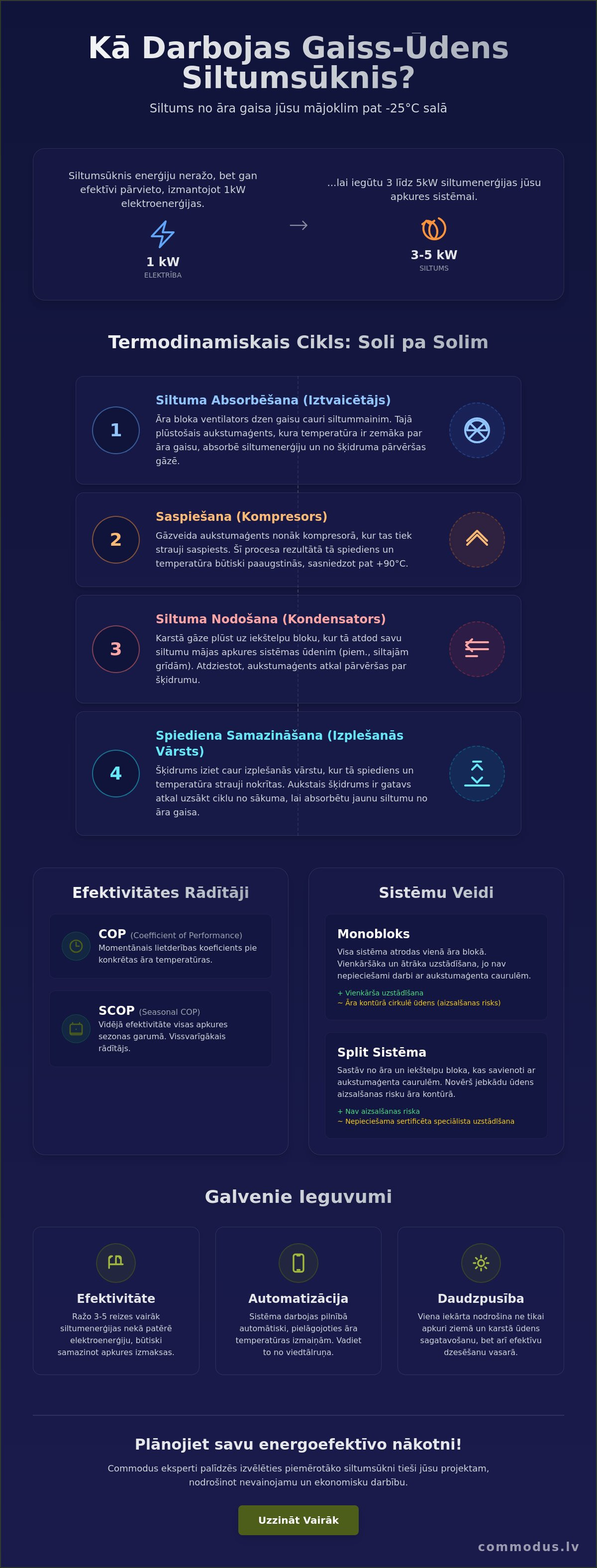
- Efficiency: 1 kW of electricity can produce 3 to 5 kW of heat.
- Automation: The system automatically adapts to changes in outdoor temperature.
- Versatility: One unit provides heating, domestic hot water and cooling in summer.
Overall, the air-to-water heat pump operating principle is designed to make maximum use of free natural resources. It is like pulling together with an intelligent assistant that performs most of the work for you. In Latvia's current climatic conditions, it is a safe and reliable choice that pays off in the long term, both financially and emotionally.
Step by step: how does the thermodynamic cycle work?
A heat pump is not a miracle, but an intelligent engineering solution that puts the laws of physics to work in your favour. The main air-to-water heat pump operating principle is based on moving energy rather than creating it from nothing. This process, known as the thermodynamic cycle, consists of four consecutive stages that repeat continuously.
- Heat absorption (evaporator): The outdoor-unit fan draws air through the heat exchanger. Refrigerant flows through it at a temperature lower than the outdoor air. Even when it is -20 degrees outside, the fluid absorbs energy from the surroundings and turns into a gas.
- Compression (compressor): The gaseous refrigerant enters the compressor, where it is rapidly compressed and its temperature rises to as much as +70 or +90 degrees. This is similar to a bicycle pump becoming warm when you pump air quickly.
- Heat transfer (condenser): The hot gas enters the indoor unit, where it transfers its heat to the water in the home's heating system. At this point, the gas cools and becomes a liquid again.
- Pressure reduction (expansion valve): The liquid passes through a small valve, where its pressure and temperature drop rapidly. It is then ready to return to the outdoor unit and begin the cycle again.
This cycle makes it possible to obtain approximately 3 to 5 kilowatt-hours of thermal energy while consuming only 1 kilowatt-hour of electricity. At Commodus, we often say that this system is like a reliable assistant that helps us “pull together” towards greater energy efficiency without demanding unnecessary effort or substantial resources from you.
The remarkable role of the refrigerant, or freon
The refrigerant is the lifeblood of the system. Its main characteristic is an exceptionally low boiling point. For example, the modern R290 refrigerant (propane) boils at approximately -42 degrees Celsius under normal pressure. This means that it can evaporate and absorb heat even during Latvia's harshest winter. The industry is currently moving towards more environmentally friendly solutions, such as R32 and the aforementioned R290, whose global warming potential (GWP) is up to 70% lower than that of older-generation refrigerants. These fluids efficiently change state from liquid to gas, making them ideal carriers of energy for your home.
The compressor – the heart of the system
The compressor is the only component that consumes a significant amount of electricity to ensure that the air-to-water heat pump operating principle is implemented in practice. Modern units use inverter technology. This means that the compressor does not operate only in an “on” or “off” mode. It intelligently adjusts its speed according to the amount of heat the home requires at that moment. When it becomes warmer outside, the compressor reduces its output and saves you money. Engineers have also devoted considerable attention to sound insulation. The highest-quality modern compressors are wrapped in several layers of insulation, ensuring that the noise level at a distance of one metre does not exceed 35 to 50 dB, which is comparable to a quiet conversation or the hum of a refrigerator. To learn more about how these technologies can improve your everyday life, you can choose the most suitable solution from our range.
Efficiency indicators: an explanation of COP and SCOP
When choosing a heating system, figures speak louder than promises. COP (Coefficient of Performance) is an instantaneous efficiency measurement showing the relationship between electricity consumed and thermal energy produced at a particular moment. If a unit has a COP of 4.0, it means that four kilowatts of heat are produced from one kilowatt of electricity. It is similar to a car's instantaneous fuel consumption, which changes depending on speed and road conditions. The air-to-water heat pump operating principle means that these figures will always be excellent under laboratory conditions at +7°C, whereas in real life the system encounters changing conditions.
In Latvia's variable weather, SCOP is a much more important indicator. It is the seasonal coefficient of performance and calculates average efficiency over the entire heating season. SCOP takes account of both mild autumn months and January frost. At Commodus, we always emphasise that a high SCOP is the key figure determining your total annual costs. For high-quality units, this value ranges from 4.2 to as much as 5.0, representing impressive long-term savings.
Several factors influence the system's actual efficiency:
- Type of heating system: Underfloor heating provides 20% to 30% higher efficiency than old cast-iron radiators.
- Thermal performance of the home: Insulated walls and high-quality windows allow the heat pump to operate at a lower temperature.
- Settings: A precisely adjusted heating curve can reduce consumption by a further 10% to 15%.
Operation in extreme sub-zero temperatures (-20°C and below)
Many people worry whether the unit can heat a home at -25°C. Modern technology allows heat pumps to maintain output even during severe frost. When the temperature falls below the bivalence point, which is usually between -7°C and -10°C, the system may require additional assistance. This is when the built-in electric heating element is activated. The fear of enormous January bills is often exaggerated. Even at -20°C, the air-to-water heat pump operating principle remains more efficient than direct electric heating because part of the heat is obtained from outdoor air rather than solely from the electricity grid.
Domestic hot-water preparation and efficiency
A heat pump is not intended only for space heating; it is also a complete solution for preparing hot water for showers and kitchens. The system operates according to a priority principle. If the temperature in the hot-water cylinder drops, the unit briefly pauses space heating and directs all its energy to heating the water. This happens quickly, and the temperature in the home does not change during this period. For a family of three to four people, we recommend a cylinder with a capacity of at least 200 to 300 litres. This volume guarantees comfort for every member of the household while maintaining high energy efficiency. By moving this shared energy-efficiency effort forward, we help customers choose the solution that best matches their needs.
System types and their integration into the home
Choosing a heat pump is not merely a technical decision; it is an investment in your family's everyday comfort and peace of mind. To understand fully how the air-to-water heat pump operating principle will help maintain warmth, you must begin by selecting the most suitable system configuration. Two principal solutions dominate the market: monobloc and split systems. A monobloc unit consists of a single unit installed outside the home, whereas a split system has both an outdoor and an indoor unit connected by refrigerant pipes.
Heat distribution within the rooms is just as important as the unit itself. Underfloor heating is considered the ideal partner for a heat pump. This is explained by the required temperature difference: underfloor heating needs water at only 30 to 35 degrees, whereas conventional radiators often require 45 to 55 degrees. The lower the heating-system temperature, the more efficiently the heat pump operates, consuming less electricity and extending the service life of the compressor.
Monobloc versus split: which should you choose?
If indoor space is limited, a monobloc is an excellent choice. The entire technological core is located outside, saving approximately 1.5 to 2 square metres of usable floor area in your plant room. With a monobloc, however, high-quality pipe insulation must be provided to prevent freezing at extreme temperatures such as -25 degrees. Split systems offer greater flexibility because the connection between the units cannot freeze. In terms of servicing, split systems require a certified specialist to work with refrigerants, but they provide maximum security during Latvia's harshest winters.
Integration with smart-home systems
Modern heat pumps have become highly technological hubs that can be controlled from a smartphone. Remote temperature control allows you to reduce heat output while you are away and increase it again shortly before returning, saving up to 12% of seasonal heating costs. Integration with solar panels is particularly advantageous. When the panels generate surplus energy, the heat pump automatically begins heating domestic hot water or increases the temperature in the buffer tank. Automatic modes based on external sensors respond to rapid weather changes and adjust operation before you even notice that the rooms are becoming colder.
By choosing the correct solution, we move this shared journey towards greater comfort forward so that your home always remains welcoming. Explore our heat-pump solutions and find the system best suited to your home.
Planning and installation with Commodus experts
When choosing a new heating system, theoretical knowledge is only the starting point. Although the air-to-water heat pump operating principle is based on proven laws of physics, the system's practical efficiency depends directly on accurate engineering calculations. Our experience shows that even a small error in capacity selection can increase operating costs by 15% or place unnecessary strain on the compressor. Therefore, the first stage of every Commodus project is a detailed heat-loss calculation that takes account of the condition of the building envelope, window areas and ceiling height.
An on-site survey allows us to see what photographs cannot reveal. We carefully select the location of the outdoor unit to ensure optimum airflow and avoid acoustic discomfort. It is important to maintain a distance of at least 30 to 50 centimetres from the wall and provide unobstructed space in front so that the fan can discharge cooled air freely. We consider ourselves partners who “pull together” with the customer towards greater energy efficiency. This means taking full responsibility, from the first project drawing until the system is fully integrated into the engineering services of your home.
Technical maintenance – a guarantee of longevity
A heat pump is one of the most reliable heating appliances, but it also requires regular care. We recommend professional maintenance every 12 months, preferably before the heating season begins. During this visit, Commodus specialists clean the filters, check the refrigerant pressure and inspect the cleanliness of the heat exchanger. A dirty evaporator can significantly impair heat exchange and force the unit to consume more electricity.
Modern technology also enables us to provide remote diagnostics. If operating deviations appear, our service team receives a notification and can often provide a remote solution or attend the site promptly within 24 to 48 hours. This proactive approach ensures that the unit can serve reliably for 15 to 20 years while maintaining a consistently high coefficient of performance.
Next steps: from consultation to warm floors
The journey towards modern and economical heating begins with a simple application on our website or a phone call. We offer a free consultation and quotation, during which we explain exactly how the air-to-water heat pump operating principle will be adapted to your home. Our team will help prepare all documentation required to obtain state support through Altum or Environmental Investment Fund programmes, allowing you to recover a significant portion of the investment.
We invite you to visit the Commodus office in Riga, where you can see the latest unit models in person and speak with our specialists. We believe that a personal meeting helps establish a relationship based on trust, which is the foundation of a safe and warm home for many years. Our aim is not simply to sell a unit, but to provide every customer with comfort and lasting peace of mind.
Begin your journey towards a warm and economical home
Understanding the air-to-water heat pump operating principle is the first step towards an energy-efficient everyday life and independence from fluctuating fuel prices. These units provide stable warmth by using free energy from the surrounding environment, substantially reducing heating bills over the long term. With more than 15 years of experience in the Latvian market, Commodus experts understand every technical detail and can help you select the solution best suited to your building. We are an authorised service partner for leading industry brands and therefore guarantee the highest quality and professional technical support whenever it is required. Our team provides a complete service cycle, from precise design to regular equipment maintenance.
We believe that pulling together and communicating openly are the foundations of successful cooperation. Whether you are planning heating for a new-build or modernising an existing system, our experienced specialists will find the most efficient route to comfort in your home. Find out the exact heat-pump installation cost with our calculator! It is a simple and transparent tool that helps you make a considered decision without unnecessary guesswork. Take the next step towards a modern heating system that will serve reliably for decades.
Frequently asked questions about heat pumps
How can an air-to-water heat pump operate in winter when outdoor temperatures are below zero?
An air-to-water heat pump can extract thermal energy even at -25°C because the refrigerant inside the unit boils at very low temperatures. Even when the weather feels cold to us, outdoor air still contains energy that the system compresses and converts into useful heat. This air-to-water heat pump operating principle heats the home throughout winter, using electricity only to sustain the process rather than for direct heating. It is a safe and proven way to keep a home warm even during the most severe frost without additional effort.
Is a heat pump suitable for older homes with radiators?
Yes. Modern high-temperature heat pumps are fully suitable for older buildings fitted with cast-iron or steel radiators. These units can heat water to as much as 65 or 70 degrees, which is sufficient to transfer heat through the existing heating system. Before installation, we normally carry out precise calculations to ensure that the radiator surface area is suitable for efficient operation at lower temperatures. This avoids the need to rebuild the entire heating system and preserves the function of the home's historic elements.
How much electricity does an air-to-water heat pump consume per month?
Electricity consumption depends on the thermal performance of the building and the unit's coefficient of performance, or COP, which averages between 3.5 and 5.0. This means that each 1 kWh of electricity can provide up to 5 kWh of thermal energy. In an average, well-insulated 150-square-metre home, monthly consumption during the heating season may range from 300 to 600 kWh. The exact amount depends on your selected indoor temperature and how often hot water is prepared for baths or showers.
What is the difference between an air-to-water heat pump and a ground-source heat pump?
The main difference is the heat source: an air-to-water system takes energy from the surrounding air, whereas a ground-source heat pump extracts it from the ground. An air-to-water system can be installed in one or two days without extensive excavation, which saves substantial space in the garden. A ground-source heat pump, by contrast, requires hundreds of metres of pipe to be buried or deep boreholes to be drilled, increasing the initial investment by approximately 40%. Both systems are efficient, but an air-to-water solution is much more flexible and can be implemented more quickly.
What is the service life of an air-to-water heat pump?
A high-quality, regularly maintained heat pump operates reliably for an average of 15 to 25 years. The main component is the compressor, whose life is extended by correct system configuration and by avoiding excessively frequent switching on and off. We recommend annual maintenance to check system cleanliness and refrigerant pressure, thereby preserving maximum long-term efficiency. Proper care is the key to ensuring that your investment pays off and the unit serves for several decades.
Is the outdoor unit of a heat pump very noisy?
Modern heat pumps operate very quietly, with noise levels at a distance of one metre generally not exceeding 45 to 50 decibels. This is comparable to a quiet conversation or gentle rainfall and is virtually impossible to hear through the walls of a home. Our experience shows that a correctly selected installation location and high-quality anti-vibration mounts ensure complete peace. Neither you nor your neighbours should experience discomfort even during the quietest night-time hours when the unit is operating at full output.
Can a heat pump also cool rooms in summer?
Yes. Most air-to-water heat pumps are equipped with a cooling function that can effectively lower indoor temperatures during summer heat. The system simply operates in reverse, transferring excess heat from indoors to the outdoor air. This air-to-water heat pump operating principle can eliminate the need to install a separate air conditioner because one unit provides an ideal indoor climate throughout all four seasons. Cooling works best through underfloor heating or fan coils, providing pleasant relief on the hottest July days.
Why choose a heat pump installed by Commodus?
By choosing the Commodus team, you benefit from more than 10 years of accumulated experience and a genuinely personal approach to every project. We do not merely sell equipment; we “pull together” with you from the first calculation in the heating calculator through to regular annual maintenance. Our specialists have installed hundreds of systems throughout Latvia, so we know precisely which solution will offer the greatest value for your home. We care about your comfort and peace of mind, and we work as knowledgeable professionals who can be trusted over the long term.
Comments