Calculation of the volume of the storage tank: step by step
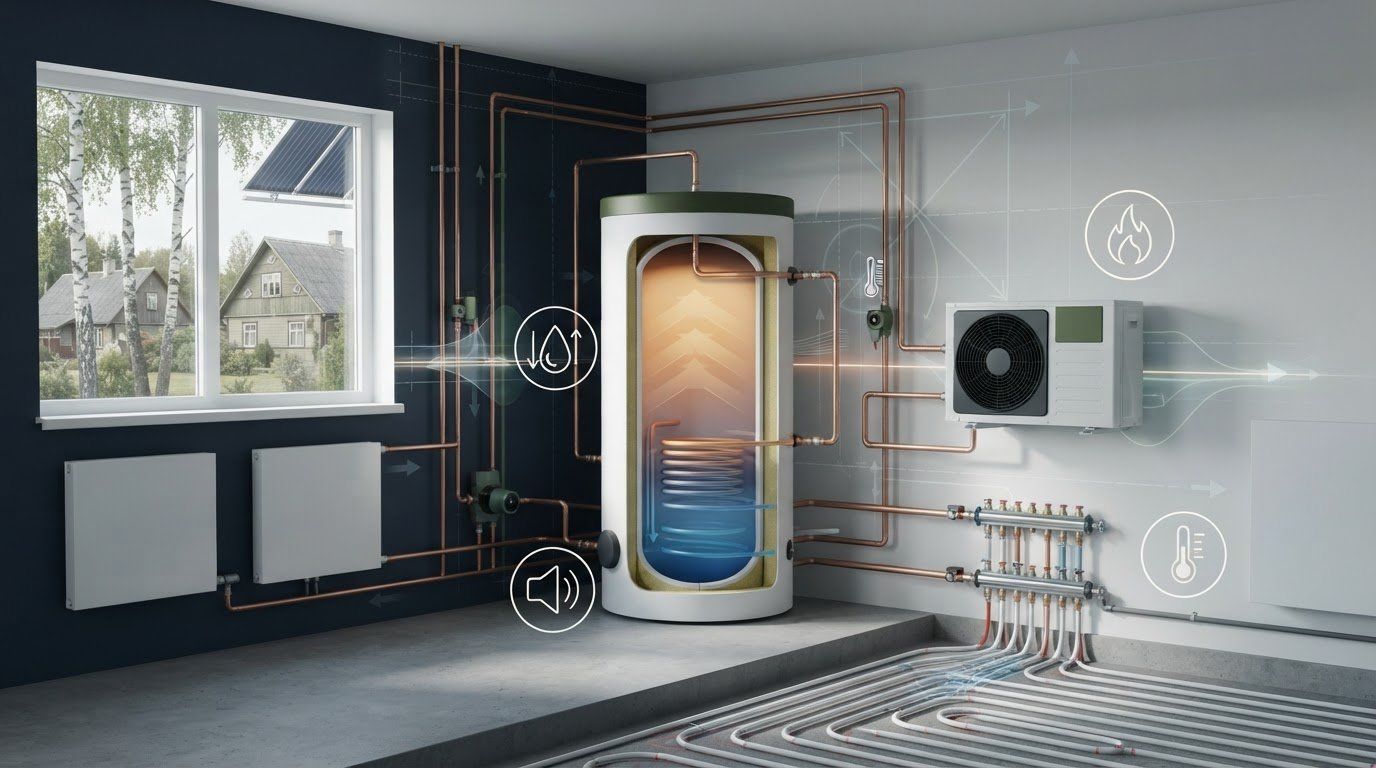
A universal rule of litres can lead to a wrong choice: one heating system will have a tank small, another unnecessarily large. Therefore, calculation of the volume of the storage tank starts not with a catalogue number, but with a specific question: how is the system producing, storing and consuming heat?
A simple formula is useful for initial assessment, but it is not enough to select the tank. A distinction must be made between the storage tank and the hot water storage tank, you must know the operating conditions of the heat source and understand how the heating circuits are connected. In this article we will look at the data required, calculate steps and situations in which the formula result must be checked against the requirements of the whole system.
The choice is based on the task of the tank. In the solid fuel boiler system it can accumulate heat produced during heating, while in the heat pump system the role of the tank can be related to water volume, heat storage or hydraulic separation. These differences determine what data is to be used and what the result actually means.
Calculation of the capacity of the storage tank: what does the tank do in the heating system?
The battery tank stores the heat transferor and the heat it contains, which can then be used for heating. Its purpose and volume depend on the heat source, heating circuits and the principle of system operation. Therefore, the choice cannot be based on the building's area or the universal number of litres per kilowatt.
Balance is important. Too small a tank may not provide the function required for the system, but unnecessarily large takes up more space and is not automatically more efficient. Thermal energy storage describes the basic principles of heat storage, but the design of the whole heating system determines the solution.
How does the storage tank work with the heat pump?
In a heat pump system, the tank can increase the amount of the heat transfer in the system, store heat or serve as a hydraulic separator. Depending on the design of the system, it can help to ensure the heat pump has an appropriate operating cycle and energy for defrosting. The tank is not mandatory for each heat pump system: the conditions of operation, control and connection of the heating circuits are required. CTC air-water heat pumps, tank solution must be considered together with the rest of the heating system.
The battery tank and hot water tank are not the same
The heat transferor in the battery tank circulates in the heating circuit and transfers heat to radiators or floor heating. Boiler or hot water tank prepares domestic water for washing and other everyday needs. As the tanks have different tasks, their volume is calculated according to different criteria: the heating tank must meet the operation of the heat source and heating, while the boiler must meet the consumption of hot water.
What data are required to calculate the volume of the storage tank?
The initial assessment requires three values: the heat capacity used for the calculation, the time at which the tank must provide this heat and the permissible temperature difference of the heat carrier. The calculation of the volume of the storage tank will only be meaningful if this data is appropriate to the vessel's task and system operation.
- Q is the heat output in kilowatts used for the calculation, determined by system requirements, rather than automatically being equal to the rated power of the installation.
- t is the time during the hours during which the heat is expected to be stored or provided.
- ΔT is the permissible temperature difference in Kelvin. The water has the same numerical temperature difference in Kelvin and Celsius degrees.
The input data is sought for a heating project, calculation of heat loss of a building, technical documentation of the heat pump and system settings. Check that the specified power refers to the entire heating need or specific operating scenario and whether the temperature difference is achievable within the system. If the parameter is not specified, it is not replaced by a guess. First, tell what task the tank is intended for.
How to use the formula and understand its units?
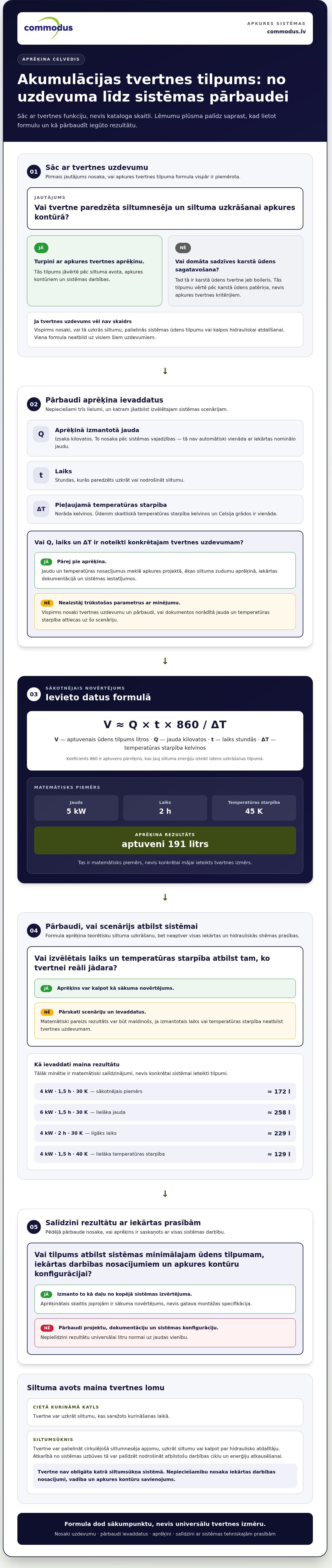
A formula may be used for the initial assessment V ≈ Q × t × 860 / ΔTIt V is the approximate volume of water in litres, Q is the power in kilowatts t is the time in hours, but ΔT is the temperature difference in Kelvin. The 860 ratio is an approximate conversion that allows the heat energy to be expressed in the volume of water storage.
For example, if the calculation takes Q = 5 kW, t = 2 hours and ΔT = 45 K, the formula gives about 191 litres. This is a mathematical example, not the recommended tank size for a particular house. The result changes with input data and calculation target.
Why does the formula alone not give final choice of tank?
The formula evaluates theoretical heat storage, but does not reflect all the requirements of the equipment and hydraulic circuit. The minimum volume of water and operating conditions of the installation may be essential for the heat pump. Therefore, the resulting figure should be compared to the design and technical requirements, rather than replaced by a universal litre rate per unit of power. air-water heat pump solution, the volume of the tank is determined together with the rest of the system configuration.
Calculate the tank volume step by step and check the result
Before calculating what you want to check directly: storage of heat for a given time or system, these are not the same tasks, so the answer determines what input data to use.
- Identify the system parameters. The capacity, temperature conditions and technical requirements of the system specified in the design and equipment documentation shall be maintained.
- Set the scenario. Choose operating hours and the permitted temperature difference in Kelvins. Both values must match the real task of the system.
- Insert data into the formula. Calculation V ≈ Q × t × 860 / ΔT. The result is an approximate volume in litres.
- Check the value obtained. Compare this with the minimum water volume and equipment operating requirements of the system. Do not consider the result to be the result of the complete assembly specification.
A hypothetical example: how input data changes result
Let's say that the power is 4 kW, the operating time is 1.5 hours, but the temperature difference 30 K. Formula gives about 172 litres. If the other values do not change and the power is 6 kW, the result increases to 258 litres. If the initial example of the time is 2 hours, it gives approximately 229 litres. However, increasing the temperature difference to 40 K, the result decreases to approximately 129 litres. These are mathematical comparisons, not recommendations for a particular system.
The test is particularly careful if the power or temperature data are not known or differ in design and equipment documentation. Also, the mathematically correct result may be misleading if the chosen time or temperature difference does not correspond to the vessel's task. A frequent error is to insert the nominal capacity of the plant into the formula without checking whether it corresponds to the particular calculation scenario.
In brief: The resulting volume is compared to the technical requirements of the installation and the system. In the case of heat pumps, the layout and management of heating circuits is also assessed, because the tank volume is only one part of the total solution.
Adjust the volume of the storage tank for the heat pump system
The same calculation does not mean the same solution for all houses. The type of heat pump, the number of heating circuits and their management scheme affect the flow of water and the required volume of the tank. Therefore, compare the calculated result with the specific equipment documentation and the design conditions of the heating system. The formula gives the starting point, not the ready installation specification.
How does the type of heat pump affect the evaluation?
Air-water heat pump transfers heat to the water heating circuit, therefore the role of the tank should be assessed together with the design of the contours and the control of the equipment. In another heat pump system, the heat transfer and operating conditions may vary, so one volume recommendation cannot be automatically applied to all equipment. More about the interaction of the equipment and heating system for salmon Air-to-water heat pump guide. When assessing CTC air-water heat pumps, the result of the calculation shall be compared with the documentation of the relevant system.
When to pass the initial calculation to the design?
Design assessment is useful if input data are missing, the parameters indicated in the documents are different or there are several heating circuits in the system. Under these circumstances, erroneous assumptions can create a numerically accurate volume that is not suitable for system needs. Commodus provides advice, design and installation of heating systems, so the tank solution can be assessed together with the system in question rather than selecting only according to one formula.
You can get acquainted with heating system solutions and design Commodus.
Choose a solution that works with heating
Before making a decision, place a heating scheme, equipment documentation and available system data. Check that the power used, operating time and temperature difference in the calculation corresponds to the tank task. This will help to determine what needs to be assessed and how the tank fits into the domestic heating system.
The volume of the storage tank must be determined together with the configuration of the heating equipment and circuits. Contact Commodus to discuss heating system solution and design.
Frequently Asked Questions
Is the storage tank required for each heat pump?
No, it depends on the design of the system and the operating conditions of the heat pump. First, the requirements for system water volume and operating cycles specified in the installation or design documentation are checked. If the system has several heating circuits or control settings changed, the tank needs shall be assessed together with the entire scheme.
How to calculate the volume of the storage tank in litres?
The initial volume in litres can be calculated by the formula described in the article, by inserting the parameters of the system in question. Then, the tank is not selected only because its nominal volume coincides with the result of the calculation. Compare it with the requirements of the equipment and the system performance envisaged by the project. The calculation gives a guide, but does not itself determine the solution for assembly.
What is the difference between the storage tank and the boiler?
The battery tank is connected to the heating circuit, but the boiler is designed for domestic hot water preparation. The difference is determined by the name of the tank and the connections to the heating circuit, not just by the external appearance. If the project does not clearly specify the tank function, the scheme review will help to avoid incorrect connection or ordering.
What happens if the storage tank is too large?
Too large a tank takes more space and can increase the cost of the installation and installation solution. Its size and location can also be limited by the layout of the room. Before choosing compare the calculated need with the available space and system technical conditions. The larger volume is not automatically better if it does not solve a specific heating system need.
What data are needed to calculate the volume of the storage tank?
The parameters, heat pump model, heating scheme and control settings specified in the project shall be prepared. Record whether the system contains radiators, warm floors or several separate circuits. This information helps to check whether the chosen calculation scenario is compatible with the real system. If documents are incomplete, it does not replace the missing parameters with assumptions.
Comments