Ground Source Heat Pump: Honest Reviews and Experience in Latvia in 2026
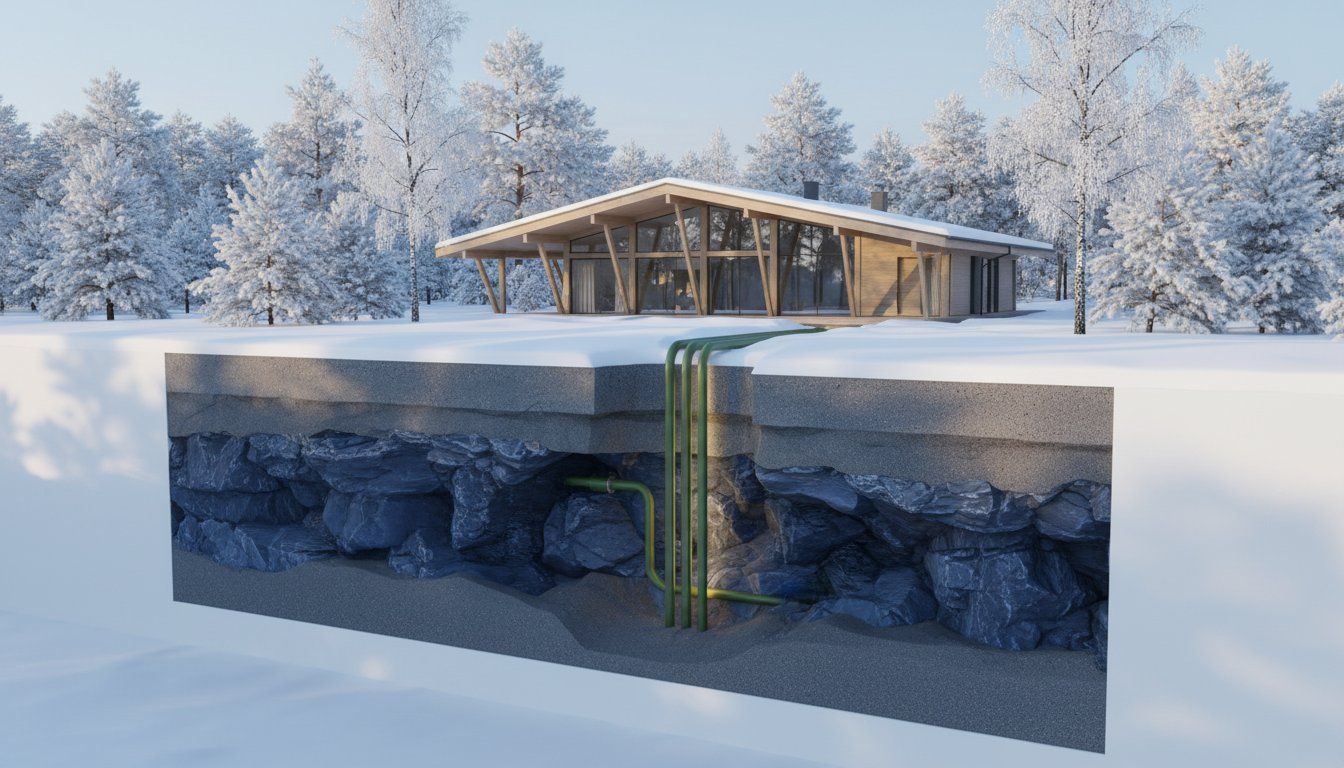
Is a ground source heat pump truly an "eternal engine" that pays for itself even at a harsh -25 degrees of frost, or is this merely a myth that justifies an expensive installation? We understand that many of you are troubled by well-founded concerns about an upturned garden or enormous initial costs when researching ground source heat pump reviews online. It is entirely logical to want one hundred percent certainty before investing in a system that must provide warmth for your family for the next 25 years without unnecessary surprises.
In this article we will tackle this challenge together and reveal an honest truth based on 2026 data and the real-life experience of Latvian households. You will find out why precise geological investigation, rather than just the brand of the unit, determines the size of your monthly bill. We will look at specific efficiency indicators and dispel myths about power losses on the coldest winter nights, so that you can make a considered decision about your home's comfort and long-term peace of mind.
Key Takeaways
- Find out what the real COP coefficient is during a Latvian winter and why objective ground source heat pump reviews help avoid overpaying for electricity.
- Identify the most important differences between a horizontal collector and a vertical borehole to choose the most suitable solution for your garden area and geology.
- Compare operating costs at -20°C and understand whether a larger initial investment truly pays off over the next 10 years.
- Obtain clear calculations for electricity consumption for 150m2 and 250m2 homes, as well as practical steps for receiving Altum and EKII state support in 2026.
- Discover why professional design and regular maintenance are the only way to guarantee system longevity and peace of mind in your home.
Ground Source Heat Pump: Reviews and Real Experience in Latvia's Climate
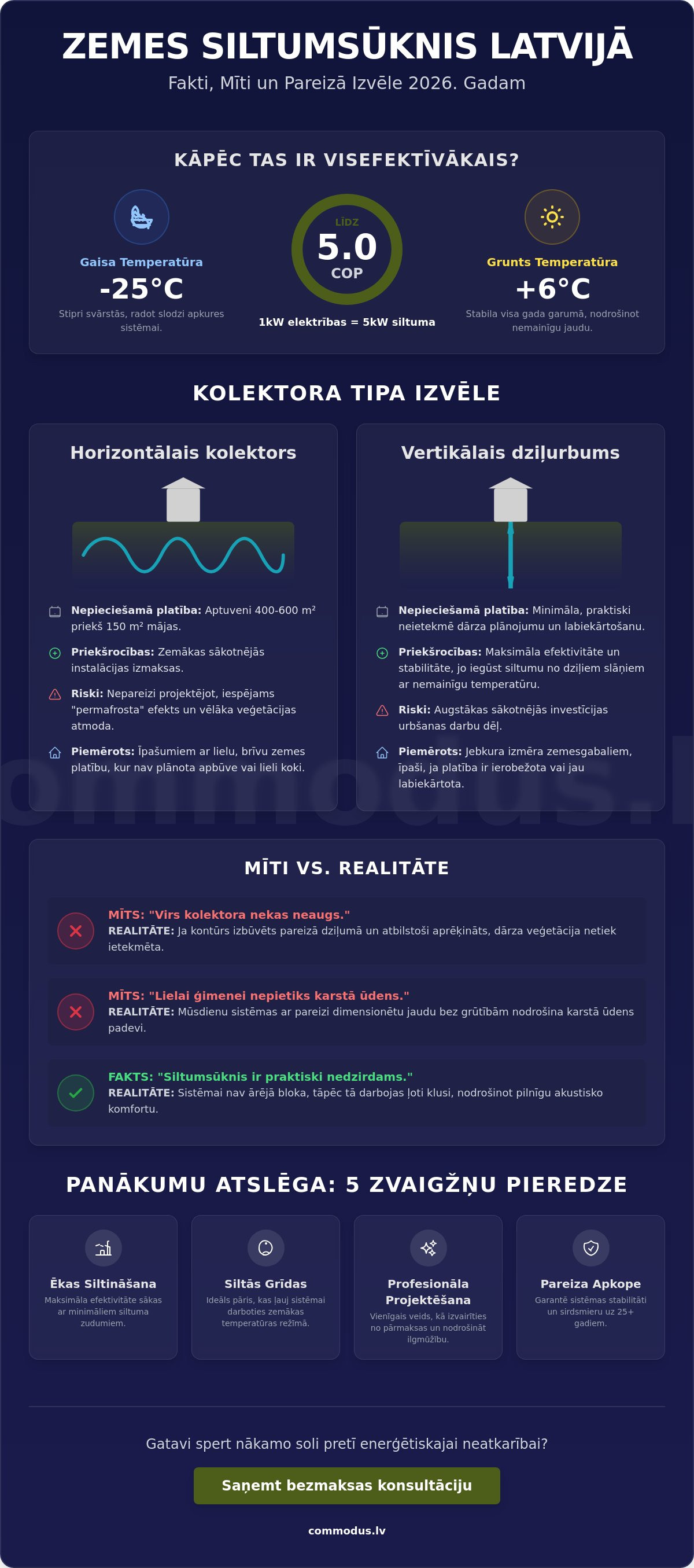
A ground source heat pump in Latvia is no longer an exotic novelty but a solid choice for those who plan their future in the long term. The main reason why this system remains the efficiency leader lies in the stability of the earth's depths. While air temperatures in January nights can drop to -25 degrees here, the ground at two metres depth maintains a constant +4 to +6 degrees. This allows the unit to operate in a steady mode without sharp power fluctuations, confirmed by many positive ground source heat pump reviews from our clients who have been using the system for more than ten years.
The real coefficient of performance or COP in Latvian winter conditions usually ranges from 4.5 to 5.0. In practice this means that for every kilowatt-hour of electricity consumed, you receive five kilowatts of heat. Compared to other heating systems, this is a figure that no other solution can achieve at extremely low outdoor temperatures. Furthermore, users particularly highlight acoustic comfort. Since the entire system is located indoors and has no outdoor unit with fans, your garden will enjoy complete silence, and your neighbours will not even suspect that your home is being heated with the most modern technology.
Myths vs. Reality: What Do Forums Say?
In the public domain one often reads ground source heat pump reviews expressing concerns about a "dying garden" or permafrost zones above the horizontal loop. Our experience shows that these are myths arising from poor design. If the loop is installed at the correct depth and calculated according to the building's heat losses, grass and ornamental plants wake up in spring at exactly the same time as the neighbours'. Likewise, modern units have no difficulty providing hot water even for a large family of five, as the energy reserve in the ground is practically inexhaustible, provided the system is balanced.
Key Factors That Influence a Positive Experience
For a ground source heat pump to work with maximum efficiency, we always encourage clients to first pay attention to the building's envelope. There is no point in "heating space" if the attic is not insulated or the windows are draughty. The second important aspect is the choice of heating surfaces. Underfloor heating is the ideal partner for a ground source heat pump, as it requires a lower flow temperature (around 35°C), which allows the compressor to operate in a more gentle and economical mode. Smart control is no less important, allowing you to remotely monitor system operation and optimise consumption according to your daily rhythm, ensuring maximum comfort without unnecessary concerns.
Why Do Reviews Differ? The Influence of Design and Borehole
Reading various ground source heat pump reviews in public forums or social networks can cause justified confusion. One user praises the system for incredibly low bills and complete carefree operation, while another complains about unexpectedly high electricity consumption and cold floors in the middle of January. The answer to this contradiction is almost never to be found in the heat pump unit itself or its brand. The key word is design quality and what is actually happening beneath your home's foundations. An incorrectly calculated loop length or insufficient borehole depth are the direct reasons why even the most expensive unit can operate inefficiently.
Unfortunately, "cheap" offers still appear on the market where savings are achieved at the expense of the geothermal loop. If the loop is too short, the ground around it is excessively cooled or "frozen". As a result, the heat pump has to expend much more energy to extract the necessary heat from frozen soil, and the COP figure drops rapidly. Geological investigation is a critical stage, because your neighbour's positive experience may not apply to your plot. Clay conducts and accumulates heat excellently, while dry sand acts as an insulator, so the same house floor area in sandy soil will require a considerably longer loop.
Horizontal Collector: When is it the Best Solution?
A horizontal collector is a popular choice for owners of large plots where there are no restrictions on garden area. Usually a standard 150 m2 house requires approximately 400 to 600 square metres of free land where no construction or large tree planting is planned. The main risk here is the so-called "permafrost" effect. If the pipes are placed too close together or at insufficient depth, the garden in spring may resemble tundra, with grass starting to turn green 10 to 14 days later than in the surrounding area. A correctly calculated and professionally built horizontal loop is more cost-effective in terms of initial investment, delivering excellent results without damaging the garden in the long term.
Borehole: Maximum Efficiency in a Limited Area
A vertical borehole is the "gold standard" in terms of stability and efficiency. Already at 50 to 100 metres depth, the ground temperature is consistently high throughout the year, regardless of whether there is a thaw or bitter frost at the surface. Such a system provides excellent regeneration capacity, which is the key to system longevity that often exceeds 25 and even 30 years. Although drilling requires approval from the State Environmental Service and requires a larger initial investment, the long-term benefit is predictable bills and a fully preserved garden landscape. If you are unsure which solution is most appropriate for your situation, we would be glad to help with a professional consultation and precise output calculations.
Ground Source vs. Air-to-Water Heat Pump: What Do Users Say?
The choice between a ground source and an air heat pump is one of the most frequent questions we hear in our office. Many initially lean towards an air-to-water system due to lower installation costs, but long-term ground source heat pump reviews often prompt reconsideration. The main difference lies in the return on investment and the unit's service life. While the average service life of an air-to-water unit is 12 to 15 years, a ground source heat pump is an investment that will reliably heat your home for 25 years and longer. This is possible because the main unit is located indoors, protected from rain, snow and the corrosion caused by outdoor conditions.
At extreme temperatures, when the thermometer drops below -20 degrees, the advantages of a ground source heat pump become obvious. Air-to-water systems at such times often activate built-in electric heating elements or "heaters", which substantially increase the electricity bill. A ground source heat pump continues to operate in its optimal mode, as the earth still supplies it with constant energy. Furthermore, the visual aspect is not unimportant. With a ground source heat pump, your home's facade remains clean, without humming boxes and fans that can disturb both your own and your neighbours' peace on quiet evenings.
Efficiency (COP) Comparison in a Latvian Winter
The efficiency or COP rating of a ground source heat pump in Latvia remains stable in the range of 4.5 to 5.0 throughout the entire season. For air-to-water systems, this figure at -15 degrees can drop to 2.0 or even lower. Our observations at sites show that in December and January ground systems consume 30% to 40% less electricity than air heat pumps of equivalent output. This means a smaller load on your home's electrical network precisely at the moment when it is most heavily loaded.
Maintenance and Service Reviews
Users who have chosen a ground source heat pump most frequently highlight the "install and forget" principle. Air-to-water units require regular cleaning of the outdoor unit from leaves, snow or ice, which can cause mechanical damage. Ground system maintenance usually amounts to a filter check once a year, which you can entrust to our specialists. We believe that reliable heating is a joint effort in which we take care of the technical side so that you can enjoy cosiness without unnecessary concerns. A ground source heat pump is a quiet, invisible and extremely reliable partner in your comfort.
Operating Costs and State Support in 2026
When it comes to heating, figures on paper are often more eloquent than any advertisement. Many of our clients researching ground source heat pump reviews are most interested in the monthly electricity bills after system installation. 2026 data shows that for an energy-efficient 150 m2 home, average consumption in the coldest winter months ranges from 350 to 480 kWh. For larger homes of around 250 m2, this figure usually does not exceed 750 kWh per month. These figures include not only room heating but also hot water preparation for the entire family, which makes a ground source heat pump an unrivalled leader in terms of operating costs.
Long-term return on investment or ROI is another important factor. Although initial investment is higher than for air heat pumps, a ground system begins to "earn" approximately in the seventh to ninth year of operation. Given that the system's service life exceeds 25 years, for most of this time you will be enjoying almost free warmth provided by the earth's depths. This is a safety cushion against changing energy prices in the future, providing stability in your family's budget for decades.
State Support Programmes and Conditions
In 2026, state support for environmentally friendly heating systems has become even more accessible, but the requirements for unit efficiency have increased. The EKII (Emission Allowance Auction Instrument) and Altum programmes prioritise ground source heat pumps due to their high COP rating. The main condition is engaging a certified installer and precise project documentation. The most common mistake made by informal installers is indicating incorrect outputs in the application, which can lead to rejection. We, the Commodus team, take on all the bureaucratic legwork on your behalf, preparing applications so that you receive the maximum possible co-financing.
Heat Pump and Solar Panels: The Ideal Pair
Many users in their reviews emphasise that precisely the combination with solar panels has allowed them to achieve a "zero bill" effect. Thanks to the NET metering system, electricity generated in summer covers heat pump operation in winter months. This is particularly noticeable in spring and autumn, when there is already plenty of sun but heating is still needed. Real examples from our practice show that such energy independence is completely achievable in Latvian conditions. If you want to precisely calculate how quickly such a system will pay off for your home, use our heating calculator, which will help you make a data-driven decision.
How to Ensure a 5-Star Experience With Commodus?
When choosing a heating system, you are not purchasing just an iron box but peace of mind for the next two decades. Positive ground source heat pump reviews are not coincidental; they are the result of precise work that begins long before the first borehole in your garden. We at the Commodus team believe that every client is a partner with whom we together pursue this energy efficiency challenge. This means that we do not simply install a unit, but take full responsibility for ensuring your home is warm even when bitter Latvian frost prevails outside.
Our approach is based on more than 15 years of accumulated experience and hundreds of completed projects throughout Latvia. We carefully select units from the world's leading manufacturers based on their performance in real local conditions, not just the promises of advertising brochures. This selection guarantees that your chosen ground source heat pump will operate impeccably, delivering the promised efficiency and indoor silence. After installation we do not disappear; our warranty and post-warranty service is your safety guarantee that any technical question will be resolved promptly.
Our Engineering Team and Experience
Why is a correct output calculation so critical? Our practice shows that even a 10% error in heat loss calculations can cause a 15% to 20% increase in electricity consumption in the long term. Commodus engineers do not rely on guesswork but carry out an in-depth analysis of each site. We take into account:
- The thermal performance of the building's envelope;
- The geological characteristics of the specific plot and groundwater level;
- Your family's daily hot water consumption habits.
The work of certified installation technicians is the next stage that ensures the system is perfectly balanced. We do not try to offer the cheapest price at the expense of quality, but we guarantee the best value for your investment. A poorly designed system ends up being the most expensive, which is why we choose to do it right the first time.
Begin Your Journey to an Energy-Efficient Home
We understand that the decision to install a ground source heat pump is a significant step. That is why we offer a free consultation and site inspection to assess in person the best solution for your specific situation. Our specialists will prepare an individual offer with precise payback calculations so that you can clearly see why this investment is the wisest choice for your family's future and peace of mind.
Apply for a consultation and receive a precise calculation for your home!
Choose Warmth That Does Not Disappoint for Decades
A ground source heat pump is not just a heating unit; it is the foundation of your home's energy independence. As we have established, real ground source heat pump reviews confirm that correct design and a quality borehole provide a stable COP rating of around 5.0 even at -25 degrees of frost. Investment in such a system pays off not only in lower bills but also in peace of mind, knowing that your home is safe for the next 25 years and longer.
We, the Commodus team, with our more than 15 years of experience in the Latvian market, are ready to be your trusted partner in this process. Our certified specialists provide a full service cycle, from precise output calculation to assistance with EKII or Altum state support documentation. We believe that working together is the only way to achieve an excellent result in each individual project.
Receive an individual ground source heat pump offer and calculation here!
Start enjoying cosiness and financial stability already this heating season. We are here to help you make a far-sighted decision that will serve your family for generations. Your comfort is our priority.
Frequently Asked Questions About Ground Source Heat Pumps
Can a Ground Source Heat Pump Provide Heating at -30 Degrees?
Yes, a ground source heat pump fully provides warmth even at -30 degrees of frost, as its energy source is the ground, not the air. At two metres depth, the temperature in Latvia remains consistently positive, usually from +4 to +6 degrees, so the unit operates in a stable mode regardless of surface weather conditions. This guarantees that your home will be warm even on the coldest January nights without connecting additional heating elements.
How Much Garden Area Does a Horizontal Collector Occupy?
For a standard 150 m2 private home, a horizontal collector occupies approximately 400 to 600 square metres of free garden area. The precise area depends directly on soil composition; wet clay requires fewer pipes than dry sand, as clay has better thermal conductivity. It is important to remember that no construction or planting of trees with deep roots can be planned above the collector.
Is a Building Permit Required for Ground Source Heat Pump Installation?
Yes, for creating vertical boreholes an approved project and permit from the State Environmental Service are required, as well as from the local building authority. For building a horizontal loop, a simplified engineering network connection diagram appended to the building documentation usually suffices. Our specialists help manage all the necessary bureaucratic aspects to make the process as simple and understandable as possible.
What is the Service Life of a Ground Source Heat Pump?
The average service life of a ground source heat pump exceeds 25 years, which is 10 years more than air heat pumps. The main reason for this longevity is the system's location; the compressor and all important components are located indoors, protected from corrosion, rain and sharp temperature fluctuations. A correctly installed geothermal loop in the ground can serve for even 50 years and longer.
Can a Ground Source Heat Pump Also Cool Rooms in Summer?
Yes, this system offers an excellent cooling function called passive cooling. It is extremely cheap as it uses the cool ground temperature to cool rooms without operating the heat pump's compressor. In this mode only the circulation pump consumes energy, providing a pleasant microclimate in the home even on the hottest July days without the noise of an air conditioner.
What Are the Average Annual Ground Source Heat Pump Maintenance Costs?
Annual maintenance costs are comparatively low, as the system has no outdoor units that need cleaning from dust or leaves. Real ground source heat pump reviews indicate that most users are limited to a filter check and system pressure control once a year. We recommend carrying out a preventive inspection before the start of each heating season to verify the correct operation of all components.
Can I Install a Ground Source Heat Pump if My Plot Has a High Groundwater Table?
A high groundwater table is not an obstacle but a significant advantage for system efficiency. Water conducts heat considerably better than air or dry soil, so in such conditions the heat pump operates with a higher COP rating. In such locations we can often build a somewhat shorter horizontal loop, as energy exchange with the ground occurs much more intensively and efficiently.
Why Choose a Ground Source Heat Pump if an Air-to-Water System is Cheaper?
Choosing a ground source heat pump is a decision for the lowest operating costs in the long term. Although an air-to-water system is cheaper at the time of installation, a ground source heat pump consumes 30% to 40% less electricity precisely in the coldest months. Taking into account the unit's 25-year service life, the total savings on bills and less frequent equipment replacement fully justify the larger initial investment.
Comments