Heat Pump Capacity Calculation: How to Determine the Correct Capacity for Your Home in 2026
Do you really want to risk your family's comfort when the thermometer outside drops to -25°C in the middle of a Latvian winter? Most homeowners understandably worry that the selected unit may not heat the rooms sufficiently during severe frost or, conversely, may lead to unexpectedly high electricity consumption. This is precisely why an accurate heat pump capacity calculation is the single most important step when planning an efficient heating system in 2026. We understand that technical terminology and complex formulas can seem intimidating, so we are ready to “pull together” with you and make the process simple and transparent.
We agree that every home is unique and that there is no universal solution, which is why the correct approach requires attention to detail. After reading this article, you will have a clear action plan and understand exactly which factors, from the total window area to wall insulation, affect the final choice. We will review a practical formula for determining capacity and provide advice that will help ensure maximum efficiency and lower bills over the long term. You will learn everything needed to select a unit that operates reliably and provides peace of mind in any weather.
Key takeaways
- Learn why “more is not better” and how selecting the correct capacity protects the unit from premature wear and unnecessary electricity consumption.
- An accurate heat pump capacity calculation is based on Latvia's climate zones and takes account of outdoor temperature variations from -19°C to as low as -23°C.
- Understand how the type of heating system and the building envelope affect heat loss so that you can choose the most suitable solution for your home.
- Learn practical steps for gathering data, using previous years' fuel consumption as the most reliable method of determining capacity for existing buildings.
- Discover why “pulling together” with Commodus engineers is more beneficial, providing a professional site survey and an individually tailored design.
Why is the correct heat pump capacity calculation critical to your comfort?
A heat pump is a long-term investment with an average service life of 15 to 20 years. Therefore, an accurate heat pump capacity calculation is not merely a technical formality, but the basis for keeping your home warm even at -20°C without overpaying for electricity. What is a heat pump? In essence, it is a smart device that transfers thermal energy from the external environment into the building, and its efficiency depends directly on how accurately its output matches the building's heat loss at the lowest design temperature.
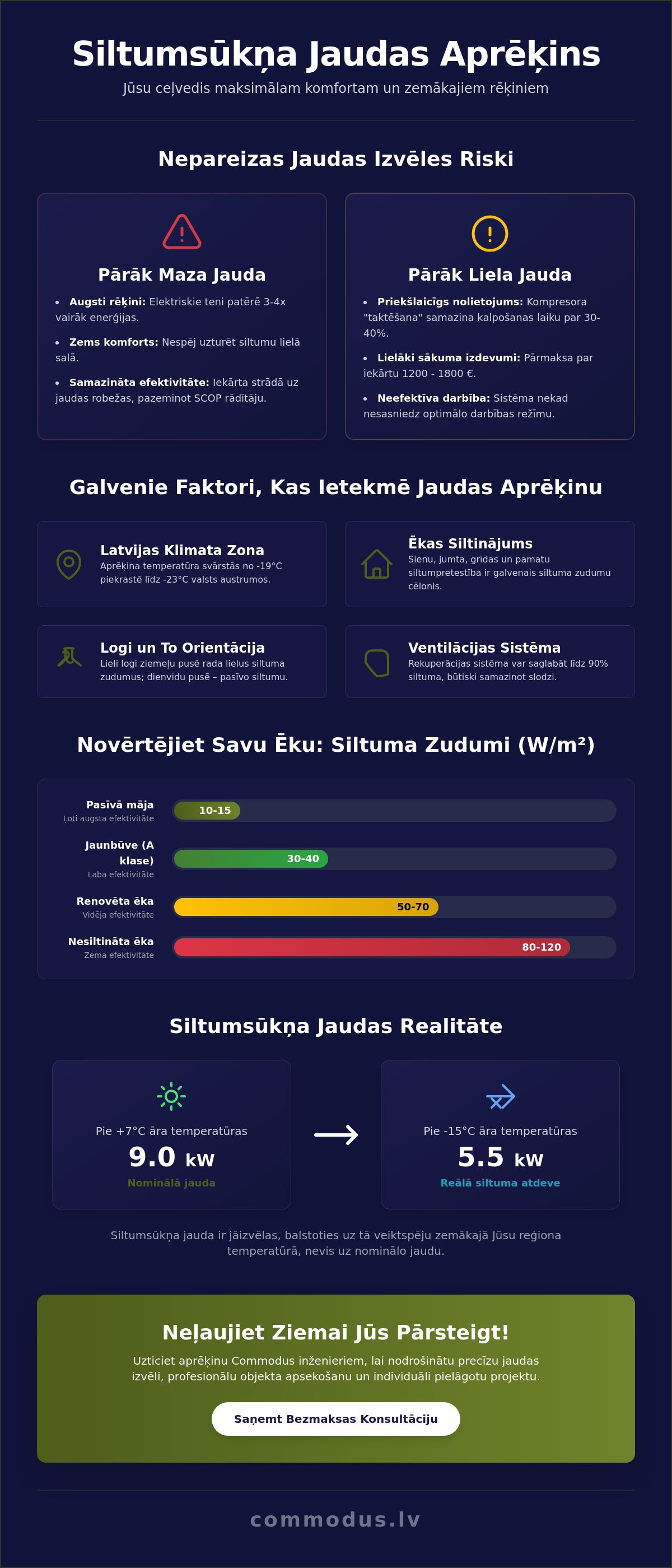
A common mistake is to assume that “more is better”. In reality, an oversized unit causes what is known as short cycling. This means that the compressor switches on and off every few minutes because the amount of heat produced is too great for the heating system. Such operation accelerates wear of mechanical components by 30% to 40% and significantly shortens the unit's service life. At the other extreme is insufficient capacity. If the unit is undersized, the electric heating elements are activated as soon as serious sub-zero temperatures arrive. They consume three to four times more energy than the heat pump itself, turning your expected savings into unexpectedly high bills.
Too little or too much capacity: the main risks
Incorrect capacity selection directly affects the system's seasonal coefficient of performance (SCOP). If the unit operates in an unsuitable mode, its average efficiency may fall from 4.5 to 3.2. This means that you pay more for every kilowatt-hour used for heating. At Commodus, we often encounter situations where a customer wants to buy a 12 kW unit for a house that requires only 8 kW. The unnecessary additional cost of the unit may reach EUR 1,200 to EUR 1,800 and will never pay for itself because the system will operate inefficiently and wear out more quickly.
Heat loss versus heating capacity – what is the difference?
A building's heat loss is the amount of energy that “escapes” through walls, windows, the roof and ventilation. In Latvia's climate, calculations in Riga are generally carried out at -20.7°C in accordance with LBN 003-19. It is important to understand that heat pump output is not constant. For example, an air-to-water heat pump with a nominal output of 9 kW at an outdoor temperature of +7°C may appear very powerful, but at -15°C its actual heating output may fall to 5.5 kW. Therefore, the heat pump capacity calculation must begin with an accurate determination of the building's heat loss rather than relying only on the nominal output stated by the manufacturer on the packaging. Maximum comfort and the lowest operating costs can be achieved only by matching the building's requirements to the unit's performance at low temperatures.
Factors affecting heat demand in Latvia's climate
Choosing a heat pump is not merely a technical purchase; it is a long-term investment in the comfort and peace of your home. For this investment to pay off, the first step is to understand how much energy your home actually consumes. Latvia's climate is unpredictable, and it directly affects the heat pump capacity calculation in each individual case. Design temperatures in Latvia differ by region. On the Kurzeme coast, for example in Liepāja, the design temperature is -19°C, whereas in the Alūksne or Rēzekne areas it is necessary to allow for harsher temperatures of -23°C. These few degrees significantly change the required unit capacity needed to keep you warm even on the coldest January night.
The building's “coat”, or envelope, is the main element that keeps heat inside. The thermal resistance of the walls, roof and foundations determines how quickly the house cools. Windows must also be considered. Large areas of glazing facing south act as a source of passive energy and naturally warm the rooms on sunny days. By contrast, north-facing windows are where heat is lost most quickly. Ventilation must not be forgotten either. Natural ventilation often means that expensively heated air escapes through the chimney, whereas a modern heat-recovery ventilation system can retain up to 90% of the heat, significantly reducing the load on the heating system.
Building energy-efficiency classes and W/m² values
A home's heat loss is most conveniently measured in watts per square metre (W/m²). In new buildings aiming for the passive-house standard, heat loss is minimal, at approximately 10–15 W/m². In older, uninsulated houses built 30 years ago, this figure may reach 80–120 W/m². The official energy-efficiency calculation method helps determine the building's class accurately, which forms the basis for selecting the correct unit. If you are planning insulation work, complete it before installing the heat pump, as this will allow you to choose a smaller and less expensive unit.
Outdoor air temperature and the bivalent point
The bivalent point is the outdoor temperature at which the heat pump can no longer cover all heat loss on its own and the built-in electric heater begins to assist it. Under Latvian conditions, the optimum bivalent point generally ranges from -7°C to -12°C. This is a sensible balance. It is not economically justified to purchase a very expensive and powerful heat pump solely for the few days each year when the temperature falls below -20°C. It is better to allow the electric heater to provide limited assistance during rare cold spells while retaining lower overall investment costs and optimum unit operation during the rest of the year.
Every home is unique, so an accurate heat pump capacity calculation requires attention to detail. If you want to be certain that the selected system will still be efficient in ten years, our specialists will help you identify the best solution. Learn more about the heat pump solutions we offer and consult experienced professionals who are genuinely committed to this work.
Type of heating system and domestic hot-water consumption
A heat pump is not simply a device that can be connected to any pipe in the hope of achieving maximum efficiency. It is a sophisticated mechanism whose coefficient of performance, or COP, depends directly on the temperature difference between the heat source and the heat-transfer medium. When carrying out an accurate heat pump capacity calculation at Commodus, we always begin with the question: how do you plan to distribute this heat throughout the rooms?
If your home has radiators, the unit will need to heat the water to as much as 55°C or more to maintain comfort on the coldest January nights. Underfloor heating, by contrast, operates at a low temperature, usually around 35°C. This 20-degree difference is not merely a figure on paper. Each additional degree of temperature reduces the system's overall efficiency by approximately 2% to 3%. Consequently, a house with radiators will require a more powerful heat pump to compensate for the loss of efficiency at higher temperatures.
Underfloor heating versus radiators: temperature regimes
Low-temperature systems are a heat pump's best friend. If you are planning to replace a wood-burning boiler with a modern solution, the existing radiator system must be carefully reassessed. Standard radiators are often too small to heat a room at low water temperatures, so it may be necessary either to install larger radiators or select a more powerful unit. In combined systems, with underfloor heating on the ground floor and radiators upstairs, we use balancing assemblies so that the heat pump capacity calculation accurately covers the requirements of both circuits without unnecessary energy consumption.
Domestic hot-water production: how many additional kW are required?
Space heating is only one part of the equation. Domestic hot water is the second-largest energy consumer, particularly in 2026 as household comfort requirements continue to increase. Standard practice is to add 0.25 kW to 0.5 kW of capacity for each permanent resident. For a family of four, this means an additional 1 kW to 2 kW in the unit's total capacity. It is important to choose a hot-water cylinder with a sufficiently large heat-exchanger surface area, at least 2.5 square metres, so that the heat pump can transfer the generated energy to the water efficiently rather than wasting time on unnecessary start-up cycles.
To ensure stable system operation and avoid short cycling, meaning excessively frequent switching on and off, we recommend installing a buffer tank. It acts as an energy reserve that helps the system “pull steadily”, particularly during thaws or when domestic hot-water consumption changes rapidly. The buffer tank stabilises the flow and extends compressor life, providing significant long-term benefits for both your peace of mind and your budget.
- Radiators: Require a 20% to 30% greater capacity reserve because of the reduction in efficiency.
- Underfloor heating: Allows a lower-capacity unit to be selected because of the higher COP.
- Domestic hot water: Priority settings must be provided so that the home does not cool while the water is being heated.
- Buffer tank: Essential for system durability where several heating circuits are used.
Ultimately, an accurate heat pump capacity calculation is a collaborative process between the engineer and the homeowner. We do not simply install equipment; together with you, we seek the optimum balance between the initial investment and monthly bills so that every euro invested delivers maximum warmth and comfort.
How to calculate heat pump capacity: practical steps and formulas
For an accurate heat pump capacity calculation you must begin by gathering the home's technical data. You will need the exact heated floor area, ceiling height and information about the insulation layers in the walls, floors and loft. In our daily work, the Commodus team sees that inaccurate information about building structures is the most common reason for selecting the wrong unit. The more precisely you know the thickness of the insulation in the building envelope, the easier it will be to determine the actual heat-loss level.
A simplified formula for a quick estimate
This method is useful for initial discussions with specialists and preliminary planning. The formula is: P = (V × ΔT × K) / 860. Here, V is the building's total volume in cubic metres; ΔT is the difference between the outdoor temperature and the desired indoor temperature, usually calculated in Latvia from -20°C to +20°C; and K is the heat-loss coefficient, ranging from 0.6 for new buildings to 2.5 for uninsulated masonry buildings.
Consider a 150 m² house with a ceiling height of 2.7 metres. A new, energy-efficient building with good insulation (K = 0.7) will require approximately 6.5 kW of capacity. An older house of the same size with average insulation (K = 1.5), by contrast, will require a 14 kW unit. Remember that this formula is only a starting point. It does not take account of the window area or the characteristics of the ventilation system, so a final decision should be made only after an engineer has inspected the property.
Calculation based on existing fuel consumption
If you are planning to replace an old heating system, your previous consumption is the most accurate indicator. It reveals the building's actual energy “appetite”. Use the following figures to convert consumption into kilowatt-hours:
- 1,000 m³ of natural gas corresponds to approximately 10,000 kWh of heat.
- One tonne of pellets contains approximately 4,800 kWh of energy.
- One stacked cubic metre of dry firewood provides approximately 1,300 kWh of heat.
It is important to deduct the efficiency losses of the old boiler. If you have a 20-year-old wood-burning boiler, its efficiency may be only 60%, which means that a large proportion of the energy escapes through the chimney. This heat pump capacity calculation helps determine how much heat the house consumes in real life rather than only on paper. It is the safest way to avoid overpaying for an oversized unit.
To obtain complete confidence in the system's efficiency, we always recommend a professional calculation in accordance with the LVS EN 12831 standard. This is an engineering task that analyses every structural junction. Our specialists are ready to “pull together” with you and help identify the optimum solution so that your home heating is both economical and durable.
Contact our experts and receive precise advice on heating your home: book a consultation at commodus.lv
A professional solution with Commodus experts
Choosing a heat pump is an investment that will determine your comfort and costs for the next 15 or even 20 years. The Commodus engineering team understands that this is not merely a technical purchase, but a long-term partnership. We believe that the best results are achieved when we “pull together” with the customer from the first meeting until the system has been fully commissioned. Our approach is based on precision, because even a small error at the initial stage can lead to unnecessary costs in the future.
An individual approach to every project is not merely a phrase; it is the foundation of our work. Whether you are planning heating for a small private house or a large industrial property, we begin with a thorough site survey. Only by seeing the actual conditions can we assess every factor affecting heat loss and system efficiency. Our warranty and after-sales service are our promise that the customer will never be left alone with technical questions, providing long-term security and peace of mind.
Why entrust the calculation to engineers?
A modern heat pump capacity calculation is no longer carried out “by eye” or using rough formulas. Commodus specialists use dedicated software that enables precise modelling of a building's heat loss while taking account of Latvian climatic conditions. The main benefits of entrusting this work to professionals are as follows:
- Brand-specific performance: We understand the real-world output curves of Midea, Daikin and other leading manufacturers. Output at +7°C is not the same as output at -15°C, and an engineer knows exactly how the unit will perform at critical points.
- Error prevention: An incorrectly selected capacity can cost thousands of euros. An oversized unit will switch on and off too frequently and wear the compressor more quickly, whereas an undersized unit will be unable to heat the home on the coldest winter nights.
- System optimisation: The engineer matches the heat pump to the existing heating system, whether radiators or underfloor heating, ensuring the highest possible coefficient of performance.
From calculation to installation: the Commodus service cycle
Our cooperation begins with a free consultation during which we establish your requirements and the building's technical data. This is followed by a precise quotation covering not only the unit price but all installation costs, so that there are no unpleasant surprises midway through the process. At present, with state funding available through EKII or Altum programmes, an accurate heat pump capacity calculation and technically correct documentation are critical to securing approval without delay.
We provide a complete service cycle, from design development to regular maintenance after installation. If you would like to make an initial preliminary estimate yourself, we invite you to use the Commodus heating calculator on our website. It will help you understand the likely investment, but we will make the final decision and complete the precise calculations together, ensuring that your home is always warm and comfortable.
Keep your home warm with verified calculations
An accurate heat pump capacity calculation is the first and most important step in ensuring that your home is energy efficient not only today but also in 2026. Remember that incorrectly selected capacity can increase electricity bills by 20% or even 30%; attention to detail pays off in the long term. With more than 15 years of experience in the Latvian market, the Commodus team understands the challenges of the local climate and the technical characteristics of every building. Our professional engineers and certified installers will manage the entire process, from the first consultation to a completed system. We provide a full service that includes design, installation and regular maintenance throughout Latvia, regardless of your location. We believe that pulling together and taking a personal approach to every customer are the keys to creating a comfortable atmosphere for every family. Choose safety and professional expertise so that your heating system operates flawlessly and warms your home for many years. Your comfort is our priority, and we are here to help you make the best decision.
Obtain an accurate heating calculation from the Commodus experts!
Frequently asked questions about heat pump capacity
What heat pump capacity is required for a 150 m² house?
On average, a 150 m² house requires 6 to 9 kW of capacity, although the final decision depends on the building's energy-efficiency class. A new A++-class house may need only a 5 or 6 kW unit, whereas a 20-year-old, partially insulated house will require at least 8 or 9 kW. An accurate heat pump capacity calculation is critical because every incorrectly selected kilowatt affects both the unit price and the monthly electricity bill.
Should the heat pump cover 100% of heat loss at -20°C?
No. It is not economical to size a heat pump so that it alone covers all heat loss during record-breaking frost. In Latvia, temperatures below -15°C generally occur for only 5 to 12 days a year, so the optimum approach is to choose capacity that heats the house fully down to the bivalent point, usually around -7°C. During colder spells, the built-in electric heater is activated automatically and helps maintain warmth without causing unnecessary energy consumption during milder months.
How can I determine whether the existing radiators are suitable for the new heat pump?
The existing radiators will be suitable if they can maintain the required room temperature with water at 35°C to 45°C. Heat pumps operate at lower temperatures than wood or gas boilers, so small, older radiators designed for water at 75°C may prove insufficient. In that case, we recommend replacing them with larger radiators or choosing a dedicated high-temperature heat pump capable of heating water to 65°C.
Does a domestic hot-water cylinder require greater heat pump capacity?
Domestic hot-water production generally requires an additional 0.25 to 0.5 kW of capacity for each resident. For a family of four, this means an additional reserve of 1 or 2 kW in the overall calculation. The heat pump operates in priority mode, which means that space heating pauses briefly while the water is heated, but in modern insulated homes these 20 or 30 minutes do not cause a noticeable change in room temperature.
What happens if the heat pump is oversized?
An oversized heat pump begins to short-cycle, meaning that the compressor switches on and off too frequently at short intervals. This operating mode shortens the unit's service life by approximately 25% and wastes electricity during start-up. Our team always emphasises that larger is not necessarily better, because a correct heat pump capacity calculation ensures smooth, quiet and durable system operation.
Can an air-to-water heat pump heat a home during severe Latvian frost?
Yes. Modern units operate efficiently at temperatures as low as -25°C, which is entirely sufficient for our climate zone. Even if the temperature falls further, the electric heating element integrated into the system ensures that the occupants remain warm. Our experience shows that a professionally installed system can reliably “pull the load” even on the coldest January nights, provided that its capacity has been selected according to the building's thermal characteristics.
How much does a professional heat-loss calculation cost?
A professional heat-loss calculation in Latvia generally costs between EUR 150 and EUR 300, although Commodus customers often have this service included in the overall quotation. This investment is insignificant compared with the risk of overpaying for an oversized unit or, conversely, being cold because of insufficient capacity. Accurate data can save up to EUR 400 a year in heating costs caused by suboptimal system operation.
Why is heat pump capacity stated at +7°C when I need heating below zero?
The rating at +7°C is specified by the international EN 14511 standard, enabling buyers to compare units from different manufacturers objectively under identical conditions. When selecting a unit for your home, we always examine the output tables at -7°C and -15°C, because heating is most important at those temperatures. It is essential to understand that the output of an air-to-water heat pump naturally decreases as the outdoor temperature falls, so calculations must use the lower-temperature performance points.
Comments