Heat Pump Efficiency in Winter: A Complete Guide and Real-World Performance in Latvian Conditions
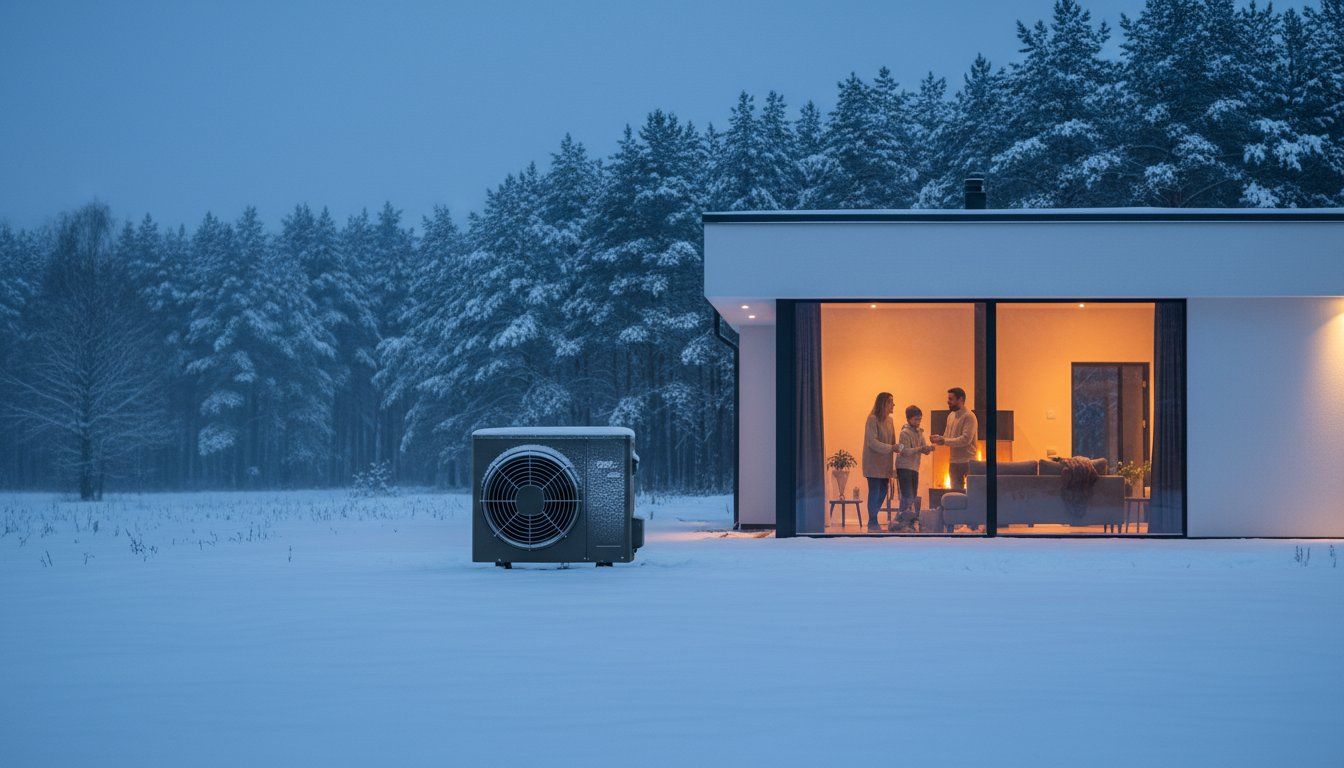
Have you ever wondered why some neighbours enjoy a warm home in a T-shirt even when it is -20°C outside, while others anxiously watch the electricity meter? At Commodus, we understand these concerns. Since 1 January 2026, when state support for compensating electricity distribution tariffs ended, the question of heat pump efficiency in winter has become even more relevant. You naturally want to avoid unpleasant surprises in your bills and worries about the unit freezing when severe frost sets in outside.
In this article, we will explain clearly why modern Full Inverter models have changed the rules of the game and why they can maintain strong performance even at low temperatures. We will examine real COP values below zero, show you how to configure the system correctly for maximum savings and explain how to apply for EKII support of up to EUR 4,700. Together, we will keep pushing this project forward so that your home remains warm and comfortable regardless of the weather or electricity exchange prices, which averaged EUR 0.15539 per kilowatt-hour in March 2026. You will gain confidence that your heating system is ready for any challenge.
Key takeaways
- Understand the difference between COP and SCOP values so that you can realistically assess how heat output changes at -15°C and lower temperatures.
- Learn why air humidity and defrost cycles affect system consumption and why there is no need to be concerned about them.
- Find out why heat pump efficiency in winter is higher when you maintain a constant temperature instead of trying to save by reducing it sharply at night.
- Compare the convenience and costs of a heat pump with pellet heating to understand which solution is better suited to your lifestyle.
- Discover how a correctly configured heating curve helps reduce bills without sacrificing indoor comfort.
Heat pump efficiency in winter: what do COP and SCOP actually mean?
Let us begin with a simple fact: a heat pump does not create heat from nothing; it transfers it. To understand how efficiently the unit operates, we use the COP, or Coefficient of Performance. The calculation is straightforward: the heat energy produced is divided by the electricity consumed. If your unit consumes 1 kWh of electricity and delivers 4 kWh of heat, its COP is 4. How a heat pump works is essential for every homeowner to understand, because COP is at the heart of the system and continues to reach new levels in 2026 as technology advances.
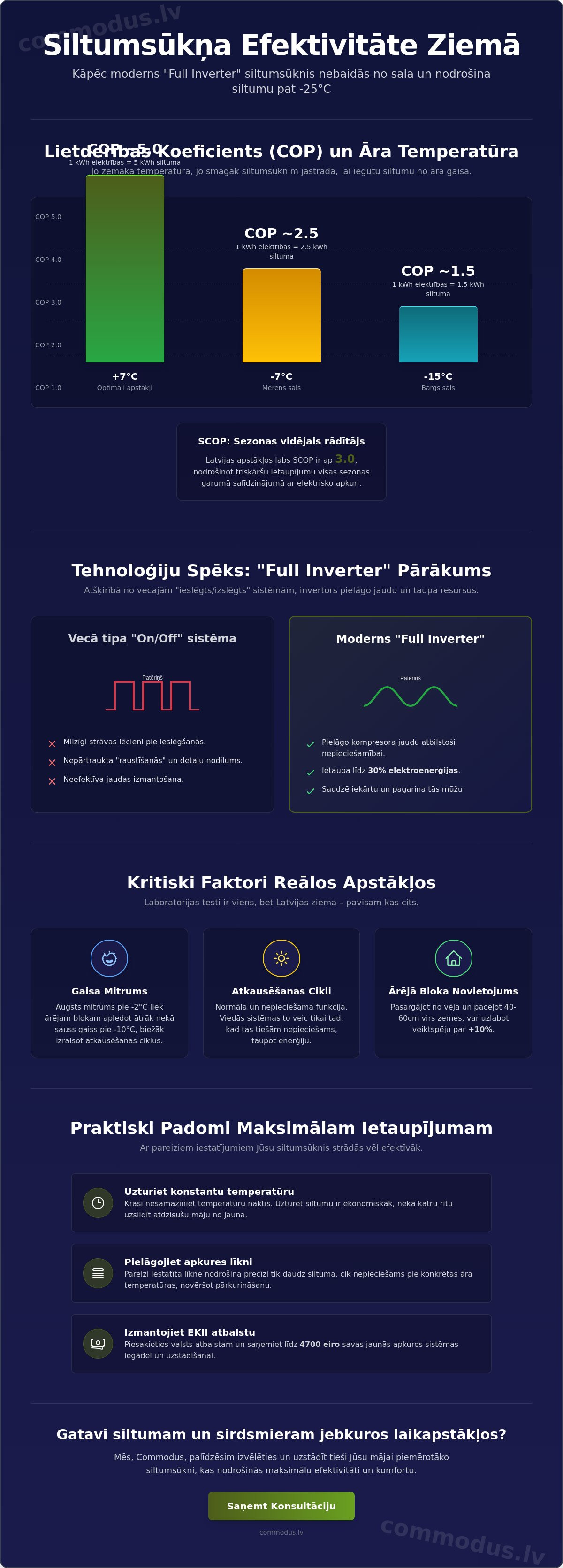
However, heat pump efficiency in winter is not a fixed figure. It changes with the outdoor temperature. At +7°C, the unit operates under favourable conditions and may achieve a COP of up to 5.0. When the temperature falls to -7°C, efficiency usually decreases to approximately 2.5 or 3.0. At -15°C or -25°C, the unit must work much harder to extract heat from cold air, and the COP may approach 1.5. This is where SCOP, the seasonal coefficient of performance, becomes important. It shows average efficiency over the entire heating season, taking into account both thaws and severe frost. In Latvian conditions, a good SCOP is around 3.0, which means approximately three times lower electricity use than conventional electric heating for the same amount of heat.
Modern Full Inverter technology plays a decisive role. Older units operated on a simple on-or-off basis, causing substantial current surges. An inverter instead adjusts the compressor speed precisely to the amount of heat required at that particular moment. This can reduce electricity consumption by up to 30% and significantly extend the service life of the unit because there is no constant abrupt cycling.
Theoretical efficiency versus real-world operation
Customers often ask why their neighbour's bills differ from the figures promised in a brochure. Manufacturers conduct tests under controlled laboratory conditions, while Latvian homes face changing humidity and gusty winds. High humidity at -2°C can be more demanding than dry air at -10°C because the outdoor unit frosts up more quickly and enters defrost mode more often. At Commodus, we always emphasise that choosing the correct installation location and protecting the unit from direct wind can improve overall performance by at least 10%.
Why does the air-to-water heat pump remain the leading choice?
Although ground-source heat pumps provide a more stable COP throughout the year, air-to-water systems have made enormous progress in recent years. New refrigerants such as R32 and natural R290, or propane, can provide flow temperatures of up to 75°C even when outdoor temperatures are well below zero. This means that even older radiator systems can now be heated effectively with a heat pump. Air-to-water systems are faster and less expensive to install because they do not require costly boreholes or extensive groundworks, making them the most economically justified choice for most Latvian households.
Critical factors affecting heat pump operation below zero
Now that the theoretical indicators are clear, it is time to look at what happens in real life. Heat pump efficiency in winter depends not only on the capacity of the unit itself, but on a combination of several conditions. The high air humidity typical of Latvia is often a greater challenge than stable, dry frost. For example, at -2°C and 90% relative humidity, the outdoor unit evaporator freezes much faster than at -10°C in clear, dry weather. This occurs because moisture in the air freezes on contact with the cold fins, forming a layer of frost that restricts airflow.
At such times, the defrost cycle comes into operation. This is a completely normal system function during which the heat pump reverses its operating direction for a few minutes to melt accumulated ice. Although the process uses a small proportion of the energy produced, it is essential for preventing a loss of capacity. Modern units that meet criteria such as official energy-efficiency standards are equipped with intelligent sensors. They start defrosting only when it is genuinely needed rather than at fixed time intervals, thereby significantly reducing unnecessary energy use.
The position of the outdoor unit also plays a major role. If the unit is installed where strong wind blows continuously, the wind effectively removes heat from the evaporator and forces the compressor to work harder. In our work at Commodus, we always ensure that the unit is raised at least 40 to 60 centimetres above ground level to prevent it from being buried in snow and to allow condensate to drain freely. When planning an installation, remember that every degree by which the heat-transfer medium temperature can be reduced improves efficiency. A heat pump will operate 10% to 15% more efficiently when producing 35°C water for underfloor heating instead of 55°C water for older radiators.
How the defrost cycle works and common myths
Many new owners become alarmed when they see clouds of steam rising from the outdoor unit on a cold morning. There is no cause for concern: this is not a fault, but a sign that the system is operating correctly and removing ice effectively. The most important thing is not to interfere with the process. Never try to chip the ice away manually or pour hot water over the unit, as this may damage the delicate aluminium fins. Intelligent sensors in modern models are sufficiently precise to determine the optimal start and end points of the cycle automatically.
The role of building energy efficiency
Even the most advanced heat pump cannot perform at its best if the house leaks heat like a sieve. A heat pump and underfloor heating are an ideal combination because they allow the system to operate at the lowest possible temperature. If your building is well insulated, the unit will run at minimum speed for most of the time while providing the stable, comfortable warmth we all want. If you are unsure whether your current heating system is ready for winter, Commodus specialists will help carry out precise calculations and identify the most suitable solution for your home.
Heat pumps versus other heating methods: the economic case
Many Latvian homeowners still hesitate between a pellet boiler and a heat pump. Pellet heating was regarded as a safe choice for years, but the reality in 2026 is different. Pellets require regular physical work, storage space and constant boiler cleaning. A heat pump, by contrast, operates fully automatically and does not demand your time or effort. Recommendations from the Ministry of Climate and Energy clearly indicate that heat pumps are among the most environmentally friendly and energy-efficient solutions. They help reduce energy consumption significantly and protect households from sharp fluctuations in fossil-fuel prices, which have become increasingly unpredictable in recent years.
Heat pump efficiency in winter directly determines how quickly the investment pays for itself. Since 1 January 2026, when state compensation for distribution tariffs ended, every kilowatt-hour saved has become more valuable. By choosing a heat pump, you become independent of firewood or pellet suppliers. If the system is combined with solar panels, for which EKII support of up to EUR 4,000 is still available, heating costs become even more predictable during the coldest months. State support for installing a new heat pump to replace an old fossil-fuel boiler currently reaches up to EUR 4,700, significantly reducing the initial investment.
Actual costs: how much does 1 kWh of heat cost?
Let us do some simple mathematics. A heat pump with an average SCOP of 3.0 means that for every euro paid to the electricity supplier, you receive three euros' worth of heat. If the average Nord Pool exchange price in March 2026 was EUR 0.15539/kWh, one kilowatt-hour of heat cost only about 5 cents. Conventional electric heating would have cost the full 15 cents at the same time, plus distribution charges. Over a month, this difference can result in savings amounting to hundreds of euros. We recommend using our heating calculator to obtain calculations for your particular home and understand your individual benefit.
Return on investment (ROI) in the Latvian climate
At Commodus, we often say that the cheapest model in the brochure frequently proves to be the most expensive in real life. With low-quality units, heat pump efficiency in winter drops sharply when temperatures fall below -10°C, causing electric heating elements to switch on. A high-quality system adapted to Latvian conditions will serve for 15 to 20 years, provided it is maintained regularly. Taking into account available Altum grants of up to EUR 5,000 for building insulation and EKII support for equipment, an investment in a modern heating system usually pays for itself within 5 to 7 years. It is a long-term investment in comfort and peace of mind rather than simply another expense.
Practical advice for improving efficiency and reducing electricity bills
Many homeowners make the mistake of assuming that a heat pump can be forgotten once it has been installed. In reality, your daily habits and system settings determine whether the bill at the end of the month is a pleasant surprise or a cause for concern. Since 1 January 2026, when households stopped receiving state compensation for distribution tariffs, every euro cent saved matters. Heat pump efficiency in winter suffers most from poorly considered temperature fluctuations. At Commodus, we always say that a heat pump is not a wood-burning stove that can be heated up rapidly. It is a marathon runner that performs best at a steady, measured pace.
Correct configuration of the heating curve is the most important factor. Instead of manually changing the temperature according to how cold it feels, allow the controls to respond to data from the outdoor sensor. When the system is set to a constant operating mode, it uses the lowest possible temperature required to maintain warmth. This is far less expensive than trying to reheat a house that has cooled down. Many people try to save money by sharply reducing the temperature at night or while they are away. With a heat pump, this is a mistake. To raise the temperature again by 3 or 4 degrees, the unit may have to operate at maximum capacity or even activate the electric heating elements, which can consume all of the savings made overnight.
Maintaining the system during winter
The unit requires unrestricted airflow to operate at full performance. In winter, regularly check that deep snow has not accumulated around the outdoor unit and that the condensate drain has not frozen. If condensate cannot drain away, it may form a block of ice that damages the fan. A clean heat exchanger can save up to 10% of electricity because the unit does not need additional power to force air through layers of dust and frost. Professional maintenance once a year is essential so that a specialist can check pressure and refrigerant levels and ensure maximum performance.
Smart settings and automation
Modern technology allows you to monitor efficiency in real time through a smartphone app. There you can view the bivalent point, which is the temperature at which the heat pump begins to lack sufficient capacity and the electric heating element assists it. Correctly optimising this point prevents unnecessary electricity consumption. If you use an exchange-price tariff, smart control can automatically heat the home slightly more during the hours when electricity is cheapest, for example when the Nord Pool price falls below the average level of EUR 0.15539/kWh. If you would like to make sure that your system is configured as effectively as possible, Commodus specialists will help make the necessary adjustments so that you can approach winter without concern.
Why choose Commodus solutions for maximum winter performance?
When choosing a heating system, you are not merely purchasing equipment; you are investing in peace of mind for the next 20 years. Since 2010, the Commodus team has worked alongside customers on thousands of different projects, from small private homes to large industrial buildings. We know that heat pump efficiency in winter is not merely a technical figure in a brochure, but the result of precise design that takes account of Latvia's variable and sometimes severe weather. Our experience shows that an individual approach to every project is what helps avoid unexpected costs during the coldest months.
We do not offer every brand available on the market, but only those that have demonstrated durability and high SCOP values in our climate zone. Our experts follow the latest developments, so in 2026 we work with advanced Full Inverter models that adapt to changing loads without unnecessary energy consumption. We also provide a complete service cycle. You do not need to struggle with complicated paperwork, because we help prepare all documents required for EKII support, which currently amounts to as much as EUR 4,700 for heat pump installation.
Our team: your guarantee of peace of mind
Commodus represents a knowledgeable and reliable specialist with an active approach to life. This energy and practical mindset are reflected in every member of our team. We do not use complicated terminology to distance ourselves; instead, we speak to you as an equal partner. We care about warmth and comfort in your home, so we remain accessible and responsive. View our completed projects and see the quality of our work and our individual approach to every customer.
How can you begin working with us today?
Do not approach the next heating season worrying about bills. We are here to help you make a balanced and economically justified decision. Book a free consultation or site survey, and we will prepare an accurate capacity calculation and proposal within 48 hours. We believe in transparency, so we also offer practical tools such as a heating calculator, allowing you to see the real potential savings yourself. Contact us and secure warm winters! We promise that with our assistance, heat pump efficiency in winter will become one of your home's greatest advantages rather than a cause for concern.
Secure warmth and peace of mind in your home today
We have established that heat pump efficiency in winter is not a myth but a precisely calculable reality. A correctly selected Full Inverter unit and intelligent settings make it possible to maintain strong performance even when weather conditions become unpredictable. Remember that good building insulation and regular system maintenance are your best allies in reducing heating bills and maintaining stable comfort in every room.
With more than 15 years of experience in the Latvian market, the Commodus team is ready to become your trusted partner in this process. As an official representative of leading global brands, we provide complete service throughout Latvia, from the first consultation and preparation of EKII support documents to long-term system maintenance. We are not afraid of challenges and are ready to work alongside you so that every winter in your home is comfortable and economical.
Book a free consultation and discover the best solution for your home! We will help you find a solution that provides warmth and a sense of security for many years. Let your home become a place where frost remains outside while pleasant calm prevails indoors.
Frequently asked questions about heat pump operation
Will an air-to-water heat pump operate at -25°C?
Yes. Modern air-to-water heat pumps are designed to operate at temperatures down to -25°C or even -30°C. Although heat pump efficiency in winter decreases in such severe frost, the unit continues to produce heat and can activate its integrated electric auxiliary heater when necessary. It is important to choose models designed specifically for northern climates and equipped with crankcase heating and intelligent control.
Why does my heat pump become covered in ice during winter?
Frost and ice forming on the outdoor unit evaporator is a natural physical process that occurs when the unit cools the outdoor air. When humidity is high, for example at -2°C, condensate freezes on the fins. The unit detects this automatically and starts a defrost cycle, melting the ice within a few minutes. This restores unrestricted airflow and stable performance.
How much electricity will a heat pump use in January?
Consumption depends on the building's thermal performance and the average outdoor temperature. For a moderately insulated 150 m² house, it may be approximately 600 to 900 kWh per month. Given that the Nord Pool exchange price in March 2026 was EUR 0.15539/kWh, you can calculate the precise amount by multiplying your tariff by your consumption. Underfloor heating can help reduce this figure by at least 15%.
Do I need a backup boiler for a heat pump?
In most cases, a backup boiler is unnecessary because heat pumps include an electric heating element for critical situations. However, in our work at Commodus, we recommend retaining an existing wood or pellet boiler as a safety reserve for extreme power outages or unexpected exchange-price increases. This provides additional peace of mind and allows the system to operate in bivalent mode, optimising costs during very severe frost.
Why does heat pump efficiency decrease as the weather gets colder?
Efficiency falls because the difference between the outdoor air temperature and the heat required by the heating system increases. The colder the air, the less readily available heat energy it contains and the harder the compressor must work to raise it to a useful temperature. For this reason, heat pump efficiency in winter at -15°C will always be lower than at +7°C, when heat extraction is much easier.
How often does a heat pump require maintenance during winter?
A full professional service should be carried out once a year, preferably before the heating season begins. During winter, the owner should check approximately once a week that the outdoor unit has not been buried in snow and that the condensate drainage system has not frozen. A clean heat exchanger and unrestricted airflow are essential for preventing unnecessary power consumption and maintaining maximum performance.
Can a heat pump provide hot water during severe frost?
Yes. Modern models using R290 or R32 refrigerants can prepare hot water at temperatures of up to 65°C or 75°C even when the outdoor temperature is below zero. The heat pump gives priority to heating the water in the cylinder before returning to space heating. During severe frost, this process may take slightly longer, but the comfort level in the shower or bath remains consistently high.
How can I reduce my electricity bill without reducing comfort at home?
The best approach is to maintain a constant indoor temperature and prevent the building from cooling down, because reheating requires substantial power. Use smart control to heat the home more intensively during hours when the electricity exchange price is below the average of EUR 0.15. Also make sure that the heating curve is configured according to your building's thermal performance so that unnecessary overheating is avoided.
Comments