Heat Pump for a 150 m² House: How to Choose the Right Solution in 2026?
Did you know that even the most expensive heat pump for a 150 m² house can become a financial burden if its capacity is calculated solely on the basis of floor area rather than the building's actual heat loss? Many homeowners make the mistake of choosing an oversized unit that wastes resources or, conversely, cutting back too far on capacity and forcing the system to operate at its limit. At Commodus, we understand your concerns about high electricity bills and complicated state-support conditions, which is why we are ready to pull together with you so that your home remains warm and you enjoy complete peace of mind.
In this article, you will learn how to determine accurately whether your home needs 6 kW or 10.5 kW of capacity and why a professional calculation is the key to a payback period of 5 to 7 years. We will help you prepare an application for support from the Modernisation Fund, which can cover up to 70% of installation costs until 1 June 2026. After reading this guide, you will have a clear action plan for achieving an efficient result with annual heating costs of no more than EUR 560.
Key takeaways
- Learn why an accurate heat-loss calculation is more important than the building's floor area when determining the optimum unit capacity and avoiding unnecessary expenditure.
- Understand how the SCOP value affects your finances, helping to reduce monthly bills and allowing the system to pay for itself within 5–7 years.
- Find out which heat pump is most suitable for a 150 m² house by comparing the performance of air-to-water and ground-source heat pumps in Latvia's changeable climate.
- Get practical information about the state-support programmes available in 2026, which can reimburse up to 70% of the equipment purchase and installation costs.
- Discover why professional installation and regular maintenance are critical to ensuring that the heating system operates flawlessly for decades.
Why is a heat pump the optimum choice for a 150 m² house in Latvia?
When choosing a heating system, a floor area of 150 m² has become something of a gold standard for private-house construction in Latvia. It is spacious enough to provide comfort for the whole family, yet it also requires an intelligent approach to energy consumption. A heat pump for a 150 m² house is a solution that not only heats the property but also protects your finances over the long term. To understand more clearly what a heat pump is, imagine a unit that works like a refrigerator in reverse. Instead of cooling the inside, it captures free heat energy from the outdoor air or the ground and transfers it to your home's heating system.
In 2026, as energy prices and environmental requirements become increasingly demanding, relying on conventional solutions is becoming more difficult. Pellet boilers require regular ash removal and physical work, while gas heating no longer provides the expected price stability. A heat pump, by contrast, offers full automation and freedom. You no longer need to become the stoker in your own home; at Commodus, we believe that your home should serve you rather than the other way round. An additional benefit is the cooling function in summer, which can provide a pleasant indoor climate throughout a 150 m² property without the need to install a separate air conditioner in every room.
Air-to-water vs ground-source heat pump: which is better for 150 m²?
Most of our customers choose air-to-water systems for houses of this size. They are quicker to install, require no extensive groundworks and involve a considerably lower initial investment. A ground-source heat pump, however, is the most efficient solution at extremely low temperatures because the temperature below ground remains stable throughout the year. The choice depends on the characteristics of your plot and your budget. If the garden is small, an air-to-water unit will be the optimum option, whereas on larger properties a ground collector may provide even lower bills and a better long-term return.
The myth of a heat pump 'freezing' during a Latvian winter
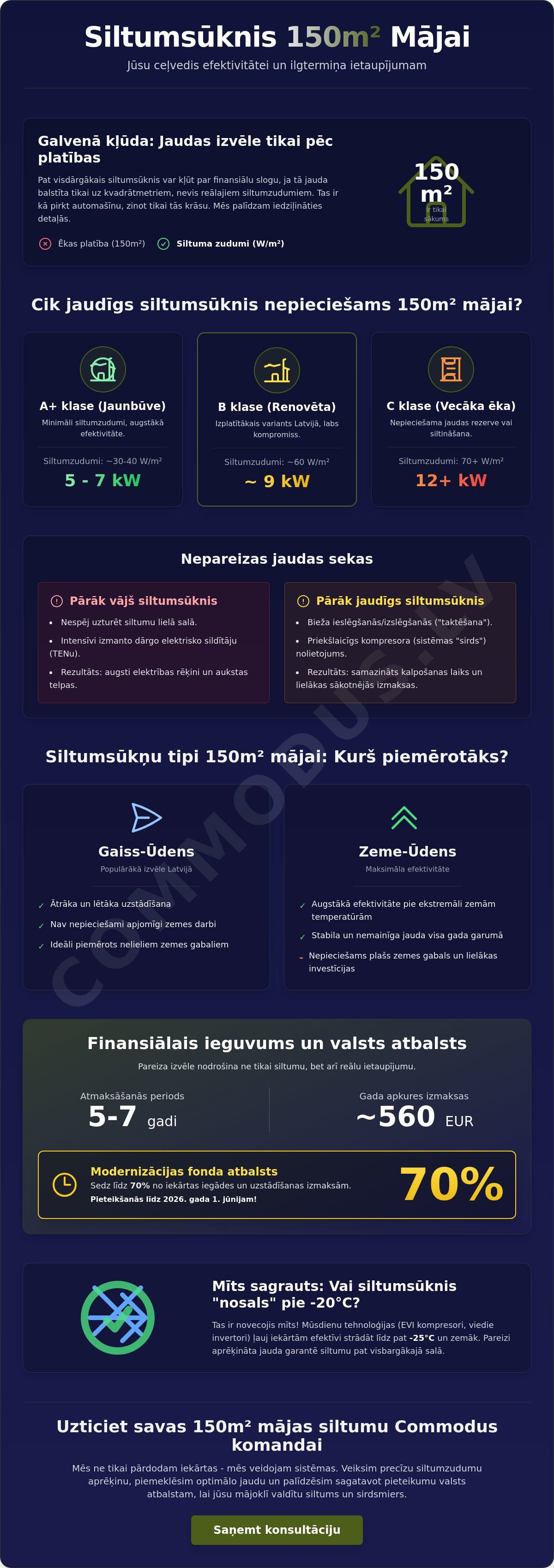
We often hear concerns that at -20°C a heat pump will simply stop and the house will become cold. This is an outdated myth that no longer reflects reality. Modern technologies, including EVI compressors and intelligent inverters, allow units to operate efficiently at temperatures as low as -25°C and below. A heat pump for a 150 m² house is designed so that, at critical moments, the bivalence-point settings or an auxiliary electric heater can provide additional support. Commodus has installed thousands of units throughout Latvia, and our experience confirms that correctly selected capacity guarantees a comfortable home even during the harshest frost. We are here to pull together with you and ensure that your family feels safe and warm regardless of the weather outside.
Capacity calculation: how many kW does a heat pump need for a 150 m² building?
When selecting a heating system, many homeowners make the mistake of relying only on the building's floor area. A heat pump for a 150 m² house is not a standard product that can simply be taken off the shelf; it is an engineered solution. Square metres do not lie, but they do not reveal everything about your home's energy 'appetite'. The key value is heat loss, which is influenced by the airtightness of the windows, the composition of the external walls and even the ceiling height.
The standard calculation formula is relatively straightforward. Multiply 150 m² by the average heat loss in watts per square metre (W/m²). If the house loses an average of 60 W/m², the required capacity will be approximately 9 kW. In practice, however, this figure can vary. If the selected capacity is too low, the unit will be unable to maintain warmth at -15°C without extensive use of the electric auxiliary heater, rapidly increasing the electricity bill. An oversized unit, meanwhile, will switch on and off frequently, causing short cycling. This process prematurely wears the compressor and reduces the service life of the system. Modern inverter technology can adjust capacity to actual demand, but even the best inverter cannot compensate for a fundamentally incorrect base-capacity selection.
How the required capacity depends on building insulation (classes A, B and C)
The building's energy-efficiency class directly determines the required number of kilowatts. A new A+ class house with minimal heat loss, approximately 30–40 W/m², will generally require a unit with a capacity of only 5–7 kW. For renovated class B buildings, which are the most common segment in Latvia, a 9 kW model is the safer choice for stable operation. Older masonry houses with average insulation may require 12 kW or more. In such cases, it is important to determine whether investing in a more powerful unit is justified or whether improving the building's insulation first would be more effective.
How domestic hot-water consumption affects capacity
A 150 m² house is usually occupied by a family of 3 to 5 people, so domestic hot-water production is an important factor. The heat pump always gives priority to hot water: it first heats the cylinder and only then returns to space heating. At Commodus, we recommend a hot-water cylinder of at least 200–300 litres for a house of this size. This ensures that hot water will not run out even if every member of the family decides to shower one after another. Correct capacity selection is essential for a successful subsequent application for state support for heat-pump installation, because programme conditions often require compliance with specific efficiency criteria. If you are unsure about your home's parameters, our heating calculator will help you make the initial calculations within a few minutes.
Heat-pump costs and payback period
Investing in a heating system is one of the most important decisions you will make when improving your home. A heat pump for a 150 m² house requires a carefully considered budget covering not only the unit itself, but also installation materials, professional labour and system commissioning. The average cost of installing an air-to-water heat pump in a house of this size generally ranges from EUR 4,000 to EUR 6,000, including the hot-water cylinder and basic installation. Although the initial quotation may appear higher than for a pellet boiler, for example, the long-term benefits are considerably greater.
Operating costs are the main argument in favour of this choice. A well-insulated 150 m² house consumes approximately 3,000 to 3,500 kWh of electricity during the heating season. At current prices, this amounts to only EUR 480 to EUR 560 per year for heating and hot water. This means that the system can pay for itself fully within 5 to 7 years. In addition, state support for heat pumps in 2026 can reimburse a significant proportion of the investment, making the transition to green energy even more attractive. At Commodus, we always say that the cheapest quotation often becomes the most expensive solution to operate, which is why it is essential to consider the efficiency indicators.
Heat-pump efficiency indicators: COP and SCOP
Many manufacturers, including Panasonic and Daikin, highlight the COP value, which indicates instantaneous efficiency under ideal conditions. In Latvia's changeable winter climate, however, SCOP, the seasonal coefficient of performance, is considerably more important. It shows the average efficiency over the whole year. If a unit has a SCOP of 4, every 1 kW of electricity consumed produces 4 kW of heat. When choosing a unit, do not be misled by low prices: low-end models lose efficiency at -15°C and activate the electric heating elements, rapidly increasing the bill.
Hidden costs to avoid
When planning the installation, several technical considerations may affect the final price. First, check the capacity of the home's electrical connection. In some cases, operating the heat pump requires a higher amperage, which must be agreed with Sadales tīkls. Second, we recommend including a buffer tank. It ensures more stable system operation and prevents the unit from switching on and off too frequently. Finally, remember the annual maintenance requirement. This is not merely a warranty condition, but a guarantee that your heat pump for a 150 m² house will operate at maximum efficiency and remain in service for decades. We are here to help you navigate this technical complexity and find a solution that is suitable for both your home and your budget.
How can you obtain state support for heat-pump installation in 2026?
The year 2026 has opened new opportunities for owners of private houses in Latvia to achieve energy independence. State-support programmes are no longer merely theoretical; they provide a practical mechanism for reducing the initial investment substantially. The most relevant programme at present is the Modernisation Fund, which accepts applications from 1 April to 1 June 2026. The programme's total funding amounts to EUR 26.8 million. This is an important opportunity for anyone planning a heat pump for a 150 m² house. In addition, the Emission Allowance Auctioning Instrument (EKII) programme remains available and can cover up to 70% of the eligible costs of replacing fossil-fuel heating systems.
At Commodus, we know that bureaucracy can often seem more intimidating than the installation itself. For this reason, we not only install the equipment but also help prepare all the required documentation. A professional design and accurate capacity calculations are the first and most important step. Without them, an application to the Environmental Investment Fund may be rejected. Remember that support is available only for buildings with an energy-efficiency class of at least D. Our experience shows that correctly prepared documents are half the battle on the way to a modern heating system.
Step by step: the route to funding
The process begins with an energy audit or technical inspection to determine the building's actual condition. Once it is clear that a heat pump for a 150 m² house is technically suitable and economically justified, the official application is prepared. After approval, the equipment is installed and commissioned. Finally, a report must be prepared documenting the achieved improvement in energy efficiency. The funds are transferred to your account only after all documents have been reviewed and approved. We remain beside you at every stage so that the process is easier and the outcome is reliable.
Equipment-efficiency requirements
The state does not support the purchase of just any unit. Funding is granted only for heat pumps that meet strict efficiency criteria and hold internationally recognised certificates. An energy-efficiency certificate confirms that the chosen model will deliver the promised savings over the long term. By choosing a certified installer with more than 15 years of experience, you minimise the risk of installation errors that could later prevent you from receiving the promised funding. High-quality equipment and professional workmanship are the only reliable route to a return on your investment.
To find out whether your home meets the conditions for receiving support, book a free consultation and we will help prepare everything required for a successful application.
Why entrust the heating of your 150 m² house to the Commodus team?
We know that choosing a heating system is not merely a technical purchase. It is a step towards lasting peace of mind and comfort for your family. The Commodus team has worked in the Latvian market for more than 15 years and has installed thousands of units at a wide variety of properties. A heat pump for a 150 m² house is one of our most frequently requested solutions, so we have refined every detail of the process. We are not simply sellers; we are your partners and assume full responsibility for the entire cycle, from the initial capacity calculation to regular maintenance of the system many years later.
Our working culture is based on the belief that every project needs someone to keep it moving. This means that you will never be left alone with unanswered questions or technical challenges. We work only with globally recognised brands such as Panasonic, Daikin and Midea and provide the official manufacturer's warranty. This gives you confidence that spare parts and qualified support will remain available even after ten years. Our objective is to create a welcoming atmosphere in your property using technology that operates quietly and efficiently.
Our experts' knowledge and tools
To avoid guesswork, we use a dedicated heating calculator that helps us prepare an accurate quotation specifically for your home. Our team includes not only engineers but also active, practical people whose energy and determination help them find the best solutions even in the most challenging situations. We understand that a heat pump for a 150 m² house requires an individual approach, which is why our service network covers the whole of Latvia. This guarantees rapid assistance and warranty service regardless of where you are located in the country.
How do you begin working with us?
Everything begins with a straightforward, personal conversation. We offer a free consultation and site survey so that we can assess the building's characteristics and your requirements in person. We then develop an individual solution that is most efficient for your particular 150 m² property, taking account of both heat loss and domestic hot-water consumption. We believe in transparency, so our proposal will contain no hidden costs or unfounded promises. We are here to pull together with you and ensure that your home's heating is in safe hands.
If you are ready to switch to modern and economical heating, take the first step today. Book a free capacity calculation and consultation and let us take care of your home's heating for the long term.
Take the first step towards a warmer and less expensive winter
A correctly selected heat pump for a 150 m² house is an investment that begins to pay for itself during the very first heating season. This decision allows you to forget about purchasing fuel and enjoy full automation. Remember that the state-support programmes available in 2026 can reimburse up to 70% of installation costs if you submit the application by 1 June. Our experience shows that an accurate capacity calculation and high-quality equipment can reduce the annual heating bill to as little as EUR 560 while maintaining comfort even during the harshest frost.
Since 2010, the Commodus team has helped Latvian families find the best heating solutions. As official partners of Panasonic, Midea and Daikin, we provide not only leading equipment but also a complete service for preparing the documents required to receive state funding. We are ready to pull together with you so that your home becomes an energy-efficient place that provides lasting peace of mind. There are no impossible situations; you simply need the right specialist who understands your needs and the characteristics of your home.
Find the exact heat-pump price for your home using the Commodus calculator and start enjoying modern comfort today. We will take care of everything else so that your home always remains warm.
Frequently asked questions about heating solutions
What heat-pump capacity is most suitable for a 150 m² house?
A heat pump for a 150 m² house will generally require a capacity of 6 to 10.5 kW, depending directly on the building's energy-efficiency class. A new building with A+ class insulation may require only a 6 kW unit, while a moderately insulated building with a class C certificate may need approximately 10.5 kW. We determine the exact capacity from a heat-loss calculation so that the unit operates efficiently without unnecessary wear.
How much does it cost to install an air-to-water heat pump in a 150 m² house?
The average cost of a complete system for a house of this size ranges from EUR 4,000 to EUR 6,000. This quotation generally includes the unit itself, the domestic hot-water cylinder and professional installation. The final price may be affected by the need for an additional buffer tank or specific technical solutions within your home's heating system.
Can a heat pump provide all the heating for a house at -20°C?
Yes. Modern units with inverter technology and EVI compressors are designed to operate at temperatures as low as -25°C. During exceptionally severe frost, the system automatically activates the built-in electric auxiliary heater to maintain consistent comfort in the house. This ensures that your family remains warm even during the harshest Latvian winter.
How much state support can I receive for purchasing a heat pump?
In 2026, residents can receive support of up to 70% of eligible costs through the EKII or Modernisation Fund programmes. The Modernisation Fund has a total budget of EUR 26.8 million for this purpose. At Commodus, we help prepare all the required documentation so that you can recover the invested funds as quickly as possible.
Is a heat pump suitable for a house with radiators?
A heat pump is fully compatible with a radiator system, although the efficiency may be slightly lower than with underfloor heating. For economical operation, we recommend larger radiators or special high-temperature models. This allows the heat-transfer medium to operate at a lower temperature, directly reducing electricity consumption.
What is the payback period for a heat pump?
A correctly designed heat pump for a 150 m² house generally pays for itself within 5 to 7 years. This period becomes even shorter when state co-financing is used and more expensive heating methods, such as diesel fuel or electric radiators, are replaced. Annual heating costs of no more than EUR 560 for a property of this size make it one of the safest investments available.
Why choose an air-to-water system instead of a ground-source heat pump?
An air-to-water system is the most popular choice because of its lower installation cost and simpler installation process. There is no need to excavate the garden or drill expensive boreholes, which are required for a ground-source heat pump. It is an ideal solution for urban houses and smaller plots where every square metre matters.
How often does a heat pump require technical maintenance?
We recommend technical maintenance once a year before the beginning of the heating season. This includes cleaning the filters, checking the refrigerant pressure and testing system efficiency. Regular maintenance is not only a manufacturer's warranty requirement, but also a way to ensure flawless system operation for at least 20 years.
Comments