Heat Pump Installation: A Complete Guide and Resources for Efficient Heating in 2026
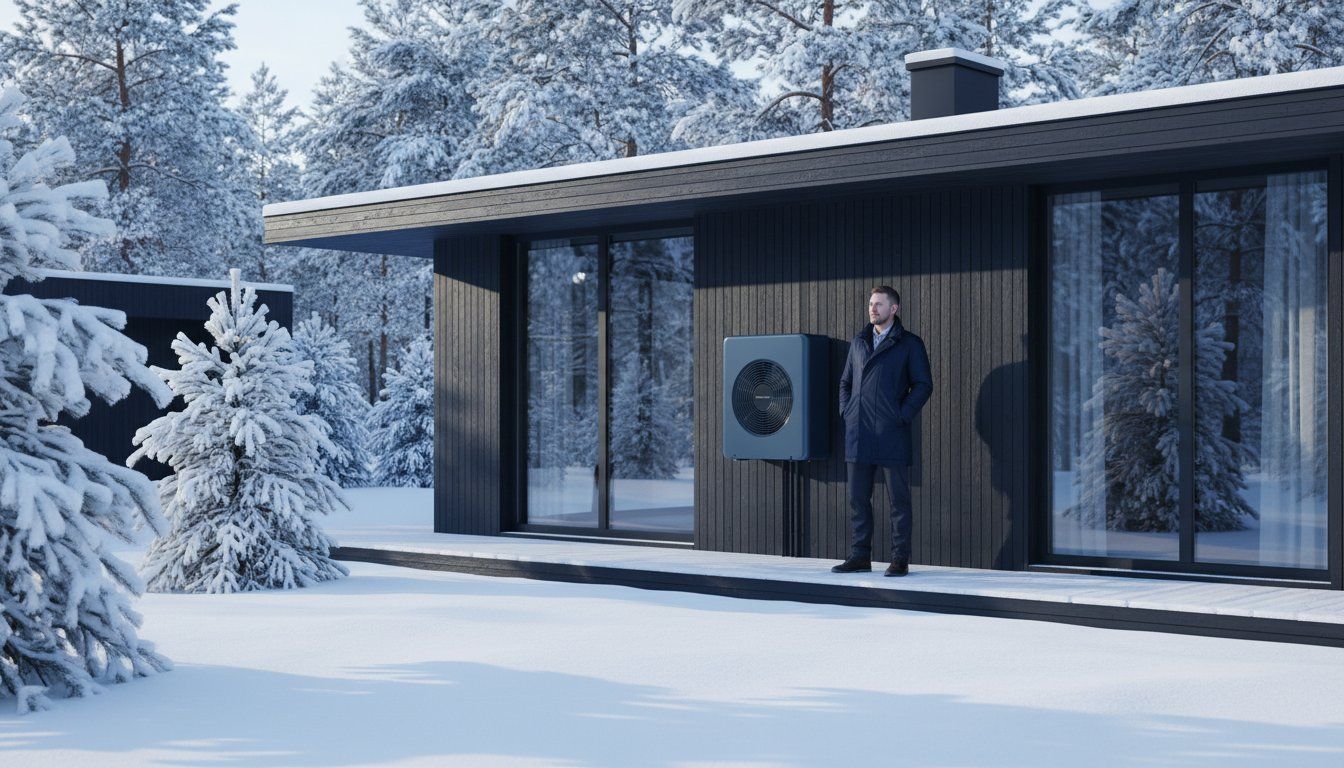
Is it possible to fully automate home heating so that even at -30°C the only thing you need to worry about is a warm cup of tea rather than carrying firewood or studying gas bills? We know that the substantial initial investment and concerns about equipment capacity in Latvia's harsh conditions often create uncertainty. It is entirely understandable to wonder whether heat pump installation will genuinely pay off and whether the complex bureaucracy surrounding state support will become too great an obstacle to your comfort.
We are here to work alongside you and make the transition to modern heating clear and secure. This guide explains the entire installation process, real market costs and how to use state support programmes successfully in 2026 to reduce the initial investment significantly. We will help you choose the solution best suited to your home, providing stable heat and lower bills for decades.
In the following sections, we will analyse everything step by step, from technical parameters to arranging the documentation, so that you can be completely confident in your decision.
Key takeaways
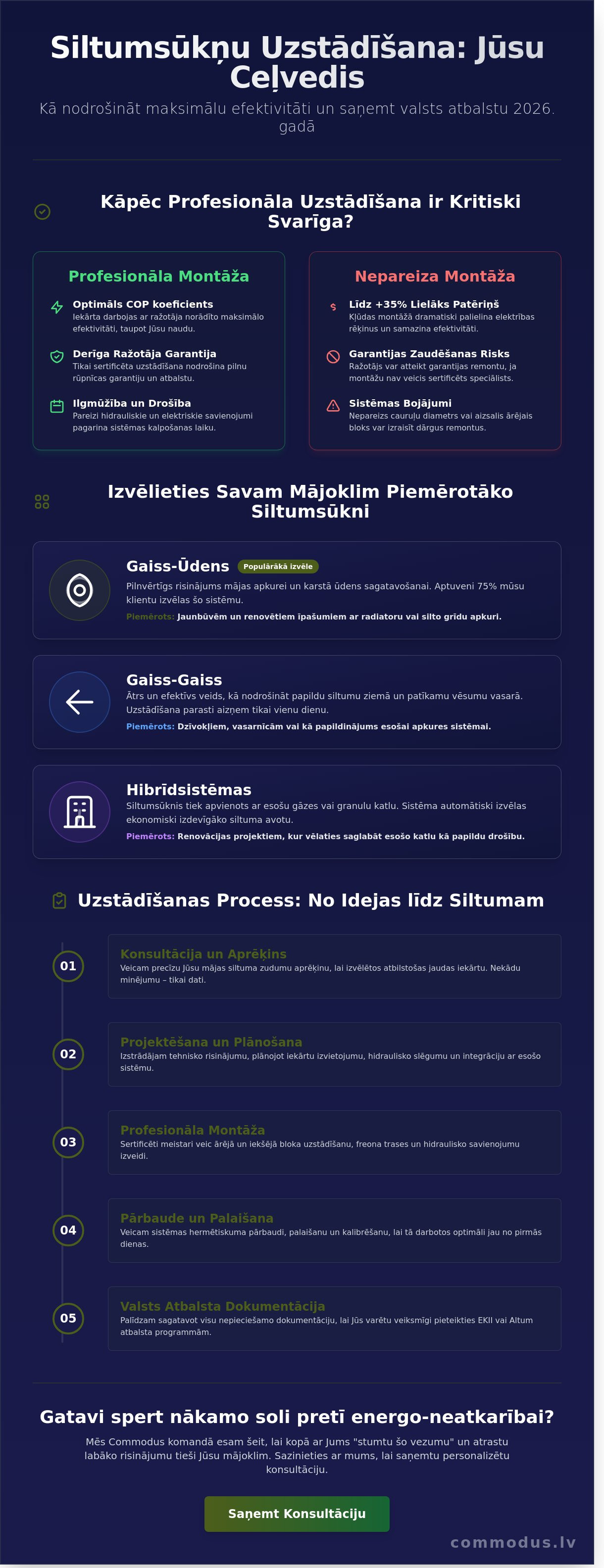
- Learn why professional heat pump installation is essential for achieving a high coefficient of performance (COP) and how to avoid the most common installation mistakes.
- Understand the differences between air-to-water and ground-source heat pumps so that you can select the most efficient solution for your home and plot.
- Discover how to integrate the heating system correctly into a new-build project or prepare a renovated building for maximum energy savings.
- Obtain a clear guide to the 2026 state support programmes (EKII and Altum) and the steps required to arrange the necessary documentation.
- Find out how Commodus's personal approach and engineering expertise will help you work towards energy independence for your home.
Why is professional heat pump installation critical to your home's efficiency?
A heat pump is not an ordinary household appliance that can simply be connected to the mains and expected to work perfectly. It is a complex engineering system centred on energy transfer. Correct heat pump installation directly affects the COP (Coefficient of Performance). If the installation is carried out carelessly, the unit may use 25% to 35% more electricity than stated by the manufacturer in the technical data sheet. To understand the nature of this technology, it is useful to know what a heat pump is and how it can extract heat from the surrounding environment even at sub-zero temperatures.
Latvia's variable weather conditions impose their own requirements. In winter, when temperatures fall to -20°C or -25°C, an incorrectly positioned outdoor unit may freeze or become covered with ice. A common mistake in amateur installations is placing the unit in a sheltered spot or too close to the ground, where snow and condensate accumulate. This forces the equipment to operate continuously in defrost mode, literally consuming the expected savings. Hydraulic risks are equally important. Selecting the wrong pipe diameter or creating an incorrect connection causes unnecessary resistance, forcing the circulation pump to operate at maximum load and shortening its service life by several years.
Before any equipment is purchased, Commodus specialists perform an accurate heat-loss calculation. We do not rely on rough estimates because every building is unique. If the house has inadequate thermal insulation, even the most expensive heat pump will be unable to provide comfort without excessive electricity consumption.
Engineering design as the foundation
When selecting equipment, the floor area alone is not enough. A new 150 m² masonry house requires entirely different capacity from a renovated timber building of the same size. During the design stage, we assess how the system will integrate with existing radiators or underfloor heating. Acoustic comfort is also important. We position the outdoor unit so that its 45–55 dB noise level and microvibrations do not disturb your sleep or your neighbours, while complying with all Latvian building regulations.
Long-term warranty and safety
Leading manufacturers such as Daikin and Mitsubishi provide the full factory warranty only when heat pump installation is entrusted to a certified partner. Installing the system yourself creates a risk of being left without support when it is needed most. Safety also includes correct electrical installation with suitable circuit breakers and residual-current protection. The professional commissioning protocol prepared by our technicians includes system pressure tests and calibration of the control unit to suit your family's daily routine. At Commodus, we work together with the customer to create a safe and warm environment for decades.
Main types of heat pumps and the technical details of their installation
Choosing a heat pump for Latvia's variable weather is not merely a technical decision; it is an investment in peace of mind and long-term stability for your home. Air-to-water systems are currently the most popular option on the local market because they provide complete space heating and domestic hot water without extensive groundworks. Approximately 75% of our customers choose this solution because of its versatility. Air-to-air systems, meanwhile, provide exceptionally rapid supplementary heating or cooling during summer heat, and installation usually takes only one working day.
Hybrid systems are becoming increasingly relevant in renovation projects, where a heat pump is combined with an existing gas or pellet boiler. This approach provides additional security because the system automatically selects the most economical heat source according to the outdoor temperature. When planning such an investment, the State support programme for energy efficiency can provide substantial financial assistance for switching to more environmentally friendly solutions.
Steps in installing an air-to-water system
Professional heat pump installation begins with selecting the precise position of the outdoor unit. It requires a stable, vibration-isolated concrete base and a carefully planned condensate drainage solution so that large amounts of ice do not form beside the wall during winter. Connecting the indoor unit and buffer tank requires high precision in the hydraulic connections to ensure correct flow distribution. We always test the refrigerant circuit for leaks using nitrogen pressure, ensuring that the system will operate without leakage for decades.
Ground-source heat pump engineering
Ground-source heat pumps are the choice for those planning far into the future because their efficiency remains stable even during the most severe frost. Where the plot is large enough, we install a horizontal collector at a depth of 1.2 to 1.5 metres, where the ground does not freeze. On smaller plots, we drill boreholes reaching depths of up to 100 metres to access a stable heat source. Measuring the thermal conductivity of the ground is critical in such projects because it determines how many metres of pipe are needed to keep the home warm at all times. Filling the system with a suitable heat-transfer fluid and carefully bleeding the air are the final stages before the equipment is handed over for use.
High-quality heat pump installation is not simply a matter of joining pipes; it is a complex engineering process in which every detail affects your monthly bill. At Commodus, we believe that working together and communicating openly helps achieve the best result at every site. To find out which system is most suitable for your home, we invite you to book a free consultation with our specialists.
Heat pump installation in different properties: From new builds to renovations
Heat pump technology has become a universal solution, but every property has its own characteristics and requires an individual engineering approach. In new builds, heat pump installation should be planned during the architectural design stage. This enables accurate calculation of the building's heat losses and allows the system to be integrated in a way that achieves savings of up to 30% compared with last-minute installation. Correct positioning of the outdoor unit and an optimum pipe layout reduce material costs and improve the system's overall efficiency.
The situation is often more complex in renovated buildings. Before choosing the equipment, the building's energy efficiency must be assessed carefully because a heat pump performs best where heat losses are minimal. Latvian residents who plan to improve their home heating systems can currently access EU funding for heating improvements. This funding provides valuable support for replacing fossil-fuel heating with sustainable solutions in urban areas while also increasing the value of the property.
A heat pump in an older building: Myths and reality
Many owners question whether an air-to-water system can maintain comfort at -25°C. Our experience shows that it can, provided the necessary preparatory work is completed. Carry out a simple test: try heating the rooms with the existing radiator system while setting the flow temperature to 45°C or 50°C. If the rooms remain warm, the heat pump will operate efficiently. If not, the windows and doors may need replacing or the loft may require insulation before installation. These improvements allow a lower-capacity unit to be selected, reducing both the initial investment and monthly bills.
Underfloor heating and a heat pump: The ideal combination
Underfloor heating is the most efficient way to use a heat pump's potential, improving system efficiency by 15% to 20%. This is due to the lower required flow temperature, which usually does not exceed 35°C. This combination offers several practical advantages:
- System inertia: The concrete floor acts as a large thermal store, retaining heat for hours after the equipment has switched off.
- Zoning: Different temperature settings can be used, for example maintaining 19°C in bedrooms and 22°C in the living room.
- Reduced load: The compressor operates more evenly, extending the equipment's service life by at least five years.
For commercial properties and areas exceeding 500 square metres, we generally choose cascade configurations. This approach connects several units into a single system, providing a high level of reliability. If one unit requires maintenance, the others continue supplying heat to the building without interruption. It is an energy-efficient way to reduce overall consumption while maintaining maximum capacity when outdoor temperatures fall sharply.
Practical process: Documentation, state support and installation stages
Heat pump installation is not merely a technical process; it is a carefully planned investment project in which the Commodus team becomes your guide. In 2026, state support programmes have become even more targeted. The Emission Allowance Auctioning Instrument (EKII) and Altum programmes continue to provide substantial co-financing, which may cover up to 50% of the equipment purchase cost. The main condition for eligibility is replacing a fossil-fuel boiler with an efficient air-to-water or ground-source heat pump whose efficiency meets the standards specified by the programme.
Our cooperation begins with active teamwork towards a shared objective. First, a specialist surveys the property and assesses its energy efficiency. This is followed by preparation of an accurate quotation, which is a critical document for the state support application. The actual heat pump installation usually takes between two and five working days, depending on the complexity of the system. Once the work is complete, we do not simply switch the unit on; we also train you to use it efficiently so that every kilowatt consumed provides the maximum amount of heat.
Financing and payback
To receive state support, the quotation must be detailed and transparent. Calculations show that, at current energy prices, a heat pump begins to pay for itself in approximately six to eight years compared with diesel or liquefied gas heating. Integrating the system with solar panels brings you closer to a zero energy bill because the energy generated in summer offsets winter heating costs. This provides not only financial independence but also long-term peace of mind.
Documentation and approvals
Many people are concerned about bureaucracy, but we make the process clear. If the heat pump's outdoor unit is fixed to the façade or the building's engineering solution is altered, an explanatory statement for the proposed construction work is required. Noise limits must also be observed: under Latvian regulations, daytime noise in residential areas must not exceed 50 dB(A). After installation, the system must be commissioned, which is a mandatory condition for Altum or EKII to pay the approved support.
The secret to long service life is regular maintenance. Servicing the heat pump once a year is key to achieving a 20-year service life. This involves more than cleaning filters; our technicians check refrigerant pressure, the cleanliness of the heat exchangers and the operation of the electronics. This preventive approach avoids costly repairs and ensures that the unit operates at maximum efficiency even on the coldest January nights.
We believe that every home deserves modern and economical heating. To learn more about the solution best suited to your property, choose Commodus as your trusted partner and let us begin work on your heating project today.
Commodus service: Working together towards your energy independence
At Commodus, we believe that energy independence is not merely a technical term; it is a goal that creates peace of mind and that we help you achieve step by step. Since 2010, we have completed thousands of engineering projects throughout Latvia, ranging from small detached houses to large industrial properties. Our approach is straightforward and honest. We do not process impersonal assembly-line orders. Every project has its own engineer and technician who understand every detail, from the first drawing to the final screw.
High-quality heat pump installation requires not only expertise but also genuine long-term responsibility for the completed work. That is why we provide a five-year warranty on installation work. It is our promise that the system will operate flawlessly and that any technical issues will be resolved promptly. Our service cycle is complete. We do not disappear after the project has been handed over. The Commodus team provides both the initial consultation and annual maintenance, ensuring that your home remains warm and comfortable for decades.
Why do customers choose Commodus?
Transparency is the foundation of our work. Customers value our open communication and clear pricing without hidden additional work or unexpected bills after completion. Our team consists of professionals who care about the result, not merely the process. We understand that a heating-system failure in the middle of winter is unacceptable. We therefore provide rapid response and technical support in every region of Latvia. We are close at hand whenever advice or assistance is required.
- An individual approach to every property, assessing the building's thermal performance and location.
- Clear and understandable communication without unnecessary technical complexity.
- Experienced technicians who regularly update their knowledge through training with leading manufacturers.
Begin your transition to a heat pump today
Switching to a modern heating system may seem complicated, but we make the process as simple as possible. It begins with a free site survey, during which our expert assesses your property and existing building services in person. Within 48 hours, we then prepare an individual proposal tailored to your needs and budget. Professional heat pump installation is an investment in your future that delivers lower bills and greater comfort from the very first day.
Book a consultation and receive a calculation
Begin your transition to smart heating today
A modern heating system is the foundation of an energy-efficient home and lower long-term bills. High-quality heat pump installation requires not only technical knowledge but also an understanding of Latvia's variable weather and the characteristics of local buildings. Remember that state support through Altum or EKII programmes may allow you to recover a substantial part of the investment, making accurate documentation and correct equipment selection crucial.
The Commodus team has more than 15 years of experience in the Latvian market and has helped thousands of households become more independent. We provide a complete service, from the initial consultation to a five-year warranty on all installation work. Our certified specialists carefully assess every detail so that the new system operates flawlessly for decades. Our aim is to be your trusted partner, working alongside you towards a warmer and greener future without unnecessary stress.
Receive a free heat pump installation quotation here
Use our accumulated expertise to make your home a model of energy efficiency and provide the comfort and peace of mind that you and your family expect.
Frequently asked questions
How long does heat pump installation take?
Heat pump installation usually takes between one and three working days, depending on the selected model and the readiness of the building's technical services. Our experience shows that in 85% of cases an air-to-water system can be fully connected and commissioned within two days. We ensure that the work proceeds smoothly and disrupts your daily routine as little as possible, providing immediate heat once installation is complete.
Will a heat pump operate when the outdoor temperature is -30°C?
Modern heat pumps continue to produce heat at -30°C, although their coefficient of performance (COP) decreases under such conditions. Most premium units are equipped with auxiliary electric heaters that switch on automatically when the outdoor temperature falls below -25°C. This ensures that your home maintains the set temperature of 22°C even on the coldest winter nights, providing confidence in the system's stability.
What are the main electrical requirements for installing a heat pump?
The main requirement is a stable three-phase electrical connection with a suitably rated circuit breaker, usually 16 A or 20 A. Before heat pump installation, our specialists inspect the existing electrical system to ensure that it can withstand the unit's maximum load. In older buildings, a separate supply cable may need to be run directly from the main distribution board, which we can arrange during the design stage.
Can I receive state support if I install the heat pump myself?
State support, for example through Altum or VPVK programmes, is not available if you carry out the work yourself without engaging a certified contractor. The rules require the system to be commissioned with the appropriate certificate signed by a licensed specialist. By choosing a professional service, you secure not only the funding but also continued validity of the manufacturer's warranty throughout the equipment's service life, which is a substantial long-term benefit.
How often does a heat pump require technical maintenance?
A heat pump should be serviced once a year, ideally before the start of the heating season in September or October. Regular inspection can reduce the risk of sudden faults by 15% and ensure optimum energy consumption throughout the winter. During maintenance, the technician cleans the heat exchangers, checks system pressure and verifies the accuracy of the electronic sensors so that the equipment operates at maximum efficiency.
What is the noise level of a heat pump's outdoor unit?
The outdoor units of modern heat pumps produce between 35 and 50 decibels, comparable to a quiet conversation or a refrigerator. Correct heat pump installation on dedicated anti-vibration mounts further reduces noise so that it does not disturb you or your neighbours. Night mode lowers the fan speed, making operation almost inaudible in the quiet hours.
Can a heat pump also provide domestic hot water for the entire family?
A heat pump can provide all the domestic hot water required by a family using either an integrated or separate cylinder. A standard 200-litre cylinder is sufficient for a household of four to enjoy daily showers and baths without restrictions. The system is programmed to prioritise water heating before space heating, ensuring continuous comfort and hot-water availability at any time of day.
How does heat pump installation affect a home's energy-efficiency rating?
Installing a heat pump can improve a home's energy-efficiency rating by one or even two levels, for example from class C to class A. Because the unit uses renewable energy, the building's primary energy consumption indicators improve significantly in the energy audit. This not only reduces monthly bills but can also increase the property's market value by approximately 10% to 15%, making it a sound investment for the future.
Comments