Heat Pumps in 2026: A Comprehensive Guide to Efficient Home Heating in Latvia
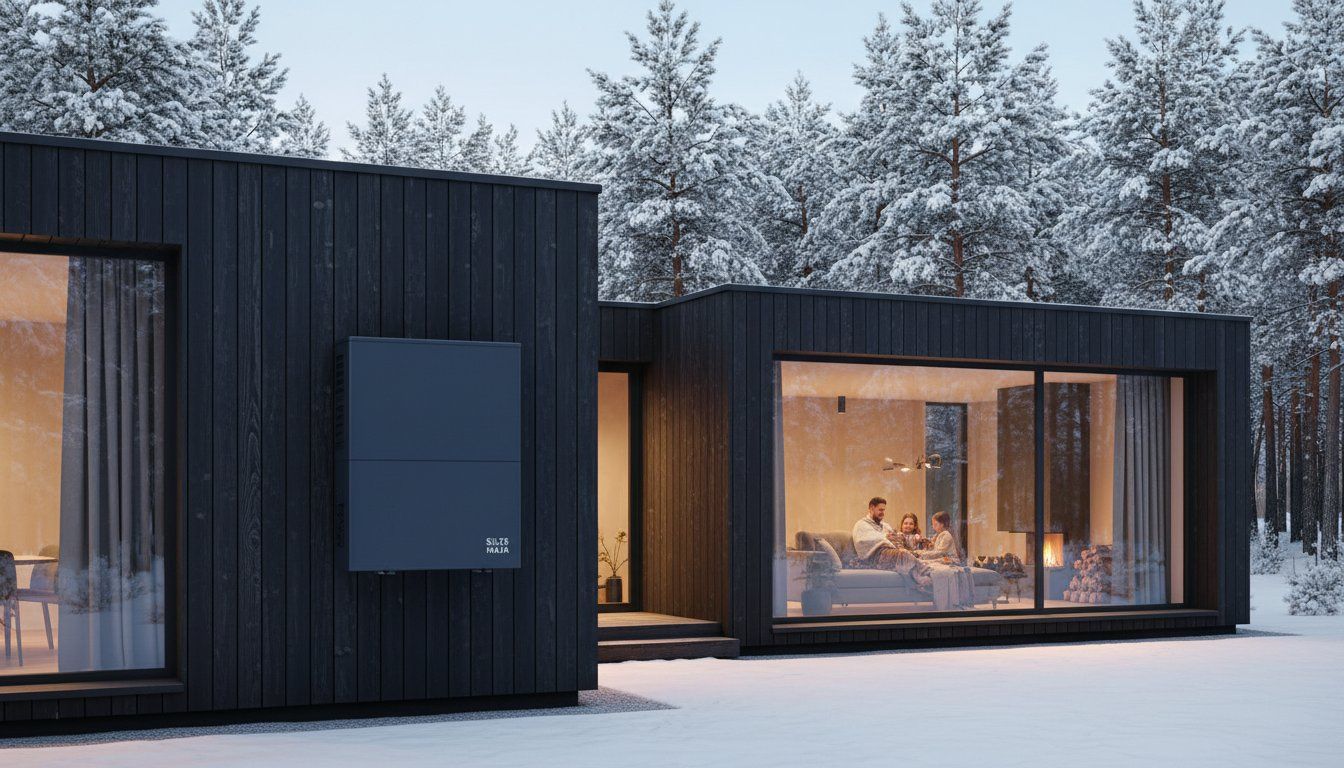
Do you believe that heating a home can cost less than a monthly grocery shop even when temperatures in Latvia fall below -20°C? We know that high electricity prices and justified concerns about system capacity during severe winters cause many people to hesitate, yet modern heat pumps have proved to be the most reliable route towards energy independence and peace of mind. At Commodus, we see every day that clarity and trustworthy advice are exactly what people need so that choosing between an air-to-water or ground-source heat pump no longer feels like a complicated technical puzzle, but a logical step towards comfort.
This guide is designed to give you complete confidence in selecting the most suitable solution for your home. You will learn about the current equipment types, their real efficiency under 2026 market conditions and state-support programmes that can currently save several thousand euros on installation costs. We examine the entire process, from accurate calculations using our heating calculator to professional maintenance, so that low monthly payments and comfortable warmth can become your new reality without unnecessary concerns.
Key takeaways
- Understand the differences between popular air-to-water and highly efficient ground-source heat pumps so that you can choose the solution best suited to your home and budget.
- Learn how to apply for EKII and Altum state-support programmes in 2026, substantially reducing the initial investment and shortening the payback period.
- Discover why an accurate heat-loss calculation and a professional on-site survey are the only reliable ways to guarantee system efficiency and avoid mistakes.
- Learn about the Commodus philosophy: we do not merely install equipment, but work alongside you and provide personal support from the first consultation through to regular maintenance.
Heat pumps in 2026: Why have they become the first choice for Latvian households?
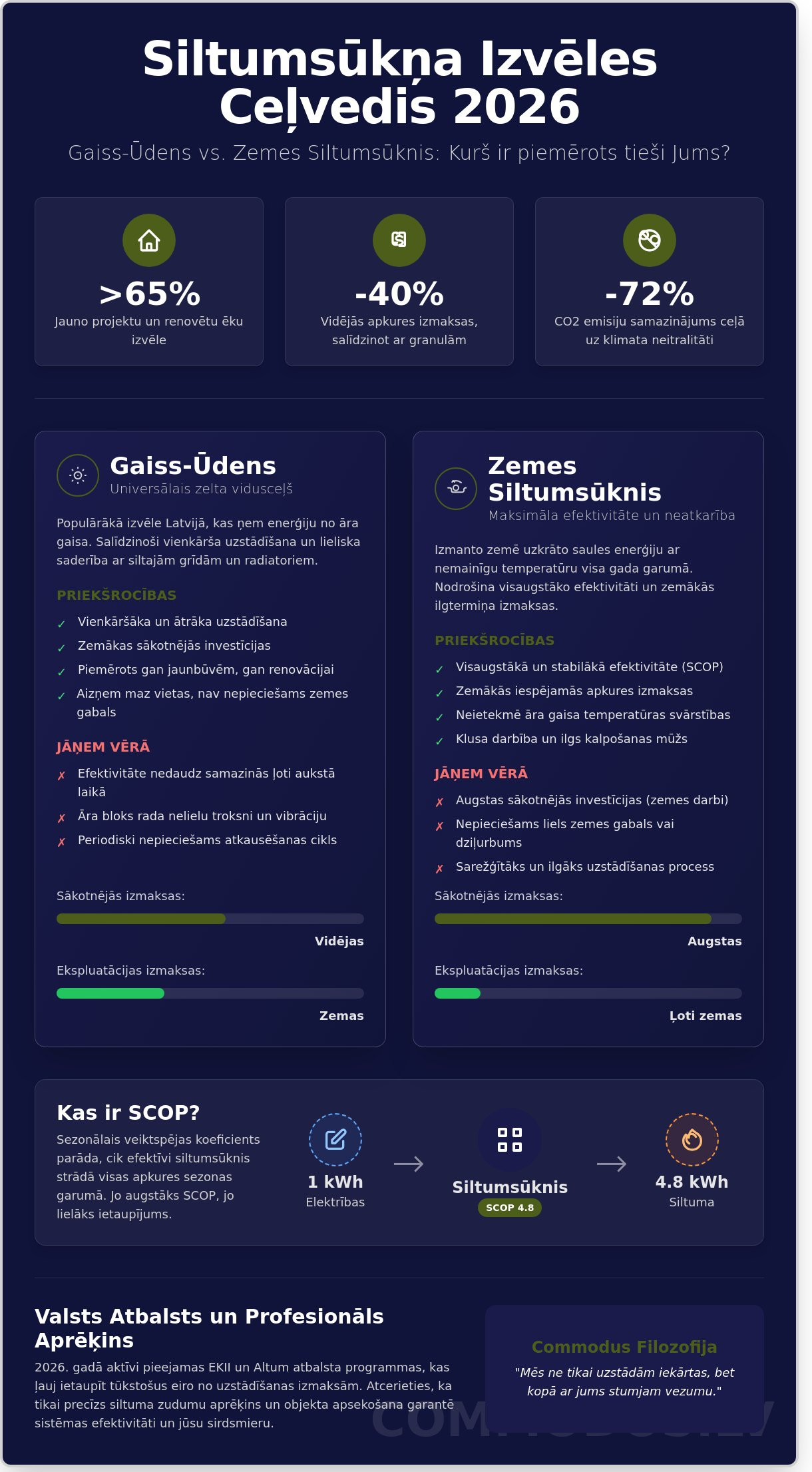
The year 2026 has brought significant changes to Latvia's energy sector. More than 65% of new residential projects and renovated buildings now choose this solution. What is a heat pump? Essentially, it is a highly efficient unit that does not generate heat from nothing, but transfers it from the surrounding environment, such as the outdoor air, into your home. Heat pumps operate according to renewable-energy principles, making heating independent of fluctuations in fossil-fuel prices, which has become a decisive factor for many families in recent years.
Environmental responsibility and economics go hand in hand in 2026. Average heating costs for a house with a correctly installed system are currently 40% lower than with pellets or natural gas. CO2 emissions can be reduced by as much as 72%, directly helping Latvia move towards its climate-neutrality targets. At Commodus, we see that customers are no longer looking only for the cheapest product, but for a sustainable investment that pays for itself within the next five to seven years.
A common myth concerns system performance during severe frost. In reality, modern units have been tested and can heat homes efficiently even at -30°C. This is achieved through improved compressors and intelligent controls. When a system is professionally sized according to the building's heat loss, indoor comfort remains stable regardless of the weather outside.
How does a modern heat pump work?
The heart of the unit is the thermodynamic cycle. The evaporator absorbs energy from the outdoor air even at sub-zero temperatures. The compressor then compresses this energy, significantly increasing its temperature. The condenser transfers the resulting heat to the home's heating circuit. When selecting equipment, it is important to consider COP and SCOP values. For example, an SCOP of 4.8 means that, on average across the season, 1 kWh of electricity provides 4.8 kWh of heat. Inverter technology ensures that the system does not operate at full capacity continuously, but adapts precisely to the required heat demand and saves electricity.
Advantages of heat pumps compared with fossil fuels
- Complete automation: Forget about stacking firewood or carrying bags of pellets every evening. The system works automatically and can be controlled from your smartphone wherever you are in the world.
- Multifunctionality: One unit solves two problems. It provides heat in winter and pleasant cooling on hot summer days, replacing an air conditioner.
- Maximum safety: There is no open flame in the home, no chimney that could catch fire and no risk of gas leaks. This provides genuine peace of mind, especially for families with young children.
Our practical mindset and years of accumulated experience show that heat pumps are not merely a passing trend. They are a considered choice for a sensible homeowner who values time and long-term financial stability.
Which heat pump should you choose? The three main types and their suitability
Choosing a heat pump is one of the most important decisions you will make when improving your home. It is not only about heating, but about peace of mind and predictable costs for years to come. Three main solutions dominate in the Latvian climate, each with its own strengths and specific installation requirements.
Air-to-water heat pumps: The balanced choice
This is the most sought-after option in Latvia because the system is versatile and relatively straightforward to install. It works best with underfloor heating, where a low flow temperature provides maximum comfort. When choosing between monobloc and split systems, installation details must be considered. A monobloc is one compact outdoor unit in which the entire heat-exchange process takes place, whereas a split system has both indoor and outdoor units. These heat pumps also prepare domestic hot water efficiently and can be integrated with hot-water cylinders, which is essential for any family of four or five people.
Ground-source heat pumps: Maximum independence
If the objective is the highest possible efficiency and the lowest operating costs, a ground-source heat pump is unrivalled. It uses the stable temperature of the ground, which remains virtually unchanged even during January frost. Research by the International Energy Agency confirms that heat pump efficiency and long-term savings depend directly on the stability of the heat source, and the ground leads in this respect.
- Horizontal ground collector: Suitable when you have a large plot of land in which a pipe system can be buried at a depth of approximately 1.2 metres.
- Vertical borehole: An ideal solution where space is limited, as heat is extracted from deeper ground layers.
The service life of a ground-source system often exceeds 25 years, making it a secure investment in the future. These heat pumps provide complete independence from fluctuations in outdoor air temperature.
Air-to-air heat pumps: A quick and efficient solution
Air-to-air systems are an excellent addition to existing wood or pellet heating and an ideal option for small homes or summer houses. They are quick to install and serve as powerful air conditioners during summer heat. Although they are not designed to heat water, their ability to warm a room rapidly is invaluable during the transitional seasons.
To determine which solution is right for you, three main criteria should be assessed: the available land area, the existing heating system and the planned budget. At Commodus, we are ready to work alongside you and help identify the most technically appropriate solution for your home. To learn more about the advantages of each model, view our range and consult our experienced specialists.
Efficiency and payback: State support and long-term savings
Installing a heat pump is one of the most sensible financial decisions a homeowner can make. Although the initial investment may appear substantial, state support and low operating costs make this technology a cost-effective choice. Significant support programmes administered by Altum and the Environmental Investment Fund (EKII) remain available in Latvia in 2026. These programmes can cover up to 50% of the equipment purchase cost, significantly shortening the period in which heat pumps fully pay for themselves.
ROI, or return on investment, is calculated by comparing existing heating costs with the forecast electricity consumption and system maintenance. With state co-financing, the average system in a Latvian household pays for itself within five to seven years. The cheapest offers on the market should be treated with caution. They often have a low COP, resulting in higher monthly electricity bills and a shorter equipment life. By choosing a high-quality solution, you are paying for efficiency that can save thousands of euros over the long term.
Steps for obtaining state funding
The application process requires accuracy and compliance with specific criteria. The following documents are required to receive support:
- A Land Register document and confirmation that the building has been commissioned.
- A quotation and design prepared by a certified contractor.
- An equipment energy-efficiency certificate rated A++ or higher.
At Commodus, we understand that preparing documents can appear complicated. We therefore help customers compile all required documentation so that applications can be approved without delays. We work through the process together so that bureaucracy does not become an obstacle to your comfort.
Heat pump and solar panels: The ideal combination
This combination is the most direct route towards a net-zero-energy home. Electricity generated by solar panels during the summer months is exported to the grid, while in winter it covers a large proportion of the energy consumed by heat pumps. Thanks to Latvia's net-billing system, the savings are immediate and visible on every bill.
Smart energy management allows the system to adapt automatically to electricity-market prices. The unit can operate more intensively when electricity is cheaper, storing heat in the building structure or a buffer tank. Compared with standard settings, this approach reduces total costs by approximately 15–20%. It is not merely a technical solution, but an intelligent way to manage household finances while caring for the environment.
Heat pump installation: From design to the first warm evening
Many homeowners make the mistake of assuming that choosing a heating system ends with purchasing the equipment. At Commodus, we have learned that high-quality installation accounts for at least half of the success. Everything begins with an objective assessment. A quotation given over the telephone is often only an approximation because, without an on-site inspection, it is impossible to determine the building's energy efficiency or the condition of its existing services accurately. Only by seeing the property can our engineers calculate the actual heat loss, which forms the basis for selecting the correct capacity.
Engineering design ensures that heat pumps are integrated into the home's infrastructure without unnecessary complications. This includes not only selecting locations for the outdoor and indoor units, but also checking the electrical capacity and designing the hydraulic layout. Installation itself usually takes one to three working days. The first stage involves preparing the base and fitting the outdoor unit, followed by installation of the indoor unit and connecting pipework. Once the mechanical work has been completed, the most important stage follows: commissioning, venting and precise adjustment according to the customer's habits. We do not regard the work as complete until the user has been fully trained to operate the control panel or smartphone application.
Five critical mistakes when choosing a heat pump
- Incorrect capacity calculation: If the system is too small, it will operate under excessive strain; if it is too large, it will switch on and off frequently, increasing electricity consumption by approximately 15%.
- Ignoring maintenance: Even the best unit loses efficiency if filters and heat exchangers are not cleaned regularly.
- Poor acoustic isolation: An unsuitable outdoor-unit location or the absence of anti-vibration mounts can create a humming noise that disturbs neighbours or residents.
- Low-quality ancillary materials: Saving money on pipe insulation or fixings can cause heat losses before the energy even reaches the radiators.
- Incompetent installation: By choosing uncertified installers, the customer risks losing the manufacturer's warranty, which normally lasts between two and five years.
Why is design more important than the equipment itself?
Heat pump efficiency depends directly on hydraulic balancing. This process sets the correct flow rate in each heating circuit, ensuring that the bathroom and living room reach exactly the temperatures you intended. Without professional design, even the most expensive heat pumps may operate inefficiently and place unnecessary strain on the compressor. By selecting certified installation specialists, you obtain not only heat but also legal protection. A correctly completed handover certificate and system commissioning report are the key documents that guarantee manufacturer support in any situation. We believe every customer should feel secure knowing that experienced specialists are responsible for the climate in their home.
To find out which solution is most suitable for your home, contact Commodus experts and receive professional advice today.
Commodus experience: We do not merely sell equipment — we work alongside you
Commodus is founded on the belief that a successful project does not end when the invoice is paid or the equipment is delivered. We believe in personal responsibility and honest treatment, so we approach every property as if it were our own. This philosophy enables us not only to sell modern technology but also to become a trusted partner who remains with you from the first sketch through to regular system maintenance ten years later. Our customers feel secure because we provide comprehensive support, from a free consultation and accurate calculations to after-sales service throughout Latvia.
Our team consists of energetic professionals who genuinely care about the warmth and energy efficiency of your home. We are practical specialists who are not afraid of difficult technical challenges, whether the work involves a small detached house or a large industrial facility. Commodus provides a complete service cycle. This means that we design, sell, install and maintain the systems ourselves. This approach guarantees strict quality control at every stage and eliminates communication errors between different service providers.
Why choose Commodus for your project?
More than 15 years of experience in the Latvian market is our greatest strength. During this time, we have helped thousands of customers find the optimum heating solution and accumulated knowledge that cannot be learned from manuals alone. Our warehouses stock a broad range of equipment from leading global manufacturers. We take an individual approach to every project and analyse the specific characteristics of the building so that the selected heat pumps operate at maximum output with minimum costs.
Long-term cooperation and technical support
We believe regular maintenance is the principal key to system longevity. Just as a car requires routine inspection, modern heat pumps require professional servicing to retain their efficiency. Our service team is distinguished by rapid response times and availability throughout Latvia. By choosing us, you gain the assurance that your home will remain warm in any situation and that support will be available when you need it most.
Contact Commodus experts and receive your personalised offer!
Warmth and peace of mind in your home as soon as tomorrow
Choosing a modern heating system in 2026 is no longer merely a technological decision, but a carefully planned investment in your family's future. State-support programmes and energy-efficiency requirements clearly indicate that heat pumps have become the most reliable solution for Latvia's climatic conditions. Since 2010, the Commodus team has accumulated the experience needed to work confidently alongside you and provide a complete service cycle from design through to regular maintenance.
Our certified specialists work with equipment from the world's leading manufacturers, ensuring system longevity and maximum performance. We understand that every house is unique, so we provide an individual approach and accurate calculations based on real data rather than rough estimates. Entrust your comfort to professionals who care not only about technical execution but also about your long-term savings and the warmth of your home.
Receive a free consultation and an accurate heat pump calculation for your home!
Let us begin work on your new heating system today so that next winter is pleasantly warm and economically efficient.
Frequently asked questions
Is a heat pump efficient enough for Latvian winter conditions?
Yes. Modern air-to-water heat pumps are fully suitable for Latvia's climate and heat homes efficiently even when the outdoor temperature falls to -25°C. Although the unit's Coefficient of Performance decreases during severe frost, it continues to provide the necessary comfort without supplementary heaters. Our experience shows that correctly selected capacity guarantees warmth even on the coldest January nights.
How much electricity does a heat pump consume per month?
During winter, an energy-efficient 150 m² detached house consumes approximately 450–650 kWh of electricity per month for heating and domestic hot water. The precise bill depends on the quality of the building's insulation and the selected indoor temperature, which each customer chooses individually. Smart control systems and operation adjusted to electricity-market prices can reduce costs by approximately 15%.
What state support is available for heat pump installation in 2026?
State-support programmes administered by Altum and the Environmental Investment Fund are also planned for 2026 to help achieve the European Union's climate targets. Current funding covers up to 50% of the equipment purchase cost, subject to a maximum of EUR 4,400 per project. We help customers prepare the required documentation so that the process is as straightforward and understandable as possible.
Can a heat pump be installed in an older house with radiators?
A heat pump can be installed in a house with an existing radiator system, although the radiator surface area and building heat loss must first be assessed. If the system was designed for high temperatures, purpose-designed high-temperature heat pumps capable of heating water to 70°C are the best option. In some cases, we recommend replacing individual radiators with larger units so that the system operates at maximum efficiency and lower cost.
How often does a heat pump require technical maintenance?
Technical maintenance should be carried out once a year and is best scheduled before the heating season begins in September or October. During a routine inspection, the specialist cleans the filters, checks refrigerant pressure and verifies the safety of the electronic components, helping prevent sudden failures in the middle of winter. This care preserves the manufacturer's warranty and ensures that the system operates at maximum efficiency throughout the season.
What is the average service life of a heat pump?
High-quality heat pumps that receive regular maintenance operate reliably for 15 to 25 years. The compressor is the main component, and its life depends on correctly configured operating cycles and timely intervention by service specialists. By choosing a proven brand and professional installation, you obtain a stable heating solution that can serve several generations without requiring major repairs.
Does a heat pump generate significant noise during operation?
Modern units operate very quietly, normally producing 35–50 decibels, which is comparable with a quiet conversation. The position of the outdoor unit is planned carefully so that it does not disturb residents or neighbours. Inverter technology ensures smooth fan operation, so the unit does not create sudden loud noises even when running at full capacity.
Why choose an air-to-water system instead of gas heating?
An air-to-water system provides complete independence from gas pipelines and fluctuations in fossil-fuel prices, which have become unpredictable in recent years. It is also safer because there is no open flame in the home and no concern about flue-gas leaks or chimney cleaning. Heat pumps increase property value and offer a sustainable solution that aligns with modern expectations for environmentally responsible living.
Comments