How fast does the heat pump heat water? What does waiting time depend on
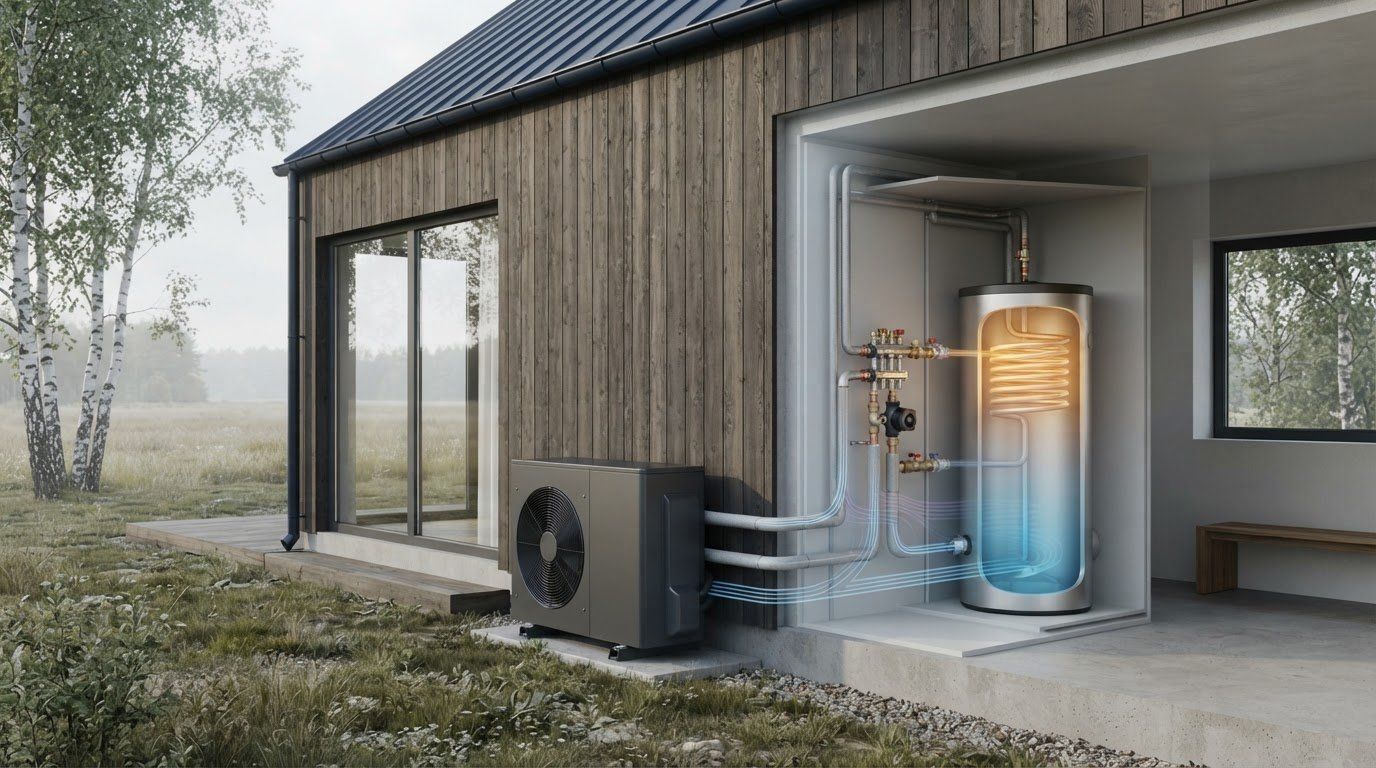
Does a larger heat pump always mean that the water for a shower will be ready faster? Not quite. The question of how fast the heat pump heats water is, there is no single answer: the waiting time is determined not only by the power of the plant, but also by the capacity of the tank, the temperature of the water starting and the construction of the system.
If hot water is used by several people in turn, it is important to understand whether the system is capable of preparing it according to household habits. Only the heat pump capacity or the size of the boiler may be overlooked how these parts work together.
In this article you will find out what affects the duration of water heating, how to evaluate the system in practice and why the heat pump has to be coordinated with the hot water storage tank. We will also look at the importance of outdoor temperatures and the desired water temperature.
How fast does the heat pump heat up water, and why is there no one answer?
One universal heating time cannot be named. The speed with which the heat pump heats water depends on the specific system and its operating conditions. To achieve the set temperature, the water tank usually means the quantity of water, the starting and desired temperature, the heat pump power and the heat transfer. A larger tank or cooler starting water usually means longer heating.
In short: different homes heat water differently because of different consumption, tank capacity, starting conditions and the construction of the entire heating system.
What does it mean to have water?
This article understands when the water tank reaches the temperature set in the system. It is not a mandatory value for all homes: settings may vary depending on the system solution and user needs.
The water should be separated in a warm water tank from the availability of hot water in the tap. After heating water still has to pass through the pipes to the place of use, therefore waiting at the tap is not the same as the time of heating the tank.
Why is the type of heat pump and system design important?
Air-water heat pump generates heat from outdoor air and transfers it to water heating system, including for hot water. Its operation cannot be assessed in isolation from the tank and other parts of the system. A more detailed view of the principle of such a solution provides a more detailed view of the principle of operation heat pump water heater description.
Therefore, when assessing waiting time, look at the whole system, not just heat pump capacity. The calculation of the system and smart design help to align the equipment, tank and household needs.
How does the heat pump heat water and what determines the duration of the process?
The heat pump takes heat from the environment and, by means of a refrigerant, compressor and heat exchanger, transfers it to the water in the tank. Simply put, the unit transfers heat from one source to water by using electricity to ensure its operation. Therefore, the question of how fast the heat pump heats water, is related to both the power of the unit and the amount of heat needed for the water.
The larger container has more water to be heated. If the water is cooler at the beginning, more heat must be added to the set temperature than if it is already partly applied. The heat pump's capacity is a measure of the amount of heat the unit can deliver in a given time, but this alone is not sufficient to predict the duration of the process.
The heat duration is most affected by the quantity of water, the starting and the desired temperature, the heat pump capacity and the conformity of the heat exchanger to the system.
What is the role of boilers and heat exchangers?
The boiler or hot water storage tank stores water, but the heat exchanger transfers heat to it from the heat pump. If the tank and heat exchanger are not suitable for the installation, the heat transfer may not be in accordance with the intended operating mode. Therefore, these parts should be selected together, also taking into account household hot water consumption.
How does heat pump capacity affect water heating?
More power can help to heat water faster if the rest of the system is able to transfer this power to the tank. However, it does not solve the problem of inappropriate heat exchangers or improperly selected tanks. The real operation is also affected by control settings and whether or not simultaneously the heat of the rooms is needed.
If you are considering an air-water solution, see CTC air-water heat pumps and assess them as part of a harmonised system.
How to assess practically how fast the heat pump will warm up the water?
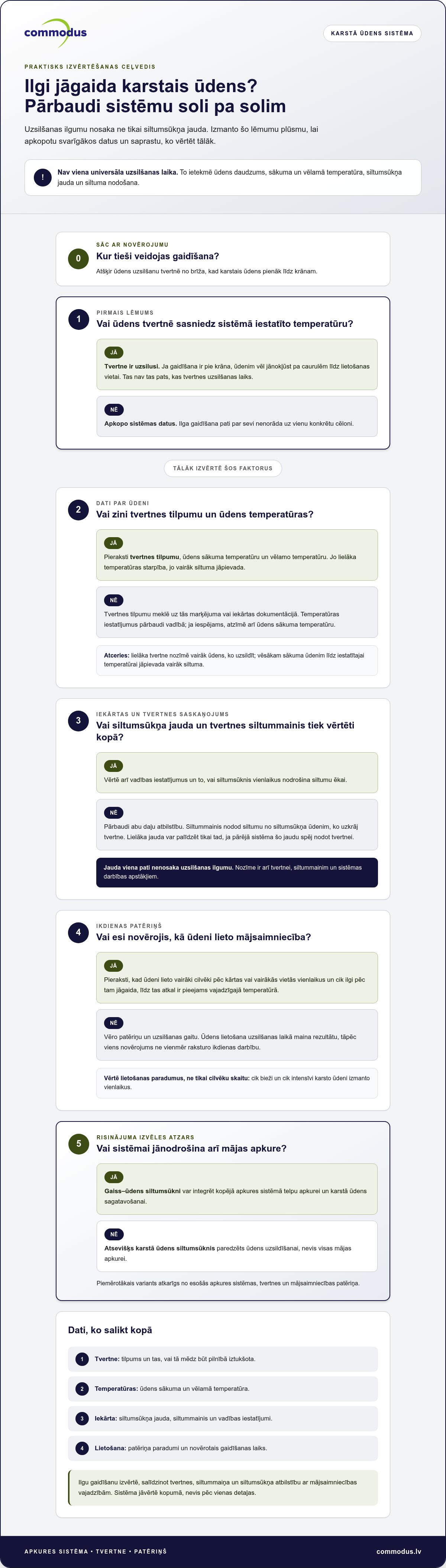
To understand how fast the heat pump heats water in a particular house, collect system data instead of relying on a general warming time. This sequence will help you understand what to evaluate and what information to provide when evaluating the system.
- Check the volume of the container. It can usually be found on the container label or on the equipment documentation. Also note whether the container tends to be completely empty or the water is used gradually.
- Find out the start and desired temperature. Check the control settings and, if possible, check how warm the water is before heating. The greater the temperature difference, the more heat you need to add.
- Check heat pump power and heat exchanger of the tank. These data should be evaluated together. Also important is the control settings and whether the installation at the same time provides heat for the building.
- Watch consumption and heat. Record when the water is used by several people in a row and how long it should be taken to allow it to be available again at the required temperature. The water use changes the result during warming, so one observation does not always describe daily activity.
How to determine whether the scheme is compatible with household consumption?
In addition to assessing the number of users, consider how often and how intensively hot water is used at the same time. For example, successive applications can cause pressures other than the use of several water applications at the same time.
How to interpret long warming times?
First, record the settings and the observed performance, then evaluate the compatibility between the tank, heat exchanger and heat pump. Long waiting does not in itself indicate one specific cause.
To evaluate the heat pump and tank solution according to your home data, consult the Commodus heat pump calculation and system design services.
How to choose a heat pump solution for reliable hot water preparation?
The choice begins with the needs of the dwelling: whether only hot water is needed, or one system will ensure both water preparation and heating. Therefore, when assessing how fast the heat pump heats water, not only the tank and equipment, but also the everyday tasks of the solution should be taken into account.
When to consider air-water heat pump?
If the housing needs a solution for both space heating and hot water, the air-water heat pump can be integrated into the overall heating system. A separate heat pump for hot water is designed for water heating rather than for heating the whole house. CTC air-water heat pumps as one of the possible solutions.
- The system's task: separate solution prepares hot water, but air-water system can also provide home heating.
- Housing needs: assess whether one or both functions should be provided and how hot water is used in everyday life.
- Information required for the calculation: heating system, heat pump capacity, tank capacity and consumption patterns.
How does Commodus help you to find a system?
The specialists advise, calculate and design heating systems, as well as perform their installation and maintenance. In the calculation, the heat pump is assessed together with the tank and housing for heating needs, not as a separate installation. Thus, the choice can be based on the data of the system and the planned use.
To evaluate the solution of your home, contact Kommodus about heat pump solution. Experts will help to discuss needs and next steps in calculation and design.
Choose a solution for your daily rhythm
The hot water system is suitable if it is appropriate for household everyday life. Therefore, the question • How fast the heat pump heats water • is it worth adding another: will hot water be available when it is most needed? This view helps to evaluate the solution in the long term.
Before choosing to consider which day water consumption is the highest and whether the heating system should also provide space heat. Clearly formulated needs help specialists to evaluate the solution for the particular housing. You do not need to know all the technical answers in advance. Start with everyday habits and questions about the current solution.
If you want to take the next step, tell Commodus specialists about your home needsThis will help to move towards a smart choice and better understand how to ensure that hot water is provided in everyday life.
Frequently asked questions about heat pump water heating
Does the air-water heat pump heat both the house and water?
Yes, the air-water heat pump can be designed for both home heating and domestic hot water, but both functions depend on the specific system. When assessing an existing or planned solution, look at the description of the system and check whether it also includes the preparation of hot water. This helps to understand what task the equipment is scheduled to perform.
Does the heat pump always need a separate boiler?
No, it cannot be generalised to all equipment. Hot water storage solution depends on the configuration of the equipment and housing needs. See the equipment documentation and system diagram to understand whether water storage is provided in a separate boiler or other configuration. When planning the system reconstruction, evaluate the overall solution, not just the tank.
Why can hot water end, although the heat pump is running?
Water may not be available at the time of use, even if the equipment is running, because the system may take time to restore the hot water supply. To assess the situation, write down when it happens and whether the problem affects all water use areas. Also, look at the control display for warning and discuss observations with Kommodus specialists.
Can the temperature setting of the heat pump be changed?
The ability to change the settings depends on the installation and its control system. Read the instructions for use before changes and write down the current setting to allow it to be restored if necessary. Use the controls provided for the user and do not change parameters that are not clear. If the instructions do not respond, the Kommodus specialists can explain the settings.
Can the heat pump heat water if the house is at the same time consumed?
This can be evaluated, but without the data of the system, it is not possible to reliably determine the amount of hot water or recovery time. Before selecting the system, describe a typical point of loading, for example, when showering and kitchen-washed dishes are used in a row. Such daily scenario helps to predict the actual use in design rather than just based on the approximate number of users.
Comments