Hybrid Heating Systems: An Efficient and Reliable Solution for Latvian Homes in 2026
Have you ever wondered whether your heating boiler could be smarter than the energy market? Most of us know the unpleasant feeling of bills rising unpredictably or the justified concern about heat pump efficiency on a January night at minus 25 degrees. In Riga, the difference in heating prices between different producers reached as much as 36% in January 2026, clearly demonstrating how risky it is to rely on a single energy source. At Commodus, we believe that working together towards energy independence begins with a carefully considered and reliable technical solution that will not let you down when you need it most.
In this article, you will learn how modern hybrid heating systems can automatically select the cheapest energy source at any given moment, providing maximum comfort and significantly lower monthly bills. We will explain how to apply for up to EUR 15,000 of support under the EKII programme by December 2026 and why the new energy-efficiency requirements entering into force on 29 May 2026 make this the ideal time to modernise your system. Prepare for a practical guide that will help you create a warm, safe and financially predictable environment in your home, regardless of changing weather conditions.
Key takeaways
- Discover how hybrid heating systems combine the efficiency of a heat pump with the reliability of a conventional boiler, ensuring warmth in your home even at -25°C.
- Learn how the bivalent point allows the system to switch automatically to the least expensive energy source, protecting you from unpredictable fluctuations in energy prices.
- Understand which combinations — a heat pump with gas or pellets — are best suited to your particular type of home and existing heating system.
- Find out why an accurate heat-loss assessment and a check of radiator operating temperatures are critical steps in avoiding unnecessary investment in excessively powerful equipment.
- Discover how Commodus's individual approach and 15 years of experience can help create a heating solution that will operate safely and efficiently for decades.
What are hybrid heating systems and why are they becoming the standard of the future?
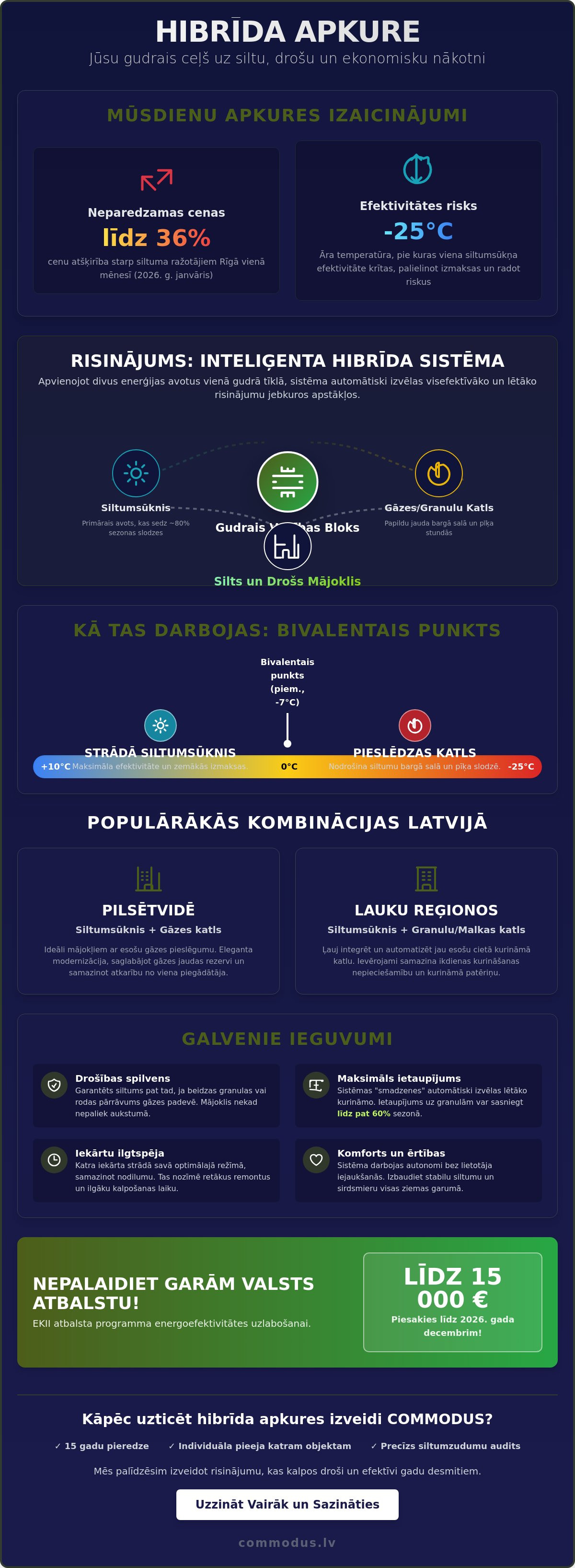
In 2026, Latvia's energy market has become a dynamic and sometimes unpredictable environment. When heating prices between different producers in Riga differed by 36% in January, relying on a single resource was like cycling on ice. This is where hybrid heating systemscome into play. They are essentially intelligent solutions that combine two or more energy sources within a single network. This approach ensures that your home never becomes cold, even if one resource becomes too expensive or technically unavailable.
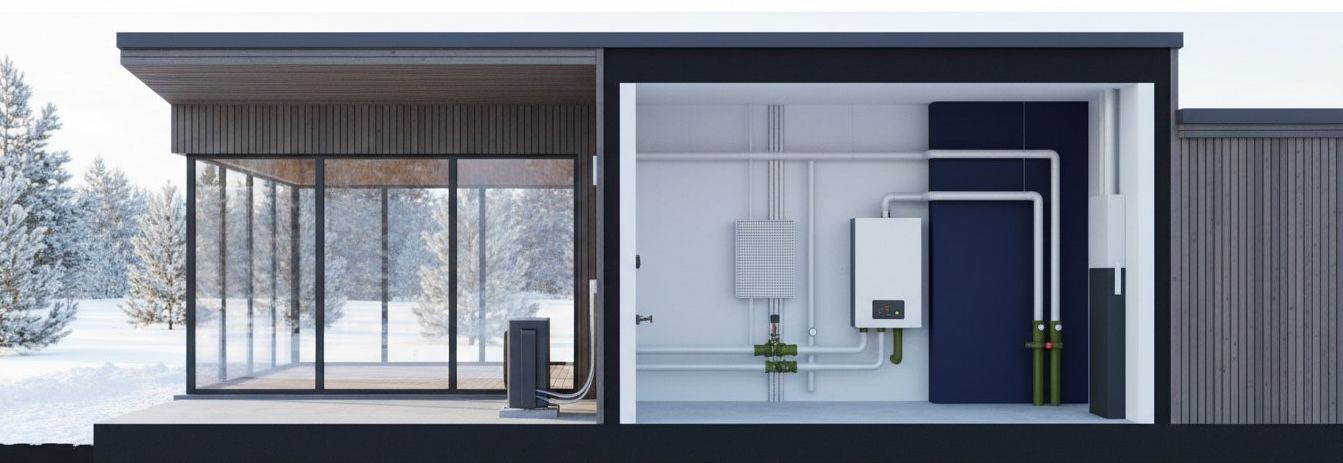
In essence, it is a home-adapted hybrid energy systemwhose main purpose is to manage heat generation intelligently. Unlike conventional solutions, a hybrid system is not tied to a single technology. You can choose a ready-made monobloc hybrid with all components housed in one unit, or create a combined system by supplementing your existing gas or pellet boiler with a modern heat pump. At Commodus, we often see that this flexibility is exactly what gives customers the greatest peace of mind.
The economic advantage lies in the system's ‘brain'. It continuously analyses the outdoor temperature and electricity prices. When the weather is mild, the highly efficient heat pump operates. As soon as severe frost arrives and the heat pump's efficiency falls, the controller automatically activates the secondary source, such as a pellet boiler. This means that your home is always heated with the resource that is cheapest and most efficient at that particular moment.
Components of a hybrid system
A high-quality system generally rests on three pillars. The primary source is usually an air-to-water heat pump, which covers approximately 80% of the load over the entire heating season. The secondary source, such as a condensing gas boiler or wood-fired boiler, is activated only during peak demand or particularly cold nights. The entire process is coordinated by a smart controller, which is the heart of the system and ensures harmonious operation of both units without user intervention.
Why choose a hybrid system instead of a single unit?
The main argument is the additional safety margin. If pellets run out in the middle of January or there is a temporary interruption to the gas supply, the heat pump takes over. The service life of the equipment is also significantly extended. The heat pump does not have to operate at the limit of its capacity at minus 25 degrees because the boiler takes over this ‘heavy work'. Each unit operates within its optimal range, resulting in fewer repairs and lower long-term maintenance costs. New energy-efficiency requirements enter into force on 29 May 2026, and a hybrid solution is one of the safest ways to prepare your home for them today.
The most popular hybrid heating combinations in Latvian homes
The diversity of Latvian homes requires flexible solutions. There is no single universal model for everyone, so hybrid heating systems are designed with the building's location and the resources already available in mind. In urban areas with a natural-gas connection, the most popular choice is a combination of a heat pump and a condensing gas boiler. It is an elegant way to modernise an older system without giving up the gas capacity reserve needed when the temperature falls below -20°C. This combination is particularly relevant for residents of Riga and its surrounding areas who want to reduce their dependence on a single supplier.
The situation is different in rural properties and regional areas. A reliable pellet or wood-fired boiler that is still in good working order is often already installed. Hybrid heat pump systems allow these units to be retained and integrated into a smart network. Instead of firing the boiler every day in autumn, the heat pump does the work using free energy from the outdoor air. It is a practical way to work towards lower bills without losing the familiar feeling of warmth.
Synergy between a heat pump and a pellet boiler
Many of our customers ask how these two units are integrated in practice. It is simpler than it may seem. The controller automatically starts the pellet boiler only when the heat pump can no longer provide the required temperature or when the electricity price on the exchange suddenly rises sharply. This automation can reduce pellet consumption by up to 60% during the season because the boiler operates only during the most severe frost. A buffer tank plays an important role here. It acts as an energy reservoir that stabilises the system and prevents the heat pump from switching on too frequently, thereby protecting the compressor and extending the unit's service life.
The role of solar energy in a hybrid system
The year 2026 has brought new standards in which solar panels are no longer an exotic extra but a necessity. In March, April and October, when Latvia has many sunny days but the air remains cool, the energy generated by solar panels can fully supply the heat pump. This means that heating during these months costs almost nothing. In summer, solar collectors or panels provide domestic hot water, allowing the heating boiler to remain completely idle. A smart inverter is an essential part of such a system. It acts like an experienced traffic controller, directing self-generated electricity to where it is needed most. If you are planning your home's energy future, we invite you to explore our heating solutionsso that together we can find the most suitable combination of technologies for your home.
Integrating wood heating into a hybrid system is another trend particularly characteristic of Latvia. It allows traditions to be preserved and locally prepared fuel to be used while still enjoying the comfort of an automated heat pump. You no longer need to get up at five in the morning to light the stove because the system itself understands when additional output is required.
Efficiency of a hybrid system in Latvian winter conditions
Latvian winters can be unpredictable, and the myth that a heat pump simply ‘freezes' at minus 20 degrees still worries many homeowners. In reality, modern technology continues to operate, although its efficiency, or COP, inevitably falls in severe cold. This is precisely where hybrid heating systems demonstrate their greatest advantage. Instead of forcing the heat pump to operate at maximum load while electricity consumption rises, the system intelligently switches to the second heat source. This happens automatically when the so-called bivalent point is reached — the moment when operating the heat pump becomes less economical than using gas or pellets.
It is important to understand that a hybrid solution also provides security. If there is a prolonged power cut, as happens every year during winter storms in Latvia, the combined system makes it possible to keep the home warm. While a standalone heat pump will not operate without electricity, a pellet or wood-fired boiler can be powered by a small battery unit or generator because electricity is needed only for the circulation pumps. The recommendations of the Ministry of Climate and Energy clearly indicate that energy independence and combining different resources should be priorities for every forward-looking household.
Operating modes at different temperatures
System efficiency changes with the weather. When the temperature is above +5°C, only the heat pump operates, delivering a COP of more than 4.0. Between +5°C and -10°C, the system operates in combined mode: the heat pump provides the base heat while the boiler starts only when necessary. When the temperature falls below -15°C, the controller assigns the main load to the fuel boiler. This approach not only saves money but also significantly protects the equipment because neither unit has to operate at the limit of its capacity.
Payback and long-term benefits
The initial investment in a hybrid system may appear higher, but it pays off through stability and lower operating costs. EKII support is available in Latvia until December 2026, providing up to EUR 15,000 for the installation of new environmentally friendly heating equipment. At Commodus, we have helped hundreds of customers prepare the necessary documentation so that state support becomes a genuine saving. In addition, a home with an A- or B-class energy-performance certificate can be worth 10–15% more on the property market, which is a significant benefit if you decide to sell in the future. This is intelligent long-term progress, where every euro invested contributes to your comfort and peace of mind.
How should a hybrid system be selected and designed? Practical advice
Careful design is the foundation for ensuring that hybrid heating systems work like clockwork. The process begins not with an equipment catalogue, but with an audit of your home's existing infrastructure. Considering that more than 90% of Latvia's apartment buildings and a large proportion of private homes were built before 1993 with poor thermal performance, the first task is to determine the actual heat losses. At Commodus, we always check the surface area of radiators and their ability to operate at lower temperatures. If your existing radiators are designed for water at 75 degrees, a heat pump alone will struggle. In a hybrid system, we resolve this by allowing the heat pump to provide the base load and activating the boiler only when hotter water is required.
One of the greatest benefits of choosing a hybrid system is optimisation of equipment capacity. You do not need to purchase an expensive and oversized 16 kW heat pump merely to cover three exceptionally cold nights a year. Instead, you can choose a more compact 9 kW model that operates efficiently for most of the season and leave peak demand to the existing gas or pellet boiler. This approach not only reduces the initial investment but also prevents heat pump ‘short cycling' — excessively frequent switching during spring and autumn, which is one of the main causes of equipment wear.
Critical design considerations
For the old boiler and the new heat pump to work together properly, the hydraulic connection must be designed correctly. This usually means installing a heat exchanger or hydraulic separator so that the flow from each unit does not interfere with the other. It is also critically important to check the capacity of the electrical connection. Although the heat pump in a hybrid system is smaller, it still requires a stable power supply. Do not forget the chimney and ventilation if combustion equipment is retained. The 2026 requirements impose stricter energy-efficiency standards, so every component must be designed with the future in mind.
Automation and user comfort
A modern hybrid system is impossible to imagine without smart control. Unlike competitors that often offer complicated and unclear controllers, we emphasise a unified ecosystem on your phone. The mobile app allows you not only to see which unit is operating, but also to set a priority: ‘economy' or ‘comfort'. If you select economy mode, the system monitors electricity exchange prices and switches to the alternative fuel whenever it is more cost-effective. Commodus service also offers remote diagnostics: we can view your system online and often prevent a fault before you even notice it. To make sure your home is ready for such changes, we invite you to book a professional heating-system auditduring which our specialists will assess all technical aspects on site.
Simple maintenance is another cornerstone. Users can monitor system pressure or clean filters themselves, but once a year it is important to invite a specialist to check the synchronisation of both units. It is another example of working together: we provide the technical support so that you can enjoy warmth without worry.
Why entrust the creation of a hybrid heating system to Commodus experts?
At Commodus, we understand that choosing a heating system is not merely a technical purchase. It is a decision about your home's comfort and peace of mind for the next two decades. That is why we do more than sell equipment. Our philosophy is to work alongside the customer from the first sketch of an idea through to annual maintenance ten years later. With more than 15 years of experience in the Latvian market and thousands of systems installed throughout the country, we have accumulated knowledge that cannot be found in manuals. We understand the unpredictability of Latvian winters and know how to adapt hybrid heating systems specifically to our changing climate.
Every project begins with precise engineering calculations. We do not believe in universal solutions that suit everyone. Our engineers analyse the building's actual heat losses, the output of the existing radiators and your family's consumption habits. Only after this audit do we propose the solution that is not simply the most expensive, but the most economically justified for your circumstances. This individual approach is why customers recommend us to neighbours and friends. We are practical problem-solvers who are not afraid of challenges, whether we are working in a small private house or on a large-scale property.
Expertise of the Commodus engineering team
Our team includes certified specialists who are equally familiar with the latest heat pumps and conventional gas and pellet equipment. This is critically important when designing hybrid solutions. Both sides of the system must operate in perfect synchronisation. We have branches throughout Latvia, which means a consultant can visit your property and assess the actual situation on site. Every customer is assigned a dedicated project manager. You do not need to explain the same problem to five different people. You have your own contact within the Commodus team who understands every detail of your home's system, down to the last screw.
Warranty and long-term peace of mind
We choose to work only with proven, energy-efficient brands that have demonstrated their reliability in harsh northern climates. This ensures that spare parts will still be available after ten years and that the system will not let you down on the coldest night. Our complete service cycle includes not only installation but also regular maintenance programmes. We monitor the system to ensure that it operates at maximum efficiency rather than simply consuming energy. If you are ready to modernise your home, book a free consultation and calculations today! We will help you make a balanced decision that provides warmth and security over the long term.
Prepare your home for the new energy-efficiency standards
By choosing hybrid heating systemsyou gain not only warmth, but also complete control over your costs. We have examined how the synergy of two energy sources can reduce pellet or gas consumption by up to 60% while providing double security even at minus 25 degrees. Given that the new energy-efficiency requirements enter into force on 29 May 2026, carefully planned system modernisation is the smartest way to increase the value of your property and protect the family budget from unpredictable price fluctuations.
You do not need to manage this technical project alone. With more than 15 years of experience in the Latvian market and certified installation specialists in every region, the Commodus team provides a complete service cycle, from precise design to prompt technical support for many years. Receive a personalised hybrid-heating proposal from Commodus experts and make sure your home is ready for any weather. We are here to help you create a warm and safe environment in which you can enjoy every day without unnecessary worry.
Frequently asked questions about hybrid heating
Is a hybrid heating system more expensive than a conventional heat pump?
The initial investment in a hybrid system is generally higher because of the additional components and control automation. In the long term, however, it may prove less expensive because it allows you to choose a lower-capacity heat pump that does not need to be designed for peak loads. This reduces both the purchase price of the main unit and electricity consumption during the most severe frost, when the boiler takes over.
Can I keep my old wood-fired boiler and add a heat pump?
Yes. Retaining an old wood or pellet boiler is an excellent way to create a hybrid solution. Our specialists install the necessary heat exchangers and control units so that both pieces of equipment operate within a single network. This approach allows heating to be modernised gradually without losing the value of existing investments, while also providing additional security in emergencies.
How much space is required to install a hybrid system?
The required space depends directly on the chosen type of solution. Compact monobloc hybrids take up approximately the same space as a standard indoor unit, while split systems with a separate boiler and buffer tank require at least 3–4 square metres in the boiler room. When planning the installation, we always look for the most ergonomic arrangement to ensure easy access for maintenance.
How does the system know when to switch from one energy source to another?
Switching is controlled by a smart controller that analyses the outdoor temperature and the parameters you have set. When the bivalent point is reached, the system automatically starts the secondary source. The most advanced hybrid heating systems can also monitor electricity exchange prices and select the cheapest resource for each particular hour without any intervention from you.
Is state support available for hybrid heating in 2026?
Yes. In 2026, EKII support is still available to households introducing environmentally friendly technologies. The programme is open for applications until December 2026 or until the available funding is exhausted. Support can reach up to EUR 15,000, significantly reducing initial costs and shortening the payback period of the entire system.
How often does a hybrid system require maintenance?
Preventive maintenance should be carried out once a year before the beginning of the heating season for each unit separately. The heat pump requires checks of refrigerant pressure and filters, while the combustion boiler requires cleaning of the flue and burner. A regular service visit ensures that the system operates at maximum efficiency and prevents unexpected faults at the least convenient moment.
Can a hybrid system also provide cooling in summer?
Yes. Most air-to-water heat pumps used as part of a hybrid system can provide cooling through underfloor heating or fan-coil units. This means that one investment provides comfort throughout the year. In summer, the heat pump operates in reverse, removing excess heat from the rooms while the heating boiler remains completely idle.
What is the average payback period for a hybrid system in Latvia?
Under Latvian conditions, the average payback period ranges from 5 to 8 years. It depends on the type of fuel previously used, the building's thermal insulation and the amount of state support obtained. Considering energy prices in 2026, hybrid heating systems pay back more quickly than purely fossil-fuel solutions thanks to intelligent resource management.
Comments