Passive cooling with a ground heat pump: operation, advantages and appropriateness
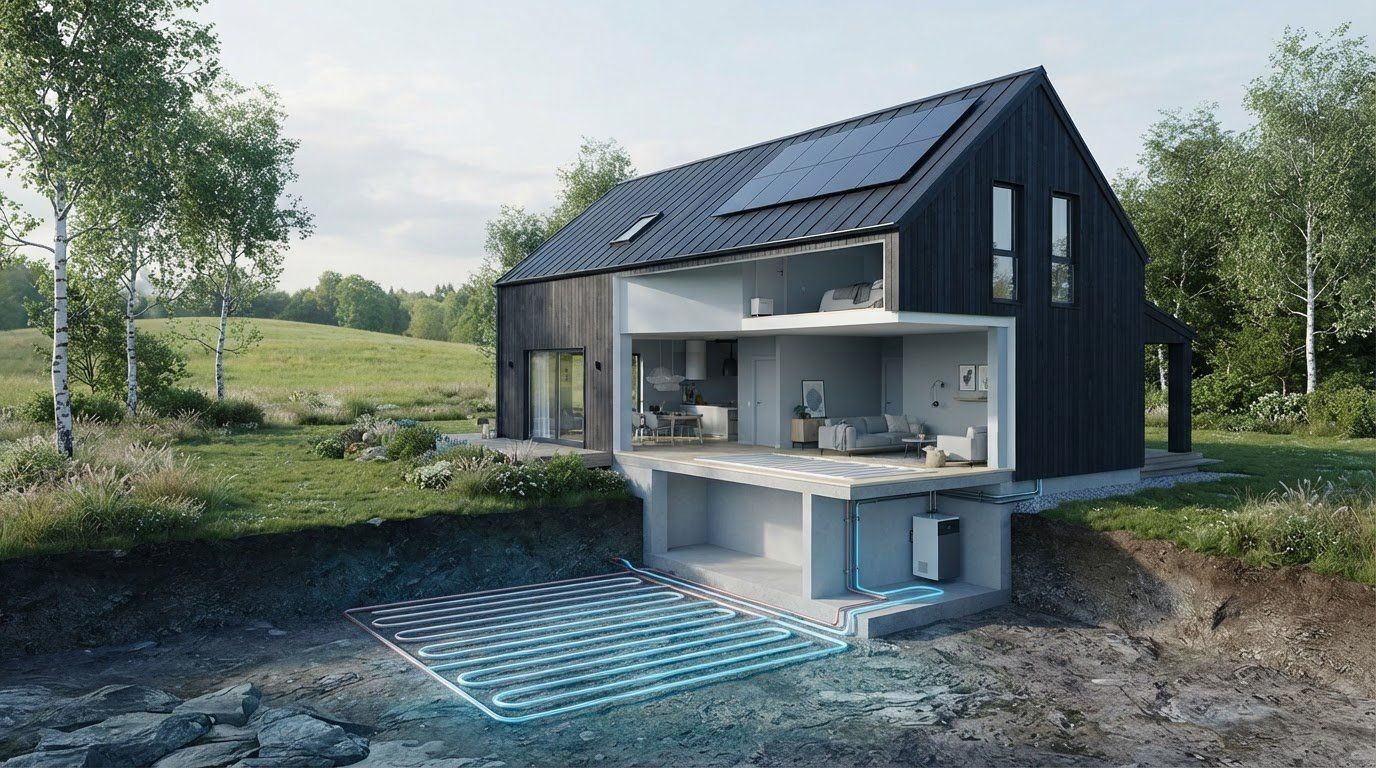
Can the house be cooled without using the usual cooling cycle of the conditioner? Passive cooling with the ground Heat pumps using the natural cooling of the ground: the system releases heat from the space to the ground contour, and the heat pump does not have to operate in active cooling mode. Therefore, this solution can consume less electricity than active cooling. However, comfort is determined not only by the equipment, but also by the characteristics of the building and how cooling is designed.
Before choosing whether the existing system of warm floors will be used for cooling, how the risk of condensate will be reduced and what temperature changes in the rooms can be expected. Answers depend on the contour of the ground, the heating load of the building and the control of the cooling system. A frequent mistake is to assume that the ground heat pump alone will suffice to cool the rooms quickly as a conditioner.
In this article you will find out how passive cooling works and how it differs from active conditions, what conditions influence the result and what to assess before design. Let's also look at the suitability of floor and other cooling elements, the risk of condensate and the importance of the land contour to understand what solution meets the needs of the building.
What is passive cooling with a heat pump on the ground, and what can it give the house?
In summer, the earth contour can serve not only to generate heat, but also to remove excess heat from the house. During passive cooling, a cooler heat transferor circulates between the ground contour and the building cooling system, for example, the warm floors. The result depends on the configuration of the system, so it cannot be predicted by the type of heat pump only.
Passive cooling releases heat from the house to cooler land, using the contour of the land and the circulation of the heat carrier. The principle of such a system and the operation of heat pumps on the ground are more broadly characterised by: overview of ground heat pumps.
Cooling indoors and hot water preparation have different functions. The purpose of cooling is to reduce the accumulated heat in the rooms, while the hot water system heats water for everyday needs. Whether and how both functions are combined depends on the system solution. Air-water heat pumps solutions uses another heat source, but this article looks at the ground contours.
How do passive and active cooling differ?
In passive mode, the cooling effect is ensured by the exchange of heat with the ground loop and the circulation of the heat transferor. Active cooling is a separate mode of heat pump operation in which the unit actively moves heat. So the same principle of operation differs, not just the name of the mode. In the selection between solutions, it is necessary to assess whether a gradual reduction of overheating or faster cooling of the space is necessary, as well as what the particular unit and the rest of the system support.
What comfort can passive cooling provide?
Passive cooling can help to reduce room temperature, but it should not be considered as a guaranteed substitute for a conditioner. The result is insulation of the building, the location and characteristics of the windows, the benefits of solar heat and the design of the cooling system. Practically, it is to start with the rooms that are most heated in summer and to find out if the heat is discharged sufficiently smoothly. The cooling plan is created together with the heating solution, assessing both the land contour and the way the coolness will be transferred to the premises.
How does the ground heat pump passively cool the rooms?
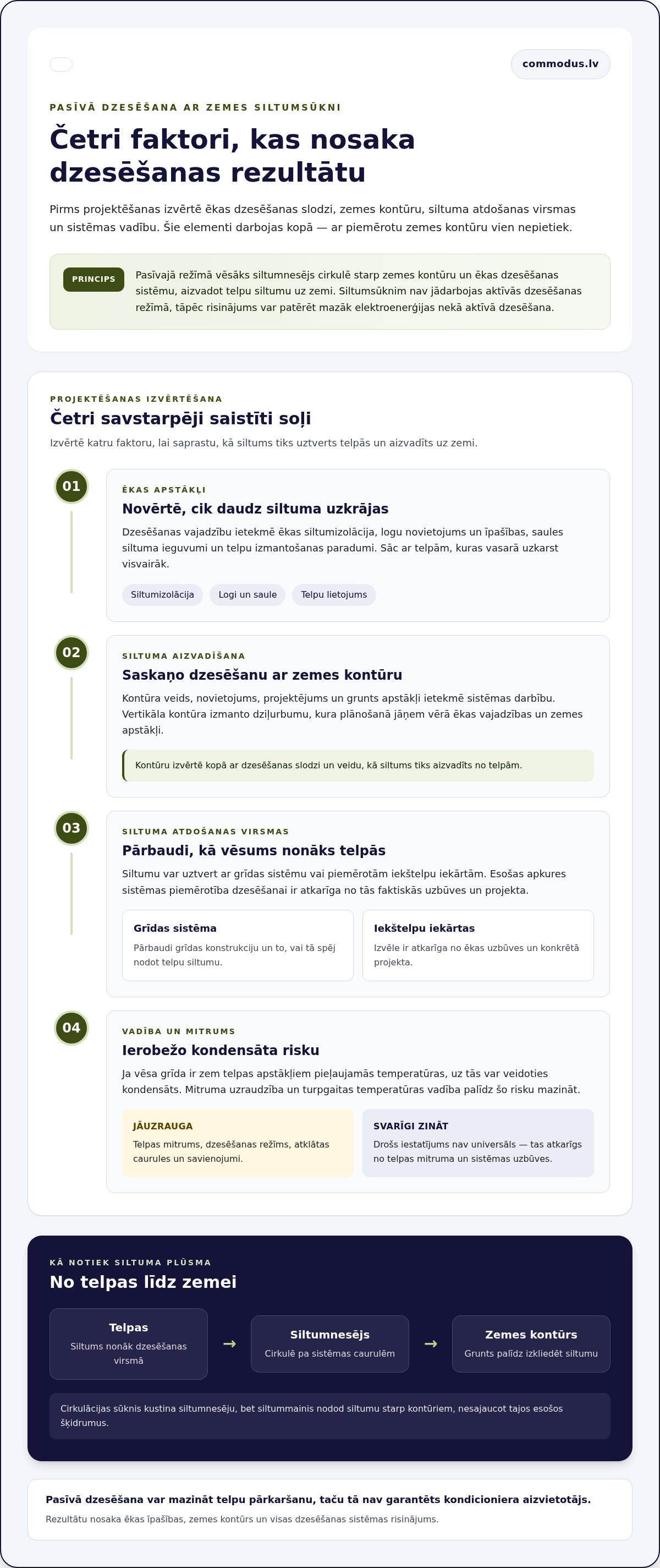
During cooling heat moves in the opposite direction than in the heating season. The space heat enters the cooling surface, from it passes into the heat transferor and is passed to the ground contour. There, heat exchange with the ground helps to disperse it. In cooling mode, heat flows from the premises through the heat transferor to the ground contour.
The circulating pump moves the heat transferor through the system pipes, but the heat exchanger transfers heat between the circuits without mixing the liquids in them. This is a general description of the operation, not a universal connection scheme: connections and facilities vary according to the design. Therefore passive cooling with the ground heat pump should be considered as part of the whole heating and cooling system, not as a separate function.
Why is the contour of the earth important in summer?
In summer, the land can serve as an environment to which the accumulated heat is transferred, but the ground conditions and contour solutions differ. The work is influenced by the shape, location and design of the contour. In the vertical contour, a borehole is used and its planning needs to take into account the needs of the building and the ground conditions. The contour should not be chosen from the cooling load and the way the heat will be removed from the premises. International Ground Source Heat Pump Association.
How is cooling provided in the premises?
For example, the heating can be perceived by a floor system or by suitable indoor facilities. In the floor cooling room gives heat through the floor surface, while in another solution it can be perceived by a separate installation. The choice is determined by the building's construction and design. Commodus website.
For which passive cooling is appropriate and what should be assessed before planning it?
The suitability of passive cooling cannot be determined only by whether the house already has a heat pump for the ground. First, you need to understand how much heat is stored in the premises and how it can be transferred to the contour of the ground. Large windows on the sunny side, insufficient shade and habits of use of the premises can increase the cooling needs.
Four factors need to be considered before design: cooling load of the building, land contour, heat recovery surfaces and system management. These elements are interlinked. An appropriate ground contour alone is not sufficient if the space is not equipped with adequate heat exchange or cooling mode cannot be controlled.
Why should floor cooling pay attention to dew point?
The dew point is the limit of conditions at which the moisture in the air can turn into drops of water on a cool surface. If the floor becomes cooler than the room conditions, condensate can form on it. Moisture monitoring and control of the temperature in the future helps to reduce this risk. A safe setting is not universal, because it depends on the humidity of the room and the structure of the system.
What elements of the system should be included in the design?
The suitability of an existing heating system for cooling must be assessed according to its actual design. The project must provide for how the heat will be perceived in the premises, how the land contour will absorb it and how the system will react to changing conditions. For example, it must be verified whether the floor design and management are in accordance with the intended cooling mode. It must also be assessed whether changes in connections or additional elements of the system are necessary.
Commodus designs heating and cooling systems, aligning the needs of the building with the chosen technical solution. Commodus website.
How does Commodus help to plan passive cooling with a ground heat pump?
Passive cooling with a heat pump should be planned together with the rest of the heating and cooling system, not added as a separate function at the very end. Commodus designs and assembles engineering systems starting with the assessment of the building needs. The planning should take into account the existing heating, land contour, type of room cooling and the desired comfort. This overview helps to reconcile the system elements and understand what works are needed in the building.
What to prepare for the first consultation?
To have a specific discussion, information about the building's surface, the current heating system and the premises where heat is most felt in summer. If the contour or borehole of the land is already in place, information about it shall be prepared. Take with it available building plans and technical documents of the heating system. They help to understand the existing solution, avoid guessing and determine what needs to be assessed in future design.
How to move from an idea to a coherent solution?
After the evaluation of needs, the cooling plan is aligned with the solution of the entire engineering system. The design should include how heat exchange will be performed in the building and how the ground contour will correspond to the planned operation. If the borehole is intended, it must be planned in conjunction with the rest of the system. After the design is followed by installation and maintenance of the system. The solution costs are affected by the necessary system elements, the adaptation of the existing heating and the construction needs of the ground contour, therefore they are assessed for a specific project.
Contact Commodus specialists to discuss their heating and cooling solution.
Plan the comfort of the house for summer
The decision on passive cooling is a good time to evaluate the comfort of the house in the long term, rather than selecting the equipment to be disconnected from everyday needs. Think about where the coolness of the rooms is the most important, how their use changes in summer and what result you want to achieve on hottest days. passive cooling with a ground heat pump Make a wise decision that meets the needs of the home.
Before the first conversation, there is no need to be a technical solution. The most important thing is to clearly state what is causing discomfort at the moment and what you want to improve.
Talk about your home heating and cooling solution with Commodus.
Frequently Asked Questions
Is passive cooling using a ground heat pump using electricity?
Yes. In passive mode, electricity is consumed by the circulator and control, but cooling is not provided by an active compressor. So consumption is not zero and it varies depending on the duration of operation and specific auxiliaries. To assess the consumption of your system, check the data indicated in the equipment documentation and compare the meter readings before and after the cooling mode. Note that the meter also records the rest of the household electricity consumption.
Can passive cooling replace air conditioning?
Passive cooling is usually intended to reduce overheating of rooms, rather than quick air cooling after hot days. Therefore, it is considered that more even cooling in several rooms or rapid temperature lowering in one particular room is more important. If a rapid reaction or a firmly defined room climate is required, passive cooling alone may not be enough.
Can passive cooling create condensate on the floor?
Yes. If the cool surface is lower than the room dew point temperature, moisture can land not only on the floor, but also on open pipes or connections. The system's management should take into account room humidity and limit cooling if circumstances require. Pay attention to changes in humidity, for example, after prolonged ventilation during wet weather. If you suspect condensate, the system should be checked, rather than independently changing the settings.
Can passive cooling be installed in a house with an existing ground heat pump?
Sometimes it can be installed in an existing system, but first it needs to be assessed its design and compatibility with cooling. Information about the heat pump model, installation documents, land contour diagram and available maintenance or setting data is useful. They help to understand whether changes to connections, controls or heat return systems are needed. If there are no documents, a photo of the installation's data plate and a home technical plan can be a good start.
Is the ground heat pump also preparing hot water during passive cooling?
The design of the system takes into account household hot water usage habits and the desired cooling mode. This information helps to evaluate the daily order of operation rather than assume that one function will not interfere with the other. Information on boiler capacity is also useful.
Comments