Solar collectors or solar cells: Which solution should be chosen in 2026?
Did you know that the most expensive solution does not always guarantee the greatest savings for your wallet? Many house owners in Latvia currently doubt whether solar collectors or solar cells are more suitable, especially in view of the latest conditions of the 2026 state support programmes. We understand that initial investments seem large and information about EQF support tends to be confusing. It is normal to worry about how effective these systems will be in our grey winters when the sun is less frequent.
In this article we will help you to get clear about the nuances of both technologies so that you can choose the most suitable and economically advantageous solution for your home. You will learn the most important differences between solar collectors and batteries, you will get a clear plan of action for choosing the system and you will understand how to actually reduce utilities. We have prepared a review that will help you make a balanced decision and ensure peace of mind in the long term, transforming complicated technical data into understandable benefits for your family budget and everyday comfort.
Solar collectors or solar cells: Definitions and principles of operation
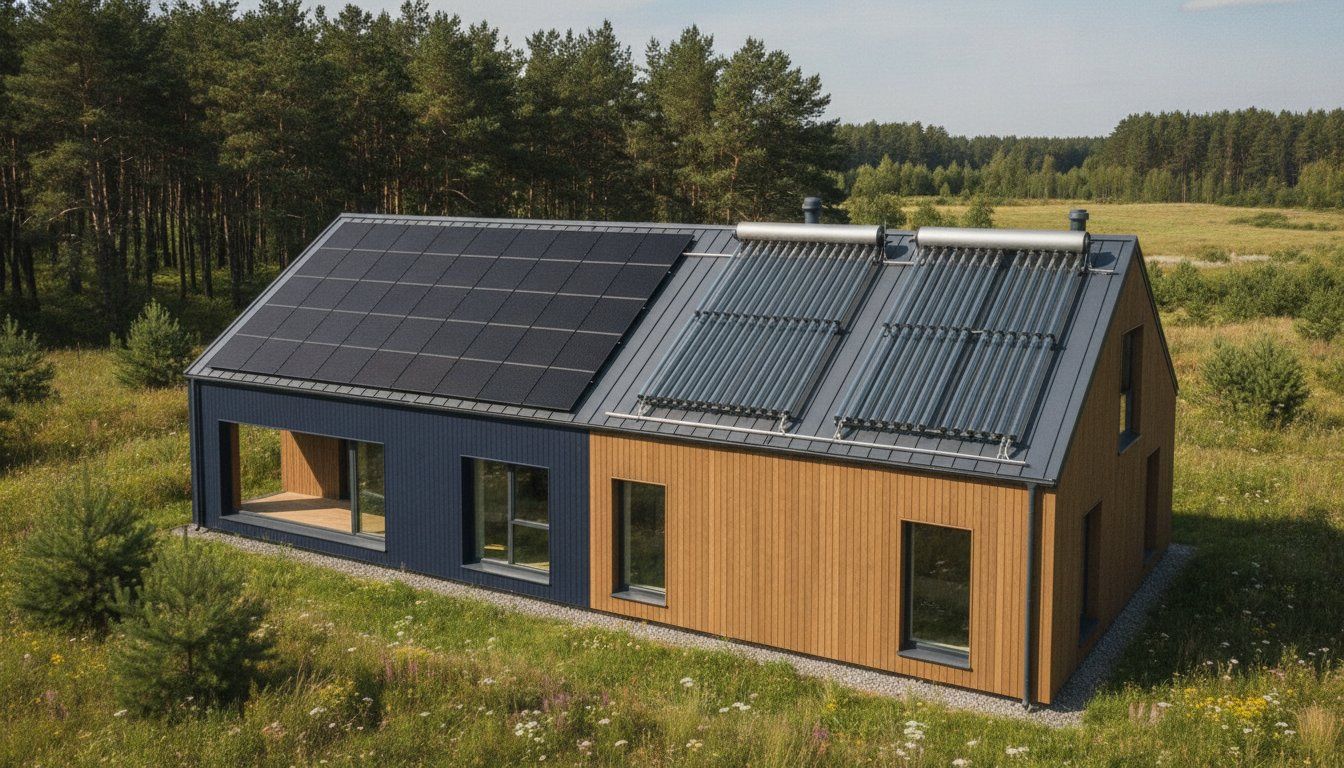
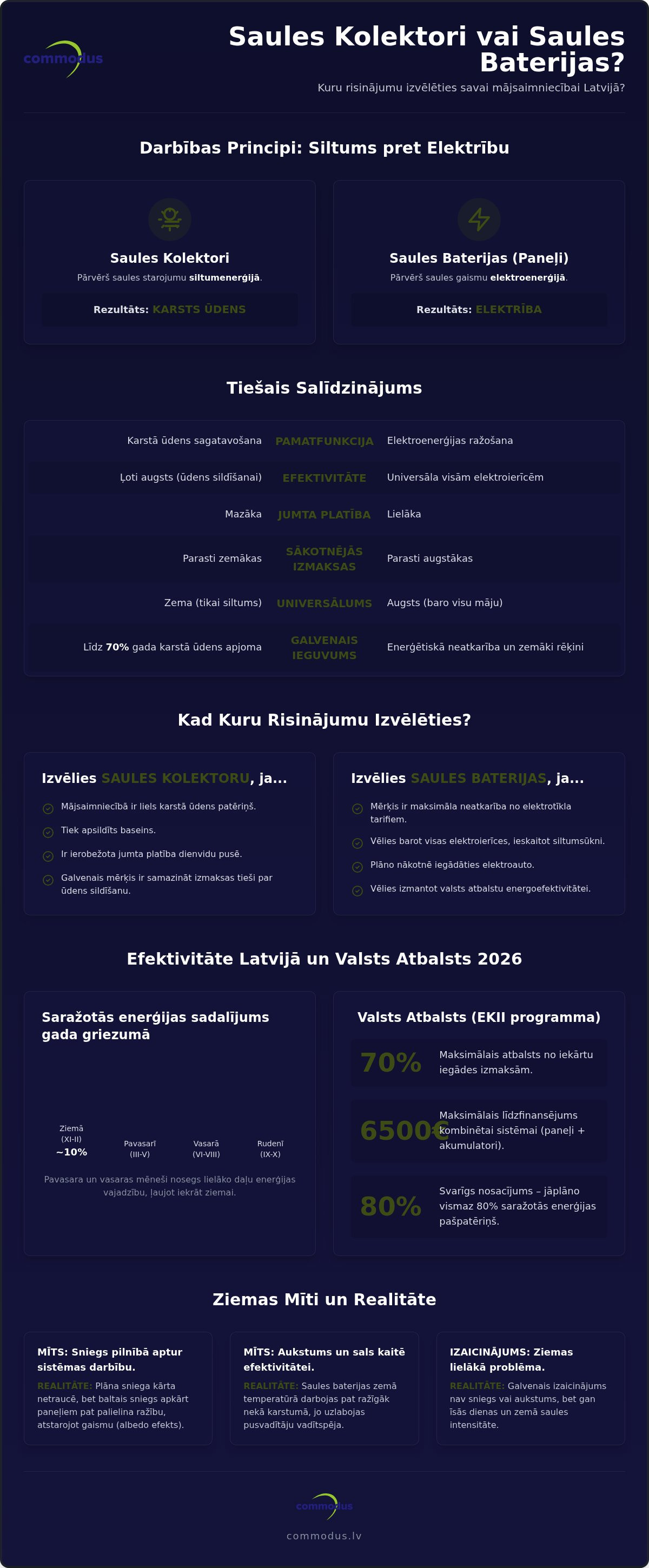
Often when driving past private homes, we notice dark panels on roofs and think about electricity automatically. In reality, there can be both solar collectors or solar cells that perform completely different tasks. It is quite easy to recognize them if you know where to watch. Collectors are usually thicker and often consist of glass tubes, while batteries are thinner and visually resemble a honeycomb surface. The main thing is to remember a simple formula: collectors produce heat water, and batteries produce electricity for your home.
Many customers fear that the cloud sky of Latvia is an insurmountable obstacle. It is a myth that we hear often. Modern technologies also take the diffuse light great, so systems work even on a smoky day. principles of solar collectors and solar panels, it becomes clear that both solutions in our latitudes are effective and pay off.
How does the solar collector work?
The collector's heart is an absorption surface that captures solar energy and converts it into heat. This heat is passed on by a special fluid or heat transferor that delivers energy through the pipes to the boiler. Flat collectors resemble large boxes and are perfect for the summer season. In contrast, vacuum pipe systems work like thermals. They also maintain high efficiency in the cooler spring and autumn mornings, becoming a reliable helper in preparing hot water.
How does a solar battery work?
There is a completely different process, called the photovolt effect. Panels convert particles of light directly into direct current. To run a kettle or a heat pump, there is an inverter in the system. It transforms current into our normal alternating current. Since the new net settlement system is in operation in Latvia, excess energy is no longer to be returned for free. It can be wisely stored in batteries or transferred to a common network to be used later when the sun no longer shines so brightly.
Technical and economic comparison: Which one to choose?
The choice between solutions for solar collectors or solar cells depends first of all on the energy consumption of your home and long-term goals. Collectors usually require lower initial investment if the primary task is to prepare only hot water. Photovoltaic panels are more universal and serve as a basis for the energy efficiency of the whole house. Although the efficiency of the collectors is considerably higher for water heating, apart from less space on the roof, batteries provide capacity for all home electrical appliances.
The service life of systems usually exceeds 20 years, but the maintenance of efficiency requires periodic maintenance. Our Kommodus service specialists will help to monitor the operation of the system so that every sun beam is used effectively. If you want to explore the power generation side in depth, it will be useful to use our Guide to solar panel sets, in which we analyse the path to complete energy freedom.
When is the solar collector the best choice?
Solar collectors are incomparable in situations where the household has a high consumption of hot water. This is especially relevant for large families or properties where the pool is heated. Also, they are ideal for housing with a limited roof area on the south side. Where there is insufficient space for a powerful panel array, some collectors can provide up to 70% of the annual amount of hot water required, significantly undermining the basic heating system.
When are solar cells an undisputed winner?
If your goal is maximum independence from network tariffs and lower total bills, choose solar panels. They will nourish everything from the refrigerator to lighting. This solution is indispensable if you plan to install CTC air-water heat pumps or in future to buy an electric car. In addition, current State aid in 2026 makes investment in solar cells and battery systems particularly beneficial, as state co-financing helps significantly reduce the system's payback time.
Efficiency in Latvia and State aid in 2026
The Latvian solar calendar is very seasonal, so it is important to look at the contribution of the system to the year. From November to February, the solar activity is the lowest, producing about 10% of the total annual volume. However, in March, when the first bright cold of spring appears, productivity is growing rapidly. When choosing whether solar collectors or solar cells are more suitable, it is important to remember that spring and summer months will cover most of your energy needs, allowing you to accumulate funds for the winter period.
In 2026, households still have significant public support through the EQF programme administered by the Environmental Investment Fund. This programme covers up to 70% of the purchase costs of equipment. For a combined system with panels and batteries, the maximum co-financing can reach up to € 6500. An important condition is to plan at least 80% of the self-consumption, which will be helped to calculate precisely by our specialists. We know in the Commodus team that bureaucracy may seem frightening, so we help to sort out all the documentation, alignment with the Distribution Network and literally push the scrap of your site so that the support is smooth and safe.
To maximise the use of solar energy for home heating, we recommend to get acquainted with our Air-water heat pump guideIf you want to know what solution will be right for your house, apply for consultation with our experts.
Winter myths and reality
In fact, the white will even improve efficiency around the panels due to light reflection or albedo effect. In addition, solar cells work more efficiently at low temperatures than heat, as semiconductor conduction improves. The main challenge is short days, not cold. In the case of collectors, vacuum tubes provide excellent insulation, preventing heat from flowing out into the environment even in severe negatives, so solar collectors or solar cells remain useful also in winter months.
Commodus recommendations: The ideal combination for maximum austerity
Our experience shows that the discussion about whether solar collectors or solar cells are better often leads to a single conclusion. Modern housing is not imagined without an integrated system that works as a single organism. In 2026 the combination of solar cells and heat pump has become the golden standard of energy efficiency. This allows not only to produce energy, but also to use it wisely, just when it is most advantageous for your wallet.
Synergies between heat pump and solar panels
When your roof produces electricity, CTC air-water heat pump Smart management allows the system to "understand" when the sun shines most intensely. At that moment the installation can heat water or storage tank, preparing an energy reserve for the evening. This optimisation of self-consumption significantly reduces dependence on variable network tariffs. This helps to reduce utility bills to a minimum, creating real and tangible savings in the long term.
Why choose a Commodus team?
We believe that every project is a personal story, not just a technical task. Our masters take care of the full cycle. It includes everything from first consultation and design to works such as: boreholes or assembly and subsequent warranty maintenance. Professional assembly is critical to avoid expensive errors that are often seen in self-operation processes. Incorrectly selected panel angle or sub-quality connections can significantly reduce system power and safety.
When choosing whether your house is more suitable for solar collectors or solar cells, trust experts who care about your comfort. We are a partner that will help to make a balanced decision and bring peace of mind for many years. Apply for consultations with Kommodus specialists, and together we will find a solution that best suits your home's specifics and family needs.
Take a step towards energy freedom today
Choice between options Other, with a discharge outlet diameter It is not just a technical decision, but a well-considered long-term investment in your home and family comfort. While collectors are still unparalleled in hot water preparation, solar panel systems together with batteries and heat pump provide comprehensive energy independence. 2026 is the right time to act, because the available state aid programmes and modern technologies allow these systems to pay off faster than ever.
We are ready to be your reliable partner in the Kommodus team throughout this process. With more than 15 years of experience in the climate technology market and thousands of successful projects across Latvia, our certified editing specialists and engineers guarantee the highest quality performance. We not only install equipment, but also help to arrange all the complex documentation for support so that you can focus on the main result.
Contact Commodus experts and receive free advice on the energy efficiency of your home! Together we will find the most suitable solution for your house, which will provide warmth, light and peace of mind for many years.
Frequently Asked Questions
Can solar collectors replace the boiler completely in winter?
No, solar collectors cannot completely replace the boiler in winter months, because solar radiation from November to February is insufficient for complete heating in Latvian latitude. They serve as excellent support for hot water preparation and can reduce the load of the base heating in spring and autumn. In winter, the system produces only a small part of the energy required, so housing still needs a stable heat source, such as a heat pump or a boiler.
How long does the installation of solar cells in Latvia pay off on average?
The average payback time for Latvian households is usually between six and ten years, but this period can be significantly shortened thanks to state support programmes. With EQF co-financing, the investment returns faster. The exact time depends on the amount of your electricity self-consumption and whether the system is equipped with batteries. Properly selected solar collectors or solar cells and their capacity is the main factor determining the economic benefits of the project in the long term.
Can solar panels be installed on any type of roofing?
Yes, modern fastening systems allow to safely install panels on almost any roofing, whether it be metal tile, bitumen chisels or classical clay tile. The primary prerequisite is the bearing capacity of the roof structure and technically correct assembly to avoid damage to waterproofing. Our engineers always evaluate the roof condition before starting their work in order to guarantee the stability and safety of the system against wind loads, regardless of the type of material chosen throughout Latvia.
What maintenance is required for the solar collector system?
The solar collector system requires regular, but simple maintenance, preferably performed once a year. The most important works include checking the pressure and quality of the heat transferr fluid or antifreeze, as well as controlling the leak-proofness of the system. It is also important to visually monitor the collector surface and to verify the proper functioning of the circulator. Commmodus specialists provide full service so that your equipment works with maximum returns and heat transferr does not lose its anti-corrosion properties over time.
Is State aid available even if I install the system myself?
No, the EQF is a mandatory condition for the provision of state aid in the EQF programme that is carried out by a certified company. Self-installation prevents the possibility of co-financing, as the fund requires certification of the compliance of the system with technical standards and safety requirements. By choosing professional assembly, you not only qualify for aid up to 70%, but also receive a guarantee for both the equipment and the work performed, ensuring stable operation of the system without any risk.
Comments