State Support for Purchasing a Heat Pump in 2026: A Complete Guide to Obtaining Funding
Deciding to switch to modern heating often comes down to one question: can I really afford it? The rules approved on 17 February 2026 clearly show that state support for purchasing a heat pump in 2026 is more accessible than ever, offering co-financing of as much as 70% to 80%. At Commodus, we see every day that fear of complicated application procedures and high equipment prices prevents many homeowners from making sensible decisions. You are not alone in these concerns, because the twists and turns of bureaucracy and the fear of missing short application deadlines can seem daunting even to experienced property owners.
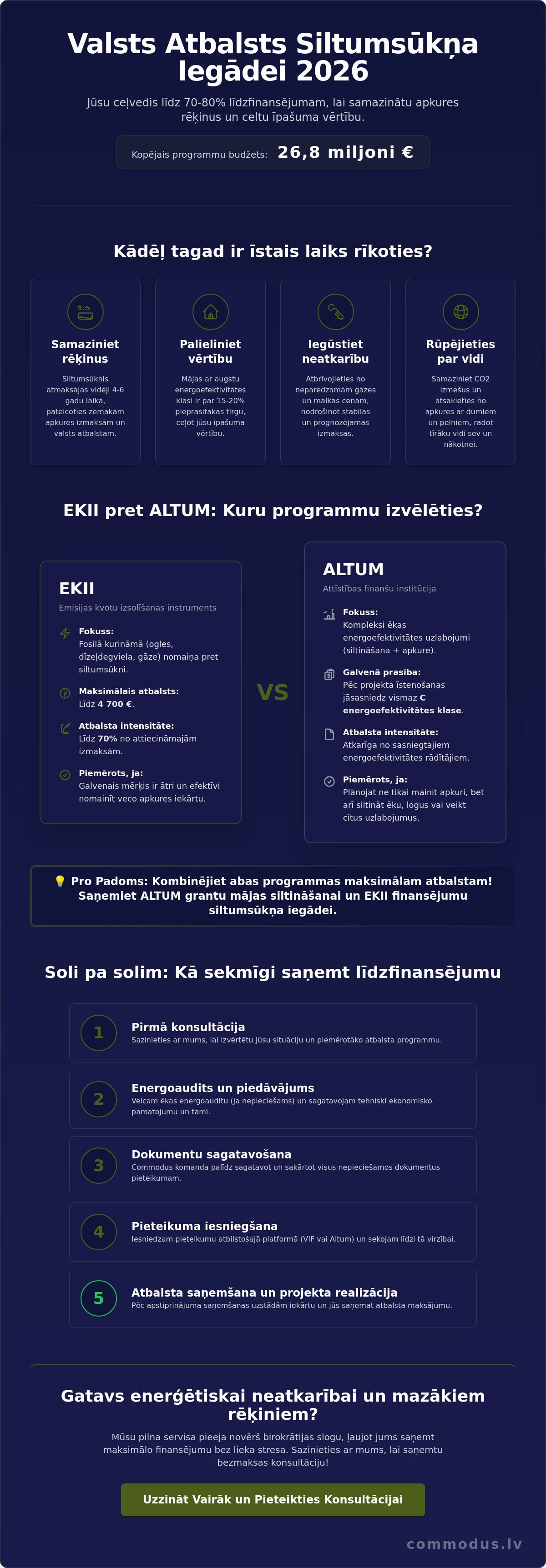
In this article, we have prepared a clear action plan to help you obtain the maximum available funding without unnecessary stress. You will learn how to apply for an EKII grant of up to EUR 4,700, why the ALTUM programme requires at least energy-efficiency class C, and how to access part of the new EUR 26.8 million fund. We will guide you through the entire process step by step, giving you confidence that you are making the right choice. Our aim is to help you reduce your heating bills while we work together towards your home's energy independence and lasting peace of mind.
Key takeaways
- Learn how to choose correctly between the EKII and Altum programmes to cover up to 80% of total installation costs.
- Find out why state support for purchasing a heat pump in 2026 prioritises the replacement of fossil-fuel heating and how this affects the priority of your application.
- Review the mandatory building energy-efficiency class requirements, which are a critical precondition for funding private homes and apartment buildings.
- Get a clear action plan covering everything from the first consultation and energy audit to the successful submission of documents through the relevant platform.
- Discover how Commodus' full-service approach and experience across hundreds of projects can help you receive the support payment without an unnecessary bureaucratic burden.
State support programmes for heat pumps in 2026: why is now the right time?
2026 marks an important turning point in Latvia's energy sector. State support for purchasing a heat pump in 2026 is no longer merely a theoretical promise, but a clearly defined mechanism with a total budget of EUR 26.8 million, approved by the Ministry of Climate and Energy (KEM) on 17 February 2026. This funding is specifically intended to help households move away from expensive natural-gas and wood heating, which require not only substantial expenditure but also hard physical work and constant attention.
Government policy has become considerably more targeted in reducing CO2 emissions from the residential sector. While support used to be the exception, it is now a principal tool for achieving the objectives of the European Green Deal. Many homeowners still ask the basic question: What is a heat pump? and why is this technology at the centre of subsidised projects? The answer lies in efficiency: a heat pump converts energy from the surrounding environment into heat, maintaining a stable indoor temperature even on the coldest January nights, without smoke or ash.
EKII and Altum: the two pillars of Latvia's support system
The Emission Allowance Auctioning Instrument (EKII) has become the main ally for those wishing to replace old coal- or diesel-fired boilers with a modern heat pump. The programme will continue until the end of 2029, but 2026 stands out because the application process has been fully digitised and streamlined. Altum, meanwhile, supports those taking a comprehensive approach by combining home insulation with the modernisation of the heating system. This year, both programmes provide unprecedented transparency, allowing applications to be submitted online and approvals to be received considerably faster than in previous years, which makes planning much easier.
Climate objectives and the impact on your finances
Investing in a heat pump is not just about “green thinking”; it is a straightforward financial calculation. With state support covering up to 70% of eligible costs for private homes in 2026, the initial investment typically pays for itself within four to six years. Given the unpredictable prices of natural gas and firewood in recent years, a heat pump provides independence from global market fluctuations. Property-market data also show that homes with a high energy-efficiency rating are 15% to 20% more sought after, increasing the overall value of your property.
At Commodus, we do more than install equipment: we help you “push the cart” from the first consultation to the final signature on the support-payment documents. There is little point in “chasing the wind” and waiting for even better terms, because the available funding is limited. For example, exactly EUR 10 million has been allocated to apartment buildings under the new KEM programme, and experience shows that such funds are often fully committed within a few months of applications opening.
EKII versus Altum: which programme should you choose for installing a heat pump?
Choosing between the EKII and Altum programmes is not merely a technical formality. It is a strategic decision that will affect the overall cost of your project and how quickly the investment pays back. State support for purchasing a heat pump in 2026 is available through both channels, but their objectives and requirements differ substantially. One programme focuses on the rapid replacement of fossil-fuel heating, while the other treats your home as a single energy-efficient system. At Commodus, we often see clients become confused by the volume of information, so we will help you “push the cart” in the right direction.
The main difference lies in the intensity of support and the scope of work included in the project. Under the EKII programme, the maximum grant for one project can reach EUR 4,700 when installing a heat pump with a capacity above 10 kW. Support cannot exceed 70% of eligible costs. By contrast, Altum's state support programme is designed for comprehensive improvements in which the heat pump is only one part of a broader energy-efficiency plan. The good news is that these programmes may be combined: you may receive an Altum grant for insulating the home and EKII funding for purchasing the heating equipment itself, thereby minimising your personal contribution.
EKII conditions: emphasis on replacing fossil-fuel heating
The EKII programme administered by the Environmental Investment Fund is ideal if you want to replace an old coal, natural-gas or diesel boiler. The main condition is the dismantling of the existing fossil-fuel heating system. The new heat pump must be certified and meet high efficiency standards. It is important to remember that funding is paid only after the project has been fully completed and all invoices have been settled. After installation, a five-year monitoring period applies, during which the unit may not be removed, allowing the state to verify that the investment remains in use.
Altum support: a comprehensive approach to energy efficiency
The Altum programme is more demanding, but offers broader long-term opportunities. To qualify, the building must achieve at least energy-efficiency class C after completion of the project, and total heat-energy consumption must fall by at least 20%. The programme is particularly favourable to large families, which may receive additional bonuses and state guarantees for loans on preferential terms. If you plan not only to replace the heating system but also to insulate the walls or replace windows, Altum will be the better choice. To learn more about our experience with these programmes, explore our offering at commodus.lv, where we have compiled practical advice and examples of completed projects.
Who can apply for support? Requirements for buildings and owners
The application process begins by establishing whether you and your property meet the applicable criteria. State support for purchasing a heat pump in 2026 is primarily aimed at private individuals whose ownership rights are registered in the Land Register. A declared place of residence at the relevant address is an important condition. This confirms that the funding is being used to improve actual living conditions rather than maintain empty buildings. At Commodus, we know that piles of paperwork can be intimidating, but proper preparation is half the battle.
The building must have been commissioned, although the energy-efficiency requirements differ depending on the programme selected. If you intend to use the Ministry of Climate and Energy (KEM) programme for apartment buildings, the building must achieve at least energy-efficiency class D. Under the Altum programme for private homes, the threshold is higher: once the project is completed, the building must comply with class C and heat-energy consumption must fall by at least 20%. These figures are not arbitrary; they are set out in the rules of 17 February 2026 to ensure that the investment delivers a meaningful result.
Technical parameters that must not be ignored
Heat-pump efficiency is not merely a manufacturer's promise; it is a measurable value assessed strictly by public authorities. COP (coefficient of performance) and SCOP (seasonal coefficient of performance) are decisive. Official guidance often fails to emphasise that cheaper units with a low SCOP may simply not qualify for support because they do not deliver sufficient long-term energy savings. We help select equipment that meets all 2026 certification standards. You should always request the product data sheet and declaration of conformity from the seller, confirming efficiency specifically for our climate zone.
Common obstacles and how to overcome them
One of the largest obstacles is an unfinished building-commissioning process. If the house is legally classified as a new build, obtaining EKII support may be difficult because the programme focuses on replacing fossil-fuel systems in existing buildings. In cases of joint ownership, especially in apartment buildings, the greatest challenge is obtaining majority consent. Remember that applications to the KEM programme are accepted on a first-come, first-served basis from the tenth working day after the rules are published in Latvijas Vēstnesis. This means there is no room for delay. We help prepare the technical documentation and energy audit so that, when applications open, you are at the front of the queue rather than left “chasing the wind” after the funds have run out.
Step by step: how to obtain co-financing successfully and without mistakes
The path to energy independence is not a sprint; it is a carefully planned journey. State support for purchasing a heat pump in 2026 requires accuracy and patience. Everything begins with an energy audit. This is not merely a document for an official; it is a health check for your home that determines the most suitable equipment capacity. Applying for funding without a professional assessment is like trying to build a house without foundations. Once the audit is complete, the next step is to consult us so that we can select the solution best suited to your home and compliant with the rules approved on 17 February 2026.
The next step is submitting the application. In 2026, all systems operate digitally. EKII applications are submitted through the Environmental Investment Fund portal, while the application window for the new KEM programme opens exactly ten working days after the rules are published in Latvijas Vēstnesis. There is no room for mistakes at this stage. Every incorrectly entered figure or omitted attachment can push your application to the back of the queue. Remember that the EUR 26.8 million budget is not unlimited, so speed and accuracy are your strongest allies.
Five critical mistakes in the application process
- Incorrect capacity: If the heat pump is underpowered, it will not heat the home adequately; if it is oversized, it will waste electricity and may be rejected for failing to match the recommendations of the energy audit.
- Careless invoices: All estimates and invoices must be clear and state the exact equipment model and specification so that there can be no doubt about the justification of costs.
- Missing deadlines: After installation, there is usually a strict deadline for submitting the final report. Missing it may result in loss of eligibility for payment.
- DIY installation: A heat pump may be installed only by a certified specialist. Self-installation will result in guaranteed refusal of funding.
- Inconsistent documents: The Land Register details must match the applicant's information exactly, avoiding unnecessary bureaucratic delays.
Document templates and useful tools
We have taken steps to make your journey easier. Before starting the official paperwork, we recommend using our heating calculator. It will give you an initial indication of the required investment and potential savings. Certified energy auditors are best found in the Construction Information System (BIS) register, where details are updated in real time. To sign applications, make sure that eParaksts mobile or an ID card with valid certificates is ready, because paper applications are a thing of the past in 2026. We are here to guide you smoothly through the process, because our experience shows that well-organised documentation is the safest route to having the money returned to your account.
The role of Commodus: from a professional design to an approved payment
Once you have decided to make your home warmer and more economical, an understandable question arises: who will take this major project through to completion? State support for purchasing a heat pump in 2026 is an excellent opportunity, but the path to receiving it can be complicated. This is where the Commodus team comes in. We are not merely equipment sellers. We are your partners, ready to push the cart with you from the first meeting until the funds are transferred to your account. Our experience shows that a successful project consists of hundreds of small details, all of which we understand thoroughly.
Choosing a full-service partner means purchasing peace of mind. We have completed hundreds of state-supported projects since these programmes became available in Latvia. This means that we know every hidden pitfall in the documentation and every technical detail required by the supervisory authorities. You will not need to spend time trying to understand complicated regulations or finding certified installers at the last moment. We manage the entire process so that you can focus on everyday life while we safeguard your investment and the long-term performance of the equipment.
Our team – your point of support
Our experts are not merely technical workers; they understand the finer details of the 2026 support programmes. During the free consultation, we not only inspect the property but also assess honestly which programme will be most advantageous for you. Client experiences from late 2025 and early 2026 show that this individual approach has helped secure funding even in complicated cases of shared ownership. We are on your side. Our goal is to make your home an example of energy efficiency rather than a bureaucratic nightmare.
Everything in one place: design, installation and documentation
High-quality installation is critical for public institutions to approve payment. Our certified installation teams work to the highest standards, ensuring that every connection and setting complies with both manufacturer and state requirements. We prepare all technical documentation, certificates and acceptance documents required for receiving support. With Commodus, you are not left alone with the equipment; we also provide after-sales service and a warranty that acts as a long-term safety net for your investment.
Contact the Commodus experts and receive an offer today! We will help you take the first step towards a warmer future and the maximum available co-financing.
Begin your journey towards energy independence today
Switching to modern heating is one of the smartest decisions you can make for your home and your finances. The EUR 26.8 million in funding approved on 17 February 2026 clearly demonstrates that state support for purchasing a heat pump in 2026 is an available and practical instrument capable of reducing the initial investment by as much as 80%. The key is to remember that an accurate energy audit and the correct choice between the EKII and Altum programmes form the basis of a successful result that will provide peace of mind for years.
With more than 14 years of experience in the Latvian market, the Commodus team is ready to support you at every stage. Our certified specialists will provide a complete service cycle, from selecting the most suitable equipment to helping prepare all documentation required for support. Do not allow bureaucracy or uncertainty to keep you from greater comfort and substantially lower heating bills. Let us push the cart together and make your home warmer, more modern and more valuable today. Your home deserves the best solution and the hands of reliable professionals.
Book a free consultation about state support!
Frequently asked questions about obtaining funding
Can I receive support if I install the heat pump myself?
No. Installing the equipment yourself will make you ineligible for state co-financing. Under the EKII and Altum rules, installation work may be carried out only by certified contractors who can issue the appropriate commissioning certificate. The state must be satisfied that the equipment will operate efficiently and safely, so a professional signature on the documentation is a mandatory condition for reimbursement.
What is the maximum amount that can be recovered for an air-to-water heat pump in 2026?
Under the EKII programme, the maximum grant for an air-to-water heat pump with a capacity above 10 kW is EUR 4,700 and cannot exceed 70% of total eligible costs. Under the new Ministry of Climate and Energy programme approved on 17 February 2026, owners of apartment buildings may qualify for co-financing covering up to 70% of the project estimate. State support for purchasing a heat pump in 2026 is generous enough to cover most equipment and installation costs.
How soon after submitting the application is the money paid?
Funding is generally transferred to your account within 20 to 30 working days after the administering authority has approved the final report. It is important to remember that the money is not paid in advance: you must first pay in full for the equipment and work using your own funds or credit. Reconciliation and transfer take place only after the system has been installed and all documents have been submitted through the digital platform.
Can I receive support if my home already has a heat pump and I want to replace it with a newer one?
The EKII programme is not suitable for this purpose because it focuses specifically on replacing fossil-fuel heating, such as natural gas or wood. However, this may be possible under the Altum energy-efficiency programme if you can demonstrate that the new equipment will reduce heat-energy consumption by at least 20%. In such cases, a detailed energy audit comparing the efficiency of the old and new systems will be required to justify the investment.
What documents are required to prove that the fossil-fuel equipment has been dismantled?
You will need a dismantling certificate signed by a certified specialist and photographic evidence clearly showing the old boiler before and after removal. In some cases, the Environmental Investment Fund may also require confirmation that the old equipment was delivered to a scrap-metal facility or hazardous-waste site. We recommend retaining every document, as accurate records help avoid unnecessary questions during assessment of the final report.
Does state support also apply to air-to-air heat pumps?
Most current support programmes, including EKII, do not cover air-to-air heat pumps because they are not treated as the primary central-heating solution. Support is aimed at systems that provide full heating throughout the home through radiators or underfloor heating, such as air-to-water or ground-source heat pumps. If your aim is to obtain the maximum co-financing, an air-to-water system will be a much safer and more advantageous choice from an administrative perspective.
What happens if the support programme budget is exhausted before I complete the installation?
Under the EKII programme, funds are generally reserved when the initial application is approved, which protects the installation process. Under the new KEM programme with a budget of EUR 26.8 million, however, applications are considered on a first-come, first-served basis. This means there is no room for delay. We help clients prepare their documents in good time so that they can apply before the available funds have been fully committed.
Can Altum support also be used for terraced houses or semi-detached houses?
Yes. The Altum programme is available to owners of sections of terraced and semi-detached houses if each section is registered in the Land Register as a separate property. Each unit must have its own unique cadastral number and separate entrance. In these cases, the application process is similar to that for an ordinary private home, but the energy-performance certificate must be prepared specifically for your part of the building so that the expected energy savings can be calculated accurately.
Comments