Underfloor Heating: A Complete Guide from Selection to Efficient Heating in 2026
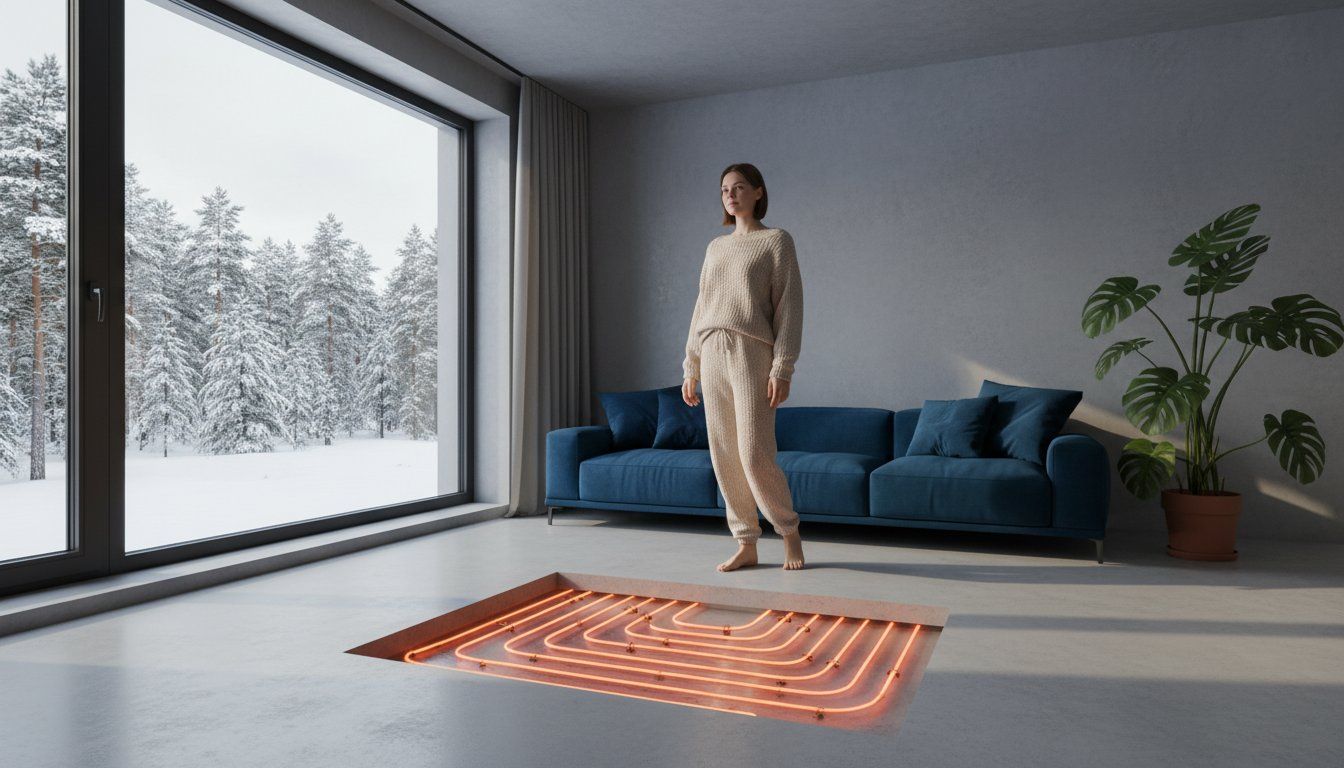
Imagine a January morning when the thermometer outside has fallen to -20°C, yet as you get out of bed your feet touch a pleasantly warm surface. For many homeowners in Latvia, this comfort still seems like an expensive luxury, but in reality, correctly selected underfloor heating has become one of the most effective ways to control high heating costs in 2026. We know that cold floors on the ground floor and uncertainty about installation complexity can create unnecessary stress when planning a renovation or new build.
We fully agree that nobody wants to overpay for heat or face expensive repairs caused by leaks. That is why we have prepared this guide to help you make a well-informed decision and turn your home into an energy-efficient haven. In this article, you will learn how modern technical solutions can reduce monthly bills by an average of 20% and why professional installation is the best protection against future problems.
We will examine the different types of underfloor heating in detail, assess their suitability for Latvia's changing climate and provide a clear overview of the installation process, so that together we can move confidently towards a warmer and more affordable winter.
Key takeaways
- Learn why distributing heat from the floor upwards is not only more comfortable but also healthier and more natural for the human body.
- Understand the main differences between water-based and electric systems so that you can choose the most suitable solution for your type and size of home.
- Discover why underfloor heating combined with a heat pump is the most effective way to maximise COP and reduce heating bills.
- Find out how an accurate heat-loss calculation and the correct choice of insulation protect against cold spots and unexpected heat losses.
- Follow a clear path from design to installation so that, together with Commodus experts, you can plan and implement your home's heating system safely and thoughtfully.
What is underfloor heating and how does it improve comfort in the home?
Underfloor heating is no longer an exclusive luxury; it is a carefully engineered solution that has become standard in new builds and renovation projects throughout Latvia in recent years. In essence, What is underfloor heating? It can be defined as a low-temperature heating system integrated directly into the floor structure. Unlike traditional radiators, which heat the air locally and create strong air circulation, this system turns the entire floor surface into an even heat source.
This bottom-up distribution of heat is much more natural for the human body. Our physiology is such that we feel most comfortable when our feet are warm while the air at head height is slightly cooler. Radiators often create the opposite effect, overheating the air near the ceiling while leaving the floor area cool. By choosing the radiant heat provided by underfloor heating, we avoid the unpleasant effects of convection. This means that dust is not unnecessarily circulated around the room, which is particularly important for people with allergies or sensitive airways. The air remains fresher and the natural humidity level is easier to maintain.
Thermal inertia and its importance during a Latvian winter
Latvia's changeable weather, where a morning frost can quickly turn into a thaw, requires a system that maintains a stable indoor climate. Heating pipes embedded in concrete act as a large heat store. This thermal inertia means that the floor warms up more slowly but also cools down gradually, preventing the home from becoming cold even if the outdoor temperature drops by 10 degrees overnight.
Based on our experience, we recommend never switching the system off completely, even when you are away for an extended period. It is far more efficient to use temperature setback modes. If the system is switched off, a large amount of energy will later be needed to reheat the entire concrete mass, which is not economical. A stable temperature in the structure also protects your home's finishing materials.
Economic benefits: Does it really pay off?
The heat-energy saving provided by underfloor heating is generally between 10% and 15%. The main reason is the lower required flow temperature. Radiators may require water at 60°C or 70°C, whereas a floor-heating system can achieve the same level of comfort with water at approximately 35°C. This makes it ideal for use with modern heat pumps or condensing gas boilers.
- Service life: A correctly installed pipe system within the floor can operate for more than 50 years without maintenance because it contains no moving parts or exposed joints that could corrode.
- Property value: In the Latvian property market, a home with integrated underfloor heating is regarded as a higher-class property, increasing its resale value.
- Aesthetics: You gain complete freedom in interior planning because there are no wall-mounted radiators taking up space or disrupting the visual design.
At Commodus, we believe that heating is not merely about pipes and boilers; it is about peace of mind in your home. We work alongside our customers so that every project is energy efficient, lasts for generations and creates a safe, warm atmosphere in every square metre.
Water-based versus electric underfloor heating: Which should you choose?
Choosing between a water-based and an electric system is the first major decision every homeowner faces. At Commodus, we see every day that the choice depends not only on personal preference but also on the building's technical characteristics and the long-term budget. Water-based underfloor heating is the most popular choice for new builds and detached homes with a central heating system. Its main advantage is low operating costs. If the home is fitted with a modern, highly efficient heat pump, heating bills will be considerably lower than with direct electric heating.
Electric systems, by contrast, are unrivalled for renovation projects or small areas such as bathrooms and kitchens. Installation requires minimal alteration to the floor level. A water-based system generally requires at least 70 to 100 millimetres of build-up for the screed, whereas electric mats occupy only 3 to 5 millimetres. This is critical in flats where every centimetre matters. Underfloor heating and its efficiency are directly linked to choosing the correct system for the particular type of home, ensuring even heat distribution without air currents that stir up dust.
Advantages and installation considerations of water-based systems
Water-based systems offer considerable flexibility in the choice of heat source. You can begin with a pellet boiler and switch easily to a heat pump five years later without replacing a single metre of pipe beneath the floor. The heart of the system is the manifold, which allows the temperature in each room to be controlled separately. Pipe spacing is important and is usually 100, 150 or 200 millimetres. The greater the room's heat loss, the closer the pipes must be installed to maintain comfort even at -20°C. Our experience shows that careful design at the outset can save thousands of euros in future operating costs.
Electric heating mats and cables
Electric solutions fall into two groups: heating mats and loose-laid cables. Mats are ideal beneath tiles because the cable is already fixed to a mesh, making installation quick. Cables are better suited to irregularly shaped rooms where fixed furniture must be avoided. This system responds much faster than water-based floor heating and can warm up within a few tens of minutes. However, in older buildings the capacity of the electrical installation must be checked before installation. If the main protective device is rated at only 16 or 20 amps, operating the floor heating, kettle and washing machine simultaneously may cause problems. If you are uncertain about your electrical supply capacity, we will gladly provide a professional consultation to identify the most suitable solution.
- Water-based floor heating: Higher initial investment, averaging EUR 25 to EUR 45/m², but low monthly operating costs.
- Electric floor heating: Lower initial investment, averaging EUR 15 to EUR 30/m², but higher operating costs.
- Build-up thickness: A water-based system requires a floor build-up of at least 8 cm, while an electric system can fit within the tile-adhesive layer.
We regard every project as a shared effort whose goal is a warm and comfortable environment. Ultimately, underfloor heating is not merely an engineering solution; it is an investment in your wellbeing for the next 30 years.
Underfloor heating and heat pumps: The most efficient combination
Underfloor heating and heat pumps have become the undisputed standard in new-home construction in Latvia. This combination is not simply fashionable; it is a technically justified solution based on physics. A heat pump is most efficient when producing a low-temperature heating medium. Combining a heat pump with underfloor heating demonstrates that reducing the flow temperature from the 50°C typically required by radiators to 35°C can increase the system's coefficient of performance, or COP, by approximately 25% to 30%. This means that every kilowatt-hour of electricity produces considerably more heat, directly reducing monthly bills.
For stable operation, the Commodus team always emphasises the role of a buffer tank. It acts as an energy store and prevents the heat pump from switching on and off too frequently. This not only extends compressor life but also maintains an even flow throughout the home, even when individual room thermostats close. Without a buffer tank, the system can become unstable, increasing wear and reducing overall efficiency.
Integration with an air-to-water heat pump
Modern underfloor heating combined with an air-to-water heat pump offers complete control and comfort. Smart automation coordinates each room thermostat with heat-pump operation, optimising consumption while you are away. A smartphone application allows you to adjust temperatures remotely while travelling home from work or during a holiday. One practical recommendation from our experience is to choose a system with cooling capability. During summer heat, the floor can provide passive cooling, lowering the room temperature by 3°C to 5°C without the unpleasant draughts associated with air conditioners.
Ground-source heat pumps and floor heating
Ground-source heat pumps are suitable for those seeking maximum independence from fluctuations in energy prices. While outdoor temperatures during Latvian winters may be unpredictable, ground temperatures remain stable. This ensures that even at -30°C your underfloor heating remains pleasantly warm without assistance from additional electric heating elements. Commodus experience shows that a correctly designed horizontal ground collector or borehole in Latvia's clay soils pays off over the long term. We work alongside the customer from the first design drawing until commissioning, providing peace of mind and reliable heat for decades.
- Low temperature: Higher COP and lower electricity consumption.
- Buffer tank: Stable system operation and longer equipment life.
- Smart control: The opportunity to save by adapting heating to your daily routine.
- Cooling: Comfort not only in winter but also on hot summer days.

Planning and installation: From design to floor finish
A heat-loss calculation is the first and most critical step in ensuring effective underfloor heating. At Commodus, we often encounter cold spots in self-designed projects. This happens when pipe spacing is selected arbitrarily without considering heat losses near windows or external walls. A precise calculation determines how much energy is required for each square metre and ensures even comfort throughout the room.
Preparing the base requires care and the correct choice of materials. Under Latvian climate conditions, a high-quality damp-proof layer and thermal insulation are essential on ground floors. We normally use at least 100 mm of EPS 100 insulation to prevent heat escaping into the ground. A reflective membrane and reinforcement mesh are installed above the insulation. The pipes must be secured to the mesh with technical precision using dedicated clips so that nothing moves during screeding.
Pouring the screed is a process in which mistakes are expensive. The mixture quality and thickness must be correct, generally 5 to 7 cm above the pipes. This thickness provides sufficient thermal mass to store heat while allowing the system to respond adequately to temperature control.
The most suitable floor finishes for underfloor heating
Tiles and stone are the most efficient choices because they have the highest thermal conductivity. They heat up quickly and retain temperature for a long time. When choosing laminate or vinyl, always check for the underfloor-heating symbol and the permitted operating temperature. Timber floors and parquet are no longer prohibited, but specific rules apply. Two-layer or three-layer engineered parquet is recommended because it is more stable during changes in humidity and temperature, provided that the surface temperature does not exceed 27°C.
Common mistakes in DIY installation
- Insufficient insulation: If the insulation layer is too thin, you are literally heating the ground beneath the house, which can increase heating bills by 15% or more.
- Failure to provide expansion joints: In rooms exceeding 40 m² or longer than 8 metres, the concrete may crack due to thermal expansion if flexible joints are not installed.
- Failure to pressure-test the system: Never begin screeding before the system has been pressure tested. Discovering a leak after the floor has hardened is disastrous and expensive.
Our specialists work every day to ensure that every installed system operates for decades without unnecessary concerns. If you are planning to make your home warmer and more efficient, explore our heating solutions and choose dependable quality.
Commodus solutions: How we work alongside you on your heating project
Since 2010, our engineers have helped thousands of Latvian households and businesses obtain energy-efficient heat. We are not merely equipment suppliers. We are your partners, planning, supplying and installing everything required together with you. Whether you are planning underfloor heating in a small bathroom or seeking a solution for a 5,000-square-metre industrial building, our approach remains the same: precision and responsibility.
Our work begins with an in-depth consultation and ends only when the system operates perfectly. We provide a complete service cycle, including design, the supply of high-quality materials and professional installation. We do not disappear after the work is completed. Warranty maintenance and after-sales service are available throughout Latvia, ensuring your peace of mind for years. Experience shows that this comprehensive approach prevents mistakes that could otherwise become expensive.
- Individual designs tailored to each customer's needs.
- A team of certified engineers with experience dating back to 2010.
- Complete service warranty and maintenance throughout Latvia.
- Only proven and energy-efficient materials.
Our specialists' personal approach
The Commodus team consists of professionals who are genuinely passionate about heating. We believe that technology is only half the solution; the other half is empathy and understanding. Our engineers will help identify the solution best suited to your budget without sacrificing quality. We do not hide behind complex terminology but communicate clearly. If you would like an in-person conversation, you are always welcome at our branches in Riga, Jelgava or Saldus. There, you can not only view the equipment but also receive honest advice from someone who works with these systems every day and understands every detail of how best to install underfloor heating.
Begin your journey towards a warm home today
Planning is the first step towards lower heating bills in 2026. To make it easier to understand the likely costs, we have created a convenient heating calculator on our website. It provides an initial estimate and helps clarify the scope of the project without unnecessary stress. However, nothing replaces the eye of a professional, so we offer a free site survey anywhere in Latvia. Our specialist will visit you, assess the situation and prepare an accurate proposal based on real data rather than assumptions.
Contact Commodus experts and receive an individual quotation!
Your journey towards an energy-efficient and warm home begins today
A modern heating system is one of the most important investments in the long-term value of your home and your everyday wellbeing. As we have seen, underfloor heating combined with an air-to-water heat pump provides the highest energy efficiency and even heat distribution in every room. Careful planning and the involvement of certified installation specialists from the beginning of the project help prevent mistakes and unnecessary future costs.
Since 2010, the Commodus team has accumulated exceptional experience by successfully completing more than 5,000 projects throughout Latvia. We not only install technically complex equipment but also become your trusted partner, working together to create the heating solution that best meets your needs. The expertise of our certified specialists allows us to adapt solutions precisely for both small city flats and spacious detached homes in the regions. By choosing proven equipment and a professional approach, you gain genuine peace of mind and predictable heating bills for many years.
Receive a free quotation for underfloor heating and your heating system here!
Let us begin improving your comfort today, because a warm floor beneath your feet is the foundation of a cosy atmosphere in every season.
Frequently asked questions about underfloor heating
Can underfloor heating be installed in an existing home without major reconstruction?
Yes. Underfloor heating can be installed in existing homes using a floor-grooving method or thin dry-construction panels that raise the floor level by only 20 to 30 millimetres. Grooving allows heating pipes to be inserted directly into the existing concrete base without extensive demolition or a significant reduction in ceiling height. In recent years, this approach has been selected for 85% of renovation projects in Latvia because it is quick, relatively clean and effective.
How long does water-based underfloor heating last, and can it fail?
High-quality water-based underfloor heating can last for more than 50 years because modern polymer pipes such as PE-Xa and PE-RT are not susceptible to corrosion or blockage. Failures within the concrete layer are practically impossible unless the pipes are accidentally damaged mechanically by drilling or sawing. Before screeding, we always carry out a mandatory pressure test at 6 bar to guarantee system tightness and safe operation for decades.
Is insulation beneath underfloor heating mandatory?
A thermal-insulation layer, most commonly EPS 100 expanded polystyrene, is essential to prevent heat escaping into the ground or building structure. Without adequate insulation, up to 20% of the produced energy could be lost heating the soil beneath the house rather than the living space. A standard detached-house design normally uses a 100-millimetre insulation layer, ensuring that energy is directed upwards to provide comfort and reduce bills.
How long does a concrete floor take to warm up after the heating is switched on?
After the system is started, a concrete floor normally takes 3 to 5 hours to warm up, depending on screed thickness and the initial room temperature. This high thermal inertia means that the floor cools slowly and retains heat for several hours after the boiler switches off. Smart control systems in 2026 can schedule temperature changes so that heating starts in good time and delivers maximum efficiency when you are at home.
Is underfloor heating more expensive to install than radiators?
Installation costs for underfloor heating are approximately 20% to 30% higher than for a traditional radiator system when materials and labour are considered. However, the investment generally pays back within 5 to 7 years because the lower operating temperature allows a heat pump or gas boiler to work much more efficiently. In Latvian conditions, low-temperature heating can reduce total energy consumption by 15%, making it more economical over the long term.
What is the maximum permitted surface temperature for underfloor heating?
The maximum permitted floor-surface temperature in living rooms is 29°C, while in bathrooms and perimeter zones near large windows it may reach 33°C. Exceeding these limits can damage floor finishes such as parquet or laminate and may cause discomfort to the feet. Correctly configured controls keep the surface pleasantly warm without allowing it to become hot, maintaining a healthy and safe indoor environment.
Can underfloor heating be used as the sole form of heating in Latvia?
Yes. Underfloor heating can fully provide all required heat as the sole heating system even at -25°C, provided that the building is insulated to modern construction standards. The most important factors are an accurate heat-loss calculation and correct pipe spacing, usually 150 millimetres. This guarantees an even temperature throughout the house without additional radiators, which often occupy valuable wall space and restrict interior design.
Why is underfloor heating often described as the healthiest form of heating?
Underfloor heating is regarded as a healthy option because it does not create strong air circulation that lifts dust and allergens into the air. It provides an optimum temperature distribution, with warmer air at foot level and cooler air at head height, which is natural for the human body. This helps maintain suitable humidity and prevents the nasal mucosa from drying out during the heating season, creating an excellent indoor climate for adults and children alike.
Comments