Heat Recovery Ventilation System: A Complete Guide to Fresh Air and Energy Efficiency in 2026
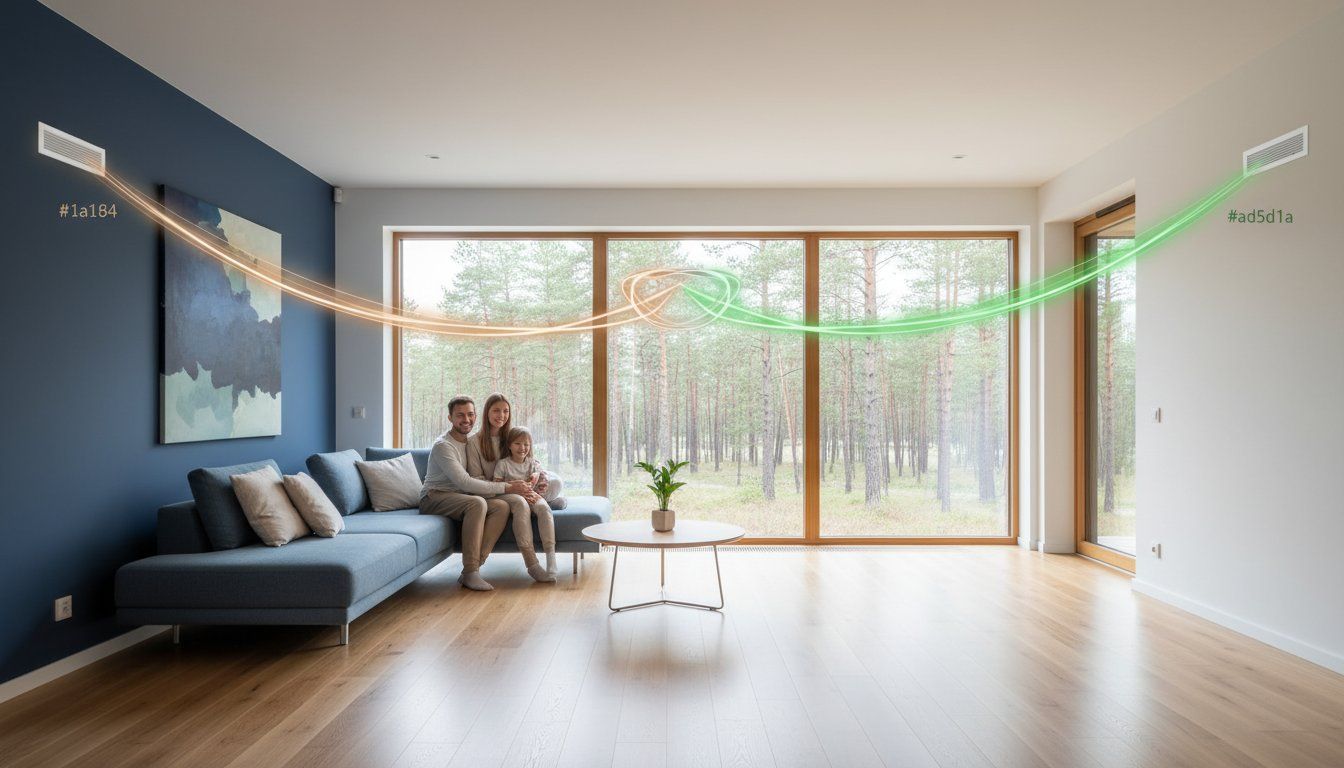
Did you know that indoor air quality in today's energy-efficient, carefully insulated buildings can be up to five times worse than the air outside? We all want to reduce our heating bills, but nobody wants to deal with mould around window reveals or wake up to stale air in the bedroom every morning. This is a familiar situation that the Commodus team encounters every day as we work alongside our customers to help their homes breathe properly, with a correctly selected heat recovery ventilation system playing the central role. You do not need to be an engineer to understand that, without effective ventilation, insulating a home can create more problems than benefits.
Modern ventilation with heat recovery is the key to enjoying comfort without compromise or unnecessary expense. In this article, you will learn how these systems work, why they have become an essential requirement under 2026 construction standards and how to choose the most suitable solution for your home. We will compare centralised and decentralised systems, provide clear answers to the most common questions and help you make an informed decision. Our aim is to offer a practical guide that will provide fresh air and lower heating bills for many years to come.
Key takeaways
- Understand why natural ventilation can no longer provide healthy indoor air in today's energy-efficient, airtight homes and why heat recovery is the solution.
- Discover how a heat exchanger effectively warms incoming outdoor air without allowing it to mix with polluted indoor air.
- Learn how to choose between a centralised duct network and decentralised room heat recovery units to find the most suitable solution for your home's layout.
- Find out how a correctly selected heat recovery ventilation system with a high energy-efficiency rating and accurate capacity calculation helps reduce heating bills in the long term.
- Gain an insight into the Commodus expert approach, where professional installation and working together with the customer ensure quiet operation and long-term peace of mind.
What is a heat recovery ventilation system and why is it needed in a modern home?
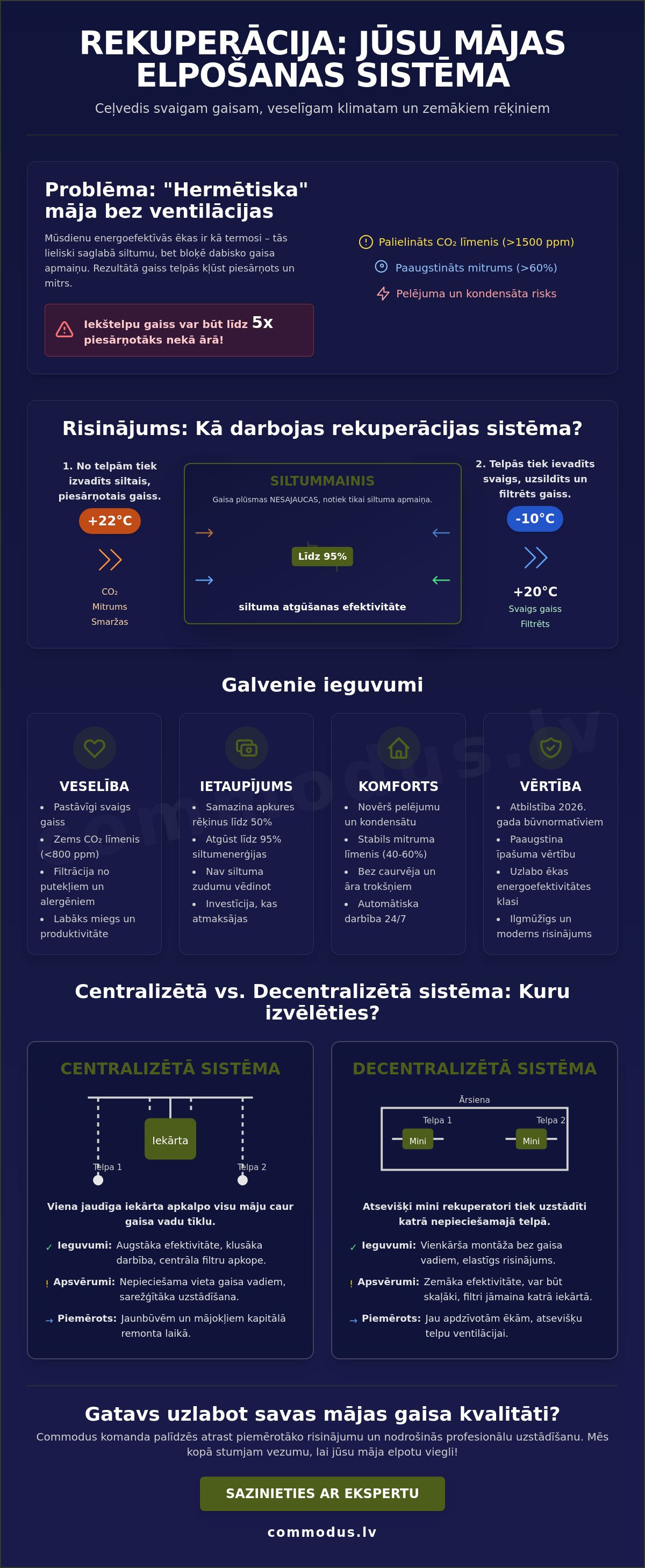
Modern construction standards have changed beyond recognition. Thirty years ago, air entered rooms through draughty window frames and gaps in walls, whereas today's energy-efficient homes have become a type of 'thermos flask'. This airtight environment helps retain heat, but it also creates a serious problem: insufficient air exchange. This is where a heat recovery ventilation system comes in. It is a mechanical ventilation system that not only maintains a continuous airflow but also recovers heat from the extract air instead of allowing it to disappear into the atmosphere.
The main difference between basic extract ventilation and a complete ventilation process lies in the heat exchanger. While ordinary bathroom or kitchen fans simply expel warm indoor air outside, a heat recovery ventilation system uses that energy to warm the incoming fresh air. The airflows do not mix, so indoor cleanliness and comfort are maintained. Without such a system, condensation quickly appears on windows and mould can develop in corners even in modern A+ class buildings, because the moisture generated by people, plants and household appliances has nowhere to go. At Commodus, we often say that a house without ventilation is like a person without lungs; that is why we work alongside our customers to make every home healthier.
Fresh air as the foundation of health and productivity
Have you noticed that the bedroom air feels heavy and your head feels foggy after a night's sleep? This is caused by a high CO2 level, which can easily exceed 1,500 ppm when the room is not ventilated. For good sleep and productivity, the level should remain below 800 ppm. Heat recovery ventilation solves this problem automatically by operating quietly in the background 24 hours a day. The system is fitted with filters that remove urban dust, pollen and other allergens from incoming air. It also helps maintain a stable relative humidity of 40–60%, preventing the air from becoming excessively dry during the heating season or too humid during periods of summer rain.
Energy efficiency: Why can you no longer afford to ventilate through open windows?
During Latvian winters, when the temperature falls to -10°C or below, an open window literally means throwing money to the wind. Calculations show that natural ventilation through windows can increase heating bills by 30% to as much as 50%. Modern heat recovery units can recover 90% or more of the heat energy. This means that the fresh air entering the room is already close to room temperature, even when it is freezing outside. Such efficiency is essential if a building is to achieve the highest energy-performance rating, which directly affects its market value. It is an investment that pays off not only through lower bills but also through improved wellbeing.
How does heat recovery ventilation work? The heat recovery process and technology
A heat recovery ventilation system operates according to a simple but ingenious principle of physics. Its main task is to exchange air without losing the heat already present indoors. The heat exchanger is where the main 'magic' happens. Warm but polluted extract air passes through the unit and warms the cold incoming outdoor air. It is important to emphasise that the two airflows never physically mix. They travel through separate channels divided by highly conductive surfaces. In this way, the fresh air receives only heat energy, not pollutants or odours from the outgoing air.
Modern technology can recover up to 95% of the heat that would otherwise quite literally escape through the window. According to the Department of Energy Efficiency, such controlled ventilation has become essential in new airtight buildings where natural air circulation is no longer sufficient. In 2026, heat recovery ventilation is no longer a luxury; it is a necessity for a healthy indoor climate.
Several components ensure the system's efficiency:
- Filter systems: Modern F7 and PM2.5 filters remove dust, pollen and urban smog particles from the air.
- Smart controls: CO2 and humidity sensors automatically regulate fan speed. If guests arrive and the CO2 level rises, the system increases its output automatically.
- Frost protection: The controls monitor the temperature and protect the heat exchanger from icing even during severe Latvian winters.
Types of heat exchanger: rotary versus counterflow plate
In Latvian conditions, choosing between a rotary and a counterflow heat exchanger is fundamental. Rotary heat exchangers are ideally suited to our cold winters because they are highly resistant to freezing and can return some moisture to the indoor air. This prevents the air from becoming excessively dry during the heating season. Counterflow plate heat exchangers, in turn, offer maximum energy efficiency and complete separation of the airflows, which is important in buildings with specific air-purity requirements. If dry winter air is a concern, an enthalpy heat exchanger is the right solution because its special membrane regulates the moisture balance effectively.
The heart of the system: fans, motors and sound insulation
A high-quality unit is built around EC (electronically commutated) motors. On average, they use 30% less electricity than standard motors and operate almost unnoticed. Sound insulation is critical, especially at night when the house is quiet. At Commodus, we always stress that a good system is one whose existence you forget about in everyday life. Modern automation also allows ventilation to be integrated into smart-home systems, providing full control from a smartphone.
When choosing the most suitable solution, it is important to feel that you are in safe hands. To find out which unit is best suited to your home, explore the products available on commodus.lv, where our experts will work alongside you all the way to complete comfort.
Centralised versus decentralised heat recovery ventilation: Which should you choose?
The choice between centralised and decentralised ventilation often depends not only on the budget but also on the technical condition of the building. At Commodus, we see every day that the right decision begins with understanding how air will move through your home. A centralised heat recovery ventilation system operates as one integrated organism, with a single powerful unit serving every room, while decentralised systems work as independent helpers in individual rooms.
For new builds and full renovation projects in 2026, a centralised system remains the gold standard. It provides the highest energy efficiency, which is essential for meeting modern low-energy building requirements. Decentralised units, by contrast, are indispensable where renovation has already been completed and installing ductwork above ceilings would require extensive demolition.
Advantages and planning of a centralised system
A centralised solution means that the main unit is installed in a plant room, loft or utility room, away from living areas. This completely eliminates equipment noise in bedrooms. Air is distributed through ducts, ensuring an even airflow. The greatest advantage of such a system is precise balancing: extraction can be set higher in the kitchen and bathroom, while bedrooms receive the maximum amount of fresh, pre-warmed air.
- Efficiency: The heat recovery efficiency of a centralised unit often exceeds 90%.
- Air quality: More powerful F7 class filters can be installed to capture even the finest urban dust and pollen.
- Aesthetics: Only small ceiling diffusers remain visible rather than boxes mounted on the walls.
Decentralised heat recovery units: The ideal solution for renovation
When a customer wants to improve the indoor climate in a flat where renovation has already been completed, a decentralised heat recovery ventilation system is often the only logical option. Installation takes only a few hours: an opening is drilled through the wall, a room unit is inserted and the electricity supply is connected. These units operate in cycles, usually expelling warm air for 70 seconds to heat a ceramic heat exchanger and then drawing in fresh air for 70 seconds, warming it with the stored energy.
However, certain limitations must be considered. Decentralised units are audible, especially in night mode when silence in the room is a priority. One unit can effectively exchange air over an area of approximately 20 to 30 square metres. For the system to operate correctly, a home will normally require at least two units working in synchronisation to maintain air circulation between rooms.
Our experience shows that decentralised solutions initially appear less expensive, but in a larger house a centralised system offers better long-term value when costs are calculated per square metre. The main question is whether we are working together from the building's foundations or looking for a smart addition to an existing interior. In either case, fresh air without open windows and heat loss is an investment that improves quality of life completely.
Key criteria for selecting and planning a heat recovery ventilation system
Choosing the most suitable solution is not merely a technical task; it is about the lungs of your home. For a heat recovery ventilation system to serve reliably for decades, planning must begin with precise figures. At Commodus, we know that every square metre and every occupant changes the calculation. The standard requirement is to provide approximately 30 cubic metres of fresh air per hour for each person. For a family of four, the system must therefore handle at least 120 m³/h without losing efficiency or creating noise.
In 2026, energy efficiency is no longer optional but essential. By selecting an A or A+ class unit, you can achieve heat recovery efficiencies of 85% or even 92%. This means that your winter heating bill will not rise simply because fresh air is being supplied indoors. The duct material is also important. We recommend flexible ducts with antistatic and antibacterial coatings. They prevent dust deposits and microbial growth inside the system, which is particularly important for children and people with allergies.
How can design-stage mistakes be avoided?
The cheapest quotation often means incorrectly calculated airflow rates and inadequate sound attenuation. If the supply and extract points are not positioned strategically, dead zones will form where the air does not move. A professional heat recovery ventilation system must also be coordinated with other building services, such as a heat pump. When both systems operate in harmony, maximum comfort is achieved with minimal electricity consumption, creating a pleasant atmosphere without unnecessary concerns.
Latvian winters and summers: Adapting the system
Our climate imposes its own requirements. In winter, when the temperature falls to -25°C, a standard heat recovery ventilation system may experience icing of the heat exchanger. Units intended for the Latvian market must therefore be equipped with intelligent preheaters. During summer heat, the bypass function becomes invaluable. It allows cool night air to enter the rooms without passing through the heat exchanger, naturally cooling the house and helping you sleep comfortably even on the hottest July nights.
To learn more about the most suitable option for your home, explore our range of heat recovery ventilation systems and consult our knowledgeable specialists.
Installation and maintenance of heat recovery ventilation systems by Commodus experts
For the Commodus team, a heat recovery ventilation system is not merely a technical solution; it is a promise of a better quality of life and improved health. We are not a company that simply sells a unit and then forgets the customer. Our philosophy is straightforward and honest: we work alongside you from the initial consultation until the system operates flawlessly and quietly in your home.
Professional installation is decisive for the system's service life. Even the most advanced heat recovery ventilation system can become a source of problems if the ductwork is installed incorrectly or the system is not balanced precisely. Our engineers ensure even airflow and keep acoustic noise within the permitted limits. This means that you can enjoy fresh air without unnecessary sound or draughts, which is especially important in bedrooms and children's rooms where silence is a priority.
Regular maintenance protects your investment. To prevent the unit from losing efficiency, filters should be replaced at least twice a year, while the heat exchanger should be cleaned and the drainage checked once a year. We provide a complete service cycle throughout Latvia. Our service team is ready to assist both during and after the warranty period, ensuring that the system serves reliably for decades.
Why choose Commodus for your ventilation project?
Since 2010, we have accumulated extensive experience in designing building-services systems throughout Latvia. We understand that every building is different, which is why our approach is genuinely individual. Whether it is a compact city flat or a large office building, we seek the optimum solution rather than applying standard templates.
Transparency is one of our core values. This means clear calculations and quotations without unpleasant surprises or hidden costs halfway through the project. You will know exactly what you are paying for and how it will benefit your home's energy efficiency and your finances in the long term.
Practical steps for starting cooperation
The journey towards fresh air begins with a simple conversation. We offer a free consultation and site survey to understand the actual situation and your needs. This is followed by an accurate quotation and the selection of equipment suited specifically to your budget and technical requirements.
- Free site survey: professional recommendations before any work begins.
- Accurate quotation: clear costs and equipment selected to suit your budget.
- Certified installation: the work is carried out by experienced specialists with the highest sense of responsibility.
- Long-term support: warranty and post-warranty service available throughout Latvia.
Join the Commodus customer community and breathe fresh air every day. We will take care of every technical aspect so that you can enjoy the comfort and peace of mind provided by a correctly installed heat recovery ventilation system.
A step towards a healthier home and lower bills
Modern energy-efficiency standards demand carefully considered solutions. A correctly selected heat recovery ventilation system is the foundation of both a healthy indoor climate and controlled long-term heating costs. You gain not only clean air without excess moisture but also substantial heat savings, which will be more important than ever in 2026. When choosing between a centralised and a local unit, the key is to assess the characteristics of the home and your family's daily needs accurately.
The Commodus team has been driving the development of this sector in Latvia for more than 14 years. We hold the widest range of energy-efficient equipment in stock, so there is no need to wait months for delivery. Installation is entrusted only to our own certified specialists, who guarantee quality in every detail. We believe that technology should serve people, not the other way around, which is why we offer only proven and dependable systems.
Contact Commodus experts and receive a free consultation on heat recovery ventilation!
Let us take care of the technical side so that you can simply enjoy comfort and fresh air every day.
Frequently asked questions about heat recovery ventilation
What is heat recovery ventilation and how does it differ from ordinary ventilation?
Heat recovery ventilation is a controlled ventilation system that provides a continuous supply of fresh air while retaining up to 95% of the heat energy in the building. Unlike ordinary ventilation, where warm air is simply discharged through windows or ventilation shafts, a heat recovery ventilation system uses a heat exchanger to warm incoming outdoor air with heat from the extract air. This can significantly reduce heating bills and completely eliminates draughts in the home.
How much electricity does a heat recovery ventilation system use each month?
A modern unit for a medium-sized detached house consumes approximately 30 to 60 kWh of electricity per month. Assuming an average electricity price of EUR 0.20 per kWh, the monthly cost will be approximately EUR 6 to EUR 12. This consumption is comparable to that of an ordinary refrigerator because the system's fans are optimised to provide effective air exchange around the clock using minimal power.
Can a heat recovery ventilation system replace air conditioning in summer?
A heat recovery ventilation system cannot fully replace air conditioning because its primary function is air exchange rather than active cooling. However, units with a summer bypass function can bring cooler outdoor air indoors at night without allowing it to be warmed by the extract air. This helps maintain a more pleasant temperature in the home, but during heatwaves, when the outdoor temperature exceeds 28°C, air conditioning remains the most effective solution for immediate cooling.
How often should the filters in a heat recovery unit be replaced, and can I do it myself?
The filters in a heat recovery unit should usually be replaced twice a year, most commonly at the beginning of spring and autumn. Homeowners can easily do this themselves without specialist assistance because the filter cassettes are readily accessible behind the unit's front panel. Regular maintenance is essential for maintaining efficiency and preventing dust accumulation, which can affect air quality and increase the load on the fans.
Does a heat recovery ventilation system create noise that interferes with sleep?
A correctly designed and installed system operates almost silently, producing approximately 20 to 25 decibels in bedrooms. We use dedicated sound attenuators and insulated ducts to prevent vibration and airflow noise. When the unit has been selected with an appropriate capacity reserve, it operates at low speed in everyday use, allowing even sensitive sleepers to rest undisturbed in a calm environment.
Is it worth installing heat recovery ventilation in an old renovated house?
Installing heat recovery ventilation in a renovated house is highly recommended because insulation and new windows make the building airtight. Without mechanical ventilation, indoor humidity and CO2 concentrations rise rapidly, often leading to mould growth on walls. A heat recovery ventilation system provides the necessary air circulation, protects the building structure from damage and creates a healthy indoor climate that is practically impossible to achieve through ordinary airing alone.
What is the average cost of installing a heat recovery ventilation system in a detached house?
The average cost of a complete solution for a 120 to 150 square metre detached house in Latvia ranges from EUR 4,500 to EUR 7,500. This includes the heat recovery ventilation unit, duct network, diffusers, sound attenuators and professional installation and commissioning. The precise cost depends on the efficiency of the selected unit and the complexity of the house layout, which is why we always recommend beginning with a detailed design.
What should I do if the heat recovery ventilation system starts icing up in winter?
Modern units are equipped with intelligent automatic frost protection that monitors the condition of the heat exchanger. During severe frost, the system temporarily reduces the supply fan speed or activates the built-in electric preheater to defrost any condensation safely. The user does not need to take any additional action, as the controls maintain safe operation even at -20°C while preserving continuous air exchange in the home.
Comments