Heating system rinsing: when needed and how to choose approach
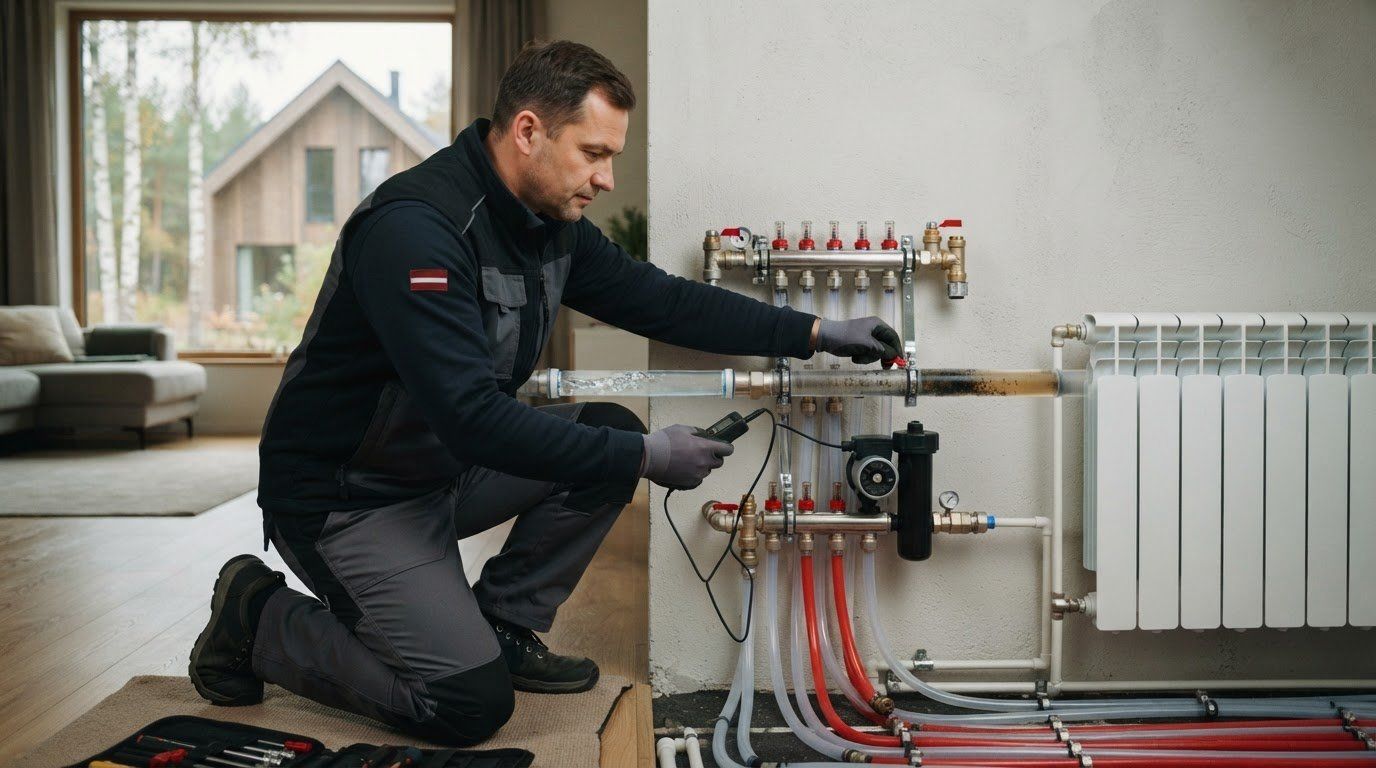
Cold radiator does not always mean that a heating system is needed for rinsing. If radiators or warm floors heat unevenly, in pipes audible noises or heating seems to have become less effective, one of the reasons may be deposits. Similar signs may also result from other system disturbances, so do not rush through the washing before the cause of the problem is clarified.
To make a valid decision, evaluate the operation of the heating system, its equipment and materials. In this article you will find out which features are worth checking for differences in mechanical rinsing, dry cleaning and filtration, as well as what to find before starting work. Calculation and optimization of the heating system can help to assess the overall situation and choose the next step instead of relying on guessing.
When can a heating system be considered?
The rinsing of the heating system may be one of the solutions if the heat breaks out unevenly in the rooms or water circulation seems weak. However, the edge of one cold radiator or unusual noise does not yet prove that the accumulated deposits in the system. These signs are the reason to check the heating operation rather than immediately choose the washing. First, note whether the problem affects one radiator, several rooms or the whole system.
How can sludge affect the functioning of the heating system?
The water circulating in the heating line can transmit corrosion particles and sludge, but mineral sludge can form on the internal surfaces of the system. Over time, sediments can interfere with water flow, especially in narrower pipe sections or radiator channels. The principle of central heating is more broadly described central heating systemswhere the heat is delivered to several premises or zones.
Sludges may interfere with the circulation of the heat transferor and contribute to uneven heat output, but their presence should be assessed together with other system performance indicators.
Check for heating if you notice any of the following signs:
- The radiator warms up only partially or its top and bottom differ significantly.
- Several radiators or warm floor areas are heated less than before.
- The premises heat up the sluggish, although the heating works in the usual mode.
- Bubbles, coughing or other unusual sound can be heard in pipes or near the heating unit.
Which features do we not yet need to rinse?
Uneven heat can be generated not only by the deposits, but also by air in the system, incorrectly adjusted valve, circulatory disturbance or control settings. Check that the radiator valve is open, whether the problem recurs and how the rest of the room is heated. One sign in itself is not a diagnosis.
Rinse, dry cleaning and filtration of the heating system: how do they differ?
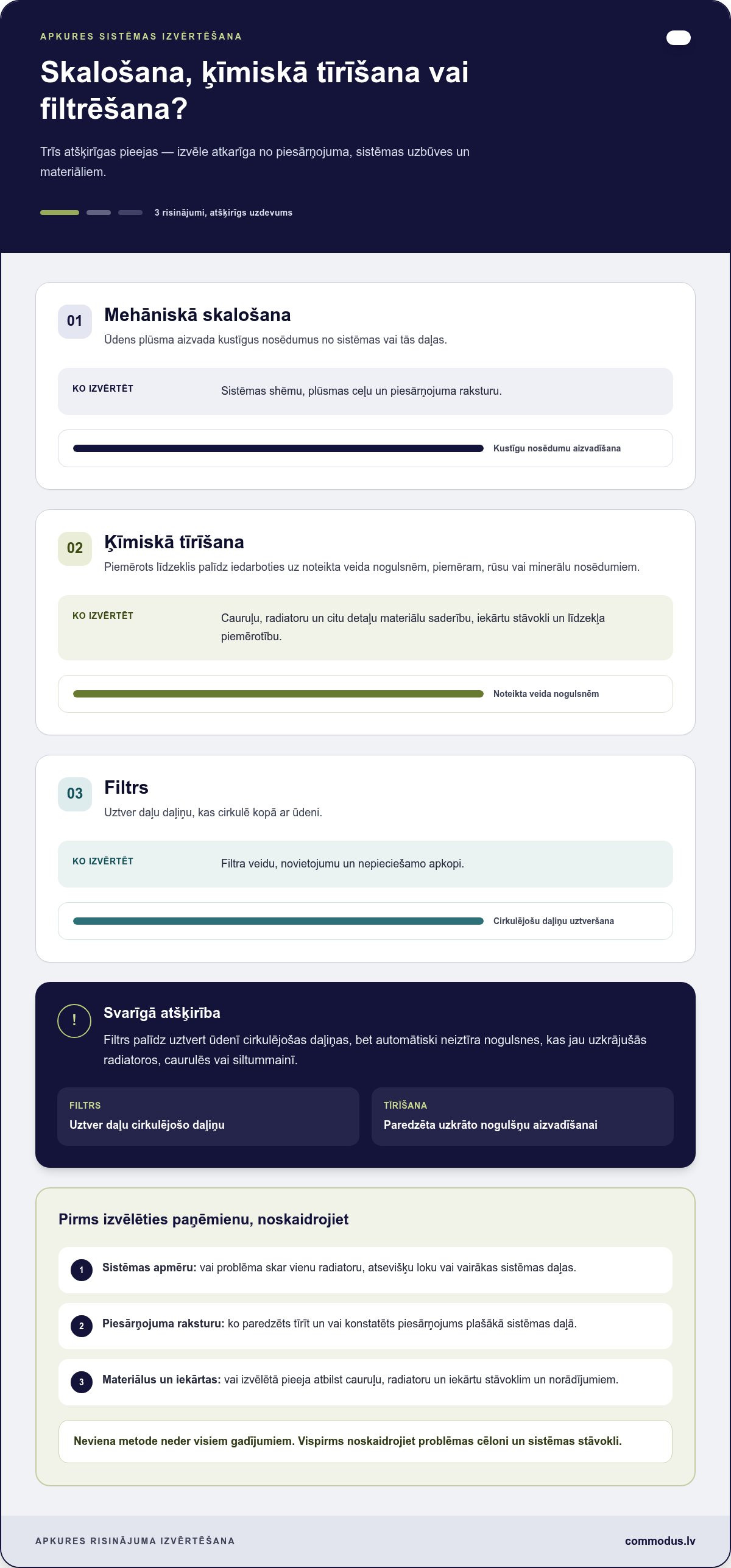
These techniques are not interchangeable. In mechanical washing, water is driven through the system to rinse away moving sediments. Chemical cleansing uses a suitable remedy for the particular sediment, while the filter captures part of the pollution that circulates with water. The choice depends on the design of the system, the materials and the contamination found.
When can washing or chemical cleaning be considered?
The washing of the heating system may be considered if the assessment indicates contamination in a wider part of the system and the flow must be restored. Chemical cleaning is considered if there is a need to act on certain types of sediment, but the suitability of the product depends on the materials of pipes, radiators and other components. There is no one method that fits all cases. First, find out what is intended to be cleaned and what condition of the equipment is.
- The technique is: Mechanical flushing; What it addresses: With the flow of water is removed by moving sediments from the system or part of it.; What is necessary to evaluate: System diagram, flow path and pollution nature.
- The technique: Chemical cleaning; What it addresses: Helps to act on certain deposits such as rust or mineral deposits.; What should be evaluated: Material compatibility, condition of equipment and suitability of the chosen product.
- Technique: Filter; What it addresses: Captures part of the circulating particles in the water.; What needs to be evaluated: Filter type, location and necessary maintenance.
What does the filter do and what does it not replace?
The filter can be part of the maintenance of the system, as it helps to retain the particles in the water. However, it does not automatically remove the deposits already collected in radiators, pipes or heat exchangers. Also, the cleaning volume varies: in one case the entire heating circle is treated, in another it is checked and a separate radiator or heat exchanger is cleaned.
The filter helps to capture circulating particles, but cleaning is intended to remove already accumulated deposits. If it is not clear which solution corresponds to the state of the system, the Kommodus consultation can evaluate the heating solution and its operation. Learn about the evaluation of heating solution.
How to evaluate the heating system before rinsing?
Before deciding on washing the heating system, collect information that helps to understand the extent of the problem. Is the whole house, one room or only a separate radiator heated less? Did the heating start to work differently after the change of repair, equipment maintenance or settings? Answers will help you understand whether the entire heating circle or a specific part of it should be assessed.
What to write down if heating works unevenly?
Make brief notes without just relying on memory. Mark rooms, radiators or warm floor areas where the heat is weaker, as well as when the problem appears and if it recurs. Record unusual noises and recent maintenance, repairs or changes in heating settings. If there is a system diagram or equipment documentation, prepare it for evaluation.
- Determine the type of system. Specify whether the dwelling has heating of radiators, a combination of warm floors or both, and also any heating equipment.
- Separate local problem from common. Record whether the feature affects one radiator, a separate floor circle, a heat exchanger or more than one part of the system.
- Collect information about materials and equipment. Documentation of equipment and information on pipe and radiator materials can help to assess the compatibility of the cleaning method.
What questions should be discussed before starting work?
Before starting work, find out which part of the system will be processed and why the method chosen. Discuss how material and equipment instructions will be taken into account, how the result will be evaluated and whether additional tests will be required afterwards.
Commodus consultations help to evaluate the heating solution, its calculation and optimization options, so that future action can be based on system conditions. Apply for heating system evaluation advice.
What to do after the evaluation of the heating system?
The evaluation helps to choose the next step rather than automatically arrive at one solution. Depending on what is found, there may be justified rinsing of the heating system, additional inspection of the equipment or optimisation of the system operation. If the disturbance affects only one part, a separate evaluation may be sufficient. If heating repeatedly works unevenly or the problem affects several rooms, see the system as a whole.
When does a wider assessment of the heating solution be necessary?
A more detailed assessment is useful if the disturbance recurs, the space heats differently or it is not clear whether the existing solution meets the needs of the dwelling. The calculation of the heating system helps to review how the selected installation and heating elements work together. Optimize allows to evaluate the system settings and operation so that the decision on future works is based on the picture rather than in one sign.
How can Commodus help to evaluate the heating solution?
Commodus provides advice, as well as services for the design, calculation and optimisation of heating systems. During the conversation you can discuss the type of heating system, its operation and considerations to be taken into account when deciding on future actions. This helps to arrange essential information and understand whether additional testing, changes in the operation of the system or other solution is necessary.
If you want to discuss your heating solution and understand what steps would be justified in your situation, apply for consultation on heating solution. Commodus team will help to evaluate options and consider the next step.
Take the next step with a clear justification
The washing of the heating system is not an end in itself. It is important to choose action that corresponds to the identified cause, rather than to perform work just because they seem to be a normal solution. Sometimes a small adjustment is sufficient, otherwise a broader review of the system is needed.
In making your decision, take into account the future functioning of the heating system. A well-considered approach helps to understand what is now a priority and what is worth planning later to ensure that heating meets the everyday needs of the dwelling.
A careful evaluation allows you to act without undue haste and with more confidence. Step by step steps steps can lead to a solution that is suitable for your heating system.
Frequently Asked Questions
What signs may indicate that the heating system needs to be checked?
The test is worth considering if the heating has started to work differently than usual, for example, in one room after changing the thermostat setting becomes cooler or the heat varies from one zone to another. Write down when the changes started and if they coincide with the switching of the heating mode. This will help to assess whether the deviation is repeated or is temporary and will provide useful information for checking the system.
Can flushing the heating system cause leakage?
Drying does not in itself mean that there will be a leak, but the risk cannot be excluded, especially if the system already has worn-out connections or corrosion affected parts. During work, water flow and system conditions change, so weak places may become noticeable. Before the method is chosen, it is important to evaluate the condition of pipes, radiators and connections. If the system appears after work, the system should be checked.
Is chemical rinsing better than conventional rinsing?
No, chemical rinsing is not automatically better. It can be suitable for cleaning certain sediments, but the choice depends on the type of contamination, the materials of the system and the condition of the equipment. Mechanical rinsing uses water flow to remove moving sediments. Before rinsing the heating system, check what is intended to clean and whether the chosen approach corresponds to the system.
How much does it cost to rinse the heating system?
The costs vary depending on the system's size, pollution and chosen method. In public market prices, the rinsing of the private house system starts from approximately €500 plus value added tax; the offers for rinsing the 12 hot floor circles range from € 250 to € 900. These are examples of the market, not the price of the Commodus service. The exact amount is determined by the amount of the work and the conditions of the object.
Will it always work more efficiently after rinsing the heating system?
No, more efficient operation is not guaranteed, because the result depends on whether the problem really was caused by the sludge. If the cause is, for example, incorrect settings, valve malfunction or other equipment problem, rinsing will not solve it. After work compare how heated previously problematic spaces, and pay attention to whether the initial sign has changed. If it persists, further testing is required.
Comments