Energy independent house with solar panels: how to match all systems
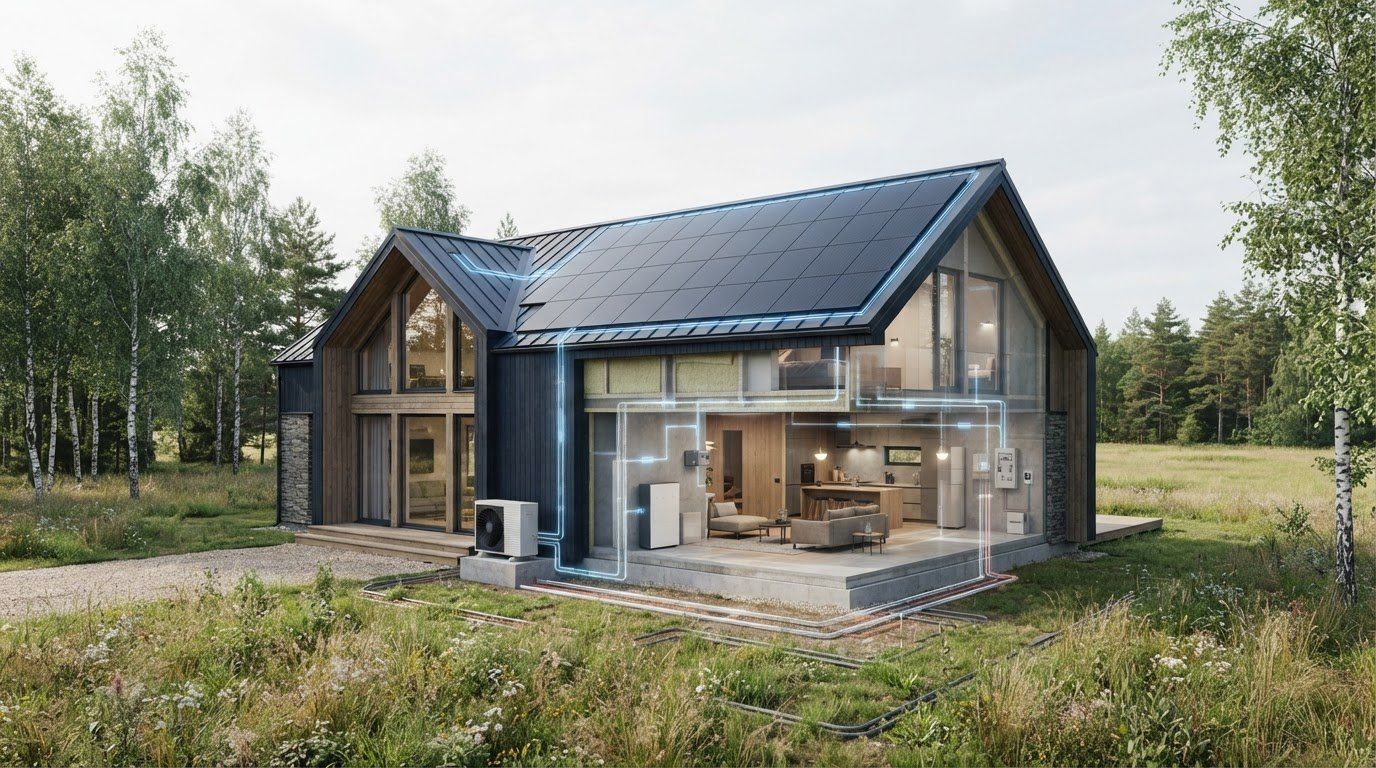
Can solar panels alone provide energy to the house even when the days are short and heating consumes more? In Latvia, the answer is not only in the number of panels. An energy independent house with solar panels is made by coordinating electricity production, storage and heating. As production and consumption change over the year, the panels do not necessarily mean that the needs of the house will always be met.
It is understandable to want to use the energy produced by them and to reduce their dependence on the electricity grid. To assess how to achieve this, you need to understand first when and how much electricity the house consumes, how the heating system affects this consumption and what role energy storage can play. A carefully designed system allows you to view these elements together, not as individual purchases.
In this article you will find out what energy independence means in everyday life and how to plan home consumption, solar panel production and storage as a unified energy system. Let's also look at the role of heating solution and practical issues that help to make informed decisions.
What does it mean to have an energy independent house with solar panels?
Energy independence does not mean that the house always works without a power grid. More practically, it is perceived as reducing dependence: the house produces more energy itself and uses a larger part of its own needs. Solar panels produce electricity, but the total energy consumption of the house also includes heating, hot water, ventilation and household appliances. Therefore, the amount of electricity produced by the panels does not in itself tell us to what extent the house is self-sufficient.
In short: self-consumption is the use of domestic electricity for own use, but full autonomy would mean providing home energy needs even without a connection to the electricity grid. This distinction helps us to choose a realistic goal. energy independent house energy plus building is a more stringent concept: it produces more energy than it consumes in the year.
Why does solar panels alone not mean complete independence?
Panels produce electricity when solar energy is available, but home needs occur throughout the day. If the production time does not match consumption, part of the electricity can be used immediately, a part of the solar battery can be stored, but at other times electricity can be supplied from the grid. Production is electricity generation, storage is its preservation for later time, but consumption is energy use for home operation.
How to set a goal of home energy independence?
Start with actual consumption data, not the assumption of the required number of panels. See electricity bills and, if possible, compare consumption in different periods of the year. Also write down the daily rhythm of the house: when heating and boiler is running, when the house is inhabited and when the most energy-intensive appliances are used.
The purpose of the formula is to increase the proportion of electricity produced by the house itself, for example, immediately or after storage. This view helps to reconcile solar panels, solar cells and heating with real needs, rather than to seek complete disconnection at any price.
How do solar panels, batteries and heating form a single system?
Each solution has a role to play: panels produce electricity, solar battery accumulates it for later use, but heating equipment uses energy to provide heat. Therefore, an energy independent house with solar panels is not just a choice of panels. It is also necessary to coordinate when the house consumes electricity and how much energy it produces can be used immediately. Description of solar technologies.
Solar panels generate electricity, while solar collectors use solar energy to heat water or other heat transmission. They are different solutions, so the choice depends on the needs of the house. When planning the system together, you can assess how the electricity and solar energy produced are most useful in the house.
- Component: Solar panels; Function: Manufactures electricity; Question for assessment: What is home consumption and when is electricity used?
- Component: Solar battery; Function: Accumulates electricity produced; Question for assessment: Do consumption often occur at a time when panels are not producing enough?
- Component: Heating equipment; Function: Provides heat and uses energy; Question for evaluation: How does heating affect total electricity consumption?
What is the role of a solar cell in the home energy system?
Battery is a storage solution, not an additional electricity producer. It can help to use the energy produced later, but its suitability depends on the production and consumption profile of the house. If electricity is mostly consumed during production, the need for storage may differ from the house where consumption increases in the evenings. To assess this, compare when electricity is produced and when the house has the largest consumption.
How does the heat pump fit into the solar energy solution?
Air-water heat pump uses electricity for heating, so its consumption should be taken into account when planning a panel system. If the heating or hot water preparation operation can be adjusted to the daily rhythm of the home, you can assess how to make better use of the electricity produced at that time. Commodus offers Mitsubishi, Daikin, CTC and NIBE air-water heat pumps. Air-to-water heat pump guide.
Heating and solar solutions are worth evaluating together with home consumption data, not choosing each machine separately. Commodus offers heating and solar system consultations, design, installation and maintenance.
How to plan an energy independent house in the seasonal conditions of Latvia?
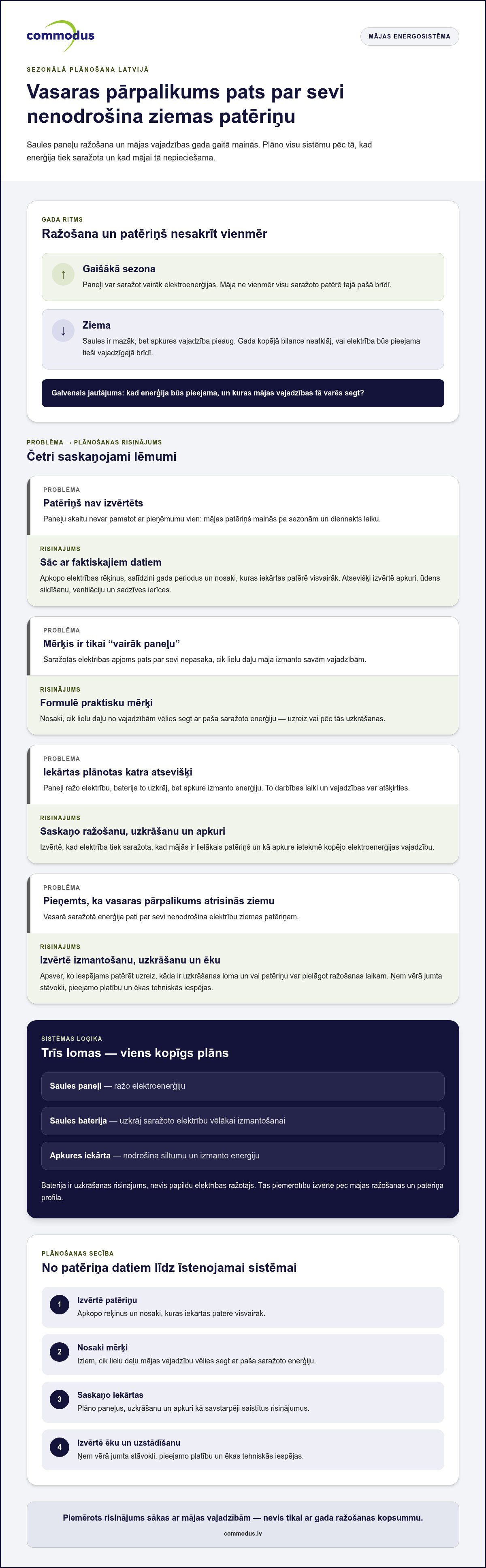
In Latvia, solar energy production changes over the year: panels can produce more in the lightest season, but in winter the sun is less while the heating need increases. Therefore, the system is planned for the needs of the house all year round, not just as much electricity can be produced on the summer day. The annual balance shows total production and consumption, but does not reveal whether electricity will be available at the very moment the house needs it.
To create a realistic plan, move along the steps:
- The consumption shall be assessed. Collects electricity bills and sets out which equipment consumes the most.
- Set a target. Decide how much of your home needs to cover by your own energy.
- Matching equipment. Plan panels, storage and heating as interrelated but separate solutions.
- Assess the building and installation. The condition of the roof, the available space and the technical possibilities of the building influence how the system can be implemented in the particular facility.
How to assess home consumption before choosing the system?
See not only the total consumption, but also its distribution by season and time of day if such data is available. Separate records of heating, water heating, ventilation and household appliances needs. This will help to understand when the energy produced will be most useful. Panel selection issues are more widely considered In the guide to solar panel sets.
How can seasonal production be taken into account in planning?
The summer surplus itself does not provide electricity for winter consumption. Therefore, it is assessed where energy can be used immediately, what storage role can be played and whether consumption can be adjusted for the production time. The US Solar Association also offers such solar and storage solutions, while the building plan must meet the needs of the building.
When comparing solutions, attention is paid not only to the total annual production, but also to when energy will be available and which home needs it will be able to cover.
How does Commodus help to create a home-friendly energy solution?
The needs of each home are different, so the appropriate system begins to be built with an understanding of the building, its heating and electricity consumption. The Kommodus team advises, designs, installs and serves heating and solar systems. This approach helps to harmonise the equipment as a single solution, not to choose each individual, without taking into account the other needs of the house.
Energy independent house with solar panels can mean something different in each facility. In planning goals and solutions are adapted to the house, its consumption and heating type. This allows making a reasonable decision without relying on a universal set or promise of a certain level of savings and independence.
How are solar and heating systems harmonised?
For example, if a heat pump is in or is planned for the house, its consumption should be included in the overall assessment of the energy system. Solar panels and heating equipment are separate solutions, but they are worth planning in a coordinated way.
The heating calculator and heat pump calculator can serve as a starting point for assessing home needs. They help to structure the initial picture of heating, which is further supplemented with information on electricity consumption and building.
What is the next step for the owner of the house?
The more you understand the needs of the house, the easier it is to discuss the appropriate solution and its planning steps.
The evaluation of heating and solar systems is based on consumption data, information on existing facilities and technical possibilities of the building.
Take the next step towards a smart energy system
To make your idea work, first of all, choose what is most important for your home: greater use of electricity produced by you, modernisation of heating or gradual transition to harmonised systems. A clear priority helps you compare options and understand which changes are now in place and which can be planned later.
An energy independent house with solar panels is not a one-day destination, but a series of well thought-out decisions. Leave space for adjustments, because the needs of the house can change over time. The most important thing is to choose a solution that is understandable and in line with the intended direction.
Start with one particular priority and move forward step by step. With a clear plan, the next decisions become easier to accept and the home energy system can evolve with its needs. Contact the Commodus team to discuss a suitable heating and solar solution for your home.
Frequently Asked Questions
Can solar panels become fully energy independent?
This is an individual objective, but the installation of panels does not ensure it in itself. First, it specifies what independence means for you: less electricity received from the grid on a daily basis or the operation of certain equipment during a power grid break. These are different tasks.
Is the solar panel system necessarily a solar battery?
No, no battery is required in every house. To assess whether it is appropriate for habits, records, which devices usually work in the evening and night and can be planned differently. This review helps to assess the role of storage solution in a common system, without choosing a battery just because it is included in other sets.
Does the solar panels provide enough energy for heating in winter?
This cannot be determined only by looking at the production estimates of panels. Heating needs also affect the condition of the building, heat losses and the operation of the current heating equipment. Therefore, when evaluating winter needs, information about the building insulation and heating system is useful, not only electricity bills.
How does the heat pump help to use the electricity produced by solar panels?
The operation of the heat pump can be taken into account when planning the use of domestic electricity. It is practical to assess whether the hot water preparation time or heating mode can be adjusted to the daily rhythm of the house, while maintaining the comfort you want. Do not assume that the modes can be changed in any system in the same way: the specific action plan is designed taking into account the needs of the heating equipment and housing.
What makes solar collectors different from solar panels?
The choice begins with the question of the task you want to solve: the production of electricity or the use of solar energy for heat. Before the decision, you will also look at the existing water heating solution and how the new equipment fits into the home system. Commodus offers solar panels and solar collectors, including HEWALEX flats and HEWALEX vacuum solar collectors.
Comments