Microinverters or String Inverter: How to Choose the Best Option for a Solar Panel System in 2026
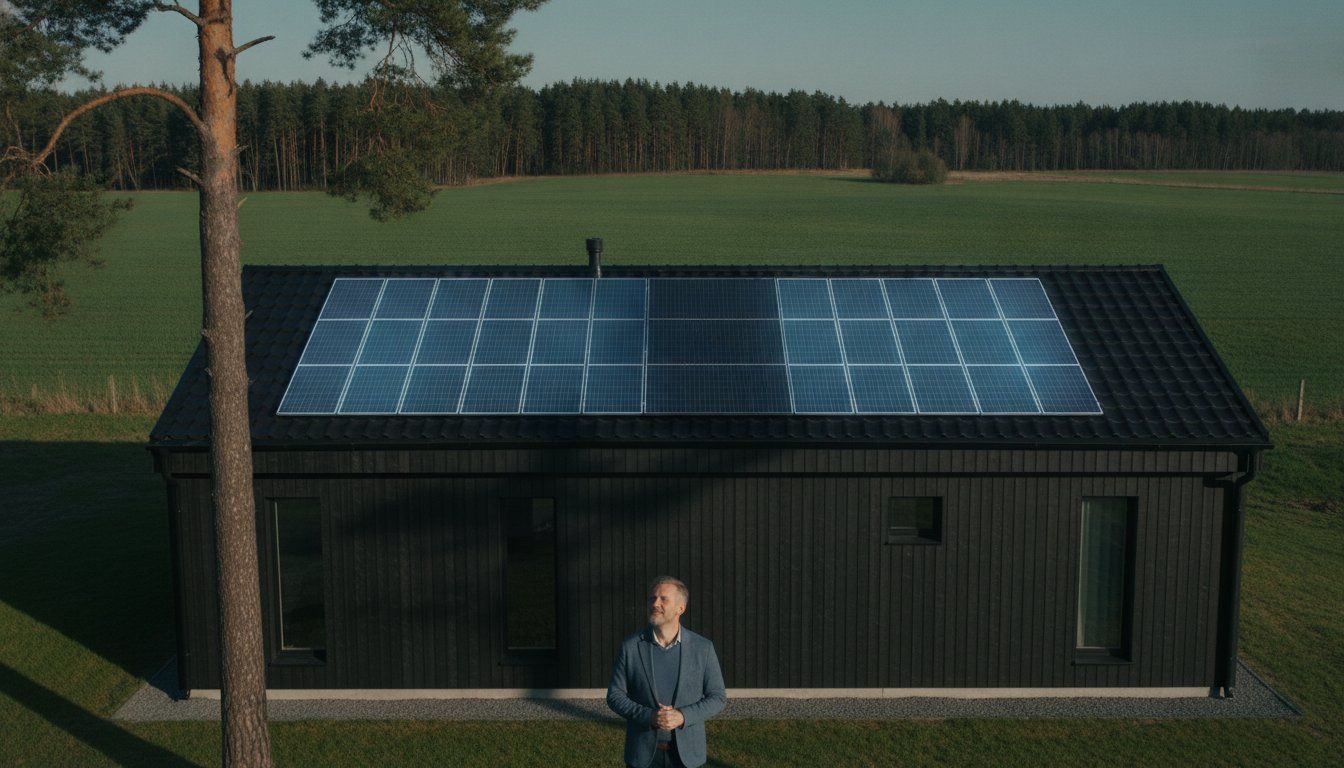
By choosing the cheapest inverter for your solar panel system, you may be signing up for thousands of euros in lost benefits over the next two decades. We understand that technical terminology can seem complicated, and concerns about how a neighbour's tree or chimney shade will affect your "virtual wallet" are completely justified. Now that the number of microgenerators in Latvia has grown by more than 400%, the question of which is more suitable –microinverters or a string inverter– has become one of the most important decisions on the path to energy independence.
Learn the key differences between microinverters and string inverters so you can make a considered decision about your home's energy efficiency and avoid unexpected maintenance costs in the future. In this article, we will explain the pros and cons of both technologies in simple language, taking into account 2026 developments and the opportunities offered by the EKII support programme. We will help you gain confidence in the solution chosen for your roof, so your system can operate at maximum efficiency for at least 20 years and every ray of sunlight is converted into a real financial benefit.
What are microinverters and string inverters: a basic explanation
Think of solar panels as a car engine and the inverter as the gearbox. Without it, power is generated, but it cannot be used for movement. Solar panels produce direct current (DC), while your home appliances and the grid require alternating current (AC).Solar inverteris the "brain" of the entire system, performing this critical conversion. The choice of whether your project is better suited tomicroinverters or a string inverterwill determine the system's overall efficiency and how many euros accumulate in your virtual wallet over the next 25 years.
A traditional string inverter operates on the "one for all" principle. All panels are connected in series like one team. Microinverters, by contrast, give each panel full autonomy. Each panel operates at its own maximum output regardless of what its neighbour is doing. To understand this better, remember old Christmas lights. If one bulb burned out, the whole string went dark. With a string inverter, the system does not switch off completely, but output drops to the level of the weakest link. If a chimney shadow falls on one panel, the whole row starts working as slowly as that single shaded panel.
How does a string inverter work?
This is a classic and proven solution where panels are connected in "strings". All the generated high-voltage direct current flows to one central device, usually located indoors, for example in a garage. It is a mechanically simpler design that makes maintenance easier because the main electronics are accessible in one place and protected from outdoor weather conditions.
How microinverters work
In this model, each panel has its own small device attached to the back. Energy is converted into alternating current immediately on the roof. This not only optimises each module separately, but also increases safety. Lower-voltage current flows through the cables to the house, reducing the risk of arc faults. In addition, this type of system allows the health of each panel to be monitored digitally and individually.
Microinverters or a string inverter: the main differences
The choice of whether your home is better suited tomicroinverters or a string inverterbecomes most obvious when clouds cover the sky or the shade of a neighbour's spruce falls on the corner of one panel. In Latvia's changing weather, where sunny spells are often replaced by haze, this technological difference directly affects the content of your virtual wallet. While a string inverter is more cost-effective at the installation stage, microinverters offer long-term peace of mind with warranties that often reach 25 years. By comparison, traditional central inverters usually last 10 to 12 years, which means they will need to be replaced at least twice during the system's life cycle.
Another important nuance is system transparency. With microinverters, you can see the "health status" of each individual panel on your phone. If a module starts performing worse because of dirt or a defect, you will notice it immediately. In a string system, you will only see the overall power drop, and finding the faulty panel may require a technician's visit and extra costs. When planning smart home energy efficiency, it is worth considering how solar energy will power other equipment; for example,air-to-water heat pumpsoperate most efficiently when the energy supply is optimised as much as possible.
Performance and energy yield
In complex conditions where roof planes face different directions or partial shading occurs, microinverters can generate up to 20% more energy. This is possible because each panel operates at its own maximum power point. In this situation, a string inverter would be forced to reduce the output of the entire row to the level of the weakest panel, preventing the full use of solar potential on the other parts of the roof.
Safety and installation nuances
Microinverters significantly improve home fire safety because direct current (DC) is immediately converted into safer alternating current (AC) on the roof. This prevents the risk of high-voltage DC arcing, which is typical of string systems. This solution is also excellent for those planning to expand their system. If after five years you decide to install three more panels, they can be added to a microinverter system easily, without worrying about the capacity limits of a central inverter.
How to choose the most suitable solution for your home?
There is no single right answer to the question of which technology to choose, because every home project is a unique story. In our experience, the decision on whether to installmicroinverters or a string inverterdepends on a combination of four main factors. These are the shape of the roof, the surrounding environment, your future plans and the balance between immediate savings and long-term benefits. If your home has a simple gable roof without obstacles, the choice will be one thing; if the roof has dormers and lush trees around it, the strategy changes drastically.
When planning an investment in 2026, it is important to think at least ten years ahead. Today, more and more households choose to integrate battery systems (BESS) to increase self-consumption and energy independence. You should also consider whether you may want to expand the solar array in a few years when an electric car appears in the family or additionalair-to-air heat pumpsare installed for cooling during summer heat.
When is a string inverter the best choice?
A string inverter is an excellent solution if your home has a large south-facing roof with the same pitch. If there are no nearby trees, neighbouring houses or chimneys casting shadows, this proven technology will deliver high efficiency at lower initial cost. It is a pragmatic choice for those looking for a simple, centralised system and whose roof is not exposed to complicated shading conditions during the day.
When are microinverters indispensable?
Latvian private-house architecture often includes complex roofs with several slopes and orientations. In such cases, microinverters become an indispensable helper because they allow each panel to operate independently without affecting the rest of the system. This is critically important if one of the modules is shaded for part of the day or if panels are placed on different roof planes. By choosing this solution, you gain maximum safety and the ability to monitor the system's operation in detail. To better understand how these components fit into the overall picture, we recommend reading more aboutsolar panel kitsand their advantages.
If you want to calculate precisely which solution will pay back faster in your specific situation, explore our solar panel kit offers and book a consultation with our technicians. 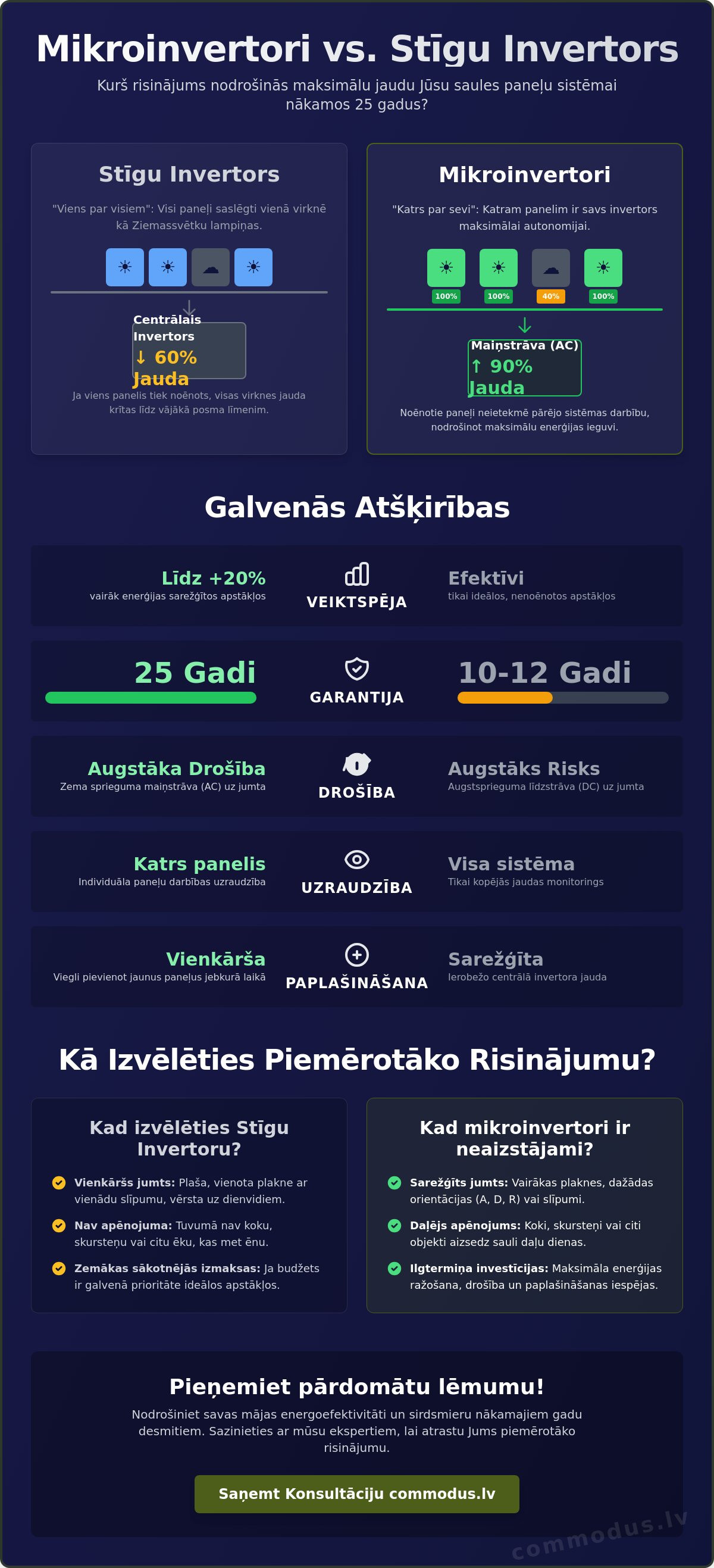
Commodus recommendations: system integration and next steps
Solar panels are not just an isolated device on your roof. They are the heart of the whole home energy ecosystem. The decision on whether your project is better suited tomicroinverters or a string inverterwill directly affect how harmoniously the other engineering systems operate. Our experience shows that the greatest benefit comes from smart energy management. This means directing solar energy directly, for example, to the operation ofair-to-water heat pumpsat times when production is highest, instead of simply sending it to the grid.
By choosing Commodus, you receive not only a technical solution, but a full service cycle. We believe you cannot rely solely on a general online calculator. Every home has its own nuances, from roof construction details to the family's daily consumption habits. Our team handles the entire process — from precise design and power calculations to professional installation and technical support throughout Latvia.
The synergy between sun and heat
A correctly chosen inverter serves as a bridge between sunlight and the comfort of your home. Using the detailed monitoring provided by a microinverter system, you can see exactly when the system generates surplus power. This energy can be automatically directed to the heat pump so it heats water or prepares underfloor heating for the evening. This significantly reduces the need to buy electricity from the grid during expensive hours. Learn more aboutair-to-water heat pump installationand how this combination helps achieve maximum energy independence.
How to start your path to energy independence?
The first step is an honest and professional conversation. We are knowledgeable technicians who care not only about technical execution, but also about your long-term peace of mind. We will help you assess whether microinverters or a string inverter are more economically justified in your situation, taking into account both your roof specifics and available state support. Our goal is to create a system that serves efficiently for at least 20 years, becoming a secure investment in your future.Apply for a free consultation and receive an individual offer!Contact our experts today to make precise calculations and start producing your own green energy.
Start your journey towards energy independence today
The choice of whether your home is better suited tomicroinverters or a string inverteris an important step that will affect your home's energy efficiency for the next two decades. Remember that a string inverter is a great choice for simple roofs without shading, while microinverters provide maximum output in complex situations and guarantee higher safety. The most important thing is to look at the system as one whole, integrating it with smart heating solutions so that every watt of solar energy produced works for you and reduces monthly costs.
The Commodus team has more than 15 years of experience in creating complex engineering systems, and we offer a full service cycle from the first project sketch to system installation and regular maintenance. Our technical experts will provide friendly and professional support, helping you make a considered decision based on real measurements and the specifics of your property. We do not just install equipment; we become your partners on the path to a sustainable lifestyle.
Receive a free solar panel system design and inverter consultation!
We are here to help you create a cosy, safe and energy-independent future. Let's start this project together today!
Frequently asked questions about solar panel inverters
Are microinverters safer than string inverters?
Yes, microinverters are considered safer because they convert direct current (DC) into alternating current (AC) right at the panel on the roof. This means that high-voltage direct current does not flow through the cables to the house, while in string systems it can reach as much as 600 or 1000 volts. This approach significantly reduces the risks of electrical arcing and fire in the home, giving the family additional peace of mind.
What happens if one microinverter fails?
If one microinverter fails, only that specific solar panel stops working, while the rest of the system continues producing energy at full power. This is one of the biggest advantages in the discussion of whethermicroinverters or a string inverterare better. In a string system, a fault in one central inverter usually means the entire system stops operating until the device is repaired or replaced.
Can I combine a string inverter with power optimisers?
Yes, a string inverter can be supplemented with power optimisers installed separately at each panel. This solution offers similar advantages to microinverters, such as higher efficiency in shaded conditions and individual monitoring of each panel. It is a middle ground between a traditional central system and a fully decentralised architecture, allowing the inverter to remain in an easily accessible indoor location.
How long do modern solar panel inverters last?
Traditional string inverters usually last 10 to 12 years, which means they will need to be replaced at least once during the 25-year operating life of a solar power plant. Microinverters, by contrast, are designed to last as long as the solar panels themselves, and their manufacturers often offer 20 to 25-year warranties. This longevity is an important factor when planning the total long-term maintenance costs of the system.
Does the choice of inverter affect receiving state support for solar panels?
The inverter type, whethermicroinverters or a string inverterdoes not directly affect your right to receive EKII state support of up to 4000 euros. The main condition is that the equipment complies with European Union technical standards and that installation is carried out by a certified merchant. However, smart monitoring can help record generated energy more accurately, which is important for making the most of the advantages of the new net billing system.
Comments