Solar Panel Kits: A Complete Guide to Energy Independence in 2026
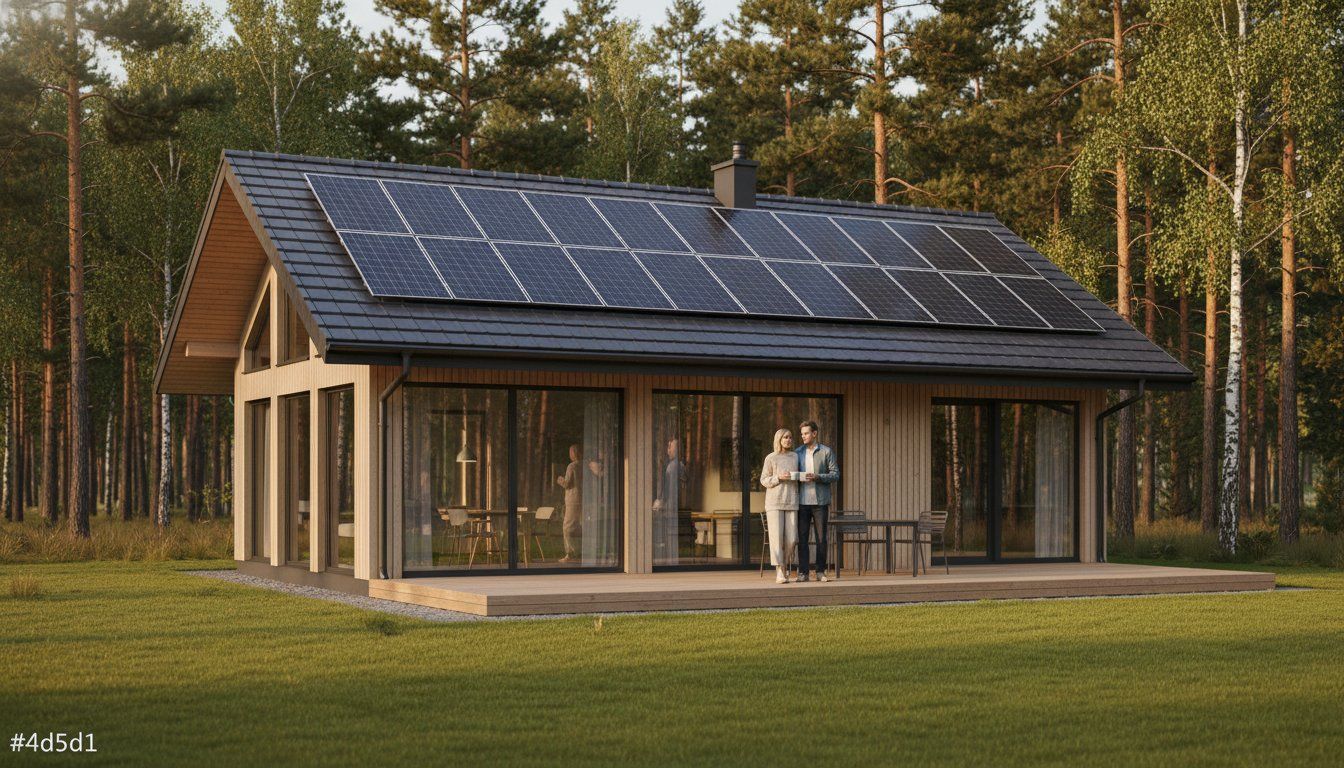
Did you know that, according to the latest energy trends, carefully selected solar panel kits can pay for themselves for Latvian households in an average of 5 to 7 years while protecting them from unpredictable exchange prices? We understand that concerns about complicated bureaucracy and the fear of choosing a system capacity that does not match actual consumption often lead people to postpone the decision to become more independent. You are not alone in having these doubts, as nobody wants to invest in a system that fails to deliver the expected savings or does not meet the real needs of the home.
This article is your guide to energy freedom in 2026. Learn how to choose the most suitable solar panel kits, why an accurate capacity calculation is critically important and how to obtain state support successfully without unnecessary stress. We will examine practical steps from project design through to regular maintenance so that you clearly understand how to reduce electricity costs as effectively as possible. We are ready to work alongside you at every stage, providing sound advice and dependable support so that your home becomes a stable source of green energy.
Key takeaways
- Learn why ready-made solar panel kits ensure flawless component compatibility and are a more financially advantageous investment than purchasing individual parts separately.
- Discover the key differences between on-grid, off-grid and hybrid systems so that you can choose the solution best suited to your consumption and lifestyle.
- Obtain a clear action plan for receiving state support in Latvia and completing the steps required to coordinate the project with Sadales tīkls.
- Learn how to choose between monocrystalline and bifacial panels to generate electricity as efficiently as possible in Latvia's variable weather conditions.
- Understand how a full-service engineering approach—from an accurate capacity calculation to regular maintenance—ensures system longevity and a short payback period.
What are solar panel kits and how do they work in Latvian conditions?
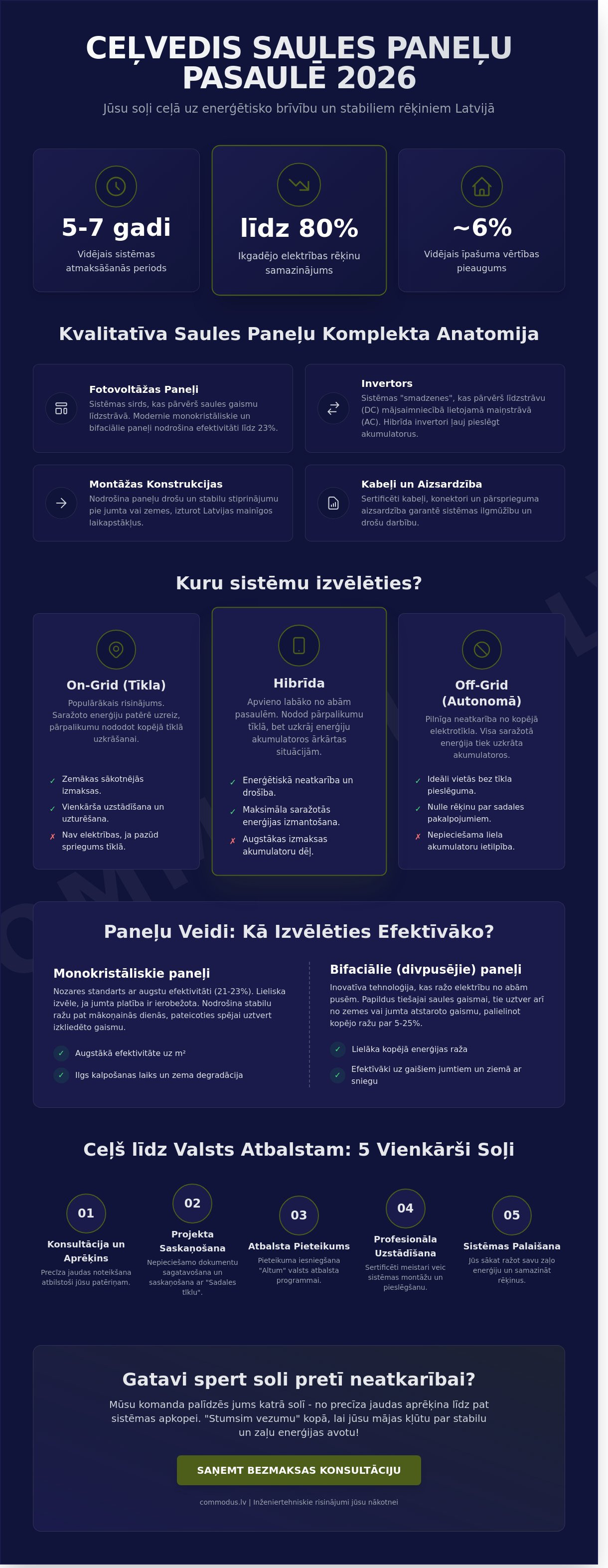
When we talk about energy independence, solar panel kits are the first step towards well-considered and sustainable energy management. They are not merely a random collection of parts. They are complete systems in which every component has been carefully selected for electricity generation. A kit normally includes photovoltaic modules, an inverter, mounting structures and connecting cables. By choosing a ready-made solution, you avoid technical errors. Component compatibility is critical: an incorrectly selected inverter can reduce the system's total output by 15% or even 20%. Our experience shows that factory-tested kits last longer and operate more reliably than systems assembled from independently selected parts.
To understand more clearly what solar energy is and how it is converted into electricity, you do not need to be an engineer. A persistent myth in Latvia is that we have too little sunshine and too many clouds. In fact, solar radiation at our latitude reaches approximately 1,000 to 1,100 kWh per square metre per year. This is comparable to northern Germany or Denmark, where solar energy is a leading renewable resource. Cloudy days do not stop generation because modern panels also capture diffuse light effectively. Although winter days are short, the lower air temperature actually improves panel conductivity and efficiency. Together, we can turn this natural resource into real savings.
Key benefits for detached-house owners
By installing solar panels, you effectively fix a substantial part of your electricity costs for the next 25 years. This provides security when global energy prices fluctuate unpredictably. The main benefits are clearly reflected in monthly expenditure:
- Reduced bills: Correctly selected solar panel kits can reduce annual electricity expenditure by as much as 80%.
- Property value: Property-market data confirm that homes with energy-efficient solutions sell for an average of 6% more.
- Energy independence: You become less dependent on general grid tariffs and increases in distribution-service charges.
Why is 2026 the right time for installation?
Technology has advanced enormously in recent years. By 2026, panel efficiency has reached a level at which the degradation rate has fallen below 0.5% per year. This means that after two decades the system will still produce at least 90% of its original output. Latvia's new net billing system allows generated surpluses to be managed much more flexibly. State-support programmes through Altum remain available and can cover a significant proportion of the initial investment. This is the moment when technological maturity meets maximum economic benefit.
What does a high-quality solar panel kit include?
High-quality solar panel kits are not merely collections of randomly selected parts. They are precisely matched systems in which every component has a role in the energy efficiency of your home. Photovoltaic panels play the central role. In 2026, monocrystalline panels with efficiencies of 21% to 23% are the standard. Customers are also increasingly choosing bifacial, or double-sided, panels. These can capture light from the rear by using radiation reflected from the roof or ground, increasing total yield by an additional 5% to 25%, depending on the installation location.
The inverter is the 'brain' of the system. It converts the direct current generated by the panels into the alternating current used in the home. Even the most expensive panels will perform poorly without secure mounting systems and high-quality controls. At Commodus, safety comes first, so our kits always include certified cables, connectors and surge protection. This approach ensures that the system will operate for 25 years or more without unnecessary problems.
Many Latvian residents have already experienced the advantages of this technology. According to official figures, state support in Latvia has helped more than 14,000 households install environmentally friendly equipment, representing a major step towards the country's overall energy independence.
Types of inverter and why they matter
The choice of inverter determines how flexible your system will be in the future. On-grid inverters are the simplest solution if you plan to consume all generated energy immediately or feed it into the grid. Hybrid inverters, however, are becoming increasingly popular. They are ready for battery connection, allowing energy to be stored for evening use. If your roof has a complex shape or is partly shaded by trees, microinverters are the best choice. They allow each panel to operate independently and extract maximum output even under challenging conditions.
Panel selection criteria
When selecting panels, do not look at price alone. The most important indicators are output in Wp and the performance warranty. A standard manufacturer's warranty normally covers mechanical defects for 12 to 15 years, while the performance warranty promises that after 25 years the panels will still produce at least 80% to 85% of their original output. If the appearance of your home matters, Full Black panels with a completely black frame and surface are an ideal option that integrates elegantly into modern architecture.
We understand that technical details can seem complicated, which is why we are ready to work through them together with you. To find out which solar panel kits are best suited to your home, explore the solutions offered by Commodus and receive a professional consultation.
On-grid, off-grid or hybrid system: Which should you choose?
Choosing the most suitable solution for your home begins with understanding your actual needs. Three main types of system dominate the Latvian market, and each has its own role in the energy ecosystem. On-grid systems have historically been the most popular choice because they interact directly with the public electricity network. They are economical to install but completely dependent on grid stability. If your neighbour loses electricity, so will you, even when the sun is shining brightly.
Off-grid systems are intended for locations where a connection to Sadales tīkls is technically impossible or disproportionately expensive. Such solar panel kits include high-capacity batteries and provide complete independence from external suppliers. Hybrid systems, meanwhile, are the gold standard of 2026. They combine the advantages of both previous types. When choosing between an on-grid, off-grid or hybrid system the decision now most often favours a hybrid solution because it ensures security during power cuts and maximises self-consumption.
Battery storage plays a critical role in a modern kit. Since Latvia's net billing system became fully operational in May 2024, energy storage has become a key tool for reducing bills. A battery allows energy generated during the day to be used in the evening instead of being sold to the grid at a lower price and later repurchased with distribution charges added.
System comparison and suitability
Latvian detached houses normally require a three-phase connection, especially if you plan to operate a heat pump or charge an electric vehicle. Single-phase systems remain relevant only for small garden houses with low consumption. Hybrid systems are becoming the standard because they allow energy flows to be managed dynamically. Although the initial investment in a hybrid system is approximately 25% to 35% higher than in a conventional on-grid system, the payback period evens out over 7 to 9 years thanks to reduced dependence on variable grid-service costs.
Common mistakes during selection
One of the most common mistakes is incorrect capacity planning. Undersized solar panel kits will not cover base consumption, while an oversized system without batteries creates unnecessary expenditure on capacity you cannot use. At Commodus, we always stress that the system must be balanced with your daily consumption habits.
- Saving on mounting components: Cheap substitutes for aluminium mounting components may not withstand Latvia's winter snow load, which can reach 150 kg per square metre.
- Low-quality inverters: The inverter is the brain of the system. If it does not support remote monitoring, you will be unable to track system operation effectively or identify faults promptly.
- Ignoring protection devices: Surge protection is not optional; it is an essential requirement for protecting expensive electronics during lightning discharges.
We believe that effective cooperation begins with an honest consultation. There is no point in installing the most expensive equipment if it does not suit the technical condition of your home. By selecting components intelligently, you gain peace of mind and predictable long-term costs.
Solar panel installation and state support in Latvia
Installation is the stage at which theoretical calculations become a real flow of energy. Choosing high-quality solar panel kits is only the first step towards independence. Our experience shows that a successful project begins with a thorough site survey. We do not rely on guesswork. An engineer assesses the condition of the roof structure, its orientation and any shading caused by nearby trees or buildings. Only after this analysis is the capacity calculated using the household's electricity-consumption data for the previous 12 months.
During the design phase, we take responsibility for the entire administrative process. Coordination with AS Sadales tīkls or the local building authority may appear complicated, but with properly prepared documentation it normally takes 14 to 30 days. Once all permits have been obtained, our team carries out the installation. Professional installation usually takes one or two working days. The system is then tested under real operating conditions, with every connection checked for safety and the inverter verified for efficient operation, giving you confidence in the long-term result.
Net billing system in 2026
By 2026, the net billing system has become the principal model for all new connections in Latvia. Unlike the previous net metering system, under which kilowatt-hours were supplied and received, the new model operates on the monetary value of energy in EUR. This means that solar panel kits provide the fastest return when as much generated electricity as possible is consumed immediately. We recommend programming major appliances, such as heat pumps and washing machines, to operate during the sunniest hours of the day. This avoids distribution charges incurred when electricity is exported to the grid and later purchased back.
State-support programmes and financing
Several support options remain available to Latvian residents in 2026. Programmes operated by ALTUM and the Environmental Investment Fund offer grants that may cover a significant proportion of the total cost. Approval requires precise documentation, including an opinion from a certified specialist and equipment declarations of conformity. We help prepare all documents required for state support, making the process as straightforward as possible. Where additional financing is needed, partner banks offer special green loans with lower interest rates specifically tailored to energy-efficiency improvements.
We regard every customer as our partner and work together towards energy independence. Our team will ensure that the technical implementation is flawless and that the paperwork does not create unnecessary difficulties.
Learn more about solar panel installation options and receive advice from Commodus experts.
Why choose Commodus solar panel solutions?
When selecting a partner to achieve energy independence, the people installing the technology are just as important as the technology itself. The Commodus team provides a full service cycle, beginning with a detailed assessment and continuing through regular system maintenance for decades. We are not merely equipment retailers; we are experienced engineers who have integrated complex building-services systems throughout Latvia, from offices in central Riga to rural properties in Latgale. Our approach is personal because we understand that every home is unique. We are ready to work alongside you and take full responsibility for ensuring that your investment pays back as quickly as possible.
High-quality solar panel kits are only the starting point. The actual benefit depends on how accurately the system is matched to the building's consumption patterns. Commodus specialists do not use standardised quotations; every project is tailored by assessing the roof structure, shading and available grid capacity. In 2026, as the energy market becomes increasingly unpredictable, this professional and solution-focused approach provides the necessary peace of mind.
Solar panels and heat pumps: The ideal pair
Heating is the largest item of household expenditure in the Latvian climate. Combining solar energy with a heat pump creates a self-sufficient system in which each technology complements the other. During spring and autumn, solar-generated electricity can cover as much as 80% of the power needed to operate a heat pump. Smart controls allow surplus energy to be converted into heat rather than simply exported to the grid, heating water in a cylinder or buffer tank precisely when solar generation is at its highest. The experience of Commodus experts in designing integrated systems ensures that these two powerful technologies operate in seamless synergy.
Warranty and technical support
Many buyers make the mistake of choosing the cheapest online offer without considering after-sales service. Local support is more important than the initial saving because every technology requires supervision. If a fault occurs, the Commodus service team is available here in Latvia rather than through a telephone line in another country. Regular maintenance is essential so that solar panel kits retain their efficiency after 10 or 15 years and the risks of microcracks or contact oxidation are addressed. We believe in long-term cooperation, which is why our warranty commitments are backed by genuine availability and prompt response.
Begin your journey towards lower bills today by drawing on professional expertise. Book a free solar panel consultation with Commodus and receive an energy plan tailored to your property.
Start generating your own energy tomorrow
Independence from fluctuating electricity prices is no longer a distant vision of the future but a practical decision you can make today. Correctly selected solar panel kits combined with available state-support programmes can significantly reduce monthly bills and increase your property's autonomy. The most important consideration is selecting a system that precisely matches your daily consumption patterns, whether it is a modern hybrid system or a conventional on-grid solution.
The Commodus team has worked in the Latvian market for more than 14 years, helping thousands of households take control of their energy use. We do not merely install equipment; we become your trusted partner throughout the process. Our certified specialists provide a full-service warranty and personal approach because we believe that every home requires an individual solution. We will prepare accurate calculations for your project completely free of charge so that you understand the expected benefit before work begins. Together, we can complete the project professionally, safely and thoughtfully.
Choose your solar panel kit and start saving today!
The sun is an inexhaustible resource, and we are here to help you use it intelligently. We look forward to hearing from you so that together we can begin the journey towards an energy-efficient and secure future for your home.
Frequently asked questions about solar panel systems
How much does an average solar panel kit for a detached house cost?
In 2026, high-quality solar panel kits with a capacity of 6 to 10 kW typically cost between EUR 5,000 and EUR 9,000 on the Latvian market, including VAT and professional installation. The final cost is affected by the type of inverter, the complexity of the mounting system and whether battery storage is included. At Commodus, we always emphasise that the investment should be assessed over the long term, as the cheapest components may require more expensive maintenance after only a few years.
Do solar panels also work in winter when there is snow?
Yes, solar panels continue generating electricity during the winter months, although output is approximately 70% to 80% lower than in summer. The main limitations are shorter days and thick snow cover, which physically blocks light from reaching the cells. Interestingly, panels perform more efficiently in cold, sunny weather than in heat because lower temperatures improve semiconductor conductivity and increase overall output.
How much roof area is required for a 10 kW system?
A 10 kW system requires approximately 50 to 60 square metres of unobstructed, unshaded roof area. A modern panel occupies an average of 2 square metres and provides an output of 430 to 460 watts. When planning the layout, safety distances from roof edges and chimneys must be observed to avoid unwanted shading, which can significantly reduce the efficiency of the entire system.
How long do solar panels last and how quickly do they pay for themselves?
Modern solar panel kits are designed to operate for at least 25 to 30 years while retaining at least 80% of their original efficiency. The average payback period for Latvian households is currently 6 to 9 years, depending on the level of self-consumption and prevailing electricity prices. We calculate the precise payback cycle for every project so that you can clearly see when the system begins to generate a net financial benefit.
Can I install a solar panel kit myself?
You may theoretically carry out the mechanical installation yourself, but connection to the public electricity grid requires approval from a certified electrical specialist. Self-installation often results in the loss of the manufacturer's warranty on expensive components such as the inverter. Our specialists carry out this work professionally every day, ensuring that every mounting point is secure and that the system operates reliably for decades, providing complete peace of mind.
How can I receive state support for solar panel installation in 2026?
State support in 2026 can be obtained through programmes operated by the Environmental Investment Fund or Altum, which offer non-repayable grants of up to EUR 4,000. To qualify, the property must have been commissioned and the system capacity must not exceed the household's permitted connection capacity. We help our customers prepare all required documentation and applications so that the administrative process is as simple and efficient as possible.
What happens if the public electricity grid fails?
For safety reasons, standard on-grid inverter systems switch off automatically when the public grid loses voltage, protecting workers carrying out repairs. For full independence, a hybrid solar panel kit with battery storage and a dedicated control module is required. This allows the home to continue operating autonomously, powering lighting and essential appliances even during a complete local power cut.
Are solar panels suitable for every type of roof covering?
Solar panels can be installed on almost all common roof coverings using mounting systems specifically designed for metal roofs, tiles or bitumen shingles. The key prerequisite is the technical condition of the load-bearing roof structure and its ability to support the additional load for the next 30 years. Before work begins, our specialists inspect the property to confirm that the selected solution will be safe and will not compromise the roof's watertightness or stability.
Comments