Solar Panel Package: How to Choose and Install the Most Efficient System in 2026
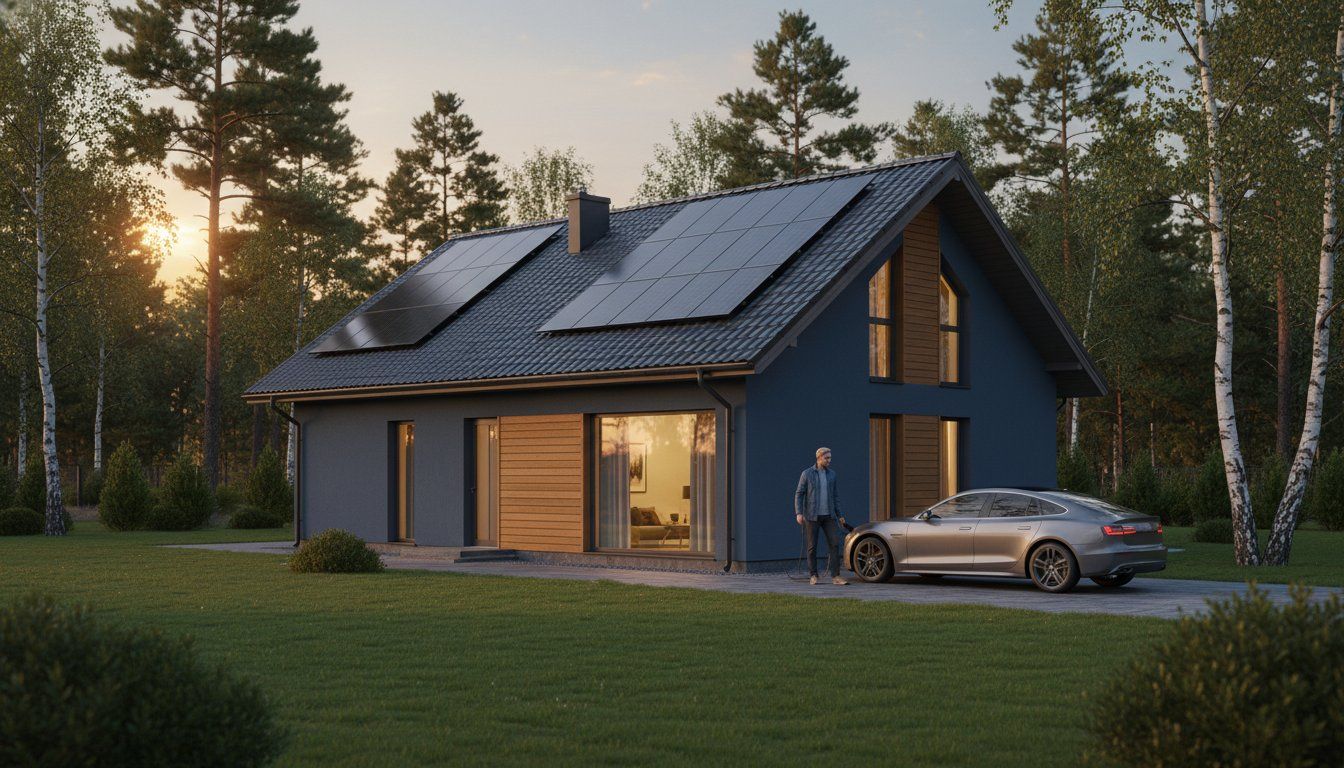
Do you believe that in 2026 your home could become a small, independent power station that completely ignores fluctuating market prices? Many Latvian residents still doubt whether a solar panel package can pay for itself at our latitude, especially when grey November lies outside the window. We at the Commodus team see daily that with proper planning and quality equipment, energy independence is not just a dream but a real and measurable benefit for every homeowner who wants to provide long-term comfort for their family.
You will probably agree that attempts to understand state support conditions or well-founded concerns about system efficiency in winter can make anyone hesitate about a major purchase. In this article we promise to dispel these fears and provide a clear roadmap on how to choose the most effective solution for your specific needs. You will learn everything about system output calculations, the latest technologies and how to manage documents without unnecessary headaches. We will tackle this challenge together, guiding you through the entire process so that the investment is safe and provides you with complete peace of mind for every euro invested.
Key Takeaways
- Understand what a modern and efficient solar panel package consists of, and how hybrid systems help ensure energy storage in your home.
- Learn to precisely calculate the optimal system output so that it can cover not only today's needs but also future plans, such as electric car charging or heat pump installation.
- Discover why professional installation is the safest path to guarantee system sustainability and successful commissioning in accordance with Latvian regulatory requirements.
- Find out everything about current state support programmes (EKII and VPVK) and how the new net metering system affects your return on investment in 2026.
- Discover how to combine solar energy with a heat pump to work with the Commodus team towards full energy independence and long-term peace of mind.
What is Included in a Complete Solar Panel Package?
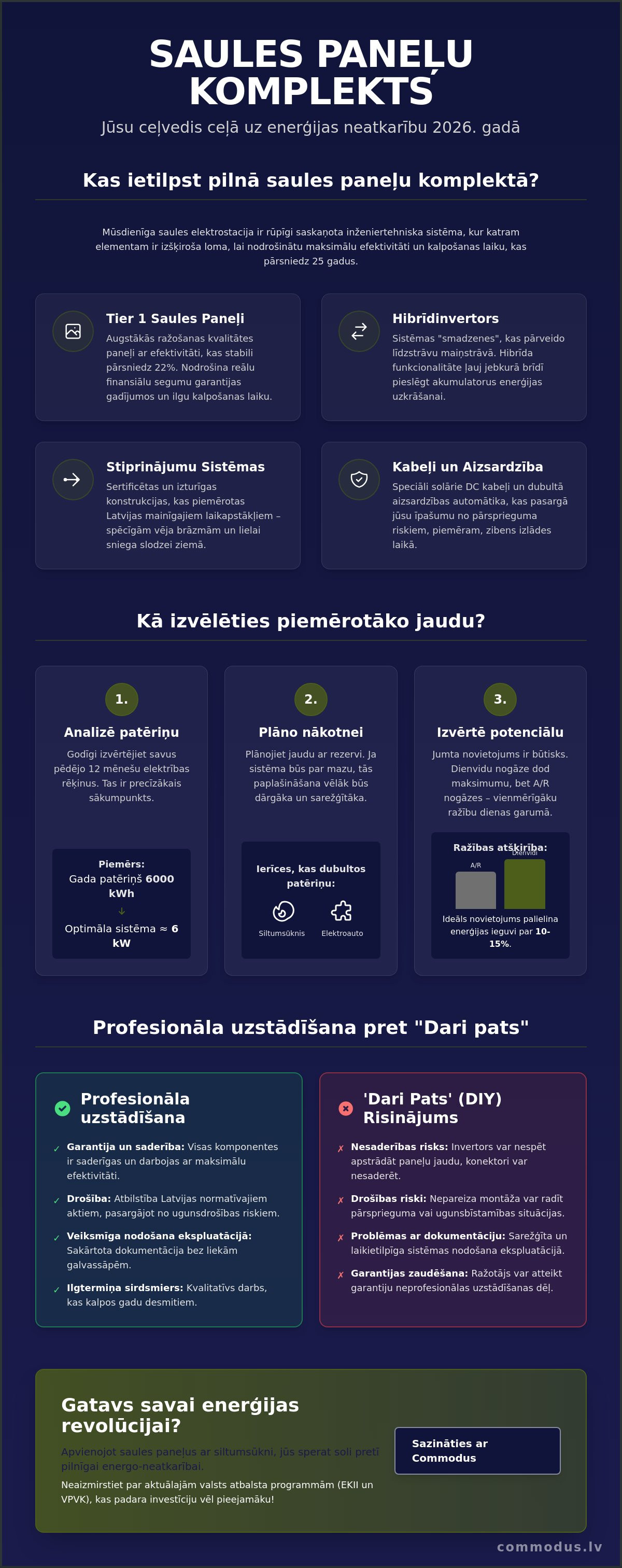
When thinking about transitioning to green energy, many initially imagine only dark glass frames on the house roof. In reality, a complete solar panel package is a carefully coordinated engineering system where each element plays a decisive role. It is like a precise mechanism; if one component is not compatible with the rest, the entire system's efficiency and service life – which for quality equipment exceeds 25 years – will suffer. We at the Commodus team believe that clients feel safest when they understand the meaning of each component, rather than simply receiving an invoice for a pile of equipment.
To better understand what a photovoltaic system is and how it works for your benefit, one must start with its basic components. A ready package usually includes photovoltaic panels, a power converter or inverter, support structures, special solar cables and protective automation. By choosing an industrially packaged solution rather than buying parts separately, you avoid the risk of connectors being incompatible or the inverter being unable to process the output generated by the panels during peak solar load hours. Compatibility is the main prerequisite for the system to work without interruption for decades.
Solar Panels and Inverters: The Heart of the System
In 2026, the market standard is Tier 1 manufacturer panels whose efficiency now consistently exceeds the 22% threshold. These manufacturers provide not only high output but also real financial coverage for warranty cases. However, the "brain" of the system is the inverter. It converts the direct current generated by the panels into the alternating current we are accustomed to and provides remote monitoring on a smartphone. Today, a hybrid inverter is becoming a self-evident choice. It allows a battery unit to be added to the system at any time, ensuring household energy independence in the evenings or during grid failures.
Mounting Systems and Cables
A quality solar panel package is unthinkable without durable mounting structures. Latvia's variable weather conditions, especially strong wind gusts and snow loads in winter, require specific solutions for each roof type. On tiled roofs, special hooks are used, while metal roofing requires mounting rails with seals that prevent moisture penetration. If space on the roof is limited, ground structures are an excellent alternative. They allow panels to be positioned at the ideal angle towards the south, increasing total energy output by approximately 10 to 15 percent compared to an unfavourable roof pitch. Safety is also guaranteed by certified DC cables and dual protective automation that protects the building from overvoltage risks during lightning.
- Tier 1 panels: Highest manufacturing quality and long-term warranty.
- Hybrid inverter: Ready to connect batteries without additional modification.
- Certified mountings: Resistance to Latvian winds and snow.
- Protective automation: Safety for your property and the electricity grid.
How to Choose the Most Suitable Output for Your Home?
The first step on the path to energy independence is an honest analysis of your own consumption. We at the Commodus team always recommend that clients not look at the neighbour's installed system but instead examine their own bills for the last 12 months. If your annual consumption is around 6,000 kWh, then a 5 or 6 kW solar panel package will be the optimal starting point to cover most needs. In 2026, we no longer plan systems only for today, as energy usage habits are changing rapidly.
When planning output, future plans must absolutely be taken into account. Are you planning to install a heat pump or purchase an electric car within the next two years? Such devices can double your current electricity consumption. If you build the system too small, expanding it later will be technically more complex and more expensive. When choosing output, it is worth remembering that the state support programme has helped thousands of Latvian households cover part of the investment, making the installation of more powerful systems financially more accessible.
Physical limitations on the roof also play a large role. One modern panel occupies approximately 2 square metres. If your roof faces south, you will achieve maximum output at midday. Using east and west slopes allows you to "catch" the sun from early morning to late evening, which is more advantageous for direct self-consumption. We will help calculate how many panels will actually fit on your roof to avoid a situation where the system is unjustifiably large or unable to provide the necessary output.
5 kW, 10 kW or More: Real Examples
For a small family home where the main consumers are a refrigerator, washing machine and lighting, a 5 kW system is usually sufficient. This is a compact solar panel package that does not take up much space. For a home where a heat pump and air conditioner are operating, 10 kW or even 15 kW output will be more appropriate. Increasing output later means not only additional panels but often also replacing the entire inverter, which increases total costs by 30-40% compared to installing a larger system from the outset.
Battery Storage: Is it Necessary?
The new net metering system in Latvia makes batteries a very sensible choice. They allow the energy generated during the day to be stored and used in the evening, when the sun is no longer shining but consumption in the home is at its highest. This significantly increases the self-consumption percentage and reduces dependence on grid tariff fluctuations. A battery also provides energy security; in the event of grid failures or storms, the lights in your home will not go out. When choosing battery capacity, we recommend aiming for your average overnight consumption, which usually ranges from 5 to 10 kWh.
By jointly assessing your home's specifics, we can move this challenge forward more effectively. If you want precise calculations for your property, our engineers are ready to prepare an individual offer based on your real data.
DIY Packages vs Professional Installation: Which to Choose?
Many homeowners believe that a solar panel package is a simple purchase that can be installed over the weekend with a neighbour's help. In reality, this approach often ends with costly mistakes. Latvian legislation and AS Sadales tīkls requirements have become even stricter in 2026. To commission the system, a certified construction specialist's signature and a precisely developed grid connection project are required. Without this, your investment will remain merely decoration on the roof, as the connection to the shared grid will be refused.
A professional project pays off already in the first year, as specialists eliminate energy losses that in DIY installations can reach as much as 20%. Fire safety is another critical aspect. Incorrectly made connections or inadequate cable insulation can cause an arc discharge, which is the most common cause of fire in solar energy systems. We at the Commodus team believe that safety and peace of mind are more important than short-term savings on installation costs. Before making a final decision, it is useful to research independent resources on how to choose solar panels and understand the nuances of the installation process.
The Impact of Installation Quality on Efficiency
Correct panel ventilation is one of the factors that self-installers often ignore. If there is not at least a 10 centimetre gap between the roof and the panels, the panels will overheat on hot summer days. This reduces efficiency by approximately 0.4% for every degree above the optimal temperature. Professional installers use certified structures that provide the correct angle, usually 35 to 40 degrees, to maximise the use of Latvia's solar intensity. The most common mistakes in Latvia are related to incorrect mounting selection, which damages the roof covering and creates leakage risks after the first heavy snow or storm.
Warranty and After-Sales Service
What happens if your solar panel package stops generating energy after two years? If you installed the system yourself, manufacturers often refuse warranty repairs citing incorrect installation. The Commodus approach is different. We tackle this challenge together with the client from the first sketch all the way to annual maintenance. Using remote monitoring, our specialists see errors in system operation before you notice them yourself. This allows minor problems to be resolved without waiting for bill increases. Our goal is to create a system that serves for 25 years, not just until the first defect. Professional maintenance and monitoring ensure that every invested euro works for your benefit for as long as possible.
State Support and Payback in 2026
Investment in solar energy in 2026 is no longer merely an experiment or a "green" lifestyle. It is a pragmatic financial decision. In Latvia's energy market, a solar panel package has become a stable instrument protecting household budgets from unpredictable electricity price fluctuations. Current state policy and support programmes are designed to motivate residents to become active energy producers, not just consumers.
Funding Opportunities
In 2026, Latvia still has two main support levers available: Environmental Investment Fund (EKII) grants and Altum energy efficiency programmes. The main difference is in the method of receipt. A state grant provides direct reimbursement after system installation, covering up to 70% of equipment acquisition costs, while bank "green" loans offer fixed, low interest rates without additional collateral.
Why apply right now? Support quotas are limited, and the 2026 cycle provides for stricter equipment efficiency requirements. For an application to be approved, a precise project, proof of building ownership and a Sadales tīkls permit are required. We at the Commodus team help push this "paperwork challenge" together with the client. Our specialists prepare all necessary documentation so that you can receive the maximum possible support without unnecessary stress.
Long-Term Economic Benefit
The net metering system (Net-billing), which has been fully operational since 2024, has become the main reference point for payback calculations in 2026. Unlike the old system, generated energy is now sold to the grid at market price and purchased back when needed. This means that the correctly chosen solar panel package and its output are critically important factors. The real investment payback period for the average household currently ranges from 6 to 8 years.
- Electricity prices: Forecasts indicate a moderate but steady increase that only shortens the payback period.
- Property value: Homes with installed solar systems are valued 5-10% higher on the market due to their energy efficiency certificate.
- 25-year perspective: Most manufacturers guarantee at least 85% efficiency after a quarter century, meaning clear profit after the first decade.
When calculating the real benefit, it is important to take into account not only the direct bill savings but also independence from grid tariff changes. Our experience shows that clients who choose quality solutions begin to feel a positive balance already in the first full summer season. We are here to ensure that the return on every invested euro cent is maximum.
Find out more about available state support and apply for a consultation with Commodus experts
Commodus Solutions: More Than Just Solar Panels
When choosing the most suitable energy system, it is clear that a solar panel package on its own is only the beginning of the path to complete home independence. We at the Commodus team believe that energy should not be wasted, which is why we help manage it wisely. Our experience shows that the best results come from solutions that combine electricity generation with efficient heat supply. We work throughout Latvia, ensuring that quality energy reaches every home from Liepāja to Alūksne, regardless of the project's complexity.
Why is it safer to tackle the challenge together with us? Because we are not just sellers but practitioners and doers. We take full responsibility for the entire process, from the first pencil stroke in the project to the moment your meter starts running in the opposite direction. Our team consists of people who use these technologies themselves daily, so we understand client needs not from brochures but from personal experience.
Comprehensive Energy Efficiency
Powering a heat pump with self-generated solar energy is the 2026 home standard. This synergy allows heating costs to be reduced by approximately 75 percent compared to traditional solutions. Commodus experts will help integrate smart home management that automatically adapts energy consumption to solar activity. For example, during the hours when the sun shines strongest, the system can intensively heat the water tank or cool rooms, storing energy for times when clouds obscure the sky.
Our competence covers both heat and electricity domains. This means you do not need to search for three different contractors who cannot agree among themselves. We see the big picture and know how the solar panel package will cooperate with your existing heating system, ensuring maximum return on every invested euro.
How to Apply for a Consultation?
We understand that the decision to transition to green energy requires clarity and facts. That is why our cooperation model is structured so that you receive all necessary information without unnecessary stress:
- Free site inspection: Our specialist will come to you to assess the roof structure, orientation towards the cardinal points and possible shading from trees or neighbouring buildings.
- Individual output calculation: We do not use approximate tables. The calculation is performed based on your historical consumption and future plans, such as purchasing an electric car.
- Offer preparation within 48 hours: We respect your time, so you will receive a precise estimate and technical solution within two working days after the visit.
The next steps are simple. From the moment you have made the decision, we arrange all documentation for receiving subsidies and coordinate the project with AS Sadales tīkls. All that remains for you is to watch your new energy system take shape. Contact Commodus experts today! and take the first step towards independence with a trusted partner by your side.
Your Path to Energy Independence in 2026
When choosing the most suitable solution, it is essential to remember that a quality solar panel package is a long-term investment in your home's value and security. 2026 offers a unique opportunity to take advantage of state support programmes that can cover a significant portion of installation costs. Technological advances now allow maximum efficiency to be achieved even in Latvia's variable weather conditions, ensuring a stable energy flow for decades.
Commodus experts in the engineering sector have been working since 2010, accumulating experience that allows the best solution to be found for every situation. We believe in joint work and are ready to tackle the challenge together with you, providing a full service cycle. This includes everything from precise project development to assistance with state support documentation and system aftercare. We will take care of the technical side so that you can enjoy peace of mind and lower electricity bills.
Receive an individual solar panel package offer!
Start generating your own green energy and become part of a sustainable future today.
Frequently Asked Questions About Solar Panel Systems
Does a Solar Panel Package Generate Electricity in Winter Too?
Yes, a solar panel package generates electricity in winter months as well, but with less output than in summer. In Latvia's climatic conditions, the system generates approximately 10% to 12% of total annual energy output during the period from November to February. This is explained by shorter daylight hours and the sun's low position near the horizon. Interestingly, cold weather actually improves panel efficiency, as semiconductor elements work more productively at low temperatures.
How Long Do Solar Panels and Inverters Last?
The service life of modern solar panels exceeds 25 years, and most manufacturers guarantee at least 80% efficiency even after this period ends. The inverter, which is the system's control centre, lasts on average 12 to 15 years, so one replacement may be necessary during the system's operation. We recommend choosing equipment from proven brands to ensure maximum return and safety for your home in the long term.
Do I Need a Permit From the Building Authority for Solar Panel Installation?
For private homeowners, installing solar panels on a roof generally does not require building authority approval, provided the building's load-bearing structures are not affected. Since March 2022, the rules have been significantly simplified, and in most cases a notification to AS Sadales tīkls about connecting a micro-generator suffices. If you plan to place panels on the ground or the house is located in a historic centre, the project will need to be coordinated with the local municipality in accordance with the spatial plan.
What is the Optimal Solar Panel Orientation in Latvian Conditions?
In Latvia, the greatest energy yield will be provided by a solar panel package oriented directly towards the south with a tilt angle of 35 to 40 degrees. South-east or south-west orientation is also very effective, usually reducing total output by only 5% to 8%. Our specialists always carefully assess each roof's specifics and shading from surrounding objects, as even a small tree's shadow can reduce an entire string's output by 30% or more.
Can I Add a Battery to an Existing Solar Panel Package Later?
Yes, you can add a battery to the system later, but this is technically simpler if a hybrid inverter is installed from the outset. If the existing system has a standard inverter, an additional control unit will need to be installed or the inverter replaced to enable energy storage. In 2026, more and more clients are choosing to invest in batteries right away, as this allows self-consumption to be increased to as much as 70% and provides independence from grid disruptions.
How Does the Net Metering System Affect My Monthly Bills?
The new net metering system, which came into force in Latvia on 1 May 2024, accumulates the value of generated energy in euros rather than kilowatt-hours. In summer months, the electricity fed to the grid forms a monetary accumulation in your customer account, which in winter you can use to cover both the electricity charge and system service expenses. This approach makes the investment more transparent, as you can precisely see your wallet's savings in every monthly bill and plan your consumption more flexibly.
Does Commodus Provide Service for Systems Installed by Others?
Our priority is the peace of mind of Commodus clients, so we primarily provide service and maintenance for systems we have installed ourselves throughout Latvia. However, we also often help other solar energy users if the system uses manufacturers known to us and we can guarantee a quality result. We believe that working together is the best way to promote energy independence, so feel free to contact our team to assess your situation.
How Long Does it Take to Install an Average-Output Solar Panel Package?
The physical installation of a solar panel package on a private home roof usually takes 1 to 2 working days depending on the type of mountings and roof covering. The overall process from the first consultation to system commissioning usually takes 3 to 5 weeks, as time is needed for document coordination with AS Sadales tīkls. Our team works promptly and in an organised manner so that you can start generating your own independent electricity and reducing household costs as quickly as possible.
Comments