Solar Panel Power Calculation: How to Determine the Right System Size in 2026
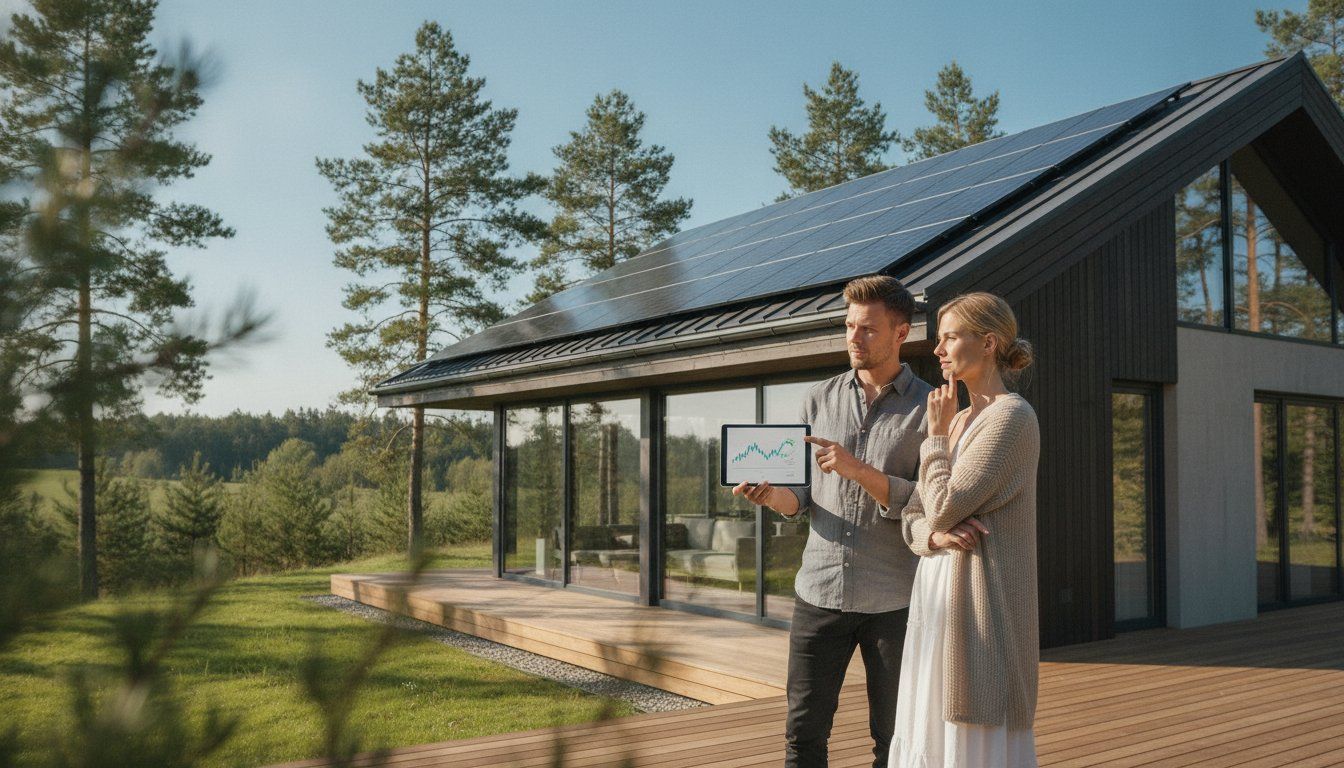
Did you know that in 2026, installing the largest possible solar panel array can be the most expensive mistake you make when improving your home? Most homeowners still think that more kilowatts automatically means bigger savings, but the new net billing system and changing market conditions have significantly changed the rules of the game. It is completely understandable if you feel slightly confused by the technical parameters and worry about whether the investment will really pay back quickly enough. That is exactly where an accurate solar panel power calculation becomes the foundation for a smart decision.
We will help you clear up these doubts and understand how to determine the optimal system size, so you can maximise self-consumption and manage your costs efficiently. In this article, you will learn how to calculate the required capacity step by step, taking into account both your electricity consumption habits and the latest state support programmes. Together, we will walk through a clear formula and look at how the right capacity choice affects the system payback period, giving you confidence in the solution you choose.
Why is an accurate solar panel power calculation the first step toward savings?
Let us start with the basics. System capacity is measured in kilowatts peak (kWp), which indicates the maximum amount of energy the panels can produce under ideal conditions. This figure determines how efficiently all solar energy system components, from the panels themselves to the inverter, will operate. If the capacity is too small, you remain dependent on the public grid and unpredictable electricity tariffs. That means the investment will not provide the sense of freedom and bill reduction you expected. You will still receive substantial bills for energy consumed during dark hours or cloudy days, because the system will not be able to generate enough financial credit.
On the other hand, we often see customers who want a "safety cushion" and choose an oversized system. In 2026, this approach can be an expensive mistake. Because the new net billing system accounts for energy in euros rather than kilowatt-hours, the surplus you export to the grid is valued at the market price. Often this price is lower than what you pay to buy electricity from the grid. As a result, excess capacity only extends the payback period, because you have invested in equipment that does not generate profit. That is why solar panel power calculation is critical, so every euro invested works for you.
Self-consumption vs exporting to the grid
In today's energy market, the main goal is maximum self-consumption. This means it is most profitable to use electricity exactly when the sun is shining and the panels are operating at full power. Capacity that is accurately matched to your daily expenses helps find the golden middle ground where the system covers your needs, but does not create a huge surplus that is sold to the grid at low prices.
In Latvia, capacity accuracy is decisive. Our team's experience shows that a well-balanced system can pay back even a couple of years faster than an unnecessarily large project. We always encourage customers to think about their daily habits in the long term. Are you planning to buy an electric car? Will you heat water with solar energy? These details help determine whether the system will become a smart investment rather than a burden. Ultimately, the goal is to make your home as independent as possible while keeping the investment economically justified.
How to calculate solar panel capacity: a 4-step method
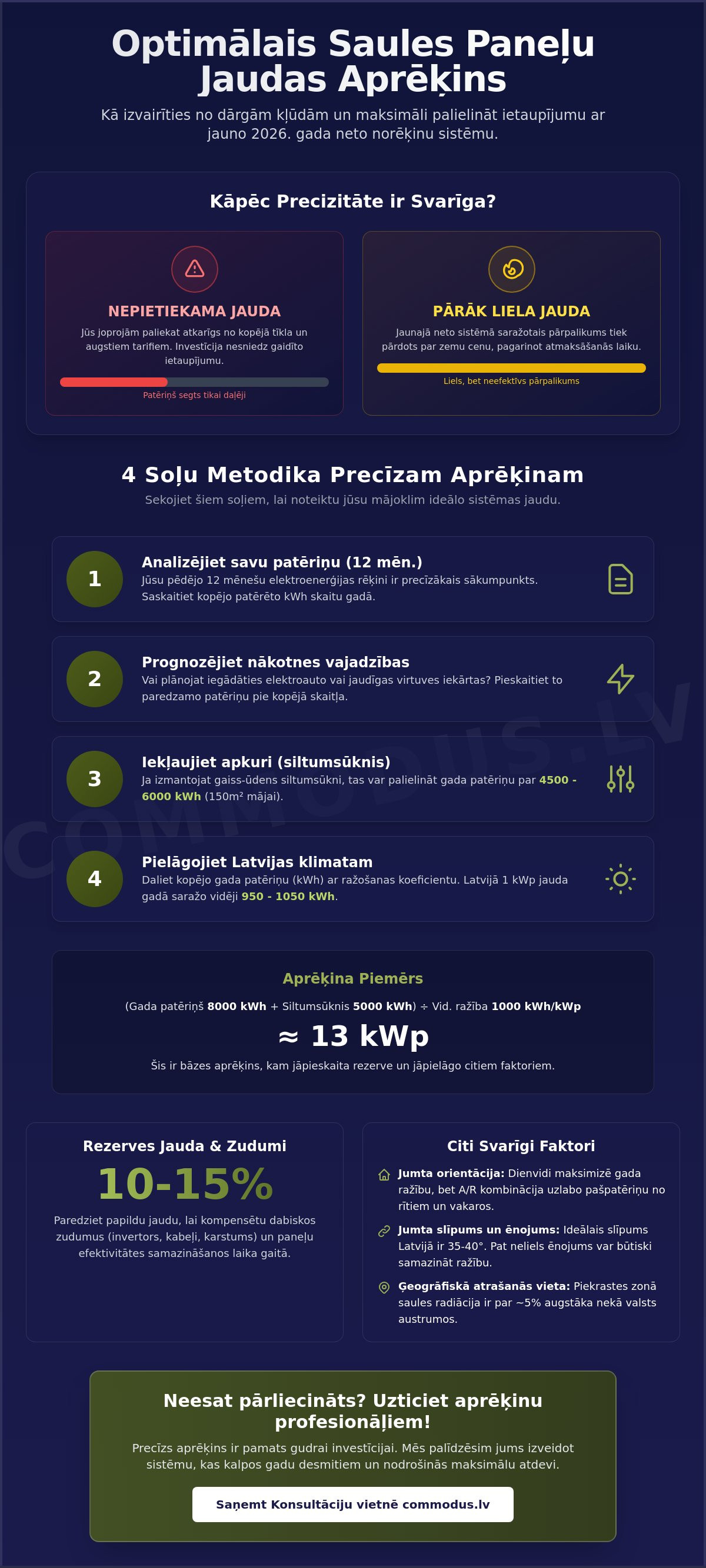
To reach a result that will not disappoint after the first year of operation, we recommend following a proven four-step method. The first step is to analyse your electricity bills for the last 12 months. This is your household's energy "fingerprint", showing the real situation. The second step is future forecasting. If you plan to buy an electric car or install powerful kitchen equipment, these kilowatts should be included now, so the system does not have to be expanded in a complicated way later.
In the third step, we focus on heating, which is one of the largest consumers. The fourth step is applying Latvia's climate coefficient. In our region, it is generally assumed that 1 kWp of installed capacity produces around 950 to 1,050 kWh of energy per year. This kind of solar energy forecasting, based on real data, is the only way to ensure that solar panel power calculation is accurate and economically justified.
Integrating a heat pump into the calculation
Our experience shows that it is precisely air-to-water heat pumps that are the main reason for increasing the total panel capacity. If your home is around 150 m2 and you use a heat pump for heating, annual consumption can increase by 4,500 to 6,000 kWh. This means the solar panel array should be approximately 5 to 6 kWp more powerful than for a home without such a heating system. If this fact is ignored, winter can bring unpleasant electricity bills that the system was unable to cover with financial credit generated during the summer months.
Reserve capacity and system losses
When planning the system, we always recommend providing 10 to 15% additional capacity to compensate for natural losses. Some energy is lost during inverter operation, in cable connections and at high temperatures during summer heat. Remember that 1 kWp of solar panels in Latvia produces around 950–1,050 kWh per year, but this figure can vary depending on panel placement and shading. If you want to be completely confident about your home's energy efficiency, we will help you choose the most suitable system that will serve for decades.
Factors that adjust the required number of panels
Once you have determined your annual consumption, the next step is to adapt the theoretical figures to the specifics of your home. Roof orientation is a decisive factor. Although the south side traditionally produces the most energy per year, the 2026 net billing system makes east- and west-facing roof slopes increasingly attractive. That is because this arrangement produces energy when your family is at home and consumption is highest, namely in the mornings and evenings. This increases self-consumption and helps avoid selling electricity to the grid at lower prices.
Do not forget shading and roof pitch. Even a small chimney or a neighbour's tree can "steal" up to 30% of a panel string's capacity unless optimisers are used. In Latvia, the ideal pitch is around 35 to 40 degrees, which helps capture the sun most effectively in the spring and autumn months. It is also important to consider that panel efficiency decreases slightly over time, usually by around 0.5% per year. That is why solar panel power calculation should be done with a small reserve, so the system can still cover your needs properly after ten years.
Geographical location and installation nuances
Location matters within Latvia. In coastal areas, for example around Liepāja or Ventspils, solar radiation is roughly 5% higher than in the eastern part of the country. If your roof is not suitable or its area is limited, ground-mounted structures are an excellent alternative. They allow the ideal angle to be set and provide better panel cooling, which improves performance on hot summer days. If you are not sure whether your roof is suitable, contact us so we can choose the best technical solution for your home together.
From theory to implementation: the role of a professional audit
Although a theoretical solar panel power calculation provides a clear direction, in reality every home is unique. Online calculators are a great tool for initial research, but they cannot assess the technical condition of your building's electrical network or the exact strength of the roof structure. This is where the value of a professional engineering audit begins. Our specialists do not rely only on algorithms; they carry out an on-site inspection to make sure the designed capacity will be not only theoretically correct, but also technically safe and feasible.
An important nuance is the compatibility of system components. There is no point in installing the maximum number of panels if the inverter capacity is not matched accordingly. A poorly selected inverter can become the bottleneck that limits energy production exactly when the sun is shining most strongly. Once the precise solar panel power calculation has been completed and the technical project approved, the next step is applying for state support. In 2026, households can still access EKII programmes with support of up to EUR 4,000 for a solar panel system, and we help prepare all the necessary documentation so the process runs without unnecessary stress.
Why choose Commodus for your project?
We believe energy independence is an integrated solution. That is why we offer a full service cycle, integrating solar panels with other engineering systems such as heat pumps or borehole solutions. Our team has been working in the Latvian market since 2010. During this time, we have gained experience that allows us to find solutions even in the most complicated situations, while maintaining a responsive, human and personal approach to every customer.
By choosing us, you gain not only technical execution, but also a long-term partner and reliable support. If you want to explore the topic in more depth, we invite you to read our solar panel kit guide, where we have collected all the essential information about energy independence in 2026. We are here to help you make a considered decision and create a cosy, safe environment for your family.
Start your journey toward energy freedom today
A precise solar panel power calculation is the foundation for ensuring that your investment in 2026 not only pays back, but also provides real independence from energy price fluctuations. Remember that the key to a successful project is balance between your current consumption, future plans and the technical specifics of your home. We see that a thoughtful approach and avoiding unjustified overcapacity is what defines a smart homeowner in today's market conditions. Careful planning today will protect you from unnecessary costs tomorrow and ensure efficient system operation for many years.
Our team has more than 15 years of experience in energy-efficient solutions, and we believe every project needs an individual engineering approach. Commodus certified installation specialists work throughout Latvia, ensuring the highest quality from the first consultation to system start-up. It is important to us that you feel safe and confident in your choice, so we are here to answer all your questions. Get a free solar panel power calculation and consultation from Commodus experts!
We are ready to become your trusted partner and help create a cosy, warm and energy-efficient environment for your family. Let us start this transformation together, focusing on quality and long-term cooperation. Your peace of mind and energy independence matter.
Frequently asked questions about solar panel capacity
How many kW of solar panels does an average Latvian private house need?
An average Latvian private house with annual consumption of around 6,000–8,000 kWh usually needs a system with 6 to 8 kW of capacity. This size can cover most daily needs and build a reasonable credit in the net billing system. A precise solar panel power calculation always begins with analysing your historical data, because every family's habits are different. We also recommend carefully assessing the number of existing electrical appliances, so the system serves efficiently for many years.
Should solar panel capacity be calculated based on winter or summer consumption?
Capacity should always be calculated based on total annual electricity consumption, not individual months. Since solar generation in Latvia is strongest from March to October, the surplus produced in summer is exported to the grid as financial credit. You use this accumulated value in winter, when solar activity is low but consumption, especially during the heating season, increases significantly. This delivers maximum savings and bill stability over the year.
How does a heat pump affect the required number of solar panels?
Installing a heat pump usually increases the required number of panels by 10 to 15 units, because the heating system is a powerful consumer. On average, an air-to-water heat pump consumes an additional 4,000–6,000 kWh per year, so the total system capacity should be increased by around 5–6 kWp. This is essential so the credit generated in summer can cover the larger heating bills in the cold months. If this fact is ignored, winter can bring unplanned costs for electricity bought from the grid.
Is it worth installing more panels than your current consumption requires?
Installing more capacity makes sense only if you plan to buy an electric car or switch to electric heating in the near future. In the 2026 net billing system, excessive capacity without real consumption is not economically beneficial, because the surplus is exported to the grid at the market price. An optimal solar panel power calculation includes a small 10–15% reserve to cover system losses, but a major oversizing only unnecessarily extends the investment payback period.
How much roof area does a 1 kW solar panel system take?
One kilowatt (1 kW) of solar panel system capacity takes approximately 5 to 6 square metres of roof area. Modern panels are becoming increasingly efficient, so a standard 10 kW system will require around 50–60 square metres of free space. When planning the layout, it is important to keep safe distances from roof edges and chimneys. This helps avoid unnecessary shading and ensures structural stability even during strong wind gusts, which are not rare in Latvia's climate.
Comments