Solar Panel Systems in 2026: A Complete Guide to Energy Independence for Latvian Homes
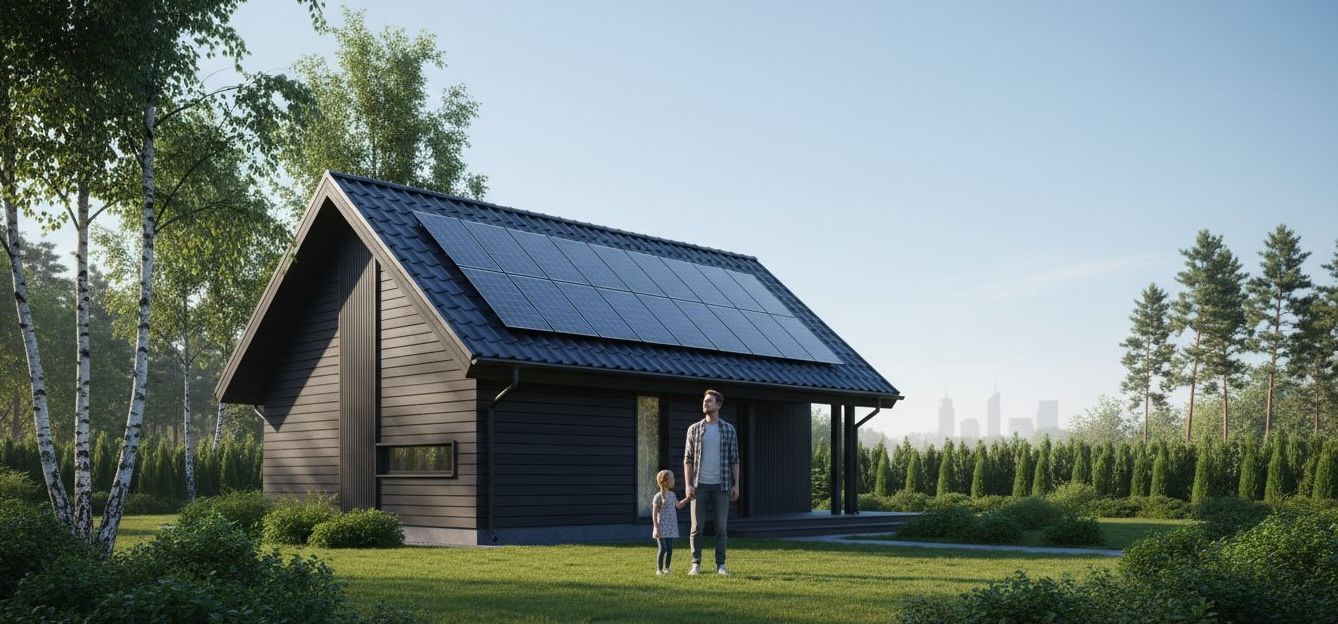
According to data from the Ministry of Climate and Energy, the number of microgenerators in Latvia has increased by more than 400% over the past three years, demonstrating a rapid shift towards self-generated electricity. We all know the unpleasant feeling when another electricity bill makes us wonder where our hard-earned money is going and why prices are so unpredictable. It is entirely understandable that fear of making the wrong technical decision or becoming lost in complicated bureaucracy often discourages people from taking action. However, modern solar panel systems in 2026 are no longer an expensive experiment for technology enthusiasts, but a proven and economically sound way to stop relying on chance and finally gain full control over household costs.
This article explains everything you need to know about choosing solar panels, the installation process and current state-support programmes so that you can turn your home into an efficient and independent energy producer. The Commodus team is ready to work alongside you, providing a clear understanding of payback periods and technical details without unnecessary terminology. Energy independence is achievable. This guide will help you understand how to reduce utility costs in practice, give your family peace of mind and avoid the most common mistakes made by new solar-energy users in Latvia.
Key takeaways
- Learn how modern solar panel systems generate energy efficiently even in Latvian weather conditions, dispelling myths about insufficient sunlight at our latitude.
- Discover the technology trends for 2026 and learn why bifacial panels are becoming the new standard for maximising energy yield from every square metre.
- Understand why combining solar panels with a heat pump is the most effective way to maximise self-consumption and heat your home with electricity you generate yourself.
- Find out how to use state-support programmes and the new net-billing system in practice so that your path towards energy independence is financially worthwhile.
- Gain confidence in the success of your project by learning how Commodus' 15 years of engineering experience and full-service approach ensure system safety and longevity.
What are solar panel systems and how do they work in Latvia?
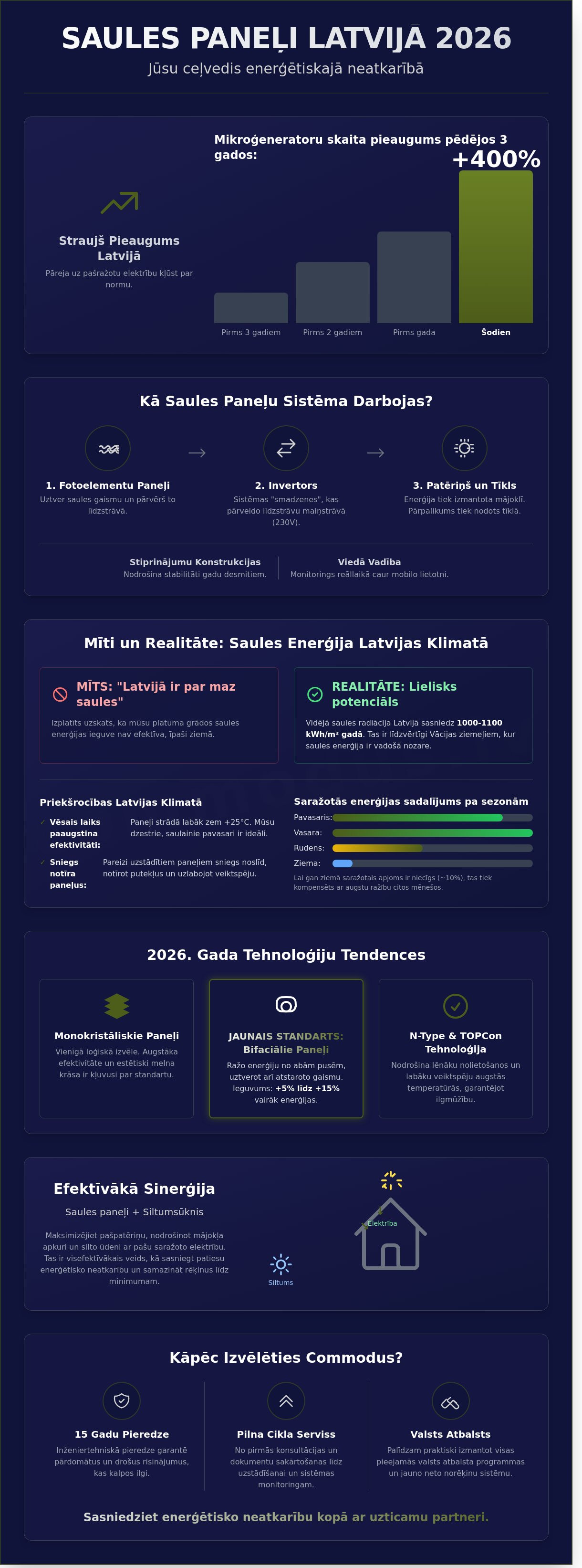
Solar panel systems are no longer merely a futuristic feature on the roofs of progressive companies. They are a practical and proven way for any household to become a producer of its own electricity. At its core, What is a photovoltaic system? can be explained as a technological process in which silicon cells capture photons from sunlight and convert them into direct current. An inverter then converts this energy into 230 V alternating current so that it can power your coffee machine or heat pump. At Commodus, we see every day that switching to self-generated electricity is one of the most reliable investments in the future.
Latvia's potential is often underestimated. The myth that we are too far north or receive too little sunshine does not stand up to the data. Average solar irradiation in Latvia reaches approximately 1,000 to 1,100 kWh per square metre each year. This is comparable with northern Germany or Denmark, where solar energy is one of the leading renewable-energy sectors. As we approach 2026, when energy-efficiency standards will become even stricter, installing solar panel systems today is a forward-looking decision that protects you against unpredictable fluctuations in electricity-market prices.
A system consists of four main components:
- Photovoltaic panels that capture light;
- An inverter that manages the energy flow;
- Mounting structures that provide stability for decades;
- A smart control system for real-time monitoring.
Solar energy in the Latvian climate
Many people are surprised to learn that winter is not a complete period of inactivity. Although output in December and January is modest, accounting for approximately 10% of annual production, the spring months can be surprisingly productive. Latvia's cool climate is actually an advantage. Panel efficiency decreases when modules become excessively hot above 25°C. Our cool but sunny March mornings are ideal because natural cooling allows the panels to operate at maximum efficiency. Snow is usually not an obstacle; when panels are installed at an angle of 35 or 40 degrees, it slides off naturally, effectively carrying out a spring clean and removing dust at the same time.
The inverter – the 'brain' of the system
The inverter determines how intelligently you use the power you generate. Grid-connected systems are currently the most common, although increasing numbers of customers are choosing hybrid inverters. These allow batteries to be added, providing electricity even when the public grid loses power. A modern inverter includes mobile applications that show every watt generated on your phone. Inverter quality is critical: while panels may last for 30 years, a cheap inverter may fail after only five. We help customers select long-lasting solutions so that we can continue advancing their energy independence together.
When choosing solar panel systems, it is important to understand that this is not simply a purchase but a long-term relationship with technology. A correctly planned system begins paying for itself from the first sunny day and provides peace of mind because your bills no longer rise with every global crisis.
Types of solar panels and technologies: How to navigate the available options
Technology develops rapidly, and what was considered innovative five years ago is already history today. If you plan to install solar panel systems in 2026, monocrystalline modules are the only logical choice. Polycrystalline panels, with their blue appearance and lower efficiency, have practically disappeared from the market because the performance and aesthetics of monocrystalline technology are now available at a competitive price.
Bifacial, or double-sided, panels are currently becoming the industry standard in Latvia. They can generate electricity not only from direct sunlight but also from light reflected by the ground, snow or roof covering. In our variable weather conditions, where snow can act as an excellent reflector, bifacial panels can increase total energy yield by between 5% and 15% compared with conventional modules.
The latest N-Type and TOPCon technologies provide a significant improvement in efficiency. Unlike older P-Type models, these panels degrade much more slowly and perform better on hot summer days. This development is closely connected with the fact that the Latvian National Energy and Climate Plan 2021–2030 provides for a substantial increase in the share of renewable resources, encouraging manufacturers to offer increasingly powerful solutions for our region. When selecting equipment, we recommend considering only Tier 1 manufacturers because these financially stable companies are more likely to honour their warranty obligations even in 20 years' time.
Panel efficiency and degradation
The efficiency of modern panels has reached and exceeded 22%. In practical terms, this means obtaining more kilowatt-hours from each square metre, which is particularly important when roof space is limited. Special attention should be paid to degradation rates. Manufacturers of high-quality N-Type panels guarantee that, after 25 years, the system will still operate at no less than 87% to 89% of its original output. This ensures that your investment will continue working and generating value long after the system has paid for itself.
Mounting systems and installation methods
Correct installation is just as important as the panels themselves. Every roof covering has its own requirements: special hooks are used for tiled roofs without compromising watertightness, while suitable fixings are selected for metal roofs to minimise corrosion risks. If the roof structure is unsuitable or has an unfavourable orientation towards the south, a ground-mounted structure is an excellent alternative. It allows the ideal tilt angle, normally around 35 to 40 degrees, to be selected and provides better panel cooling, improving efficiency by approximately 3% to 5%. To determine which option is best suited to your property, our specialists will help you select the most efficient solar panel systems and the safest installation method.
Synergy: Solar panels combined with a heat pump
When the Commodus team plans new projects, solar panel systems and air-to-water heat pumps increasingly form an inseparable combination. This is not merely a modern trend, but a mathematically sound solution that allows a household to become as independent as possible from fluctuating energy prices on the market. A heat pump is the most efficient major electricity consumer in a home, while solar panels provide the least expensive source of energy. By combining the two, you effectively turn your roof into a personal filling station for your heating system.
Maximising self-consumption is the principal advantage. Under Latvia's new net-billing conditions, electricity is most valuable when consumed at the moment it is generated. A smart control system can automatically instruct the heat pump to increase output and heat the buffer tank or underfloor-heating system when solar production is at its highest. This means that solar energy is literally stored as heat in the structure of your home. Real-life examples show that, in a well-insulated 150 m² house in Latvia, this synergy can reduce annual heating bills by 60% to 80%.
Financing is an important consideration when planning such an investment. The good news is that the state-support programme for solar panels and heat pumps has been extended until the end of 2029. This provides reassurance that the investment can pay for itself considerably faster than calculations based solely on current tariff rates would suggest.
Heating domestic hot water with solar energy
Many customers ask about solar thermal collectors, but modern solar panel systems are more versatile and effective for water heating. Panels are more durable, do not require heat-transfer fluid replacement and can also power other appliances. By integrating the hot-water cylinder into a smart system, the heat pump can effectively rest throughout the summer. Solar energy alone can provide all the hot water required by a family of four without any additional electricity costs from the grid.
Batteries and energy storage
Hybrid systems with batteries are the next step towards complete autonomy. We recommend lithium iron phosphate (LiFePO4) batteries because of their longevity and safety. They can withstand more than 6,000 charging cycles, corresponding to at least 15 to 20 years of reliable service. Is battery installation worthwhile in 2026? As battery prices have fallen by approximately 30% over the past two years and state support is available, the payback period has shortened to approximately 7 to 9 years. Batteries provide not only a financial benefit but also peace of mind during grid failures or voltage fluctuations.
Planning and state support: The route to a completed system
Beginning a solar-energy project means understanding your home's electricity consumption and technical possibilities precisely. At Commodus, our first step is always a visit to the customer's property. A thorough survey and capacity calculation form the foundation of the entire process. There is no value in installing the maximum possible number of panels if the output cannot be used effectively; we seek the optimum balance between investment and real benefit. This type of solar panel system planning helps prevent mistakes that might otherwise become apparent only after several years.
The rules in Latvia changed on 1 May 2024 with the introduction of the net-billing system. Unlike the previous net-metering arrangement, energy exported to the grid is now valued in euros according to electricity-market prices. This encourages households to consume energy more thoughtfully at the time it is generated. The state provides significant support to make the transition to green energy easier. Under the Altum programme, households may receive a grant of up to EUR 4,000, while the EKII programme focuses on reducing greenhouse-gas emissions. We help customers navigate these requirements so that they can receive the highest possible co-financing.
Step by step towards solar energy
The process begins by preparing an application and obtaining technical conditions from Sadales tīkls. During the design stage, we plan the optimum panel layout while considering orientation and possible shading from neighbouring buildings or trees. Once the documentation has been approved, our specialists complete the installation. The work normally takes between one and three days, depending on the roof covering and system complexity. Installation is followed by commissioning and obtaining permission to generate electricity, all of which we arrange on your behalf.
Economic justification and payback
Return on investment, or ROI, is the main question for every property owner. On average, solar panel systems in Latvia pay for themselves within six to nine years, although state grants and high self-consumption can reduce this period considerably. If a household consumes at least 40% of the electricity it generates during the day, the payback is faster. Charging an electric vehicle at home provides an additional benefit. By using self-generated electricity for transport, you not only save on fuel but also make maximum use of the system during peak solar-production periods. This is energy independence that can be felt every month through lower bills.
We are ready to work alongside you, providing both the technical implementation and management of the entire administrative process. To find out which solution is best suited to your home, book a consultation with Commodus experts.
Why choose Commodus for your solar panel system?
Commodus has operated in the building-services solutions market since 2009 and has accumulated more than 15 years of experience. During this time, we have learned that a successful project depends not on simply selling equipment, but on providing a complete service. Our work begins with a detailed consultation and does not end even after the solar panel system has been commissioned. We accept full responsibility for the entire cycle, including design, document approval, installation and long-term technical supervision.
Reliability is decisive when selecting a partner. We do not use subcontractors for installation because we entrust the work only to our own certified specialists. This allows us to guarantee that every mounting point and cable is installed in accordance with the highest safety standards. We work with internationally recognised Tier 1 manufacturers and supply components capable of withstanding Latvia's variable weather, from strong wind gusts to heavy snow loads.
Our team and values
Humanity and honesty form the basis of our company culture. We often say that we are pulling the same load as the customer because your benefit from the energy generated is our shared success. Commodus engineers examine the specific features of every project, whether it is a small detached house or a large industrial park. We do not use complicated terms to create an artificial impression of expertise; we communicate clearly and understandably.
- Transparent pricing: The quotation you receive at the outset is the final price, without hidden costs or unexpected additional invoices during the work.
- Availability throughout Latvia: Our teams travel promptly to projects anywhere in Latvia, providing the same high level of service regardless of location.
- Individual solutions: We do not use a one-size-fits-all approach, but adapt the system configuration to your actual electricity consumption.
Long-term cooperation and warranties
We understand that solar panel systems are investments expected to provide returns for the next 25 to 30 years. We therefore offer regular technical maintenance to help preserve equipment efficiency at its original level. If repairs are required, our service department responds quickly rather than making customers wait weeks for spare parts. We honour our warranty obligations in practice, not merely on paper, because our goal is your long-term peace of mind.
Begin your journey towards energy independence with a reliable partner. We invite you to book a free consultation and individual calculation. Our specialists will assess the suitability of your roof and prepare an accurate payback forecast so that your decision is based on real data and facts.
Your path towards energy freedom begins with the right decision
Energy independence in Latvia is no longer merely a distant vision of the future. It is a practical reality in 2026, defined by smart technology and the considered use of resources. The main benefit lies in the ability to combine the latest solar panel systems with heat pumps, creating a fully automated and cost-effective indoor climate for your home. With state-support programmes, this investment becomes one of the safest ways to protect your budget against unpredictable fluctuations in energy prices.
The Commodus team has helped Latvian families become more self-sufficient since 2010. During this period, we have successfully commissioned more than 1,000 projects across every region of Latvia. We entrust the work only to certified installation specialists who understand the specific requirements of every roof and property. We are not merely service providers; we are your partners, working with you to provide heat and light in your home. It is important to us that you remain confident in your decision ten and twenty years from now.
Receive a free solar-panel calculation for your home from Commodus experts!
Let us begin creating your home's energy-efficient story today, because the sun will continue to shine and we know how to turn that energy into your comfort.
Frequently asked questions
Do solar panels pay for themselves in Latvia despite the limited number of sunny days?
Yes. Solar panel systems in Latvia pay for themselves in an average of six to nine years because our climate is suitable for efficient energy generation. Solar irradiation in Latvia reaches approximately 1,000 to 1,100 kWh per square metre each year, which is comparable with northern Germany, where solar energy is widely used. This amount of energy is entirely sufficient for the system to be economically justified and deliver real savings to a household budget over several decades.
How large a solar panel system do I need to cover my entire consumption?
The required system capacity is determined by your home's annual electricity consumption. In Latvia, 1 kW of installed capacity generates approximately 1,000 kWh of electricity per year. If your family uses 5,000 kWh annually, you will need a solar panel system with a capacity of approximately 5 kW. We normally recommend including a small capacity reserve so that new equipment, such as a heat pump or electric-vehicle charging station, can be added later without concern about increasing bills.
What is the difference between solar panels and solar thermal collectors?
The main difference is the form of energy produced: solar panels generate electricity, while solar thermal collectors heat water. Solar panels are a more versatile solution because the electricity can be used for every household appliance, lighting and water heating with an electric heating element. Collectors are designed specifically for producing heat, so their application is narrower and they cannot reduce the portion of your electricity bill associated with household appliances.
Do I need to clear snow from solar panels during winter?
Solar panels do not normally need to be cleared of snow because they are installed at an angle and their smooth surface encourages snow to slide off naturally. The dark colour of the panels helps them warm quickly in sunlight, melting the lower layer of snow so that it can slide off without intervention. Mechanical cleaning with sharp tools can scratch the protective glass, so it is better to allow nature to do the work, particularly because solar intensity is low during the winter months.
What state support is currently available for solar-panel installation?
Latvian residents may receive state support through Altum or Environmental Investment Fund programmes, allowing owners of detached houses to recover up to EUR 4,000 of installation costs. The amount of support depends on the selected system capacity and the conditions of the specific programme at the time of application. This funding considerably reduces the initial investment and shortens the system's payback period, making the transition to self-generated electricity more financially attractive.
What happens to the energy generated if I do not use all of it immediately?
Electricity generated but not consumed immediately can be exported to the public grid through the net-billing system, which functions similarly to a virtual credit. Energy exported on summer days is accounted for in monetary terms or kilowatt-hours and can be used during evenings or winter months when there is less sunshine. This allows consumption to be balanced effectively throughout the year, with charges applying only to grid services or the difference between the energy exported and received.
Will a solar panel system operate if the public electricity grid fails?
A standard solar panel system automatically shuts down for safety reasons if the public grid loses power, protecting emergency and maintenance personnel. To maintain electricity during a grid outage, the system must include a hybrid inverter and battery storage. This allows the house to operate autonomously using energy stored in the batteries, providing peace of mind and security in unexpected situations.
What is the service life of a solar panel system?
A high-quality solar panel system has a service life of 25 to 30 years, and most manufacturers guarantee that panels will still generate at least 80% of their original output after this period. The absence of moving parts makes the system durable and minimises long-term maintenance requirements. The inverter, which converts the electrical current, normally lasts between 10 and 15 years, so it may need to be replaced once during the system's service life.
Comments