What you need to know before buying solar panels: Full guide in 2026
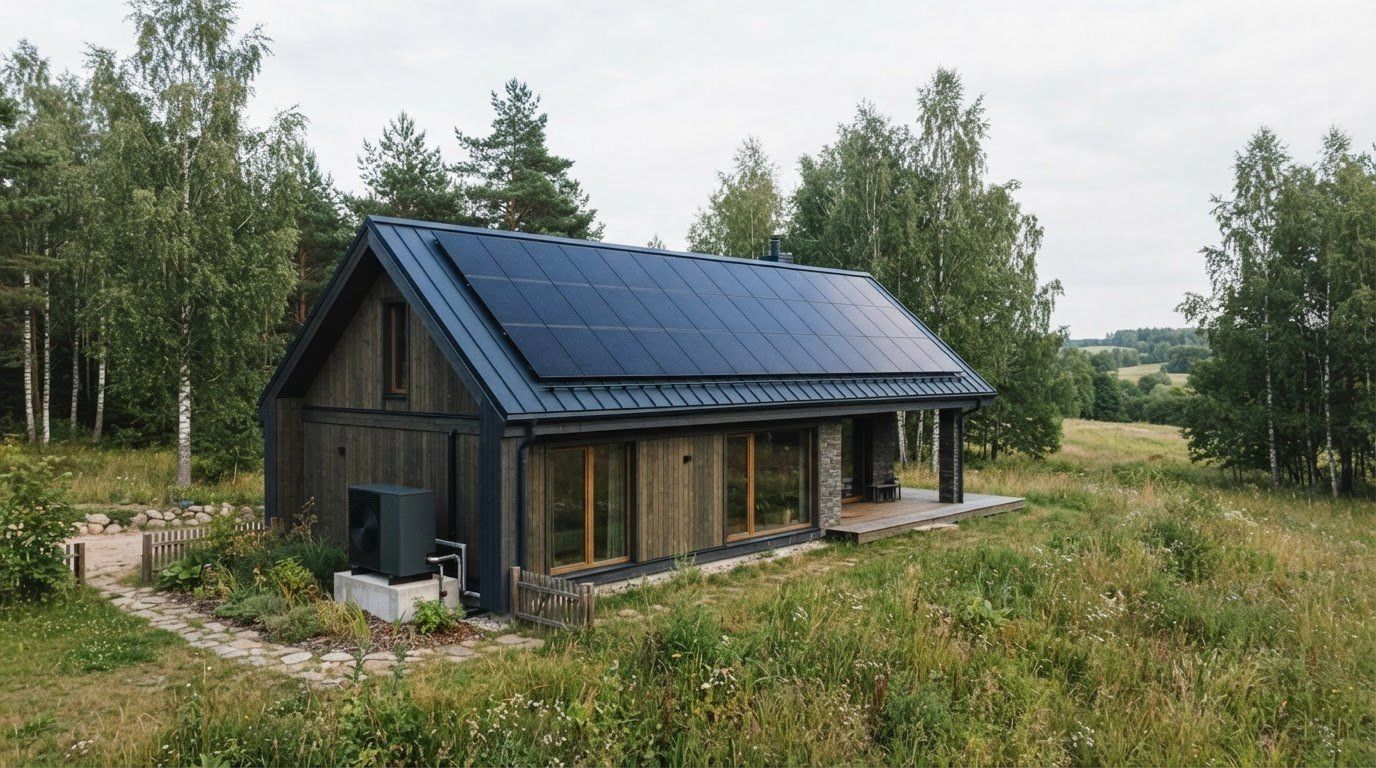
Will solar panels pay off your home, or will the savings in the cost of electricity not outweigh the initial investment? The answer depends not only on the power of the panels. The power consumption, the suitability of the roof, the use of energy produced and the compatibility of solar panels with other equipment should be assessed.
It is understandable to be concerned about the state aid application, the quality of the assembly and the unpredictability of electricity prices. A thoughtful project starts with a concrete evaluation, not with expectations. Commodus offers consulting, designing, assembling and maintaining heating, air conditioning and solar panel systems. When planning solar panels, it is worth evaluating their possible cooperation with the heat pump.
This 2026 guide will find out what to check before purchase and how to compare the conditions of support, assembly offers and possible payback time in Latvia. Practical action plan will help to make a balanced decision and to use the energy produced efficiently.
What you need to know before buying solar panels: suitability of the house and roof
Start with an assessment of the roof, surrounding area and home wiring. The orientation of the south is usually desirable, but it is not mandatory. Also, a roof facing in another direction can be suitable if its slope and surrounding conditions allow the panels to be located efficiently. Ask for an assessment of your roof, rather than just relying on a general calculation of power.
Check the condition of the roof and the suitability of the construction before installation. If the roof is about to be restored, first match the order of work so that the panels should not be dismantled and re-installed later. Pay attention to the trees, chimneys and neighboring buildings that can create shadows.
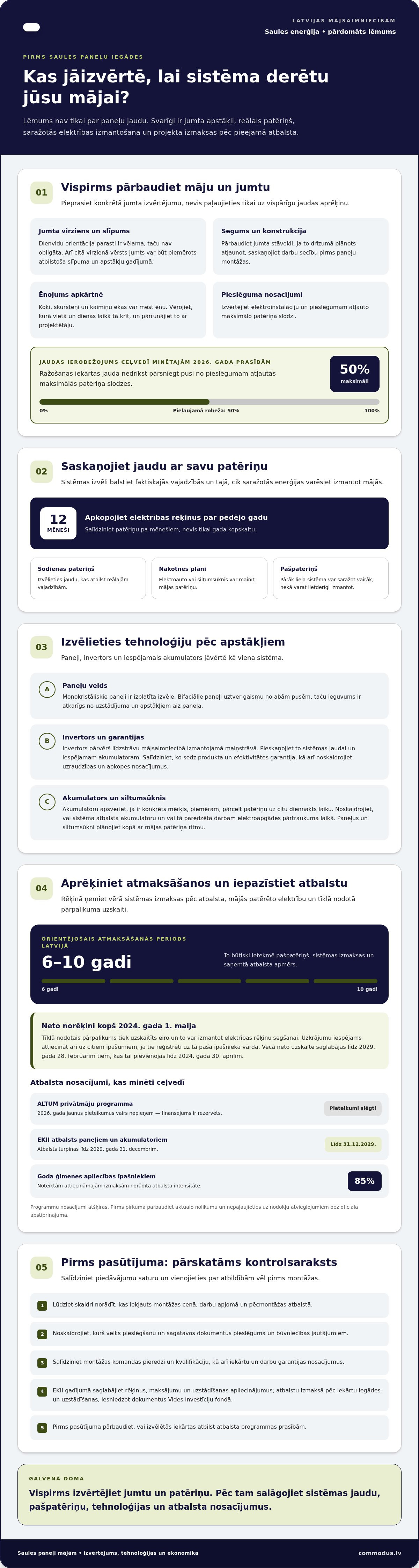
Also, assess the maximum consumption load allowed for electrical installations and connection. According to the information provided in this guide, the production capacity of the installation for 2026 should not exceed 50% of this load.
Consumer analysis: how many panels do you really need?
To understand what system is suitable for your home, collect electricity bills for the last 12 months and compare consumption by months. This will allow you to choose capacity based on real needs rather than just the total annual consumption. Think about the future plans: an electric car or a heat pump can change the domestic consumption. Too large a system can produce more than you can use usefully and prolong the return on investment.
A neutral overview of the comparison of Panels' technologies is also useful Of a kind used on construction or industrial handling vehicles and machines and having a rim size not exceeding 61 cm. The assessment of roof and consumption in Commodus can help to understand what solutions are appropriate to housing conditions.
Technology choice: panels, inverters and accumulators
When comparing panel technologies, take into account not only their type, but also the expected productivity and roof conditions. Monocrystalline panels are a common choice, while bifaced panels can capture light from both sides. The potential benefit depends on the setting and conditions behind the panel, so a bifacel solution will not always be more appropriate.
The inverter converts the DC produced by the panels into household alternating current. Its choice must be adjusted to system capacity and intended equipment, including the possibility to connect the battery later. Before deciding how you can monitor the system operation and what the maintenance and warranty rules are. The product warranty applies to the equipment, but the efficiency guarantee describes the maintenance of the productivity in certain conditions. Compare not only the warranty terms, but also what each guarantee covers.
Consider the battery if you have a specific objective, such as moving part of the energy consumption to another time of the day. Find out if the chosen system allows you to connect the battery and if it is designed for your configuration to work during the power supply break. Another important issue is how the equipment and its documentation correspond to the planned project. the construction of a solar power plant.
Synergies with other heating systems
Plan the operation of panels and heat pump together: assess when the house consumes electricity and how the management of systems can adapt to this rhythm. This helps to harmonise the operation of the equipment rather than to choose them individually. Air-to-water heat pumpswhich can be assessed as part of a common energy efficiency idea and be aligned with the solar panel system.
Economic rationale and State aid in 2026
In calculating the repayment of solar panels, please note not only the total energy produced, but also the amount of electricity you use immediately. Since 1 May 2024, the net settlement system in Latvia is in place: the surplus transferred to the grid is counted in euro, which can be used to cover electricity bills. The savings can be extended to other properties if they are registered in the same name of the owner.
In the calculation of the refund, compare the system purchase costs after the aid with savings from the electricity consumed and net savings. The indicative repayment period in Latvia is 6-10 years, but this is significantly influenced by the self-consumption, system costs and the amount of support received. The more electricity you use at home, for example, the operation of the heat pump, the less the calculation will depend on the transfer of surplus to the network.
In 2026 new applications for private house support in ALTUM are no longer accepted because the funding is reserved. EQF support for solar panels and accumulators continues until 31 December 2029. For holders of a family certificate, the aid intensity for certain eligible costs is 85%. The conditions in the programmes are different, so check the current statute before purchase.
Documentation and bureaucratic steps
First, agree with the installer who prepares documents for connection and construction issues and whose activities you must carry out. EQF support is paid after the purchase and installation of the equipment, submitting documents to the Environmental Investment Fund. Keep invoices, payment and installation statements. Before ordering, check that the selected equipment meets the requirements of the program.
Additional information on Commodus heating, cooling and solar panel solutions is available at: on the company's website.
Installation, maintenance and safety
The amount of work, documentation and post-mounting support may vary from one estimate to another. Please clearly indicate what is included in the price, who will connect and what to do if the system productivity decreases. Also, find out the experience and qualification of the assembly team, as well as the conditions of the warranty of works and equipment.
After starting your system, follow the production data in the inverter or system application if the equipment provides this option. Compare data by day and season instead of worrying about every cloud day. If readings are significantly different from what you expected, contact the installer to find out the possible reason.
Check manufacturer's maintenance instructions and ask specialist to assess the situation if there are dirt or damage. Check the inverter and system connections according to the manufacturer's and installer's instructions. Lightning protection and fire protection solutions must be evaluated for the specific object: find out what is planned in the project and how to safely disable equipment.
Experience and support of Commodus
The solar panel system is not finished with the warranty period, so before purchase, you should find out how to maintain and where to turn to in case of malfunction. Kommodus is a Latvian company that offers a full service cycle from consultation and design to installation and maintenance. The company also deals with heating and air conditioning systems that allow to evaluate solar panels in the wider context of home energy.
Frequently asked questions about solar panels
Do solar panels generate electricity in winter and cloud weather?
Yes, panels can also produce electricity in winter and cloud, but usually less than on the sunny summer day. Productivity is affected by the amount of daylight, cloud cover, shadow and the location of panels. Snow or dirt can cover the surface of panels, so follow the system's production instructions and follow the manufacturer's maintenance instructions.
How long is the average payback time for solar panels in Latvia?
In Latvia, the average pay-back period for a solar panel system is about 6-10 years, but it is not the same for all households. It is affected by system costs, state support received, electricity consumption and the amount of energy you use right away. When calculating pay-back, also take into account the net settlement conditions and planned changes in household consumption.
What is the lifetime of solar panels and how often do they need maintenance?
The service time and warranty conditions vary depending on the model of the panels and the manufacturer, so check the equipment documentation before purchase. Differentiate the product warranty from the warranty panels for efficiency because they cover different aspects.
Do I need a battery if I'm connected to the network?
No, the battery is not necessarily necessary for the connection to the common network. This may be useful if you want to store the electricity produced daily and use it later, but you should assess whether the benefit corresponds to your consumption and costs. Since May 1, 2024, in Latvia a net settlement system is in place, where the surplus transferred to the network is accounted for in cash, so compare both solutions for your needs.
What permits are needed for installing solar panels on the roof of a private house?
The requirements may depend on the particular roof, building and planned system, so before starting work, you should check the current order. Agree with the installer who prepares the technical documentation and what operations you have to perform. Check the connection conditions with the relevant distribution system operator and check whether the project in question should be addressed to the construction board.
Make a wise decision about your energy
A successful solar panel project starts with a house and roof evaluation, not just a choice of equipment. The system's capacity must match your consumption and future plans, but the panels, inverter and potential battery should be seen as a single solution. It is equally important to understand the support conditions and to find out in advance what will take care of the system's operation after installation.
If you want to assess what you need to know before buying solar panels directly for your home, contact Kommodus on the evaluation of solar panel solution. Consulting, designing, assembling and maintenance helps plan the system, taking into account the needs of the house and possible cooperation with the heat pump.
Comments