Solar Collectors for Water Heating: Complete Guide for 2026
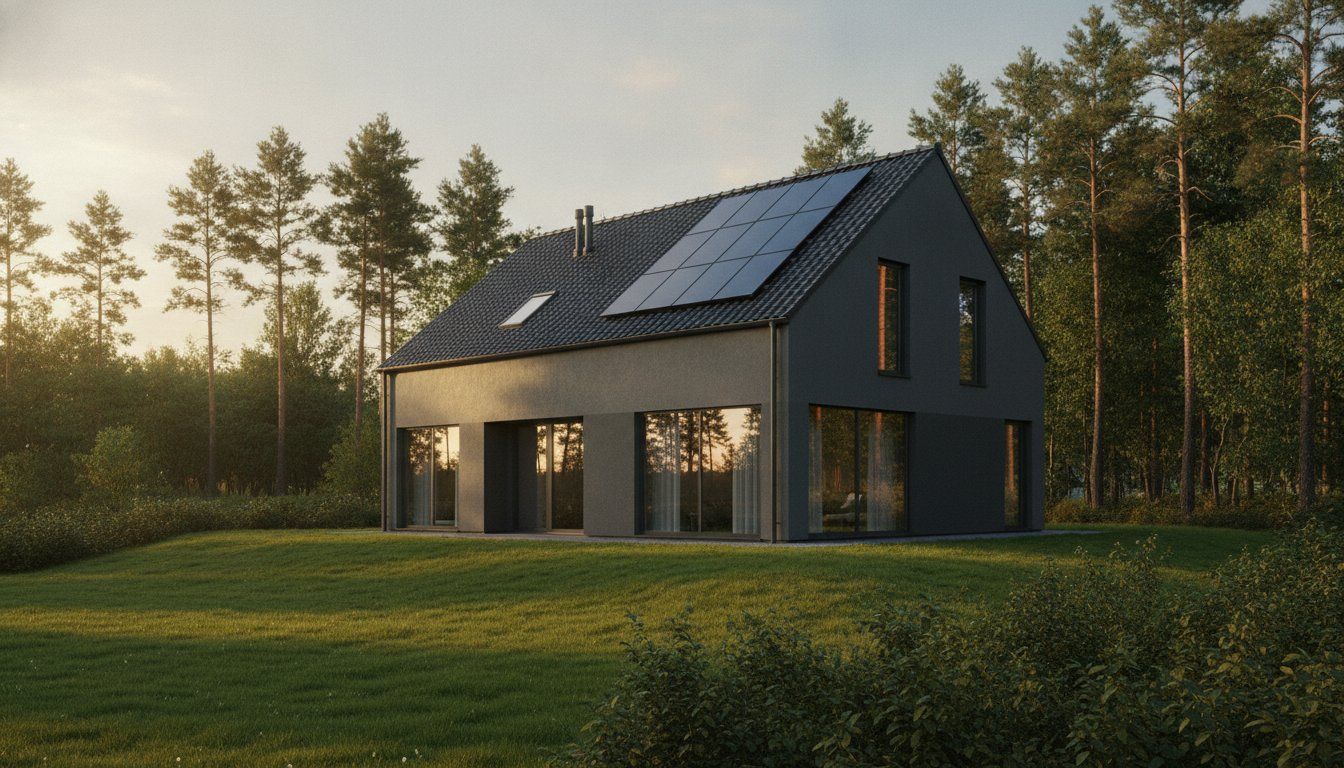
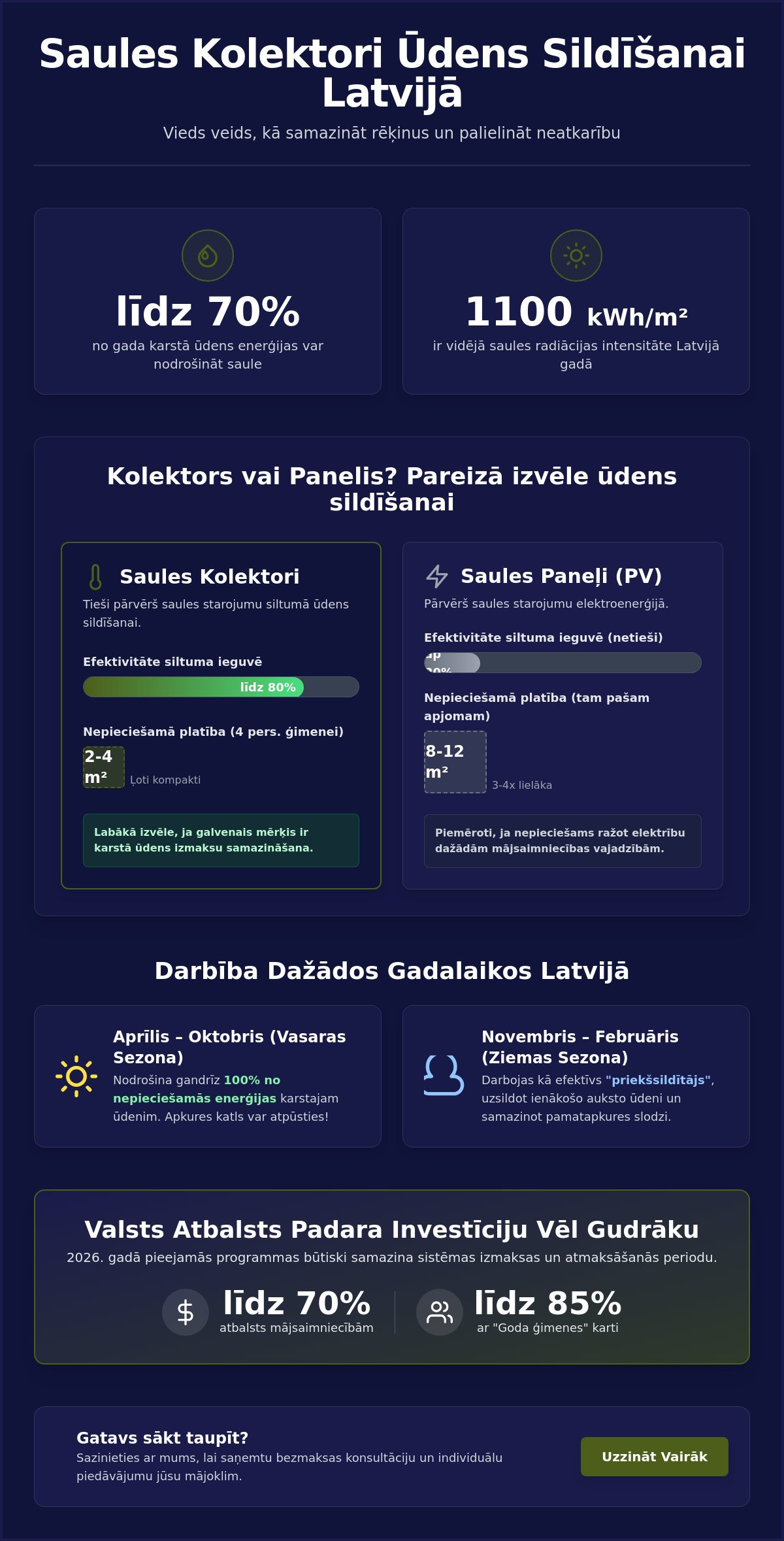
Did you know that the Latvian sun can provide up to 70% of all the annual energy your home needs for hot water? Many homeowners still believe that, in our latitude, solar collectors for water heating are only an expensive experiment, but the data shows otherwise. With average solar radiation intensity of 1100 kWh/m2 per year, this technology has become one of the most effective ways to literally "switch off" a large part of your hot-water bills from April through October.
We understand your concerns about high energy prices and whether the system will work efficiently enough during grey winter months. It is easy to get confused when trying to understand the difference between solar panels and collectors, or to worry that installing the equipment will be too complicated. That is why we are here to help you navigate this choice as trusted partners, not just sellers.
In this guide, you will learn how to choose the system best suited to Latvia's changing weather conditions and which state support programmes are available in 2026 to cover up to 70% of installation costs. We will look at everything from technical details to real savings examples, giving you confidence in the system's longevity and peace of mind about your investment.
What are solar collectors and how do they differ from solar panels?
Solar collectors for water heating are devices that operate on a very clear and efficient principle: they capture solar radiation and convert it directly into heat. People often confuse collectors with solar panels, but the difference is important. While solar panels (PV) produce electricity that can later be used for lighting or appliances, a solar thermal collector specialises specifically in energy-efficient water heating. This technology is significantly more efficient for heat production because it does not involve transforming energy from light into electricity and then back into heat, which always creates losses.
A complete system usually consists of four basic elements: the collector itself, a pump station, a smart controller and a storage tank. This setup makes it possible to use every ray of sunshine as efficiently as possible, providing hot water even when clouds temporarily cover the sky. Thanks to high thermal efficiency, collectors take up far less roof space than panels to prepare the same amount of hot water.
Solar collectors vs. solar panels: which should you choose?
If your main goal is specifically to reduce hot-water costs, solar collectors for water heating will be the more rational choice. They are technically simpler and take up about 3 to 4 times less roof area to produce the required amount of heat. This is critically important for homes where free roof space is limited or the roof structure is complex.
| Parameter | Solar collectors | Solar panels (PV) |
| Efficiency in heat production | High (up to 80%) | Low (around 20%) |
| Required area | Small (2-4 m2) | Large (8-12 m2) |
| Service life | 25+ years | 25+ years |
How does a solar collector system work in a Latvian household?
The system is safe and adapted to our climate. A special heat-transfer fluid circulates through the collectors, usually a propylene glycol mixture that does not freeze even in severe winter frost. The pump delivers this heated fluid to the storage tank, or boiler, which acts as the heart of the system. There, energy is transferred through a heat exchanger to the water you later use in the shower or kitchen. The storage tank stores heat efficiently, allowing you to enjoy hot water late in the evening or the next morning as well.
Efficiency of solar collectors in Latvia's climate
In our latitude, we often hear the myth that solar energy is suitable only for southern countries. The reality is different. In Latvia, average solar radiation intensity reaches 1100 kWh/m2 per year, which is completely sufficient for solar collectors for water heating to become a serious competitor to traditional energy resources. Modern technologies have moved forward. They no longer rely only on direct sunlight, but also use diffuse radiation efficiently on cloudy days.
The system's efficiency lies in its ability to capture heat even when it is not hot outside. Thanks to vacuum tubes or high-selectivity flat-plate collectors, water is also heated on cooler spring mornings. This means that an average Latvian family can save up to 70% of annual hot-water preparation costs. Such savings significantly ease the household budget, especially when energy prices are volatile.
Operation in different seasons: what does the data show?
From mid-April through October, you can almost completely forget about running the heating boiler just for hot water. During this period, the sun provides nearly 100% of the required energy. Solar water heating systems work most actively in Latvian conditions precisely during these seven months. In winter, from November to February, collectors instead perform a "preheating" function. They heat incoming cold water from 5 degrees to around 15 or 20 degrees, so the main heat source needs to spend much less energy to reach the usage temperature.
Return and payback period in 2026
Investments in solar collectors have now become even more attractive thanks to state support programmes. In 2026, households can apply for support from EKII or the Ministry of Climate and Energy, which covers up to 70% of eligible costs. For large families with a "Goda ģimene" card, this intensity can reach as much as 85%. Taking this support into account, the system payback period has shrunk to just a few years. To achieve maximum efficiency throughout the year, we recommend considering combining the system with modern CTC air-to-water heat pumps, which will automatically switch to the most economical mode depending on weather conditions.
How to choose the most suitable type of solar collector?
Choosing between different technologies may seem complicated, but once you know a few basics, everything becomes clear. The main decision is usually between flat-plate and vacuum tube collectors. Flat-plate solar collectors for water heating are the most popular choice in Latvia because of their durability and price. They serve well for 25 years and more, require no special maintenance, and are most efficient precisely in the summer months when there is the most sun.
Vacuum tube collectors, in turn, capture heat better in cooler weather. However, they have their own risks, for example, they can overheat on hot July afternoons if household water consumption is low. The tubes are also more fragile in hail or mechanical impacts. The efficiency of modern solar water heater systems depends on how precisely the equipment matches your family's habits and your home's technical possibilities.
Flat-plate vs. vacuum collectors: which wins in Latvia?
In Latvian conditions, flat-plate collectors are often the more practical choice. They are cheaper, easier to install, and snow melts off them faster in winter. Vacuum collectors are more powerful, but their higher price and more complicated maintenance do not always pay off if the main goal is hot water in the summer season. When choosing equipment, pay attention to the Solar Keymark certificate, which confirms product quality and compliance with European standards.
- Flat-plate collectors: Ideal for families with high water consumption in summer; resistant to weather conditions.
- Vacuum collectors: Suitable when roof space is limited or a higher temperature is needed in cooler months.
Planning before installation
For the system to work at full output, your roof should face south, preferably with a 35 to 45 degree slope. If the roof faces east or west, efficiency will decrease by about 20%. This can be compensated by installing an additional collector panel. Remember that the technical room will need space for the storage tank (boiler) and pump unit, which usually occupy about one square metre of floor area.
The programme approved by the Ministry of Climate and Energy in February 2026 opens up wide opportunities to receive funding for the implementation of such systems. This is the right time to act. If you are planning a full home heating modernisation, solar collectors can be combined very successfully with efficient RTB pellet boilers, which will serve as a reliable backup heat source during the winter period.
Installation, integration and maintenance: the path to longevity
For solar collectors for water heating to serve for decades, correct integration into the home's engineering systems is crucial. They should not be seen as an isolated device. Modern systems work perfectly with existing gas, wood or pellet boilers. When the sun does not heat enough, smart automation itself signals the main heat source to switch on, ensuring that your home never runs out of hot water.
The most effective solution in 2026 is hybrid systems. By combining collectors with air-to-water heat pump technology, you gain maximum independence from energy prices. In summer, collectors allow the heat pump to rest, which significantly extends the service life of its compressor. This synergy not only saves money, but also protects the equipment itself, because it does not have to run unnecessary low-power cycles in the hot months.
System control is fully automated. Modern controllers monitor the temperature difference between the collector on the roof and the tank indoors. You do not need to become an engineer or perform any manual switching. All that is required from your side is periodic visual inspection and professional maintenance once every few years.
Why choose professional installation?
DIY installation may seem tempting, but mistakes in setting the heat-transfer fluid pressure or insulating pipes can lead to system downtime exactly when the sun is shining brightest. A professional installer guarantees tightness and the correct slope, which are critically important for removing air from the system. To learn more about service options and receive advice from our experienced experts, visit the Commodus service section.
System maintenance tips
Regular maintenance is simple, but essential for system longevity. The condition of glycol, or the heat-transfer fluid, should be checked every two to three years. Over time, it can lose its anti-corrosion properties, which can damage the heat exchanger. It is also important to monitor the pressure on the manometer. If you notice a rapid pressure drop or the collector surface has become visibly dirty after a long dry period, it is worth booking a technician visit. Clean collectors and a correctly adjusted pump ensure the highest efficiency coefficient and long-term peace of mind.
Start your path to energy independence today
Solar collectors for water heating are no longer just an exotic alternative, but a proven and rational choice that allows Latvian households to significantly reduce monthly expenses. You now know that even at our latitude it is possible to obtain up to 70% free energy for hot-water preparation, especially if you intelligently combine the system with a heat pump or a modern heating boiler. With its extensive state support, 2026 is an excellent moment to finally implement this idea in your home.
Our team is ready to become your trusted partner at every stage. With more than 15 years of experience in energy-efficient solutions, we offer a full service cycle, from precise design and selection of the most suitable equipment to professional long-term maintenance. Commodus certified installation specialists work throughout Latvia, ensuring that the highest quality standards are observed in every project, regardless of its scale.
Take the first step towards lower bills and a more environmentally friendly home today. Receive a free consultation and individual calculation from Commodus experts! We will help you make a balanced decision that provides comfort and peace of mind for many years.
Frequently asked questions about solar collectors
How many solar collectors does a family of 4 need?
A family of four usually needs two or three flat-plate solar collectors and a 200 to 300 litre storage tank. Such a set provides an optimal balance between investment and generated heat, allowing hot-water consumption to be fully covered in summer. If you choose a vacuum tube system, a set of 20 to 30 tubes is usually required to achieve equivalent capacity.
Can solar collectors break during hail?
Modern solar collectors for water heating are very durable and usually do not suffer from hail or strong wind. Their surface is made from specially tempered 3.2 or 4 millimetre thick solar glass, tested to withstand impacts from even large hailstones. Of course, damage is theoretically possible in extreme natural disasters, but standard Latvian summer storms and hail do not pose a threat to the equipment.
What happens to solar collectors in summer if nobody uses hot water?
If water is not consumed in summer, the system automatically enters stagnation mode, which is a safe and designed process. Smart automation stops circulation once the tank has reached the maximum temperature. The heat-transfer fluid in the collectors heats up and turns into vapour, but after the temperature falls in the evening it condenses again and the system resumes work without your intervention. This is a standard operating cycle that does not harm the equipment.
Can solar collectors be installed on the ground instead of the roof?
Yes, solar collectors can be installed on the ground using special metal structures with the appropriate slope. This is an excellent solution if the roof orientation is unsuitable or the structure is too weak to withstand significant weight. A ground-mounted system is easier to access for maintenance and cleaning, but it must be ensured that it is not shaded by trees, buildings or other obstacles during the active part of the day.
How quickly does an investment in solar collectors pay back in Latvia?
Using state support programmes that cover up to 70% of costs in 2026, the investment usually pays back within 3 to 5 years. Without state support, this period is longer, but taking energy price volatility into account, solar collectors for water heating remain one of the most profitable home improvements. The exact period depends on your family's water consumption habits and the previous energy source used, such as electricity or gas.
Comments