Solar Panel Payback Period in Latvia in 2026: Complete Guide
Will solar panels really pay for themselves only after the children have already finished university? Many homeowners are still afraid of a 15-year waiting period, but 2026 data shows that the reality in Latvia is much more encouraging. In our daily work, we see that fears of an endlessly long investment recovery period are often based on outdated information, not on the current market situation.
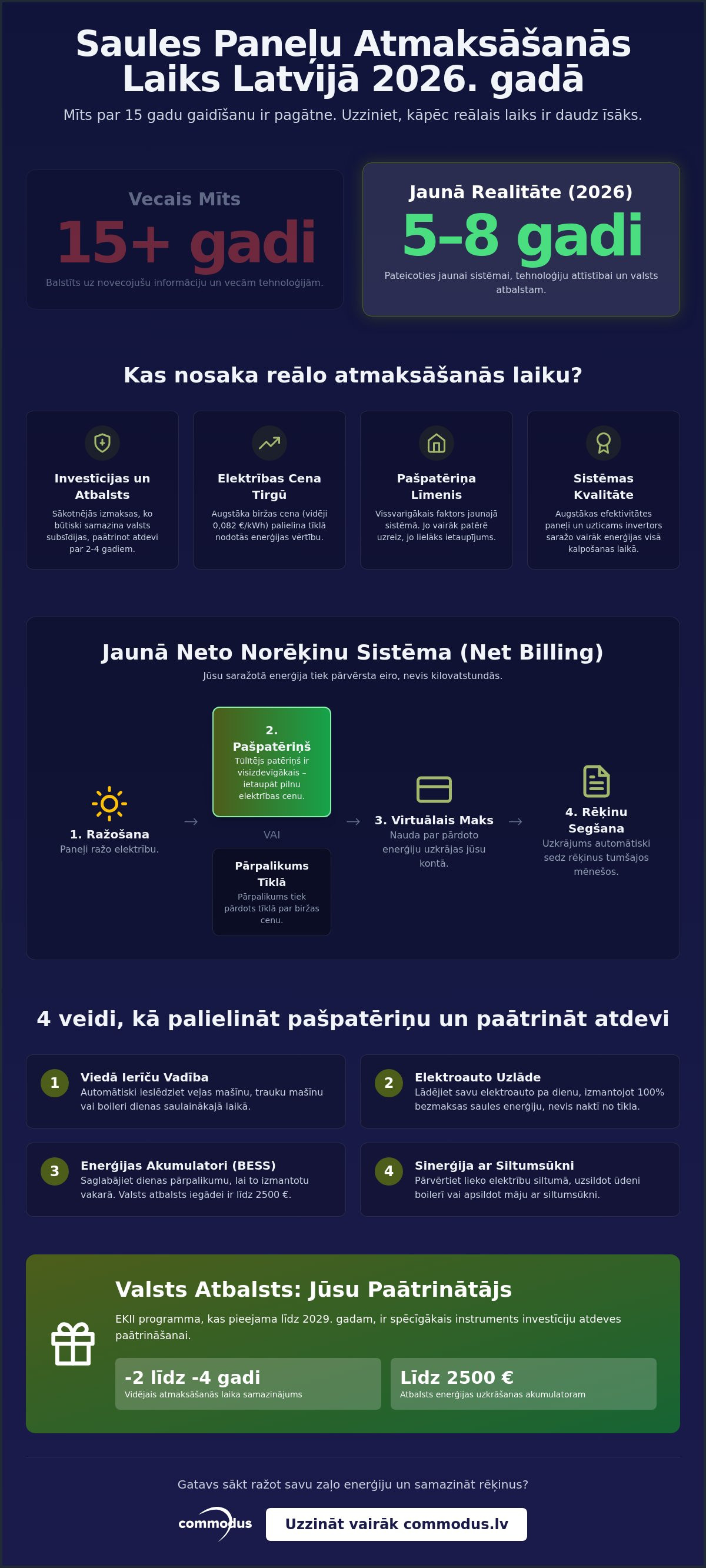
We fully understand that the new Net Billing system and concerns about bureaucracy when applying for state support can create considerable confusion. It is difficult to make a decision without clarity on how exchange prices and the new subsidies affect your family budget. In this article, we will dispel the doubts and show that the real solar panel payback period is currently only 5 to 8 years on average. Our team has compiled the most up-to-date information so you can make a balanced decision.
You will learn how to use state support for battery purchase wisely, up to EUR 2,500, why increasing self-consumption and creating synergy with a heat pump is your biggest opportunity, and how the 2026 rules help your system become a profitable investment much faster than expected. We will guide you through the entire process, making the complicated simple and understandable.
What determines the solar panel payback period in Latvia?
In simple terms, the solar panel payback period is the time during which the value of the energy you produce and consume yourself fully covers the costs of purchasing, installing and maintaining the system. In 2026, for Latvian households this figure usually ranges from 6 to 9 years. This is much shorter than the guaranteed service life of panels, which often exceeds 25 years, making this one of the safest long-term investments.
This period cannot be set in stone, because it is affected by several variables. System capacity, installation price and state support are only the visible part. The electricity market price and how skilfully you use the energy you produce yourself are just as important. Sometimes the seemingly cheapest set can become the most expensive decision. Lower efficiency means fewer kilowatt-hours produced and a slower return on investment, so quality here is directly linked to profit.
Structure of the initial investment
A high-quality photovoltaic (PV) system consists of three main pillars: the panels themselves, the inverter and the mounting structures. The inverter is the heart of the system, and its reliability directly affects how smoothly your investment will work. In the Latvian market, installation work and design account for a significant part of the budget, but professional installation guarantees safety and system longevity. From our experience, documentation approval and commissioning is a step that must not be rushed, because it is a prerequisite for receiving state support.
Electricity price forecasts for 2026
By mid-2026, the average Nord Pool price in the Latvia bidding area has stabilised at around 0.082 EUR/kWh. This significantly affects the value of energy exported to the grid under the new Net Billing system, where surplus energy is converted into euros rather than kilowatt-hours. Dynamic tariffs provide greater flexibility. They allow you to save more if you shift your largest consumption to sunny hours or use energy storage batteries, for which state support is available. Fixed tariffs provide predictability, but they can slightly extend the payback period when market prices are lower. A smart choice is to combine solar energy with modern solutions, such as CTC air-to-water heat pumps, thereby turning sunlight into heat exactly at the moment of production.
Net Billing system and the role of self-consumption
Since 1 May 2024, only the Net Billing system has been available in Latvia for new microgeneration connections. It is a fundamental shift from accounting for energy volume to monetary value. This means that the solar panel payback period is now directly linked to your household's ability to "catch" the sun and consume its energy immediately. The higher your direct self-consumption, the less you are affected by the difference between the purchase and sale price of electricity.
When you consume the energy you produce at the same moment, its value equals the full electricity tariff you would otherwise pay your supplier. By contrast, when you export surplus energy to the grid, its value is reduced by the supplier's retained commission and distribution network costs. That is why immediate self-consumption is your main tool for accelerating ROI.
How does the Net Billing system work?
This system works like a virtual wallet with your chosen electricity supplier. When your panels produce more than the house consumes, the surplus is sold to the grid at the Nord Pool hourly exchange price. The supplier may not reduce this price by more than 0.02 EUR/kWh. The accumulated money automatically covers your bills in months when there is less sun. However, it should be remembered that distribution network services and the fixed capacity charge will still have to be paid in euros, so the complete disappearance of the bill depends on the overall efficiency of the system.
Methods for increasing self-consumption
To accelerate the return on investment, it is worth reviewing your daily habits. Smart control systems can automatically align the operation of electrical appliances with peak production hours. This applies both to dishwashers and to electric vehicle charging during the middle of the day. Energy storage batteries (BESS) are a particularly valuable addition. They allow surplus energy produced during the day to be used in the evening instead of being exported to the grid at a lower price. State support for solar panels and batteries is available until the end of 2029, and the subsidy for a battery can reach EUR 2,500.
By combining panels with a modern heating system, such as CTC air-to-water heat pumps, you can turn excess electricity into heat, storing it in a boiler or underfloor heating. This is one of the most effective ways to maximise self-consumption and ensure that the solar panel payback period is as short as possible.
State support and subsidies in 2026
State support is the strongest driver that helps reduce initial costs and makes green energy accessible to everyone. In 2026, the expanded support programme is still in force, with total funding increased by EUR 40 million. Our experience shows that, by using the available instruments skilfully, the solar panel payback period can be shortened by an average of 2 to 4 years. This means the system starts earning much sooner than originally planned, because the state covers a significant part of the equipment purchase costs.
The main player in the household segment is the Environmental Investment Fund (EKII). Its support is a direct grant paid after the system has been installed and commissioned. It is important to note that support is available only if the installation is carried out by a certified merchant and new, industrially manufactured components are used. The deadline for submitting documents has been extended until 31 December 2029, but funding is allocated in the order applications are submitted, so it is not worth delaying.
Altum grant vs. loan
Altum programmes offer a slightly different approach. While EKII focuses directly on equipment, Altum often supports complex solutions for improving the energy efficiency of private houses. It is possible to receive both a non-repayable grant and a favourable loan with a reduced interest rate. This is especially useful if you plan not only to install panels, but also to insulate the house or replace the old heating system. The main requirement is to achieve at least 20% primary energy savings for the entire building as a whole.
How to apply for support without unnecessary stress?
Bureaucracy often seems intimidating, but the process is logical and can be completed step by step. Everything begins with careful planning and obtaining technical requirements from Sadales tīkls. Once the system has been installed and the commissioning certificate has been received, you can prepare the application to the fund. To guarantee receipt of support and avoid documentation errors, it is worth trusting professionals. By choosing a certified installer, you gain not only quality installation but also peace of mind about the legal process being properly arranged.
We will help you find the best solution and take care of the technical implementation so that your path to energy independence is smooth. Apply for a consultation with Commodus experts and find out what support you can receive specifically for your project.
Synergy with heat pumps: maximum ROI
By combining solar energy with modern heating technologies, you gain the maximum benefit from every ray of sunshine. Solar panels and air-to-water heat pumps are an ideal combination, because they work hand in hand to reduce your dependence on the power grid. This synergy directly affects how quickly the solar panel payback period is reached, because most of the energy produced is used for heating your home and preparing domestic hot water instead of being exported to the grid at a lower price.
In spring and autumn, when the days become sunnier but heating is still needed, the heat pump can run entirely on solar power. This means your heating season becomes significantly cheaper. At Commodus, we have observed that integrated solutions pay for themselves faster than systems installed separately at different times. This is because installation costs and mutual equipment control are optimised from day one.
Domestic hot water preparation with solar energy
During the summer season, your panels produce the most, and this is the right time for the heat pump to prepare hot water almost free of charge. By setting smart control, the system heats the water precisely during peak production hours in the middle of the day. Compared with traditional solar collectors, photovoltaic panels offer greater flexibility. They not only heat water but also power other electrical appliances and the air conditioner once the water tank has already reached the required temperature.
A comprehensive approach to home energy independence
When planning solar energy solutions together with the heating system, you avoid unnecessary rebuilds in the future. This makes it possible to calculate the required panel capacity precisely so that it covers both household electrical appliances and heat pump consumption. This approach ensures that the solar panel payback period is predictable and the investment is safe. To better understand the available options, we recommend reading the information we have prepared about solar panel kits.
We believe every house is unique, so an individual calculation is the best starting point. Contact Commodus experts, to receive a detailed forecast and learn what opportunities you have to become energy independent already today. Our team will be happy to help find a solution that best matches your family's needs and budget.
Start your journey to energy independence today
Solar energy in Latvia is no longer just an exotic experiment, but a logical and economically sound decision for every homeowner. As we have seen, the solar panel payback period in 2026 has become a predictable and attractive indicator, helped by both the new Net Billing system and generous state support. The main element of success is thoughtful system planning, adapting it to your daily consumption habits and combining it with modern heating solutions.
At Commodus, we believe that high-quality execution and a personal attitude are the start of a secure foundation. With more than 15 years of experience in energy-efficient solutions, we offer a full service covering everything from design to navigating the bureaucracy of receiving state support. Our certified installation specialists work throughout Latvia, ensuring that your investment is safe and will serve for decades.
Do not let uncertainty about technical details stop you from saving money. Receive a free solar panel payback calculation from Commodus experts! We will help you see the real benefits and create a solution that provides peace of mind and financial stability for your home in the long term. See you in your sunny project!
Frequently asked questions about solar panel payback
Do solar panels produce anything at all during a Latvian winter?
Yes, solar panels continue to produce electricity during the winter months, but the volume is significantly lower than in summer. The main driver of production is light intensity, not heat, so even on a cold but clear day the system will work efficiently. In winter, production usually covers only a small part of the home's expenses, but in the annual balance every sunny moment helps reduce bills and improve the system's profitability.
What capacity (kW) does an average Latvian private house need?
An average Latvian private house usually needs a 5 to 10 kW system, depending on the family's annual electricity consumption. If the house uses a heat pump or charges an electric vehicle, it is advisable to choose a higher capacity. An accurate calculation is essential, because correctly selected capacity ensures that the solar panel payback period is as short as possible without investing in excess capacity that you will not be able to consume on site.
Is solar panel maintenance and servicing expensive?
Solar panel maintenance is relatively inexpensive and simple, because the system has no moving parts that could wear out quickly. The main tasks include monitoring inverter operation and visually inspecting the panels once a year to make sure the mountings are secure. Latvia's weather and rain usually wash away dust very well, so special washing is needed only in rare cases, maintaining high efficiency without major additional costs.
What happens to the solar panel payback period if the electricity price changes?
An increase in electricity market prices directly shortens the return on investment, because every kilowatt-hour you produce yourself becomes more valuable and the saving is greater. If prices fall, the solar panel payback period may become slightly longer, but the system still protects you from unpredictable fluctuations in the future. Stability and independence from the whims of the energy market are among the most important benefits valued by our customers when planning their family budget in the long term.
Can I install solar panels myself and still receive state support?
No. To receive state support, installation must be carried out by a certified merchant who can issue the necessary certificates and documents confirming safe installation. Self-installation may seem cheaper at first, but it prevents access to subsidies and can create serious problems with system safety or commissioning. Professional installation guarantees that all documents will be in order and that the support application process will proceed smoothly and without unnecessary stress.
Comments