Ground Collector Installation: A Guide to Efficient, Sustainable Heating in 2026

Installing a ground collector is not just a technical process or a matter of burying pipes in your garden; it is the transformation of your property into a personal, independent energy reserve. In 2026, this decision has become more relevant than ever, as new state support programmes, with an application deadline of 1 June, offer co-financing of up to 80 percent. We understand that the thought of digging up your garden and making a large investment can be daunting, just as trying to work out complex capacity calculations on your own can feel overwhelming.
We fully agree that improving your home's energy efficiency is a serious investment that calls for clarity and peace of mind. In this article, you'll learn everything you need to know about the different types of ground collectors and how to make effective use of free ground heat in Latvia's climate. We'll guide you through the entire installation process, helping you choose the right solution and feel confident about the system's long-term payback. Get ready to discover how to keep your home warm while staying at ease about future bills.
What is a ground collector, and why is it the best solution in Latvia?
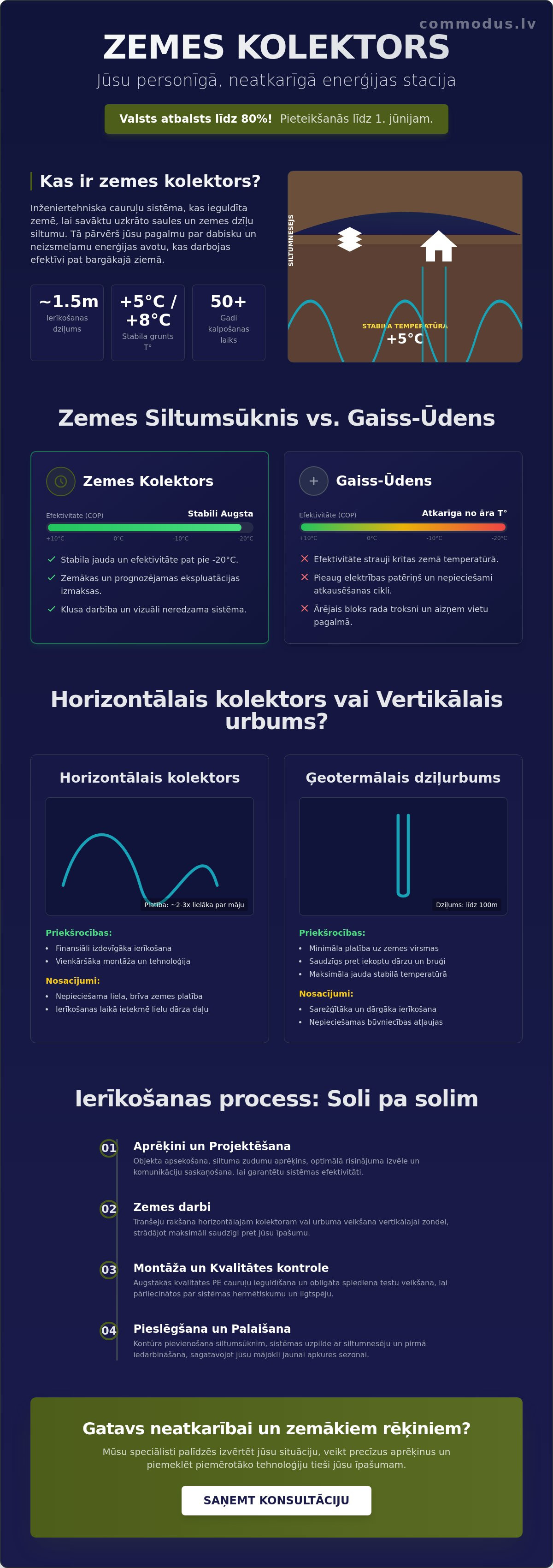
A ground collector is an engineered network of pipes laid horizontally at a depth of roughly 1.2 to 1.5 metres. At this depth, the soil acts as a huge natural battery, storing solar heat and geothermal energy throughout the summer. Even when a blizzard rages on the surface, the ground at depth maintains a stable positive temperature, usually around +5 to +8 degrees. The best way to describe what a ground collector (heat pump) is and how it works is that the system doesn't generate heat from nothing - it simply moves heat from your garden into your home's heating system.
Installing a ground collector is a long-term investment, since a properly installed system can last more than 50 years. The key figure every homeowner should understand is the COP, or coefficient of performance. For ground-source heat pumps, this remains consistently high throughout the winter. In practice, that means for every kilowatt of electricity you use, you get four to five times more heating power in return. The system is quiet, invisible above ground, and takes up no indoor space.
Geothermal energy in your own backyard
Latvian winters can be unpredictable, but the ground below the frost line is a reliable ally. A special glycol solution circulates through the pipes, absorbing heat from the soil and carrying it to the heat pump. Unlike direct-expansion systems, glycol loops are easier to maintain and gentler on the environment. It's essentially a free energy source that never runs dry, since the ground replenishes itself every warm season.
Ground collector vs. air-to-water heat pump
The main difference becomes apparent once the temperature drops below -20 degrees. In these conditions, air-to-water systems lose efficiency rapidly and their electricity consumption rises. Installing a ground collector, on the other hand, ensures that your heating system performs just as well in October as it does during the depths of a January frost. Running costs stay lower, since the system doesn't have to fight ice build-up or sharp swings in outdoor temperature. That gives you the peace of mind of predictable bills even in the coldest months.
Horizontal collector or vertical borehole: which should you choose?
Choosing between a horizontal collector and a vertical borehole is one of the most important decisions at the planning stage. Both solutions are energy-efficient, but their suitability depends on the size of your plot and the type of soil. A horizontal ground collector installation is usually more cost-effective, provided you have a sufficiently large undeveloped area of land. Boreholes, on the other hand, are a lifesaver for owners of small urban gardens, where every square metre counts and there's no desire for extensive earthworks across the whole site.
Horizontal collector: when space is an advantage
This method involves laying pipes in loops at a depth of roughly 1.2 to 1.5 metres. To heat an average-sized house, you'll need a free area roughly two to three times larger than the heated floor area. It's important to keep in mind that the soil type significantly affects the system's output. Clay and damp, dense ground conduct heat excellently, whereas in dry sand the pipe loop needs to be longer to collect the required energy. Looking at the different types of ground collectors, horizontal systems are clearly the most popular in Latvia's rural areas thanks to their relatively straightforward installation.
Geothermal boreholes: concentrated capacity
If your garden already has an established lawn, expensive paving, or fruit trees, a vertical borehole is the gentler choice. Drilling takes place at a single point, reaching depths of up to 100 metres, where the temperature stays constant year-round regardless of conditions on the surface. Latvian regulations require specific permits for this kind of work, so it's worth bringing in experienced specialists right from the start. This system delivers maximum output in a minimal footprint, which is especially valuable in densely built-up areas or coastal regions with loose soil.
Keep in mind that every project is unique and requires a precise capacity calculation. If you're not sure which solution will work best for your particular property, Commodus specialists can help assess the situation and recommend the right technology. Installing a ground collector is a step towards complete home energy independence, and it shouldn't be rushed without professional advice and careful garden planning.
The ground collector installation process: step by step
Many homeowners worry that installing a ground collector will turn their yard into an unrecognisable construction site for months. In reality, with a well-thought-out plan, the process is logical and runs smoothly. Everything starts with a thorough site survey, during which our engineers assess the soil composition and your home's heat loss. This is not just a formality - an accurate design is the foundation for the system to run efficiently for decades.
Preparation and design
Why are the engineering calculations so critical? If the collector is too short, it can over-cool the ground, which in turn reduces the heat pump's efficiency right in the middle of winter. During the design stage, we map out all existing underground utilities and select the optimal location where the ground collector installation will deliver the greatest return. This stage also includes arranging the necessary permits so the works proceed in full legal compliance.
Installation and quality control
Once the equipment arrives on site, the active phase begins. For horizontal systems, trenches are dug; for vertical systems, drilling takes place. We use only high-quality PE pipes that are resistant to mechanical damage and corrosion. Before the trenches are backfilled, we always carry out pressure tests to confirm the system is fully sealed. This guarantees a predictable lifespan and costs, since a correctly installed ground loop lasts more than 50 years.
At Commodus, we know how important your garden is to you. That's why we work as carefully as possible, levelling the area thoroughly once the pipes are laid and the system has been filled with heat-transfer fluid (antifreeze). Once the loop is connected to the heat pump and the first start-up is complete, your home is ready for its first season of free ground heat. If you're planning your heating system now, book a site survey and together we'll design the solution that's right for your home.
Investment and state support in 2026
The initial investment in a ground-source heat pump may seem significant, but 2026 is a unique time to take this step wisely. State support programmes currently offer unprecedented opportunities. For example, funding of EUR 26.8 million available under the Modernisation Fund is open for applications until 1 June 2026, allowing energy communities and municipal buildings to recover as much as 70 to 80 percent of their costs. Private homeowners can still access the EKII programme, with a total budget of EUR 85 million, which helps cover the cost of replacing heating equipment.
This isn't just about the bills. Installing a ground collector can cut your monthly heating costs by 70 to 80 percent compared with fossil-fuel systems. This level of efficiency means the system starts paying for itself from day one, protecting you from unpredictable swings in energy prices in the future.
Why a ground collector is an investment, not an expense
Looking at the long term, energy-efficient heating directly increases your property's market value. In 2026, buyers are looking for homes with low running costs and a solid technical foundation. It's complete independence - you no longer have to worry about how much pellets or gas will cost next heating season, because most of your energy comes free of charge from your own backyard.
Synergy with Commodus solutions
A ground collector reveals its full potential when integrated with modern heat distribution systems, such as underfloor heating or high-capacity water heaters. Sometimes the optimal solution is a hybrid system that also uses an air-to-water heat pump for extra capacity or flexibility. Installing a ground collector requires precision, which is why regular maintenance and professional monitoring are key to keeping the system running at maximum efficiency for decades.
Our specialists will help you choose the best solution for your land and your needs. We'll take care of the entire process, from the precise capacity calculation right through to the final pressure test. If you want a safe, warm and cost-effective home, book a consultation with the Commodus experts and let's start planning your energy independence today.
Start your journey to energy independence today
A ground-source heat pump is one of the smartest investments you can make in your home. It provides consistent warmth even on the coldest nights and brings predictability at a time when energy prices are volatile. Given the generous state support programmes available in 2026, installing a ground collector is now more financially attractive than ever.
We at Commodus, with more than 15 years of experience in the Latvian market, are here to help you at every step. Our certified engineers and installation teams provide a full service, from the precise capacity calculation and design through to help with preparing state support documentation. You don't have to deal with complex technical questions on your own.
Book a free consultation and capacity calculation
Choose a solution that will last for decades and give your family peace of mind. We'd be delighted to become your trusted partner on the way to a warmer, greener future.
Frequently asked questions about ground collectors
How deep does a horizontal ground collector need to be buried in Latvia?
In Latvian conditions, a horizontal ground collector should be laid at a depth of 1.2 to 1.5 metres. This depth is optimal because it sits below the frost line, ensuring a stable heat supply even during the harshest winters. If the pipes are laid too shallow, the system's efficiency drops, while burying them too deep prevents the ground from warming up sufficiently from solar energy in summer.
Can a ground collector freeze my garden and affect plants?
A correctly calculated ground collector installation does not affect plant growth in your garden or freeze the soil to the extent that it would harm your lawn or shrubs. Since the pipes sit more than a metre deep, they don't affect plant root systems, which are usually found in the upper layers. Engineers precisely calculate the required loop length so the ground can naturally regenerate each season without disrupting your garden's ecosystem.
How long does installing a ground collector take?
The earthworks and pipe-laying themselves usually take between two and five working days. The exact time depends on the size of the site, the type of collector chosen, and the complexity of the soil. The overall process, including design and connecting the heat pump, can take several weeks, but we plan the work so that the garden disruption phase is as short and smooth as possible.
Can a ground collector be installed in an existing, landscaped garden?
Yes, it's possible, but with a horizontal collector you should expect substantial earthworks that will temporarily change the look of your garden. If you don't want to dig up an existing lawn or expensive paving, we recommend choosing geothermal boreholes instead. The drilling rig requires only a small area, allowing existing plantings and garden design to remain almost untouched.
How much state support is available for installing heat pumps in 2026?
In 2026, state support is particularly generous, covering as much as 70 to 80 percent of costs for energy communities and municipalities through the Modernisation Fund. Private homeowners can use the EKII programme, receiving support of up to EUR 4,000 for installing a new heat pump. These programmes are a great incentive that makes installing a ground collector a financially accessible and forward-looking decision for every homeowner.
Comments