Heating systems for zero-energy house: costs and choice
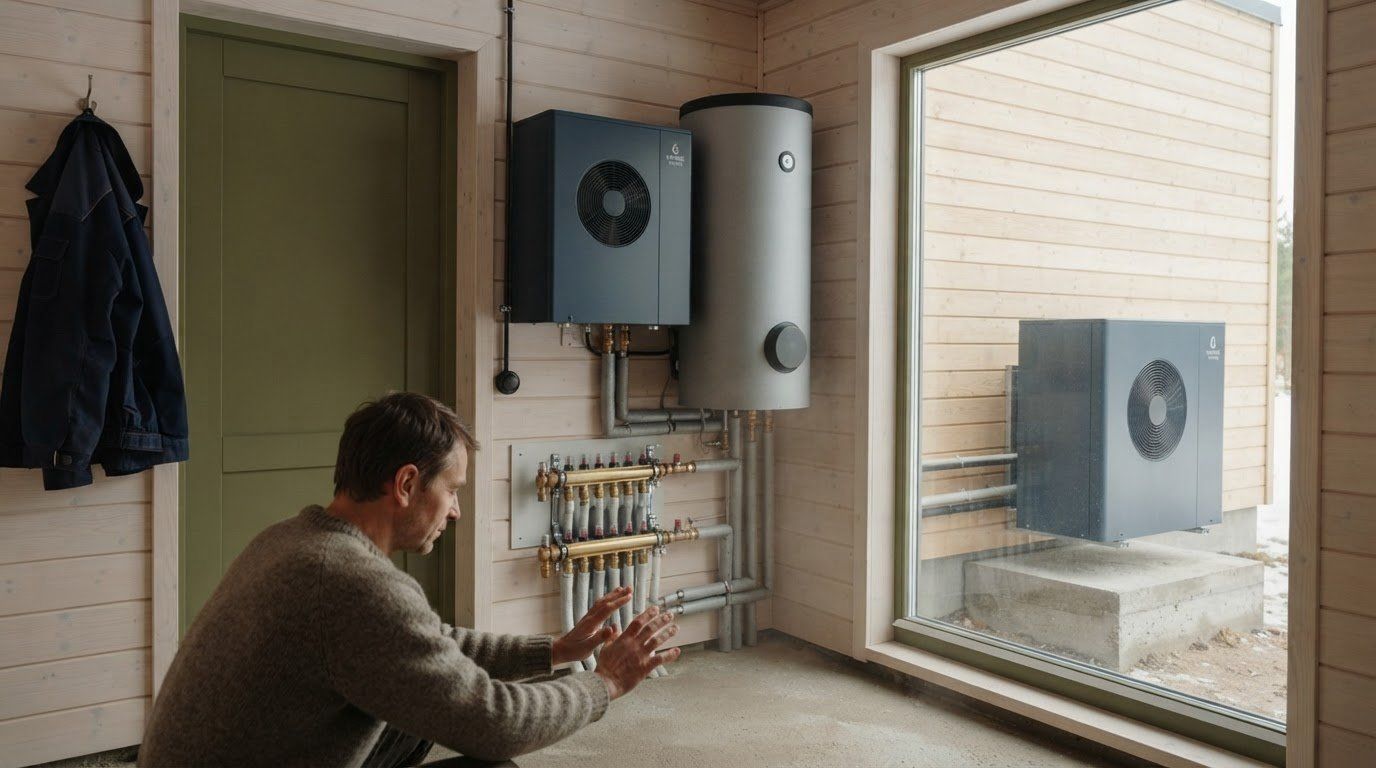
The heat pump and solar panels are not the only way to an energy efficient house. Nearly zero energy building renewable energy should be used at least in part, but Latvian regulation does not set a specific proportion of it. Therefore, heating systems for a zero energy house are chosen taking into account the heating demand of the building and available energy sources.
If these technologies are not suitable, this does not mean that you have to abandon the choice of smart heating. First, find out how much energy the house needs for heating and cooling, which affects the total costs and how to include renewable resources in the system. We will look at how to evaluate these issues, compare heating solutions and choose a system that meets the needs of the house.
Calculation of the energy needs for heating and cooling
Heating and cooling demand is determined by the building's design, climate and use. Calculation helps to determine the required capacity, evaluate cost factors and understand whether the system is suitable for the building.
Determination of heating energy demand
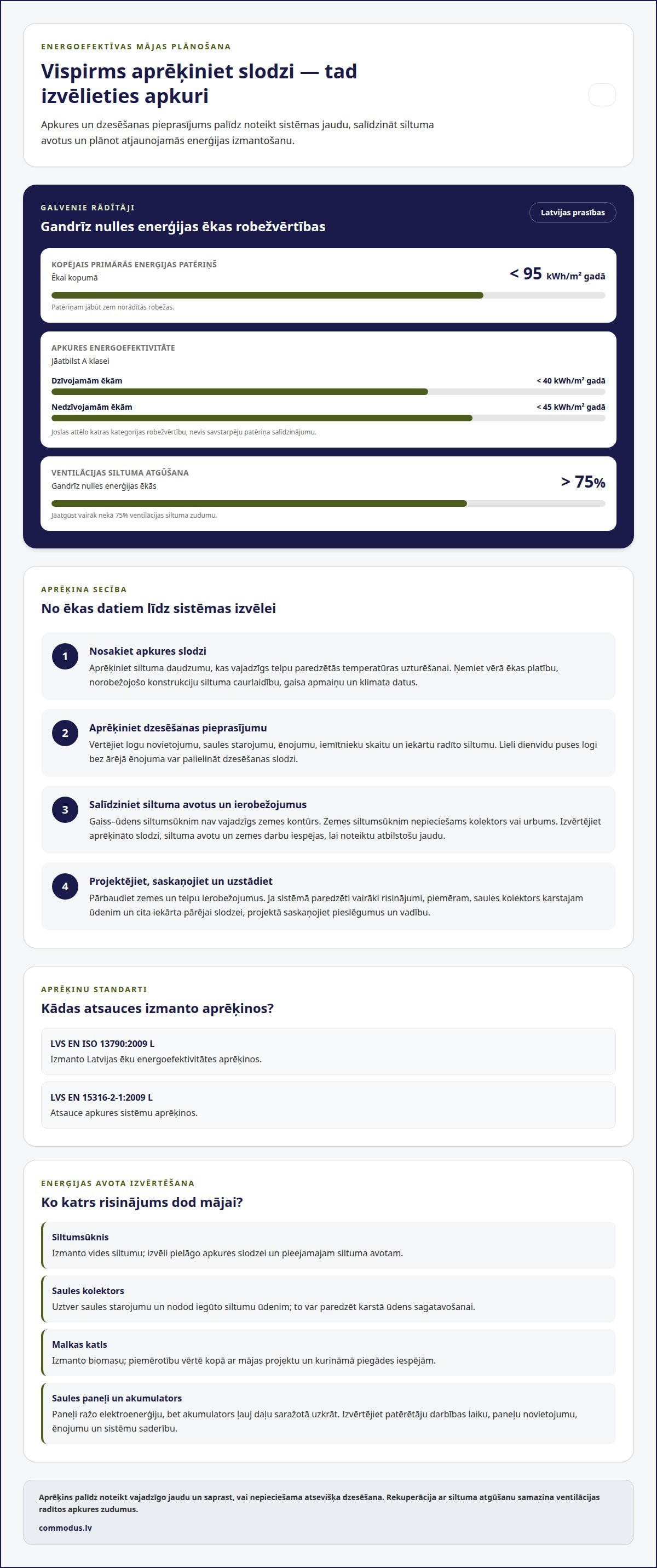
Heating demand is the amount of heat needed to maintain the specified temperature in the premises. When calculating it, the building area, heat permeability of the envelope constructions, air exchange and climate data are evaluated. The energy efficiency of Latvian buildings is calculated using standard LVS EN ISO 13790:2009 L, while the heating system calculations refer to LVS EN 15316-2-1:2009 L.
When comparing air-water and ground heat pump, evaluate the project heat load, heat sources and ground work options. Air-water heat pump does not need a ground contour, while ground heat pump needs a collector or well. Calculated load helps to determine the appropriate power of the equipment.
In Latvia, the total primary energy consumption of a nearly zero-energy building should be less than 95 kWh/m2 per year. The heating energy efficiency should be in Class A; the heating consumption threshold is less than 40 kWh/m2 per year for residential buildings and 45 kWh/m2 per year for non-residential buildings.
The application for State aid may be submitted by households until 31 December 2029 or by the end of the funding.
Maintenance requirements vary depending on the installation: the boiler must be tested for combustion, but the pump and ventilation system units must be kept clean. The selection sequence is simple: calculate the heat load, compare the heat sources and assess the limitations of the ground and space.
Determination of the cooling energy demand
Cooling demand is the amount of heat to be discharged to maintain comfortable temperatures in the rooms. The calculation takes into account the location of windows, solar radiation, shading, number of occupants and heat generated by the equipment. For example, large southern-side windows without external shadows may increase the cooling load.
The recuperation with heat recovery is suitable for an energy efficient house: it recovers part of the heat from the air and reduces the heating losses caused by ventilation. In almost zero-energy buildings in Latvia, more than 75% of the heat loss from ventilation is recovered. Cooling calculation in turn helps to determine whether separate cooling is necessary and how to manage the benefits of solar heat.
Actual costs of heating and hot water
For comparison of bills, both heating consumption and actual costs are necessary. On average, in the Upesciema 278 m2 house for heating and hot water preparation between 2018 and 2020 was used 15.62 kWh/m2 electricity per year.
This example shows why a single bill is not enough. The monthly amount reflects the consumption of a given period and electricity costs, while the calculation per square meter allows you to compare houses of different sizes. When comparing your data, separate the heating from hot water if you can count it and evaluate full year consumption, not just winter month.
The assessment of the costs is influenced by the building's heat losses, habitants, hot water consumption and heating management. The heat source chosen during construction determines the principle of operation of the system, but the daily consumption is also influenced by the construction of the house and the set temperature.
To make a meaningful comparison, please arrange the data as follows:
- Collect bills and meter readings for heating and hot water preparation.
- Separately record the electricity consumed in the house and the electricity produced by the house itself.
- Compare annual consumption, costs and building area, with the period.
If you are looking at heating systems for a zero-energy house, separate the initial contribution from the operating costs. Support programmes may affect the initial investment, but do not replace the consumption assessment. Heating and hot water costs are best compared using one-period data, the same accounting approach and clearly indicate the house area. Thus, the assessment is based on actual consumption rather than on the choice of the equipment.
The experience of √Pilver Houses gives additional guidance to citizens: by August 2025, they managed to save 2067 euros. This amount can be taken into account when assessing how practical decisions are reflected in the overall economic result, but it does not reveal in itself what measures made the savings. Therefore, compare this experience with your home, check whether data on consumption and costs are available for a similar period and if the same criteria are used in the calculation. If you keep invoices and meter readings, you can follow the changes and notice if they match the changes made in the house use or heating management. Also, separately, you can write down what is included in the savings calculation to avoid confusion with a simple comparison of the amount of invoices. Such conclusions will be more cautious and useful for further cost assessment.
Renewable energy use
Renewable resources in the house can be used for both heat and electricity. By choosing the solution, find out what energy it produces and where you will use it in the home system.
Renewable energy for heating
Renewable energy heating has heat from the environment or biomass used for space heating and water heating. This separation helps to choose the source according to the type of heating in the home. The heat pump uses the environmental heat, while the solar collector captures the solar radiation and transfers the resulting heat to the water. The wood boiler uses biomass and its suitability is assessed alongside the home project and fuel supply options.
For example, a solar collector can be prescribed for hot water, but the rest of the heat load is assigned to another system. This combination must be provided in the project so that the connection and control of the equipment work in a coordinated way.
Alignment of solar panels and battery with heating
Solar panels generate electricity, but battery allows for some of the electricity produced to be stored. By choosing the type of heating, you can find out which equipment consumes electricity and how it can be controlled. For example, heat pump and water heater operations can be planned in a coordinated way to use the electricity available in the house.
Before harmonising your systems, collect data on electricity consumers, their lifetime and hot water preparation mode. Then evaluate the location, shading and possibility of connecting the battery. This data helps you understand whether the electricity produced is more profitable to use at once or to accumulate for later use.
On 14 July 2022, the Cabinet of Ministers approved the Recovery Fund support programme for improving energy efficiency of multi-apartment houses and the use of renewable energy technologies. When planning the solution, check whether the conditions of support apply to the envisaged building and technology. Directive 2010/31/EU of the European Parliament and of the Council on the energy performance of buildings defines a building with a high energy efficiency, the necessary energy is produced from renewable energy sources on the ground. Therefore, in the assessment of the technologies alongside the installations, take into account the energy efficiency of the building and the use of energy produced locally.
In 2024, solar energy covered the cost of sharing electricity in the home each month. These examples remind you that both the function of the equipment and the use of energy produced in the house should be assessed. The installed capacity of supported solar panels and low-capacity wind generators is sufficient to produce approximately 100.7 GWh of electricity per year. By selecting the project, compare the benefit with the consumption profile of the house and plan which needs the energy produced will serve.
What heating systems are suitable for a zero-energy house in Latvia?
The suitability is determined by the heat demand of the building, available resources and system management. In Latvia, nearly zero energy heating equipment for low-efficiency fossil fuel heating should not be installed in the building. Therefore, you should not only assess the type of equipment, but also its efficiency and impact on the overall energy consumption of the building.
The heat pump may be suitable if the building has a low calculated heat load and the heat distribution is in accordance with its operating principle. The air-water heat pump transfers heat to the water heating system, while the air-air heat pump heats the space directly. The ground heat pump requires a collector or well, therefore the solution should take into account the territory and the ground works.
If the heat pump or solar panels are not suitable, evaluate other heat sources, taking into account the consumption of the building. A wood boiler can use renewable fuels, but this does not automatically mean that the installation meets the requirements of a nearly zero-energy building. Its utility and overall impact on the energy assessment must be assessed. Low-efficiency fossil fuel installations in such a building are not allowed.
When choosing the system, compare also the heat distribution solutions. Warm floors and radiators require different water temperature, therefore their compatibility must be envisaged in the project. The recuperation system recovers part of the air heat and reduces heat losses from ventilation, but it is not a heating system in itself.
- If water heating is required, consider the compatibility of heat pump and heat distribution.
- If you are considering a wood boiler, check its usefulness and its impact on the building's energy balance.
- If the main thing is to reduce the loss of ventilation, evaluate recovery.
Choose a heating solution together with a plan for ventilation and heat distribution.
Commodus: Air-to-water heat pumps
Commodus helps to assess whether the air-water heat pump meets your home heating needs. This solution is suitable for considering if the house is designed for water heating system and equipment can be adjusted to the calculated heat demand of the building. When choosing, also consider the way the heat is distributed, such as warm floors or radiators.
Commodus offers consultations and design, as well as installation and maintenance of equipment. If your house is more suitable for heat source, air-air or ground heat pump can also be evaluated. The solution is chosen taking into account the construction of the house and the heating system, rather than the characteristics of only one installation.
Visit commodus.lv or contact Commodus to discuss a heating solution suitable for your home.
Take the next step wisely
The next step is to convert the calculation of the project into a specific solution that fits with the building's thermal distribution, hot water needs and everyday habits. This makes it clearer even if solar panels or heat pump are not suitable.
Commodus offers air-water, air-air and ground heat pumps. They differ in heat source and connection to the home heating system, so the most appropriate solution is determined by the needs of the project.
Contact CommodusA thoughtful project will help you move to a home where you can live nicely.
Frequently Asked Questions
What if you have no possibility of installing a heat pump and solar panels?
First, please check whether the house can be connected to the district heating. If this is not possible, evaluate the usefulness of the existing heating unit and the state of the heat distribution. Another boiler may also be considered, taking into account fuel type and building energy efficiency requirements. Check also if management can be improved to deliver the heat only to the required premises.
What are the operating costs of heating systems and electricity consumption?
Operating costs consist of energy consumption and tariff, maintenance of equipment and operation of auxiliary equipment. Electricity consumption is determined not only by the manufacturer of heat, but also by circulators and controls. By comparing solutions, please note separately fuel or electricity costs and maintenance works. It will be easier to see which costs are changing with consumption and which are independent of it.
What heating capacity is required for a zero-energy house, and how is it calculated?
The heating designer determines the heat load of each space and collects it to calculate the need of the entire building. This helps to select the equipment that is capable of providing heat in the coldest planned operating mode, instead of determining the power only by area. After the installation, the control settings are adjusted to the actual system.
Comments