How Much Electricity Does an Air Conditioner Use? Real Consumption and Costs in 2026
Do you really know how much one cool hour in your home costs, or do you wait for the new electricity bill with concern every month? The question of how much electricity an air conditioner uses is becoming increasingly important, because at the beginning of 2026 we saw sharp price fluctuations, with the electricity price in January rising as high as 153.43 EUR/MWh. We understand that technical parameters and changing market conditions can create justified concern about home running costs.
Our team is here to help you bring clarity and take control of your home's energy efficiency. We promise that after reading this article, you will know exactly how to calculate your air conditioner's electricity consumption and which solutions to choose so that cooling is as affordable as possible. We want you to feel confident about your choices and enjoy comfort without unnecessary worry or uncertainty.
We will explain the essence of energy-efficiency classes, analyze how SEER and SCOP indicators affect your wallet, and provide practical recommendations for reducing bills. Together, we will find a path toward smart and economical climate control tailored specifically to Latvian conditions and your family's needs.
What determines air conditioner electricity consumption: Myths and reality
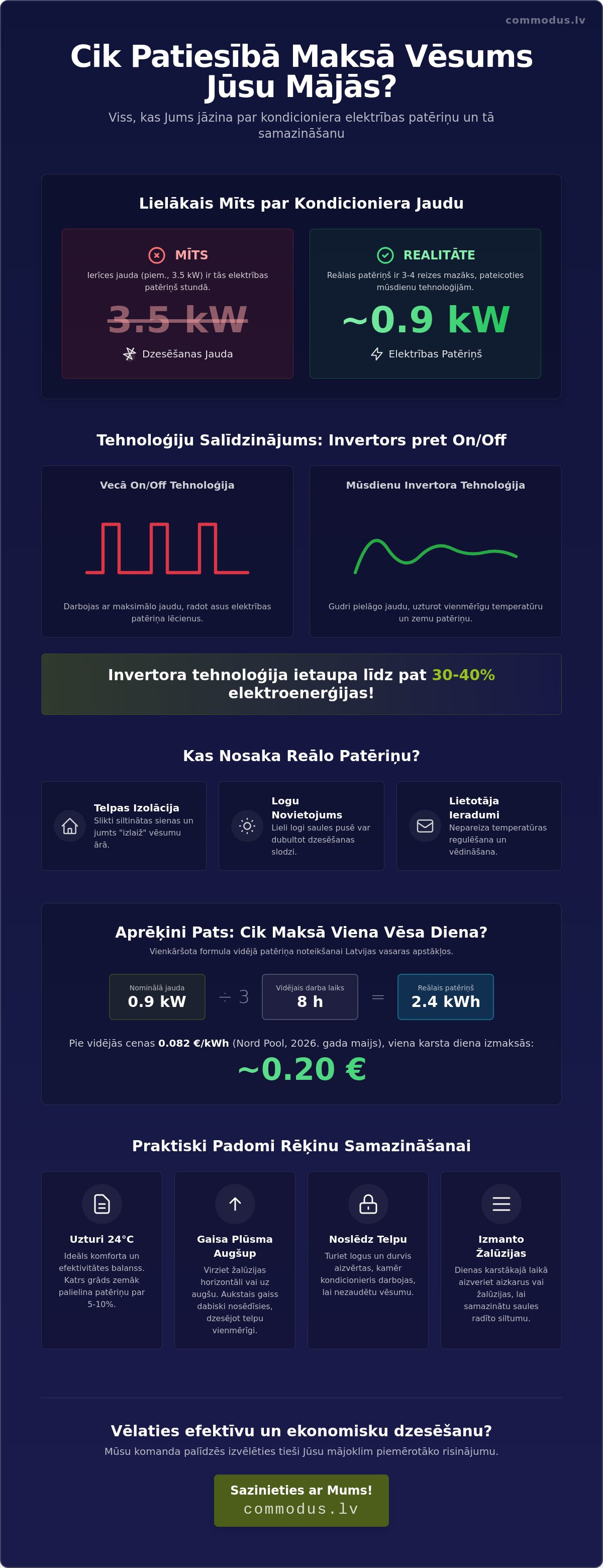
Let us start with the biggest misunderstanding almost every buyer encounters. Seeing "3.5 kW" on the unit's box, many people get worried, thinking this is the hourly consumption. In reality, it is the cooling capacity, not the electricity consumption. The real answer to the question of how much electricity an air conditioner uses is hidden in completely different numbers. Usually, to provide 3.5 kW of cooling capacity, a modern unit uses only about 0.8 to 1.0 kW of electricity.
Nominal capacity versus actual consumption
Inverter technology is the heart of modern cooling. Older models worked on an "all or nothing" principle, using maximum power every time the compressor switched on. Modern units, such as Alpicair air heat pumps, adjust their output intelligently. Once the desired room temperature is reached, the unit does not switch off; instead, it lowers its speed to a minimum. This not only protects the equipment, but also significantly reduces bills, because the most energy is used precisely at start-up.
Actual consumption is affected by several critical factors that we always recommend assessing before installation:
- Room insulation: Poorly insulated walls "let out" coolness just as quickly as heat in winter.
- Window placement: Large south-facing windows without blinds can even double the required cooling capacity.
- Ceiling height: The more cubic meters of air there are in the room, the more energy will be needed to cool it.
Energy-efficiency classes (A+++ to D)
When choosing equipment, the A+++ letters on the label are a good starting point, but in 2026 professionals pay more attention to the Seasonal Energy Efficiency Ratio (SEER). This indicator more accurately reflects efficiency across the whole season, taking Latvia's changeable weather into account. A higher SEER means that for every euro spent, you receive more cooling. An investment in a more efficient unit usually pays for itself within a few seasons, especially with today's electricity price fluctuations.
User habits play a huge role. Many people make the mistake of switching on the air conditioner only when the room has already overheated. It is smarter to maintain an even temperature throughout the day. Latvian summers are unpredictable, so the unit usually uses maximum capacity only for a few of the hottest afternoon hours, working in economical maintenance mode the rest of the time.
How to calculate air conditioner consumption per hour and per month?
For many homeowners, the math around electricity bills seems complicated, but the calculation is actually quite simple. To understand how much electricity an air conditioner uses, we recommend using a proven formula: divide the nominal electrical power by three and multiply it by the operating hours. Why divide by three? Because a modern unit works at full power only at the beginning, while the rest of the time it simply maintains coolness.
Let us assume your device's nominal consumption is 0.9 kW. On a hot July day, when the unit operates for 8 hours, actual consumption will be about 2.4 kWh. If we calculate using the May 2026 Nord Pool average price, which was around 0.08226 €/kWh, one such day will cost you only a few dozen cents. How much electricity an air conditioner uses directly depends on how intelligently you use dynamic tariffs. If you cool the rooms during night hours, when prices tend to be lower, the total costs will be even friendlier.
Modern units, such as AlpicAir air heat pumps, are equipped with smartphone apps. They allow you to track every watt used in real time, preventing any surprises at the end of the month.
Inverter versus On/Off: Consumption comparison
Older-generation On/Off units work with huge energy jumps. Every time the temperature rises, they switch on at maximum power, creating peak loads on the grid. Inverter technology, by contrast, works smoothly, like an experienced runner who saves energy for the whole distance. This approach can save up to 30 or 40% of electricity in the long term, because unnecessary engine strain and constant restarts are avoided.
Monthly cost forecast in Latvian conditions
Realistically, in a typical Latvian summer, an air conditioner works intensively for only 10 to 15 days a month. For comparison, an electric kettle with 2000W power, used several times a day, can consume a similar amount of energy as a modern air conditioner maintaining comfort throughout the afternoon. If you want a more precise calculation for your home, assess your home's ventilation system and consult our specialists, who will help choose the model best suited to your exact floor area.
Practical tips for reducing cooling costs
Habits have enormous power over your electricity bill. Although we have clarified how much electricity an air conditioner uses on average, you can influence the real number at the end of the month yourself. One of the simplest ways to save is smart temperature setting. We recommend staying at the 24°C mark. This is the ideal balance where the body feels comfortable and the unit does not operate under excessive load. Every degree you try to "push" lower can increase consumption by about 5 to 10%.
The laws of physics work in your favor when used correctly. Cold air naturally sinks, so direct the air conditioner's louvers horizontally or slightly upward. This will ensure even cooling throughout the room, not only directly below the device. Also remember that a single open gap in a window or door can double how much electricity an air conditioner uses, because the system will constantly try to cool the "street". Tips on how to save money on home cooling often also emphasize using blinds during the day, preventing the sun from heating the room before the unit even starts working.
Air conditioner maintenance as a saving tool
Regular maintenance is not only a hygiene issue. Dirty filters and a clogged heat exchanger are like running with a blocked nose; the compressor has to work 20% harder to achieve the same result. Cleaning the filters yourself once a month is the simplest way to save. However, once per season, a professional Commodus service is needed to check the refrigerant level and system tightness, ensuring that the unit operates at maximum efficiency.
Smart home and remote control
There is no need to cool an empty home all day long. Modern Wi-Fi modules and sensors allow you to control the climate remotely. The most efficient approach is to switch on the air conditioner about 30 minutes before arriving home. This is enough time to create a pleasant environment without wasting energy while no one is indoors. Smart functions help automate this process, adapting to your daily rhythm and preventing unnecessary consumption.
Our team is always ready to help with advice so that your home is not only cool, but also energy-efficient. If you are looking for a reliable and economical solution, choose proven Alpicair air heat pumps, which stand out for high performance and friendly running costs.
The air conditioner as part of a modern energy ecosystem
Today, an air conditioner is no longer just a luxury product for hot days. It has become an essential element in a smart energy ecosystem. If earlier we calculated only how much electricity an air conditioner uses in cooling mode, now we look at the overall home energy balance. Modern units can provide comfort all year round, becoming an economical solution both in heatwaves and during the first cool days of autumn.
Many homeowners forget that a modern air conditioner is also an efficient air-to-air heat pump. This means that in spring and autumn you can significantly save on basic heating costs by using this unit to warm rooms. This way of using air-to-air heat pumps is becoming a main choice in Latvian private homes. It allows flexible response to changing weather without switching on the large heating system, which in the shoulder season is much more expensive and inefficient.
Solar panels and free cooling
The hottest summer days, when cooling is needed most, coincide with the time when solar panels generate the most energy. This synergy is ideal. Solar panel kits turn this peak load into practically free comfort. You no longer have to worry about how much electricity an air conditioner uses during peak exchange-price hours, because your system consumes the "green" energy generated at that exact moment. The net billing system makes this process even more transparent, moving the home toward complete energy independence.
Why choose professional installation?
It should be remembered that even the most expensive and efficient unit will lose its purpose if installed incorrectly. Installation mistakes, such as insufficient airflow or an inaccurate refrigerant level, can make the system use 30% more energy than specified by the manufacturer. An incorrectly chosen location for the indoor or outdoor unit creates unnecessary load on the compressor, shortening its service life.
A consultation with Commodus experts is the first step toward a sensible choice, regardless of whether you are planning simple cooling or a full ventilation system modernization. We believe that quality work and an individual approach to every project are the only path to true comfort and low bills in the long term.
Prepare for a smart and affordable cooling season
Understanding how much electricity an air conditioner uses is the first step toward a thoughtful home budget and genuine comfort. We have established that modern inverter technologies, correctly set temperature and regular maintenance can protect you from unexpected bill jumps. By combining cooling with solar panels, you not only save money, but also become part of a modern and sustainable energy ecosystem.
Our team has more than 14 years of experience in the Latvian market; we know which solutions work best in our changeable weather. We provide professional installation and service throughout Latvia, offering only energy-efficient solutions from the world's leading manufacturers. We are here to help you make a balanced decision that will serve you for many years.
View energy-efficient air conditioners and heat pumps in the Commodus store!
Enjoy the summer heat with pleasant coolness and complete peace of mind about your running costs. We will take care of the technical side so you can simply relax.
Frequently asked questions about air conditioner consumption
Does an air conditioner use more electricity than a regular electric heater?
An air conditioner is significantly more efficient than any regular electric heater. While an electric radiator produces only one kilowatt of heat from one kilowatt of electricity, an air conditioner, or air-to-air heat pump, can produce three to five kilowatts of heat or coolness. This is possible because the device does not produce heat itself, but moves it from one environment to another using physical processes. That is why cooling or heating with such a unit is several times cheaper than using traditional heaters.
How much does it cost on average per month to run an air conditioner in Latvia?
On average, running one air conditioner in Latvian conditions costs from 15 to 30 euros per month for one room. The exact amount depends on how much electricity the air conditioner uses in a specific month, taking into account the outdoor air temperature and your chosen electricity tariff. Since extreme heat in Latvian summers usually lasts only a few weeks, total seasonal costs remain relatively small and predictable. Many of our clients admit that comfort and quality sleep on hot nights are worth more than this small addition to the bill.
Is it worth leaving the air conditioner on when I am not at home?
It is not useful to leave the unit running at full power all day long if the home is empty. A smarter approach is to use economy maintenance mode or Wi-Fi control. We recommend switching on cooling remotely about half an hour before returning home. This will help avoid unnecessary consumption while ensuring that you enter already pleasantly cooled rooms. If there are pets at home, you can set a higher temperature, for example 26 degrees, which will require minimal energy while protecting the rooms from overheating.
How does energy-efficiency class A+++ affect real savings compared with class A?
The difference between A+++ and ordinary class A can reduce your bill by about 20 to 30 percent over a season. Although higher-class units are initially more expensive, their technological equipment allows them to operate much more efficiently at partial load. In the context of 2026 electricity prices, an investment in class A+++ pays back increasingly quickly. It should also be considered that such devices are usually quieter and offer more precise temperature control, which directly affects your everyday comfort.
Does air conditioner capacity affect electricity consumption if the room is small?
Yes, incorrectly selected capacity directly affects how much electricity an air conditioner uses in everyday operation. A unit that is too powerful for a small room will operate unevenly, constantly switching on and off, which significantly increases energy jumps and wears out the compressor. A unit that is too weak, on the other hand, will work at its limit without stopping, unable to achieve the desired result. That is why it is critically important to make an accurate calculation before purchase so that the system operates in an optimal and economical mode.
Comments