How Many Solar Panels Does a Private Home Need: A Guide to Accurate Calculation in 2026
Did you know that since January 1, 2026, electricity bills for many households have increased by several euros per month simply because state support for Sadales tīkls tariffs ended? These changes are making all of us become small energy experts in our own yards. The question of how many solar panels a private home needs is no longer only about ecology, but about precise mathematics so your investment does not become an expensive decoration on the roof. We understand the concerns that arise when thinking about the new net billing system or whether there will be enough capacity for a heat pump in a harsh winter.
We agree that choosing between different power options can seem confusing, especially when you hear so many conflicting opinions around you. In our daily work, our team sees how important it is not simply to install equipment, but to find a solution that fits your home and lifestyle exactly. That is why we have prepared a clear guide to help you accurately calculate the required number of panels, optimize costs, and achieve maximum energy efficiency in Latvia's changing weather conditions. In this article, you will learn how to balance system capacity with your real consumption and why, in 2026, the focus should be on self-consumption and energy storage so you can feel confident about your choice in the long term.
Why is the right number of solar panels more important than ever?
The previously popular approach of "let's install more so there is enough" no longer works in 2026. Since January 1, when state support for Sadales tīkls tariffs ended, every extra panel whose generated energy you do not use immediately can extend the payback period of the entire system. Today, the main question is not only maximum capacity, but how many solar panels a private home needs for it to work efficiently in the new market conditions and avoid unnecessary expenses.
At Commodus, our work is guided by the philosophy that a system must be adapted to your real consumption, not to a theoretical maximum. A high-quality photovoltaic system is a long-term investment, so the goal is to achieve maximum self-consumption. This means you will benefit most if you use most of the energy at the moment when the sun is shining brightest. If the system is too large, you will generate surplus energy that you feed into the grid at a lower price, but later buy back while paying the full distribution fee, which has become more expensive since the beginning of this year.
The impact of the net billing system on calculations
The transition from the old net metering system to the new net billing model has significantly changed the rules of the game. Previously, we calculated kilowatt-hours that we "deposited" in the grid like in a bank, but now we calculate euro value. It is critically important to align production peaks with the operation of your home's electrical appliances. If air-to-water heat pumps or air conditioners operate in your home, the number of panels must be calculated precisely so they cover these devices' consumption during production hours. The right number helps avoid a situation where you effectively give energy to the grid, but overpay for electricity from the shared grid in the evenings. We help find this golden middle so every euro you invest in panels works in your favor.
Calculation formula: how many solar panels are needed based on kWh consumption?
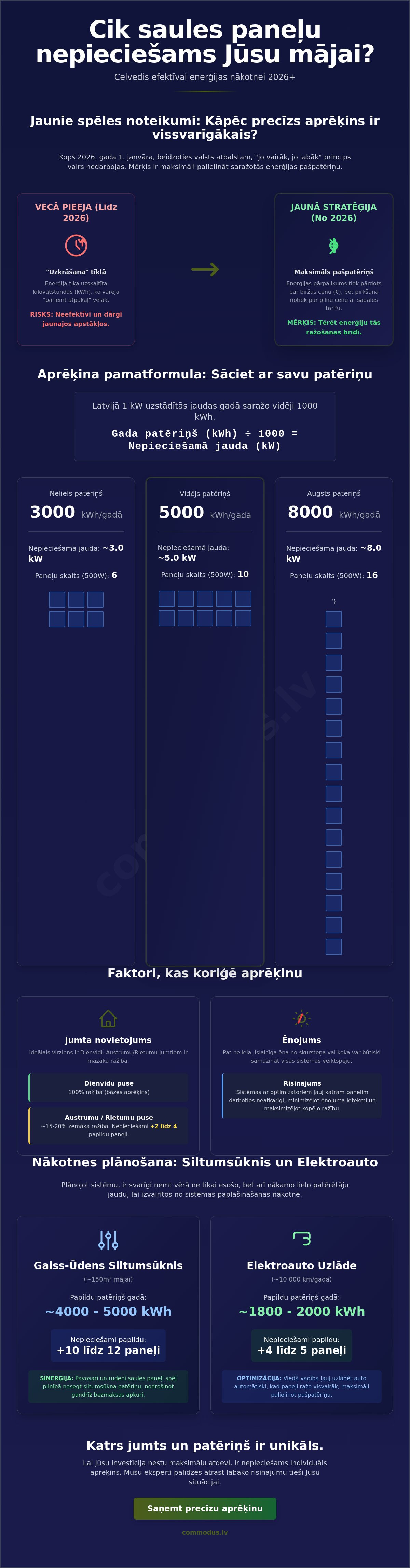
To understand how many solar panels a private home needs, you should start with a very simple basic formula. In Latvian conditions, each installed kilowatt (kW) of capacity produces an average of 950 to 1050 kilowatt-hours (kWh) per year. This means the goal is to match total annual consumption with the system's total capacity in order to cover your needs as efficiently as possible.
Today, we most often use panels with 450W or 500W output. The calculation is logical: annual consumption is divided by 1000 to obtain the required number of kW, and then that number is divided by the output of one panel. Below is an example of how the required volume changes depending on consumption when using 500W panels:
| Annual consumption (kWh) | System capacity (kW) | Number of panels (500W) |
|---|---|---|
| 3000 kWh | ~3.0 kW | 6 panels |
| 5000 kWh | ~5.0 kW | 10 panels |
| 8000 kWh | ~8.0 kW | 16 panels |
How roof specifics adjust the number of panels
The south-facing side is ideal, but not every home has such an orientation. If you plan to install panels on east- or west-facing planes, you should expect approximately 15% to 20% lower production. This means you will need 2 to 4 more panels to achieve the same result than on a south-facing roof. To obtain more accurate data for your location, the PVWatts calculator is a useful tool that helps model solar radiation at your exact coordinates.
Shading must also be taken into account. Even the shadow of a small chimney or a neighbor's tree can significantly reduce the efficiency of an entire row. If your roof has a complex shape or is affected by shadows, we recommend choosing optimized solutions. Our solar panel kits are configured to ensure maximum output even in imperfect conditions, helping you avoid overpaying for unnecessary capacity and gain clear peace of mind.
Heat pump and electric car: how do the calculations change?
When planning how many solar panels a private home needs, we can no longer look only at historical electricity bills. A modern home has become a small energy hub where powerful equipment plays the main role. If your plans include an air-to-water heat pump, it will be your biggest ally in the fight for lower costs. On average, such a unit for a 150-square-meter home consumes around 4000 to 5000 kWh per year for heating and hot water. To cover this consumption with self-generated energy, the system will need approximately 10 to 12 additional panels beyond the base calculation.
The situation is similar with charging an electric car at home. If you drive around 10,000 kilometers per year, charging will require another approximately 1800 to 2000 kWh. That means 4 to 5 additional panels. To accurately calculate the number of solar panels for such a complex system, it is important to think about smart control devices. They automatically direct solar power to the heat pump or car charger exactly when the panels are producing the most. This approach maximizes self-consumption, which is the most important factor in the 2026 net billing system.
The synergy between a heat pump and solar panels
This combination is especially beneficial in autumn and spring, which we often call the "shoulder seasons". In March and April, when the sun is already shining brightly but it is still cool outside, solar panels can fully support heat pump operation throughout the day. By using our solar panel kits, you effectively extend the free heating season by several months. This is one of the main reasons why heat pump owners in particular see the fastest return on investment. If you want to learn more about how these technologies work together for your benefit, review the air-to-water heat pumps we offer and their integration options.
Next steps: from calculation to installation
Once you have gained an approximate understanding of how many solar panels a private home needs, it is time to move from theory to practical work. Although formulas provide a good starting point, online calculators cannot assess the load-bearing capacity of your roof structure or the technical condition of the electrical grid. A professional engineering survey is a critical step to make sure the selected system will operate safely and efficiently for the next 25 years, so we always recommend starting with a specialist visit to the site.
In 2026, state support remains an important driver of energy independence. Programs administered by Altum and the Environmental Investment Fund are available until December 31, 2029, or until funding runs out. Particularly encouraging news applies to "Latvijas Goda ģimenes", for whom the support intensity has increased to up to 85% of eligible costs since May 2026. This significantly reduces the initial investment and makes solar energy more accessible than ever before.
At Commodus, we take care of the entire bureaucratic process. We help prepare applications for state support, coordinate the project with "Sadales tīkls", and ensure that your connection meets all the latest safety requirements. Our service does not end when the last screw is tightened; we also provide regular maintenance and monitoring so you can enjoy peace of mind and see real savings in your bills.
How can you receive state support for solar panels?
To qualify for co-financing, homeowners must observe several important conditions that affect how many solar panels a private home needs and how they must be paid for:
- Certified installer: Support can be received only if the system is installed by a company with the appropriate certificates. Our experience shows that this is the main prerequisite for successful application approval.
- System proportionality: The installed capacity must be justified by the home's self-consumption so that state support is used efficiently.
- Ownership: The building must have been commissioned, and the application can be submitted by a natural person who is the owner or co-owner.
By choosing to work with us, you gain not only technical execution, but also a reliable partner throughout the process. We know every turn of the bureaucracy and help you get through it quickly so solar energy can start working in your home as soon as possible, creating a cozy and secure atmosphere for your family.
Start your journey toward an energy-efficient future today
An accurate calculation of how many solar panels a private home needs is the first and most important step toward a home that can take care of itself. In 2026, we can no longer afford to rely on guesswork, because the new net billing system and changes in state support programs require engineering precision. A successful system is based on a smart balance between your immediate self-consumption and capacity planning, especially if a heat pump or electric car charging station operates at home.
Our team, with more than 14 years of experience in energy-efficient solutions, is ready to become your trusted partner on this journey. Commodus certified installation specialists work throughout Latvia, offering a full service that includes both project development and assistance in receiving state support. It is important to us that you feel confident about your choice, so we do not only install equipment; we also help create a cozy and economically sound living environment for the long term.
Receive a free solar panel capacity calculation from Commodus experts and start enjoying energy independence this season. We will be by your side so every hour of sunlight works for your family and provides genuine peace of mind.
Frequently asked questions about solar panels
How many solar panels does a 100-square-meter home need?
On average, a 100-square-meter home needs 6 to 10 solar panels, but the exact number depends on your electricity consumption, not only on the floor area. If an air-to-water heat pump or air conditioner is used in the home, the number of panels may increase to 14 or more. It is important to evaluate your total annual consumption in kilowatt-hours so the system is economically justified and efficiently covers daily needs.
Will solar panels produce enough electricity in winter?
In the winter months, solar panel production in Latvia is significantly lower, providing only about 10% of the total annual volume. The most active production period in our latitude is from March to October. Although panels will not fully cover all home needs in winter, the new net billing system allows the surplus produced in summer to be converted into monetary value that can be used to cover winter bills, thereby smoothing costs across the whole year.
How long does it take for a solar panel system for a private home to pay back?
The payback period for a solar panel system in a private home is usually 6 to 9 years, but with state support programs this period may be even shorter. The main factor influencing payback is immediate self-consumption. The more energy you use at the moment it is generated, the faster the investment will repay itself. An accurate calculation of how many solar panels a private home needs helps avoid overpaying for unnecessary capacity and ensures a faster return.
Do I need batteries together with solar panels?
Batteries are not a mandatory requirement, but in the 2026 net billing system they become a very valuable addition to energy independence. A battery system allows you to store energy generated during the day and use it in the evening when the sun is no longer shining, increasing self-consumption to as much as 70% or more. This provides greater security against grid tariff fluctuations and improves the overall efficiency of the entire system, especially in households that use most of their energy in the mornings and evenings.
What is the maximum number of panels that may be installed for a private home?
For private homes, the maximum number of panels is usually limited by available roof area and the microgeneration connection capacity, which for households is often up to 11.1 kW. This corresponds to approximately 22 to 24 modern 500W panels. If you plan to install a larger system, additional approvals from AS Sadales tīkls and possible reconstruction of the electrical grid will be required. That is why it is always worth starting with an engineering survey to determine the optimal option for your property.
Comments