Heat Pump for a New Build: How to Choose the Most Efficient Heating Solution in 2026
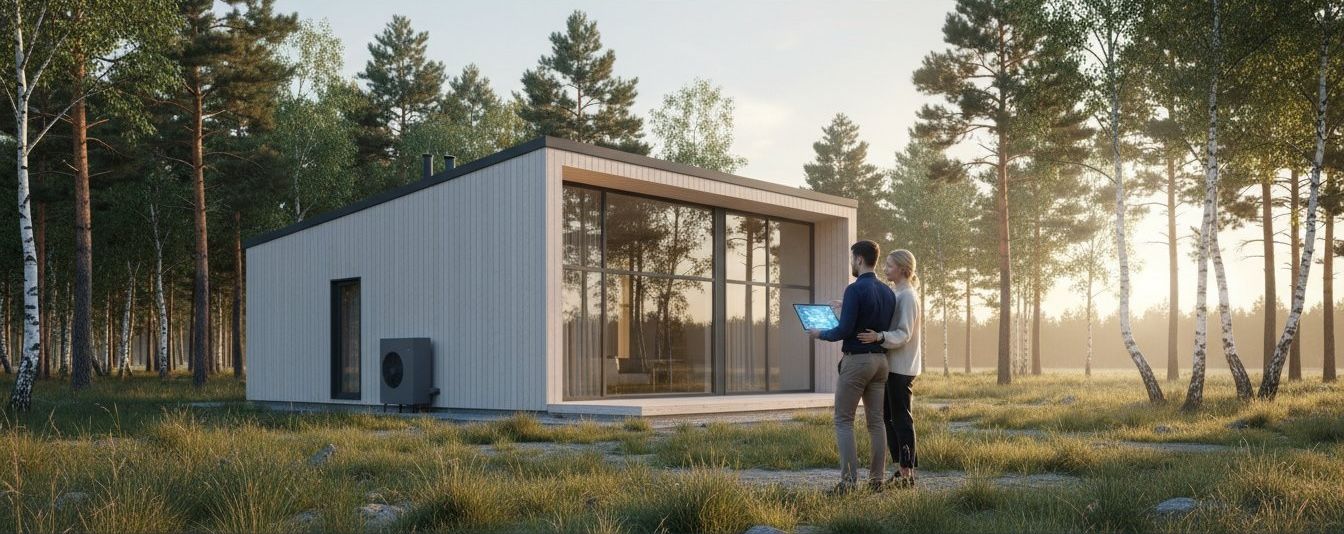
A heat pump for a new build is no longer just a modern alternative to traditional heating methods; it is the central element of a smart, independent home energy ecosystem that should be planned from the very first architectural sketch. With the new energy efficiency requirements that came into force in Latvia in May 2026, efficient heating has become a mandatory standard for every new building. We know that future homeowners often feel overwhelmed by technical terms and worry about the system's capacity on the harshest winter nights. These concerns are justified, because building a home is a major and emotional step where every technical decision affects your family's comfort and peace of mind for the long term.
In this article, we will help you gain clarity and understand why a heat pump is the most forward-looking choice for a new home, as well as how to plan the system correctly for maximum energy efficiency. We will review the key differences between air and ground source systems so you can make the decision that suits you best. You will also learn about the current state support opportunities from the Modernisation Fund, which in spring 2026 offers substantial support for renewable energy equipment. You will see how our team's expertise can turn complex engineering questions into clear and reliable solutions that will serve you for decades.
Why is a heat pump for a new build the standard choice in 2026?
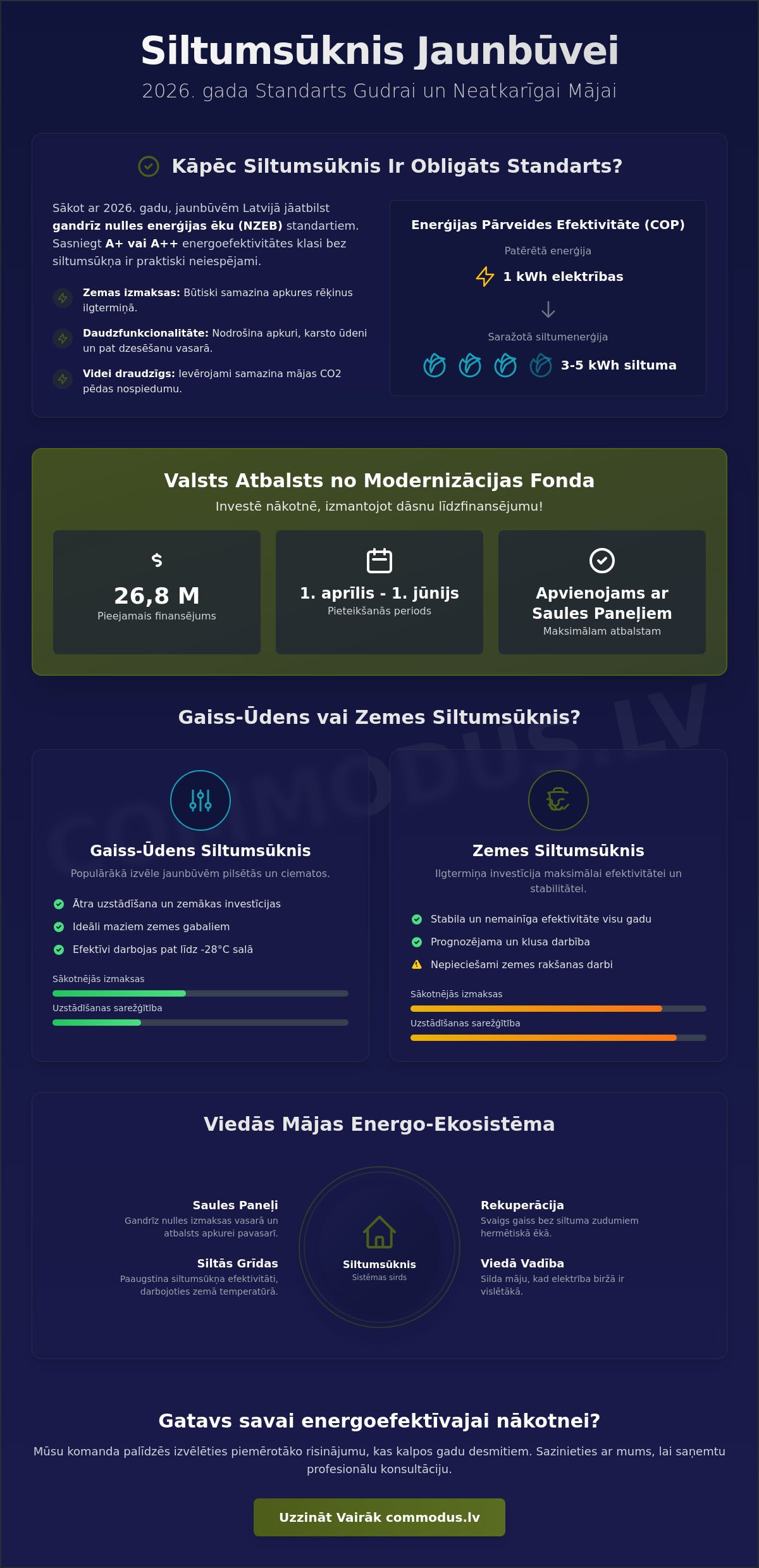
When planning a home in 2026, the question is no longer whether this technology is needed, but which heat pump for a new build will best fit your lifestyle. Latvia's new building standards now strictly require nearly zero-energy building (NZEB) performance. Achieving an A+ or A++ energy efficiency class without this type of solution is practically impossible. A heat pump is not simply a heating appliance; it is an intelligent unit that efficiently converts ambient energy into heat. Once you understand the operating principles of a heat pump, it becomes clear why this system can produce several kilowatt-hours of heat for every unit of electricity consumed.
Low operating costs are only one of the benefits. By choosing this solution, you directly reduce your home's CO2 emissions. Modern units are multifunctional. They take care of underfloor heating in winter, provide domestic hot water, and offer pleasant cooling on hot summer afternoons. That means fewer unnecessary devices and simpler control of your home's engineering systems.
The role of heat loss calculation in capacity selection
Modern new builds are exceptionally well insulated. This means you do not need a huge, oversized heat pump for a new build. If the unit is too large, so-called cycling begins. This means switching on and off too frequently, which wastes electricity and damages the compressor. We always recommend starting with an accurate design. It helps select the optimal capacity that will operate steadily and quietly even in -25 degree frost.
State support and financing for new projects
2026 is the right time to act, because significant support is available from the Modernisation Fund. The application period runs from 1 April to 1 June, and the available funding totals 26.8 million euros. Support intensity for new projects can be very generous, especially if you plan to combine heating with solar panels. This investment immediately increases the market value of the building. It also provides confidence that your home will remain desirable and inexpensive to maintain even ten years from now.
Air-to-water versus ground source heat pump: which is better for your new build?
When choosing which heat pump for a new build is right, homeowners often hesitate between the two most popular systems. The decision is not only about numbers. It is about the possibilities of your land plot and long-term comfort. Modern technologies have proven that a heat pump is an exceptionally energy-efficient heating solution that can significantly reduce home maintenance costs. In our daily work, our team sees that the right choice starts with an objective assessment of the situation. As our installation managers often say: "The choice is determined not only by efficiency, but also by the geology of the land plot and the planned budget."
Advantages of air-to-water heat pumps in Latvia's climate
This solution has become the most requested choice for new builds in towns and villages. The main reason is fast installation and comparatively lower initial investment. Modern air-to-water heat pumps have made a huge technological leap. They can heat a home reliably even when it is -28°C outside. You do not need to dig up the garden or carry out expensive boreholes. This is especially important on small building plots where every square metre is valuable.
A ground source heat pump as a long-term investment
If you own a spacious plot of land, a ground source heat pump can be an excellent choice. Its greatest advantage is a stable COP coefficient. The ground temperature several metres below the surface does not change even in the harshest winter. This means the unit works steadily and predictably. However, you should account for excavation work that will affect garden landscaping. If you do not want to install a horizontal collector, you can choose a vertical borehole, which is a more expensive but more compact solution.
It is also important to think through the unit's placement in the design. The outdoor unit must not disturb neighbours or spoil the aesthetics of the building facade. We always help find a location where the noise level will be minimal and the unit will not draw attention. To find the best option for your home, we invite you to explore our heat pump range and consult our specialists.
Engineering system synergy: underfloor heating, solar panels, and heat recovery ventilation
A modern new build is like a precise mechanism where every engineering system affects the overall result. A heat pump for a new build reveals its full potential when it works in tandem with a low-temperature heating system. The most efficient solution in this respect is underfloor heating. It allows the unit to operate with a lower flow temperature, which directly reduces electricity bills and extends the compressor's service life. Reports by the International Energy Agency on the future of heat pumps clearly point to smart control as the next step. We offer systems that can be synchronised with electricity exchange prices. This means your home "charges" heat during the hours when electricity is cheapest.
To achieve maximum independence, installing solar panel kits is an excellent choice. In summer, they fully cover domestic hot water preparation and cooling costs. On sunny spring days, the panels also make a meaningful contribution to heating, turning your home into an almost self-sufficient energy ecosystem. It is a forward-looking investment that pays back with every sunny hour.
Heat recovery ventilation and air quality in a new build
New homes are highly airtight, so a heat recovery ventilation system is no longer a luxury but a necessity for a healthy microclimate. It provides fresh air without heat losses by recovering up to 90% of the energy from extracted air. This significantly reduces the load on the heat pump. It does not need to spend huge amounts of energy heating icy outdoor air that would otherwise enter through simple ventilation vents or gaps around windows.
Domestic hot water preparation
For a family of four, we usually recommend heat pumps with an integrated 180 to 200 litre tank. This is a compact solution that takes up little space in the technical room and looks like a neat refrigerator. If your family is larger or you plan a large bathtub, it is better to choose a separate boiler with a larger volume. Modern units also automatically perform legionella protection cycles. They regularly raise the temperature in the tank so you can be completely confident about water quality and your family's health.
Would you like to know how to combine these systems in the best way for your specific project? Book a consultation and view our range of heat recovery ventilation units and heat pumps.
Why choose Commodus for heat pump installation?
When choosing a partner to build the engineering systems for your dream home, trust and real experience matter most. We, the Commodus team, have been working in this industry since 2010. During that time, we have helped hundreds of families settle into their new homes by providing a full-service cycle. This means we are with you from the first consultation and design stage through to commissioning the unit and maintaining it later. We speak with our clients as equal partners, emphasising human responsiveness and availability at every stage of the project.
A heat pump for a new build is a technologically complex system whose correct operation depends on the precise installation of every detail. That is why our technical support and branches are available throughout Latvia, ensuring that a technician can be reached when needed. We do not select the most expensive solution, but the optimal capacity and brand that best match your building's specific characteristics and planned budget.
Design and site inspection
Our engineers never prepare an offer without careful analysis. Every project begins with detailed capacity calculations, taking into account the building's insulation indicators and your family's habits. We are happy to work with your home architect already at the planning stage. This allows the heating system to be integrated into the building so organically that technical units do not take up unnecessary space and operate with maximum performance. This approach prevents mistakes that could become expensive later.
Warranty and long-term service
Installing the equipment is only the beginning of our cooperation. We believe that regular maintenance is the key prerequisite for system longevity and sustained efficiency over many years. The Commodus team is known for its responsiveness and ability to find solutions even in complex situations. Our specialists regularly update their knowledge with leading manufacturers. You can be sure that your home's heat is entrusted to knowledgeable technicians who care about your comfort and long-term peace of mind.
Let us create a warm and energy-efficient future in your new home today
By choosing the most suitable heating system, you invest not only in equipment, but also in your family's comfort and financial stability for decades. In 2026, a heat pump for a new build has become an undisputed standard that allows you to achieve the highest energy efficiency classes and significantly reduce maintenance costs. Remember that the best result comes from a well-planned synergy of engineering systems, where heating, ventilation, and solar energy work as one smart ecosystem.
We are ready to become your trusted guide in this process. With more than 15 years of experience in the Latvian market and hundreds of successfully installed CTC and other leading-brand heat pumps, our team will ensure the highest quality at every stage. We do not only install equipment; we also take full responsibility for its maintenance and service throughout Latvia, giving you peace of mind in any weather.
Contact Commodus experts and receive an individual heating solution for your new build!
May your new home always be a place of warmth, calm, and modern comfort. We will be happy to help you make it happen!
Frequently asked questions about heat pumps in new builds
Will a heat pump be able to heat a new build even in a very harsh winter?
Yes, modern units are specially designed for northern climates and provide stable warmth even at -25°C or -30°C. Because new builds are constructed according to high energy efficiency standards, heat losses are minimal and the system works without overload. If extreme frost sets in, the integrated backup electric heater automatically helps maintain the required temperature. This guarantees that your family will feel comfortable and safe in any weather.
How much space does the indoor heat pump unit take up in a new build?
An indoor unit with an integrated hot water tank usually takes up no more space than a standard refrigerator, approximately 60x60 centimetres on the floor. It is a compact and visually aesthetic solution that can be easily integrated into a technical room or utility room. If you choose a system with a separate boiler, a little more space will be needed for pipework and the additional tank, so it is advisable to coordinate the room layout with our engineers in good time.
At what construction stage should heat pump installation be planned?
Ideally, a heat pump for a new build should be planned already at the architectural design stage, before the foundations are poured. This makes it possible to provide all necessary engineering connections, the outdoor unit location, and the technical room dimensions in good time. Early planning helps avoid unnecessary costs for rebuilding structures at later stages. We recommend contacting us as soon as you receive the first house sketch so the system can be integrated as efficiently as possible.
Is a heat pump suitable if the new build will not have underfloor heating but radiators instead?
Yes, a heat pump can also be used with radiators, but for the best efficiency it is advisable to choose low-temperature radiators with a larger surface area. Standard radiators usually require a higher flow temperature, which can slightly reduce the overall system efficiency compared with underfloor heating. Our engineers will help carry out accurate calculations to choose the radiator type and quantity that will provide pleasant warmth and economical operation in your new home.
How much electricity does a heat pump consume in a 150m2 new build?
The average electricity consumption for a 150 square metre, well-insulated new build is approximately 3,000 to 3,500 kWh per season. Exact consumption depends on the heat pump for a new build model you choose, the set indoor temperature, and domestic hot water usage habits. These data are based on real observations in Latvia's climate. By combining the system with solar panels, these costs can be reduced even further, bringing your home closer to complete energy independence.
Comments