How to Reduce Heat Pump Electricity Consumption: A Practical Guide for 2026

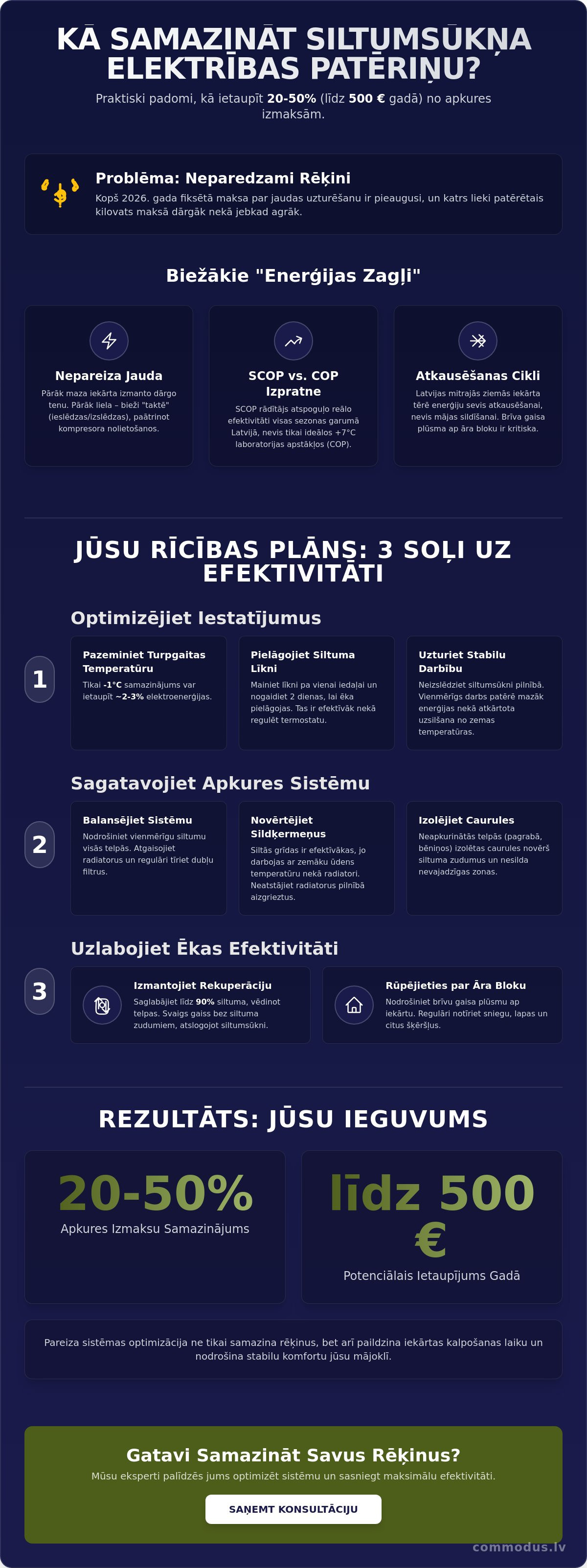
Did you know that since 1 January 2026, when state support for distribution tariffs ended, the fixed fee for capacity maintenance has increased for many households by up to €3.50 per month? This means that every unnecessary kilowatt consumed today costs more than it did last year. We at the Commodus team know all too well that uncomfortable feeling when bills become unpredictable in cold months, and complicated control panels leave you feeling helpless. The fear of breaking something by changing settings often holds people back from acting, but sitting idle is no longer affordable.
In this article, we will show you how to reduce heat pump electricity consumption without losing an ounce of warmth in your home. Together we will tackle this challenge and look at practical steps for saving 20 to 50% on heating costs through proper planning and smart NordPool controllers – which over a year can amount to as much as €500. Find out how to optimise your system's operation and take advantage of the 2026 state support programmes to ensure stable and efficient heating in your home for the long term.
Why Does a Heat Pump Consume More Than Expected? The Basics of Efficiency
Often, after installing a modern heating system, homeowners expect miracles on their bills, but reality tends to surprise. If the unit is running at full power but there is a lack of heat, the problem is usually found in the fundamentals. It is not just a question of pressing the right button, but about how heat pump operating principles adapt to your home's specific characteristics and Latvia's unpredictable weather.
Incorrectly chosen output is a classic stumbling block. If the unit is too small, it will run continuously on cold nights, switching on the expensive electric heater. If it is too large, "cycling" begins – constant switching on and off. This not only wastes excess energy but also accelerates compressor wear. Therefore, the first step when thinking about how to reduce heat pump electricity consumption is a system audit and understanding how it operates under real conditions.
What is SCOP and Why is it More Important Than Regular COP?
COP (Coefficient of Performance) is a momentary indicator measured under ideal laboratory conditions, usually at +7 degrees. SCOP, on the other hand, shows the average efficiency over an entire season. In Latvia, where temperatures fluctuate from positive to deep negatives, SCOP is the only indicator that has practical significance. When the thermometer drops to -20 degrees outside, the efficiency of an air-to-water system can fall by up to three times. This happens because extracting heat from frozen air requires enormous energy, and it is precisely in these moments that the quality of the system's design becomes apparent.
Defrost Cycles – The Invisible Energy Consumer
Our damp winters are a real challenge for any heat pump. When air humidity is high and the temperature fluctuates around zero, the outdoor unit's heat exchanger quickly frosts over. The unit is forced to periodically reverse its direction of operation to defrost itself. During this time, rooms are not being heated, but the electricity meter keeps turning. To reduce the frequency of these cycles, ensure that no snow drifts, leaves or other obstacles have accumulated around the outdoor unit that would impede free airflow. The easier it is for the unit to "breathe", the less often it will need the energy-intensive defrost cycle.
Technical Settings: How to Optimise Heat Pump Operation?
Many homeowners make the mistake of thinking that a heat pump is like a regular hairdryer – you simply switch it on and it heats. In reality, smart settings are the main tool for how to reduce heat pump electricity consumption in the long term without losing home warmth. One of the most important parameters is the flow temperature. We at the Commodus team have observed that reducing it by just one degree can save approximately 2 to 3% of electricity. This is a simple way to significantly affect the bill, especially at a time when distribution tariffs are no longer subsidised.
We often say that a heat pump is like a marathon runner – it feels best working steadily and without sudden bursts. If you are unsure whether your current system is operating efficiently, it is worth looking at our air-to-water heat pumps, which are specially adapted to Latvia's variable conditions.
Step by Step: Setting the Heating Curve
The heating curve determines the relationship between outdoor air temperature and the water temperature supplied to your radiators or underfloor heating. For Latvia's climate, where the morning can start with frost but the afternoon already sees sunshine, an accurate curve is critical. If you feel that rooms are too warm, do not reduce the wall thermostat, but rather the curve itself in the unit's menu. This process requires patience. Reduce the curve by one unit and wait two days, as the building needs time to adapt to the new mode. Only in this way will you find the lowest possible temperature that still provides complete comfort.
Temperature Modes and Using Thermal Inertia
Never switch off the heat pump completely at night or when going to work. This is one of the most common mistakes. A heat pump consumes the most energy precisely when warming up, trying to recover lost degrees. Maintaining a stable temperature is much more efficient, as it uses the inertia of the building's structure. Proper heat pump maintenance and checking circulation pump modes will also help avoid situations where the unit operates with excess power. Make sure your smart thermostat is not in direct sunlight or in a draught, as this can provide false data and cause the system to consume unnecessary kilowatts.
Preparing the Building and Heating System for Maximum Savings
A heat pump is not separate from the building's structure – it is one complete organism. To understand how to reduce heat pump electricity consumption, you must start with the "circulation" of the heating system. Underfloor heating is the ideal partner for a heat pump, as it provides a large heating surface at a low temperature. Radiators, on the other hand, require a higher flow temperature, which makes the compressor work harder. If your home has radiators, make sure their thermostatic heads are not turned fully closed. This often achieves the opposite effect, as the system's overall flow decreases and the unit starts switching on and off more frequently, wasting resources unnecessarily.
Air exchange also plays a major role, as improper ventilation can eliminate any savings. Opening a window in winter literally throws heat out the vent. This is where a modern heat recovery system comes to the rescue, retaining up to 90% of heat while providing fresh air without heat losses. This directly reduces the load on your heat pump, as it does not have to repeatedly heat incoming cold air from scratch. Also pay attention to main pipes in the basement or attic. If they are not properly insulated, you are heating rooms where nobody lives.
Balancing the Heating System
If one room is hot but another is cold, the system is not balanced. This forces the heat pump to increase its output to "push" heat to the furthest point. Do not forget about regular radiator bleeding and cleaning mud filters. Even a small air bubble or a clogged filter can cause circulation pumps to consume more electricity to overcome resistance. We at the Commodus team always emphasise that system cleanliness is the first step towards a lower bill.
The Role of Buffer Tanks and Boilers
Hot water preparation is the second largest energy consumer in your home. Set the boiler heating times so that they do not coincide with the most intensive heating periods. Also reconsider Legionella prevention cycles. These are best carried out once a week, preferably at night when electricity prices are lower. If you are planning to upgrade your heating system, Commodus specialists will help you choose the most suitable heating solutions that will serve you for years.
Smart Management and Regular Maintenance with Commodus
Many homeowners focus only on the numbers on the display, forgetting that a heat pump is a mechanical device that requires physical care. Heat exchanger cleanliness is one of the most critical factors that we do not notice in daily life. If the outdoor unit's fins are clogged with dust, tree fluff or autumn leaves, the unit can no longer efficiently extract heat from the surrounding air. This forces the compressor to work at much higher output than necessary. Our experience shows that a dirty heat exchanger can increase electricity consumption by 10 to 15%, creating unnecessary expenses that could easily have been avoided. Therefore the question of how to reduce heat pump electricity consumption often starts not with settings, but with simple cleanliness.
Why Does Service Maintenance Pay Off Already in the First Season?
Commodus service engineers see daily how significantly maintenance affects system efficiency. During a professional inspection, we not only clean the filters but also check refrigerant pressure and electronic components. A real example from our practice: a client complained about unreasonably high bills, but it turned out that a clogged outdoor unit was causing the compressor to operate at maximum output even at moderate outdoor temperatures. After maintenance, the unit's efficiency immediately returned to normal levels. This is the challenge we tackle together – we provide technical excellence so that you can enjoy comfort without worry.
Smart Control and Using Exchange Electricity Prices
Modern technology offers yet another powerful tool for savings – smart monitoring and integration with electricity exchange prices. By setting the system to heat your home more intensively during hours when electricity is cheaper, you can significantly reduce overall costs. An even greater effect is provided by solar panel packages, which on sunny spring and autumn days can fully cover the heat pump's base consumption. If you are planning to install a new system, take a look at our air-to-water heat pump guide, where we have compiled all the necessary information about the most modern solutions on the Latvian market. We at the Commodus team are convinced that smart management and regular care of the unit is the only path to true energy efficiency.
Start Saving Today: Your Path to Efficient Heating
Heat pump efficiency is not a matter of chance, but a combination of thoughtful actions and technical knowledge. The main thing to remember is that even the most modern unit requires precise settings and regular care. By adjusting the heating curve to suit your home and keeping the system mechanically clean, you eliminate unnecessary energy waste, which in the changing tariff conditions of 2026 is more important than ever. Small changes today create large savings throughout the entire season.
We at the Commodus team are ready to tackle this challenge together with you, ensuring that your heating system operates with maximum output. With more than 15 years of experience in the Latvian market and certified engineers who understand the nuances of CTC and other leading brands, we offer a full service cycle from design to maintenance. Knowing how to reduce heat pump electricity consumption, you gain not only lower bills, but also peace of mind and confidence in stable warmth in your home for the long term.
Book a professional heat pump service with Commodus and start saving now!
May your home always be filled with cosiness, warmth and energy independence!
Frequently Asked Questions About Heat Pump Efficiency
Does Lowering the Heat Pump Temperature at Night Really Save Electricity?
In most cases, no, because a heat pump consumes the most energy when reheating the cooled building structure and furniture. Maintaining a stable temperature is the most effective way of how to reduce heat pump electricity consumption, as the unit can operate at low speeds with higher efficiency. Rapid fluctuations force the compressor to operate at maximum output, which often consumes more kilowatts than were "saved" during the night when the temperature was reduced.
How Often Should Heat Pump Maintenance Be Carried Out to Maintain Its Efficiency?
Professional maintenance should be carried out once a year, ideally before the start of the heating season in September or October. This ensures that all heat exchangers are clean, refrigerant pressure is correct and the system operates with the manufacturer's intended efficiency. Regular inspection allows you to notice small deviations in operation in time, which without maintenance could imperceptibly increase your bills throughout the entire winter by 10 to 15%.
Can Solar Panels in Winter Provide Enough Energy for a Heat Pump?
In winter months, solar panels cannot fully cover the heat pump's consumption due to the short daylight hours and low sun angle. However, they are an excellent support during transition periods – in spring and autumn when there is more sun but heating is still needed. The 2026 support programmes for installing solar panels and batteries help use this generated energy more wisely, reducing overall dependence on the grid and expensive tariffs.
What is the Optimal Flow Temperature for Underfloor Heating and Radiators?
For underfloor heating, the optimal temperature is usually in the range of 25 to 35 degrees, while for radiators it is 40 to 55 degrees. The lower this temperature, the higher the unit's efficiency coefficient and the lower the bill. Our engineers will help set up the system so that it operates at the lowest possible temperature that still provides full comfort in your home even at minus 20 degrees.
What Should You Do if a Heat Pump Starts Consuming an Unusually Large Amount of Electricity at Mild Frost?
First check whether the mud filters are clogged and whether the outdoor unit's heat exchanger is covered in dust or snow. If everything looks visually fine, it is possible that the bivalence point – the temperature at which the additional electric heater switches on – is set too high. In such cases it is better to schedule a visit from a specialist to precisely diagnose how to reduce heat pump electricity consumption and eliminate unnecessary operation of the electric heater when the unit could manage on its own.
Comments