Solar collectors or solar panels: which should you choose?
Did you know that the most expensive investment in your home is not the machine itself, but the unused energy that literally passes through your roof every day? Many Latvian hosts are rightly confused by trying to understand whether solar collectors or solar cells are the best solution, especially when hearing controversial stories about their effectiveness in our grey winters. Fear of being wrong with thousands of euro investments and confusion in technical details is perfectly understandable, as every home is unique.
We are here to help you see a clear picture and make the most energy efficient decision for your peace of mind. In this article you will find out the main differences between the two technologies and how to integrate them in practice with your existing heating system. We will also look at the current 2026 state aid programmes, which allow up to 70% of the costs to be covered, making green energy more accessible than ever. By reading this review, you will have in your hands specific criteria for making a choice to make your investment pay as quickly as possible and serve for decades.
Solar collectors or solar cells: Main differences
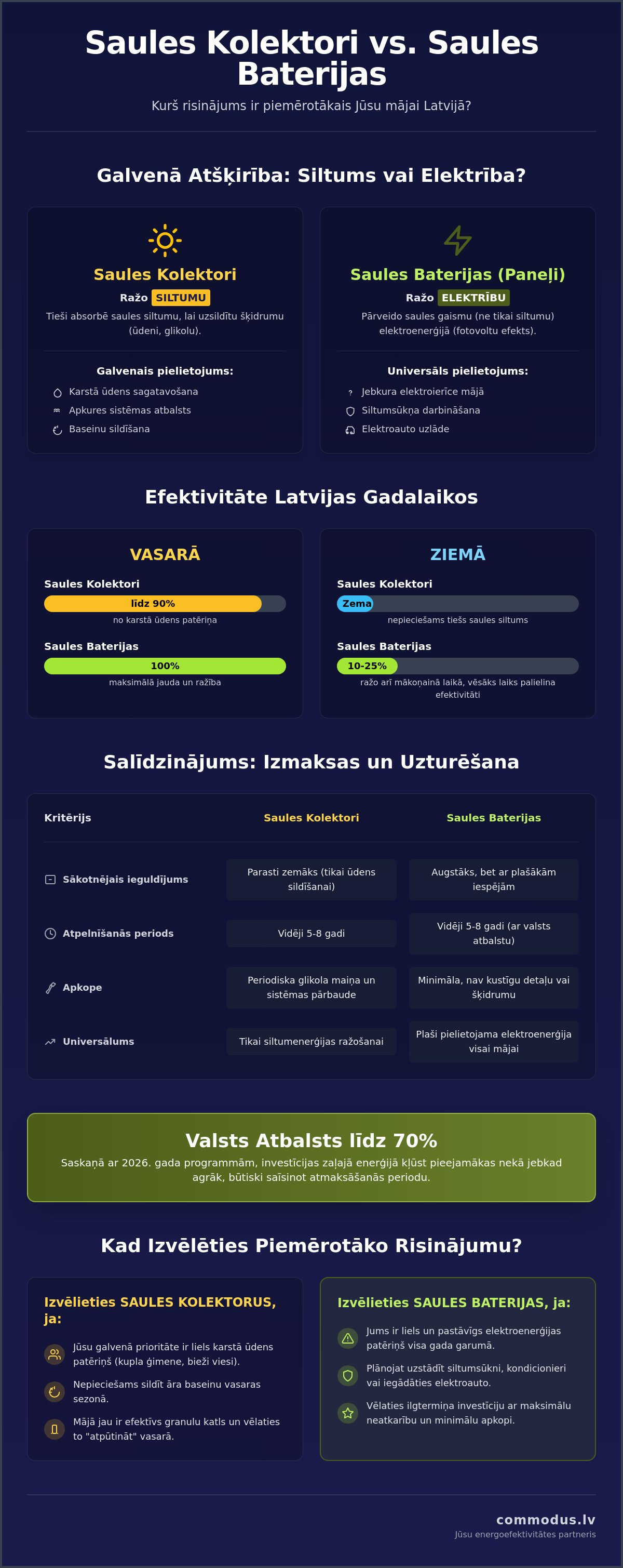
The biggest mistake made by home owners is that both solutions do the same. Not at all. The main choice you are facing is quite simple: do you need hot water or universal electricity as a priority? Solar collectors absorb solar heat directly to heat the liquid, while solar cells use light to generate current. in 2026 this choice, Solar collectors or solar cells, is even more pressing, as energy prices and state aid conditions require the search for solutions that pay the fastest.
The types of energy transformation determine how easy it will be to store the resulting resource. The heat generated by the collectors can only be stored in a storage tank, or boiler, and losses are inevitable. On the other hand, electricity produced by batteries can be consumed immediately, stored in modern batteries or even used to power CTC air-water heat pumps, thus converting current into heat only when really necessary.
What are solar collectors?
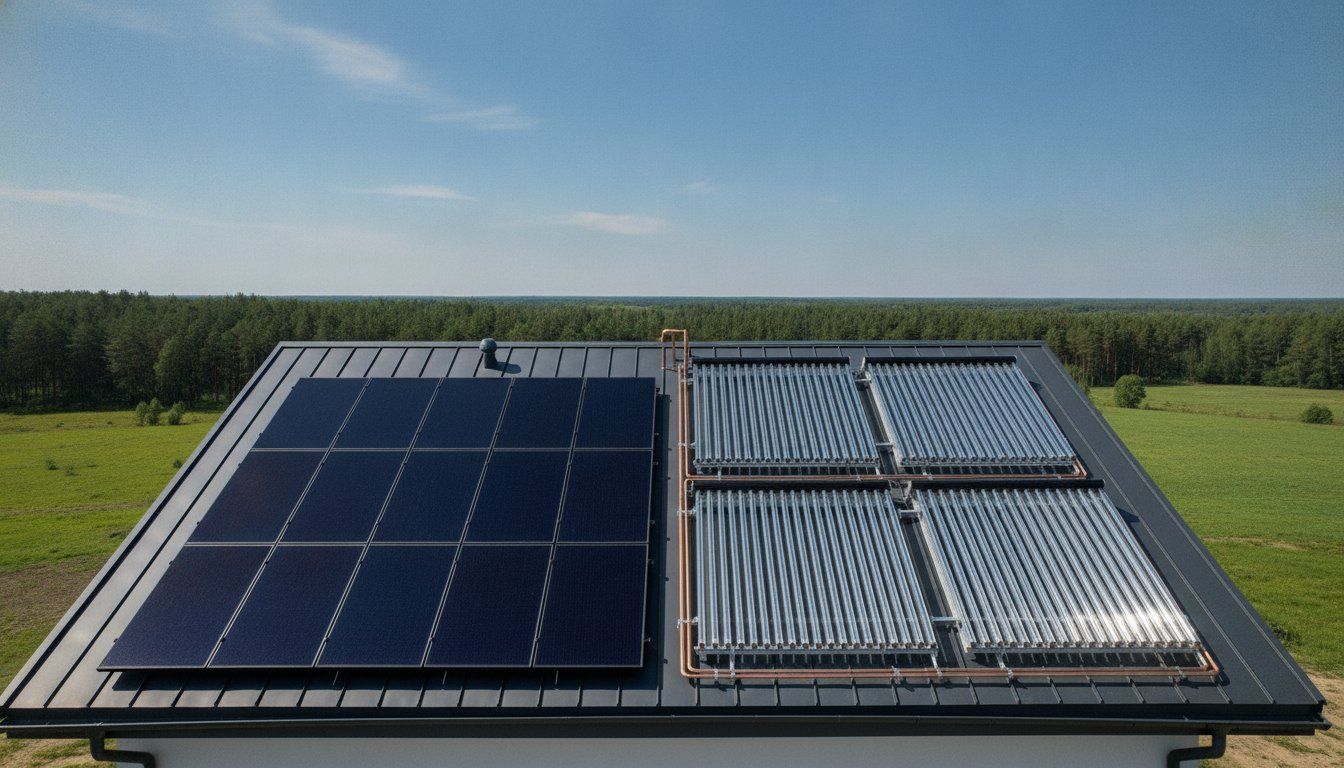
Solar collectors are high efficiency devices designed for direct heat generation. Their principle of operation is similar to that of a garden hose that heats up in the sun, only technically advanced to the maximum. In Latvia, vacuum pipes or flat collectors are the most commonly used. Their primary use is hot water preparation and support for heating or swimming pool heating.
- Summer: Collectors can cover up to 90% of the domestic hot water needs.
- In winter: Efficiency falls significantly because collectors need direct solar heat and not just light.
What are solar cells (panels)?
Here is a process called photovolt technology. Solar There are many differences, but PV panels have become the standard for private houses as they also produce currents in cloud time. The system consists of the panels themselves, an inverter that converts direct current into useful alternating current for us, and more and more often battery storage.
This is a universal solution. The electricity you produce can be used for lighting, electrical equipment or even charging an electric car. If your home is installed RTgasoline with smart control, solar power output can help optimise the operation of the whole system by reducing fuel consumption in spring and autumn months.
Comparison of efficiency and costs in Latvia
The amount of investment is the first measured by the landlords to plan the transition to renewable energy. Solar collectors usually require less initial investment if the aim is only to prepare hot water. However, solar panels offer a much wider range of options, as you can redirect the current you produce to any device in the house. In 2026, when State aid covers up to 70% of the purchase costs of equipment, the choice between Solar collectors or solar cells becomes a strategic decision for the next 25 years. Our experience shows that the payback period for both systems in Latvia is on average 5 to 8 years.
Maintenance requirements are an important factor that is often forgotten in the first conversation. Collector systems shall circulate glycol, which must be tested and modified every few years to ensure the system's longevity. Solar cells are more modest in this regard. They do not have moving parts or liquids, so maintenance is usually limited to remote monitoring of the inverter. Understanding main differences among these technologies, it becomes clear why modern households increasingly choose universal electricity.
Solar production cycle of the season
Latvia's climate is more grateful than it might seem at first glance. Even in cloud days, modern panels can produce between 10 and 25 percent of their nominal power. Interestingly, many do not know: solar cells work more efficiently in cool weather. Low air temperature improves semiconductor conductivity by preventing panels from overheating. The snow on a sloping roof usually does not last long, as the dark surface of the panels quickly warms up and contributes to its slipping. For collectors both winter months is a quieter period, because their operation requires direct solar heat, which in our latitudes in December and January is rare.
If you plan to combine the system with a new heating solution, we recommend evaluating how CTC air-water heat pumps can work in tandem with your chosen solution to maximise the energy you produce for your own consumption.
How to choose the most suitable solution for your home?
Choice between Solar collectors or solar cells is not just a technical question, it is a story about your family's everyday habits. The first step is a fair analysis of last year's bills. Where does most of your money go? If they are one hundred euros for electricity consumed by conditioners, computers and kitchen appliances, the answer will be one. If, on the other hand, the electricity bill is small, but the preparation of hot water requires huge resources, the direction may change. The roof area and orientation are also important. Collectors usually take less space, but they need a direct South side, while solar cells can also be efficiently placed on East and West slopes to provide energy in the morning and evening peak hours.
When to choose solar collectors?
This solution is ideal for homes where large families live or where guests are often welcomed. What is a solar collector? It is a machine that directly heats water, so it will be the best choice if your priority is pool heating or high consumption of hot water for showers and baths. If already installed in the house RTgasoline, collectors can perfectly complement the heating system in the summer season, allowing the boiler to fully relax and save the pellets.
When is solar cells the best investment?
For modern, electrified household batteries are unparalleled. They allow the use of the "Net billing system" by storing excess energy in the network or in modern batteries. This is particularly important if you plan to install or already use CTC heat pumps, because the current produced will directly act on your heating. In 2026 state aid programmes are particularly generous. Within the EQF, you can get up to €4,000 for panels and €2,500 for batteries, covering up to 70% of the costs. This support can reach up to 85% for the families of Latvian Honor.
Before you make a final decision, it is worth talking to the masters who will help to reconcile the new technology with your home's existing wiring and heating system. We invite you to contact our specialiststo jointly develop the energy efficiency plan that is best suited for your home and to calculate the exact return on investment.
Future solution: Synergies between solar panels and heat pumps
Today's energy world is changing rapidly. In 2026 we see a clear winner in terms of efficiency. While discussing whether to choose Solar collectors or solar cells, continues, more and more hosts understand that it is electricity generation that opens the door to complete independence. Our team sees how properly chosen Panels, panels, tiles and similar articles becomes a driving force for the entire home engineering system. By combining powerful panels with a heat pump, you not only produce currents, but also provide heating and cooling for your home, practically forgetting about monthly bills.
Smart leadership is the heart of this synergy. Automatic system optimization allows devices to "negotiate" each other. When the sun shines brightest, the heat pump increases its capacity to heat water or cool the rooms, storing the energy when the sun sets. Experience with Commodus shows that such a complex approach to energy efficiency is the safest way to peace of mind in the long term.
Air-water heat pumps and solar energy
Modern air water heat pump is the perfect partner for solar batteries. It is capable of efficiently converting each kilowatt-hour produced into heat. In the summer months, this combination becomes a real rescue. While the sun produces the maximum amount of energy, your heat pump provides conditioning for virtually free. This is an important advantage that is not provided by ordinary solar collectors whose functions are limited to water heating.
Why entrust design and assembly to professionals?
Proper capacity calculation is critical. Too small a system will not deliver the expected savings, but will increase investment payback times excessively. We provide a full service cycle. It starts with fair consultation and ends with regular MaintenanceTo make your equipment serve decades. We are not afraid of challenges, regardless of the scale of the project. Our goal is to create a cozy and safe atmosphere in every home of Latvia.
Are you ready to take the first step towards energy freedom? Contact Kommodus specialists for free consultation! We will help to assess the potential of your home and find a solution that best meets your family's needs and the state aid conditions of 2026.
Start your way to energy independence today
The choice between whether your home is more suitable Solar collectors or solar cells, is a long-term contribution to your comfort and financial stability. Remember that collectors are still unparalleled in the preparation of hot water, while solar cells offer universal power that is capable of running both household appliances and modern heat pumps. 2026 with generous state aid programmes is the right time to turn your home into an efficient and environmentally friendly energy plant.
We, Kommodus team, with more than 15 years of experience in the Latvian market, know that each project requires individual approach and precise calculations. Our certified assembly specialists throughout Latvia will only help to install equipment of tested manufacturers, such as CTC, RTB or Midea, ensuring quality that will serve for years. Apply for free energy efficiency consultation on Commodus homepage! Together we will find a solution that will save your money most and bring true peace of mind in the long term.
Frequently asked questions about solar solutions
Can solar collectors fully replace the boiler in winter?
No, solar collectors cannot completely replace the boiler in the winter conditions of Latvia. They serve as an excellent supplement that covers up to 90 percent of hot water needs during spring and summer months, but in December and January their efficiency is minimal. In winter, the main load will still be borne by your boiler or heat pump, so collectors are considered to be an ancillary system for reducing bills in the warm season.
What is the average payback time for solar cells in Latvia in 2026?
The average payback time for solar cells in Latvia is 5 to 8 years. Thanks to the 2026 State aid programmes covering up to 70 percent of the investment, this period has been considerably shorter than before. The exact time depends on the volume of your own consumption and how efficiently you use the current you produce right at the time of production, operating the most powerful electrical or heat pump.
Does the installation of solar panels require a building permit?
Private house owners usually do not need a classic building permit if the panels are installed on the roof and the bearing structures are not affected. However, connection to the Sadales network must be harmonised and a statement of intent must be submitted to the Construction Board. If you plan to place the system on the ground or the dwelling is located in the historical centre of the city, the rules can be stricter, so it is advisable to consult our specialists before starting work.
What happens to the energy produced by solar panels if it is not spent at once?
If the electricity produced is not consumed immediately, it may be stored in private batteries or transferred to a common network through a Net Accounting System. This allows for virtual storage and use of summer capacity in the darkest months. In assessing whether it is more appropriate to: Solar collectors or solar cellsThis flexibility in power storage is a significant advantage for battery systems, as heat energy from collectors cannot be stored for so long.
How often should solar collectors be maintained so that they do not freeze?
It is recommended that maintenance of the solar collector system, which includes a glycol density and pressure check, be performed every 2 to 3 years. Glycol protects the system from freezing even at a temperature of minus 30 degrees Fahrenheit [30 ° C], but over time it may lose its chemical properties. Regular checks ensure that the collectors will operate safely and will not cause emergency situations on the winter island, protecting your investment from damage.
Comments