Air-water or ground heat pump: Which one to choose for your house in 2026?
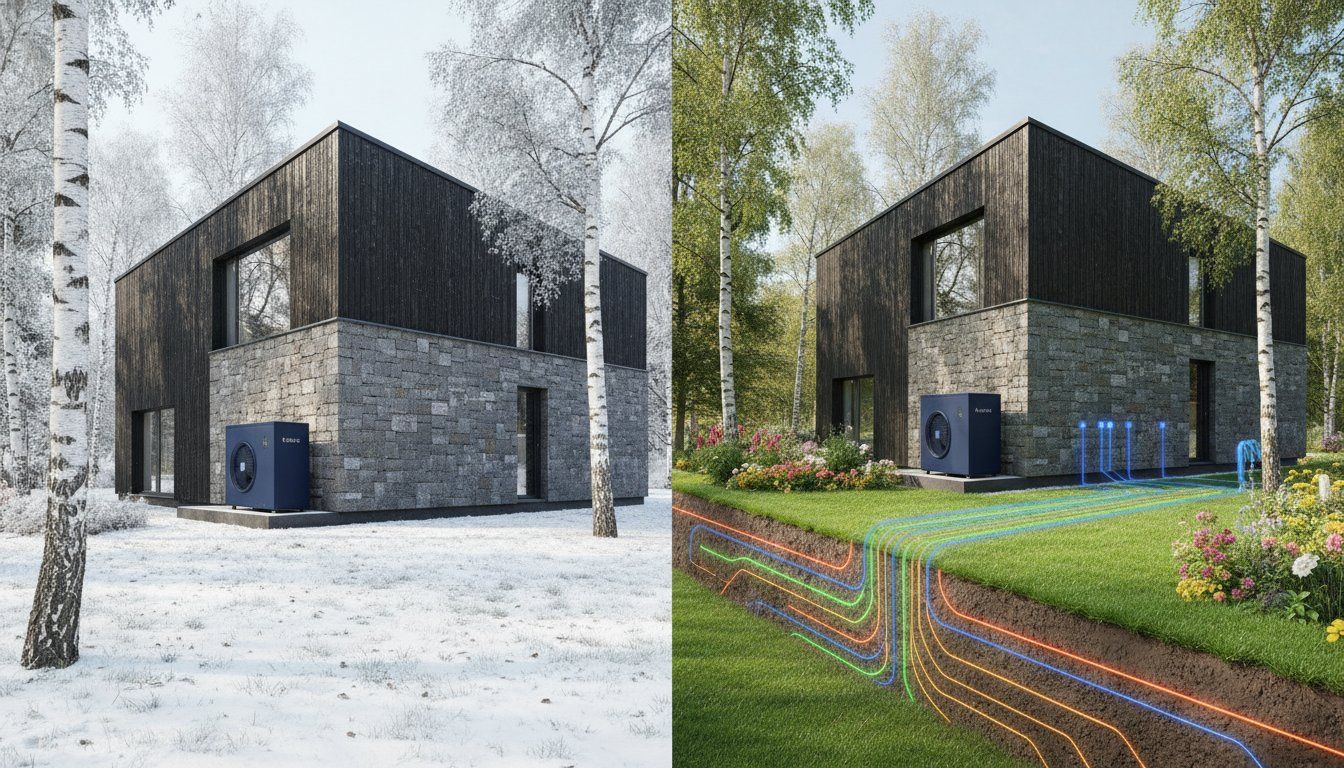
Did you know that in 2026 more than 65% of new homes in Latvia choose heat pump technologies to finally end unpredictable heating bills? air-water or ground heat pump, often depends not only on the budget, but also on your garden geology and long-term plans. We see that the owners are most concerned about two things on a daily basis: whether the heat will be enough at minus 30 degrees and whether the expensive installation is really worth it. It is a fully justified excitement when planning such a significant investment in their property.
We fully understand these concerns, because changing the heating system is a serious step towards home autonomy and comfort. This guide will help you understand the main differences between the two systems so that you can make a valid decision about the most energy efficient heating for your property. We will not only compare technical parameters, but also provide clarity on how modern equipment reaches the high SCOP score up to 4.8. In the article we will continue to look at the real payback period, the specifics of installation under the climate in Latvia and how to successfully use state support to recover up to half of the purchase costs.
Air-to-water and ground heat pumps basic differences
Choosing whether your house is more suitable air-water or ground heat pumpThe main difference lies in the energy source. The air-water system heat is obtained from the ambient air, while the ground heat pump uses stable temperatures at the bottom of the earth. This directly affects both the installation process and the system's longevity. In 2026, the technologies are so developed that both solutions provide excellent comfort, but their suitability depends on the area of your garden and the investment horizon.
- Mount speed: Air system installation takes an average of 2-3 working days. The ground heat pump takes several weeks, because it needs to coordinate the project and carry out extensive excavation or drilling works.
- Effects on garden: The outdoor block near the house wall is unobtrusive and does not require garden digging. The earth contour requires either a wide area of horizontal collector or special access to the technique to create a borehole.
- Service time: While air blocks work reliably for 15 to 20 years, the earth contour is investment for generations. The pipes in the land serve 50 years and longer, without changing their physical properties.
How does the air-water system work?
This technology is ideal for renovation projects and for dense urban construction. Even in severe cons modern equipment is able to efficiently obtain heat from outdoor air. The resulting heat is transferred to a water heating system by heating radiators or heated floors. CTC air-water heat pumps shows excellent efficiency even at -25°C temperature. This is an excellent solution if you want a quick result without major changes in the yard, keeping the heating costs low.
Principles for the operation of the ground heat pump
The ground heat pump works using a closed geothermal circuit. In winter, the land is considerably warmer than the air, so the system works with a constant high efficiency throughout the whole season. principles of heat pump operation, it becomes clear why the earth's systems are so stable and reliable. Heat transferor circulates through pipes in the ground, heats and transfers energy to the internal block that is integrated with the boiler and control unit. If the garden space is few, we recommend to choose a For a current exceeding 2 A but not exceeding 63 A, which allows access to the earth heat vertically without damaging the landscape.
Energy Efficiency and SCOP: Which Solution Is More Beneficial?
The selection of the heat pump often hears the terms COP and SCOP. COP describes the efficiency of the equipment at a certain point in time, whereas SCOP is a seasonal indicator that gives the true picture of the costs of the year. Air-to-water heat pumps The technological leap allows SCOP to reach 4.8. This means that on average, the system produces almost five times as much energy per season as it consumes from the grid.
Comparison of COP indicators under different circumstances
The heat pump is the champion of stability. Because the temperature in the ground is constant, it keeps the COP 4 to 5 even when snowfalls outside. The efficiency curve of the air heat pump is more variable. Although modern equipment reliably heats the house at -25°C, its efficiency increases as your property gets warmer. air-water or ground heat pump, it should be borne in mind that the ground system shows its superiority in extreme cons, when the temperature falls below -20°C.
Long-term operating costs
Real data show that 150 m2 of private house in Latvia consumes about 450 to 650 kWh of electricity for heating and water heating during winter months. In terms of maintenance, both systems are very grateful to require only one technical test per year. The refund period is influenced by the initial investment, which is higher for the land system, but its lowest energy consumption on colder days gradually compensates for it. For a more detailed analysis of how these costs are comparable to other heating types, see our article: Air-water heat pump vs gas boiler.
Our team will help you choose the most efficient heat pumpbased on accurate calculations for your home.
Installation specific: From garden area to boreholes
Deciding whether your property is better air-water or ground heat pump, is often accepted at the moment when we look at the courtyard plan. Horizontal land collector requires a significant free area, usually two to three times the heating area of the house. This means that 150 m2 of the house will require at least 300 to 450 m2 of land, where construction, paving or planting of large trees is not planned. In turn, the installation of an air heat pump is much simpler.
Impact of land works on improvement
If the garden area is limited, vertical depth is the ideal solution. This ensures maximum efficiency, with the exception of just a few square meters of surface area. When planning a horizontal collector, you have to consider the over-delaying of the garden. This is why the ground heat pump is best planned at the same time as the house's foundations. This will save time and resources at the expense of improvement. In the case of air systems, a small base for the outdoor block at the facade of the house is sufficient, which does not affect the existing greenery.
Design and coordination
The installation of ground heat pumps, especially deep drilling, requires careful design and coordination. Depending on the specifics of the project, acceptance from the local construction board or the State Environmental Service (LVD) may be required. In the practice of Kommodus we provide a full cycle, including engineering systems. Our specialists will help to navigate the bureaucratic grid so that the installation process is as clear and peaceful as possible.
If you are considering using the heat of the land, we recommend timely apply for deep-hole consultationto assess the suitability of your plot and the necessary reconciliations.

How to make the final decision? Step by step checklist
The final choice between whether your house is more suitable air-water or ground heat pumpFirst, assess the building's thermal insulation class and planned energy consumption. If the house is energy efficient, both options will provide excellent comfort. However, when assessing investment in a ten-year perspective, it is important to compare not only the installation bill, but also the expected savings and system longevity.
When to clearly choose the air-water system?
This solution is best if you have a small plot of land or a yard already well-maintained and do not want to convert it into a building site. It is also a sensible choice for renovation projects in an urban environment where, due to limited access, you cannot make boreholes. Air system installation is fast and lower initial costs allow you to achieve financial returns more quickly, while ensuring full automation and heat in any weather.
When is the ground heat pump the best investment?
Choosing whether you are better off air-water or ground heat pump, the ground solution wins if the house area exceeds 200 square meters or the family has a high consumption of hot water. It has a stable value with the highest efficiency, which does not change depending on the temperature of the air. If the construction is in the initial stage, the ingraining or drilling of the collector is easy to realise and becomes a smart investment for several generations.
In 2026 full energy independence is achievable by combining a heat pump with a set of solar panels. Such a system allows for the production of electricity itself, which is effectively converted into heat and hot water by the heat pump, practically excluding the impact of public utility bills on family budgets.
Contact Commodus specialists to apply for free consultation and for a survey of the object. We will help you make a balanced decision to keep your home warm, comfort and peace-of-peace economy.
Getting the way to energy freedom today
Choosing whether your property is more appropriate air-water or ground heat pumpWhile air systems win at the speed of installation, the ground heat pumps provide unparalleled stability and efficiency even in the harshest winter. By 2026, combining these technologies with solar panels, you not only reduce the bills, but also get true energy independence and peace of mind.
The team has more than 15 years of experience in heating solutions. We provide full service from the first project drawing to regular maintenance, and our certified assembly specialists work throughout Latvia. You do not have to go in the technical parameters for one because we address our clients as equal partners. Get free consultation and individual offer on Commodus website, so that together we find the most effective solution for your house. Your home deserves reliable heat and we are here to implement it professionally and sincerely.
Frequently Asked Questions
Is the ground heat pump really so much more efficient than the air-water system?
The ground heat pump is more efficient at low outdoor temperatures, as the ground temperature at 1.5 to 2 metres depth is stable. The air system's efficiency is reduced when it is a large frost. air-water or ground heat pump, it should be noted that 2026 technologies have significantly brought air systems into line with ground solutions, making the difference less than ever before.
What is the area of the horizontal collector?
The horizontal collector requires a spacious area, which is usually two to three times the area of the space to be heated. If your house is 150 square meters, at least 300 to 450 square metres of free land will be required. It is important that there should be no buildings, paved areas or large trees with deep roots; they prevent the natural warming of the earth from the sun and rain.
Can air-water heat pump heat the house at -25 degrees?
Yes, a modern air-water heat pump reliably heats the house also at -25 degrees. Modern equipment is equipped with inverter compressors and if necessary uses the built-in electric heating element to provide the necessary temperature. air-water or ground heat pump, it is to be assumed that electricity consumption will be higher at a large island, but comfort will remain constant.
How much does the ground heat pump bore cost?
The costs of the borehole depend on the depth required, geological conditions and materials used. As each project is individual and requires precise calculation of the civil engineering capacity, we do not name one fixed amount. The costs include drilling works, the installation of the probe, the laying and harmonization of the heat transferor. To find out the precise estimate of your property, we invite you to apply for specialist consultation and the observation of the object; we provide a full cycle from the project to the installation.
Can the heat pump be combined with existing radiators?
Heat pumps can be successfully combined with existing radiators, but the appropriate system capacity must be ensured. Heat pumps work most efficiently in low-temperature systems, for example, with warm floors. If the house has radiators, it may be necessary to increase their surface area or choose a more powerful device that can provide higher temperature of the incoming water. Our specialists will help to evaluate the existing system and recommend the best solution for effective operation.
Is there State aid available to both systems?
Yes, in 2026 state support for the purchase of both systems is available in Latvia. The programmes administered by Altum and the Environmental Investment Fund allow to recover up to 50% of the purchase costs of the equipment. To receive financing, the equipment must meet certain energy efficiency criteria and the installation must be performed by a certified merchant. We help customers to prepare all necessary documentation for the support, so that the transition to new heating is financially more advantageous.
Comments