Connecting a Heat Pump to Underfloor Heating: A Complete Guide to Efficient Heating in 2026
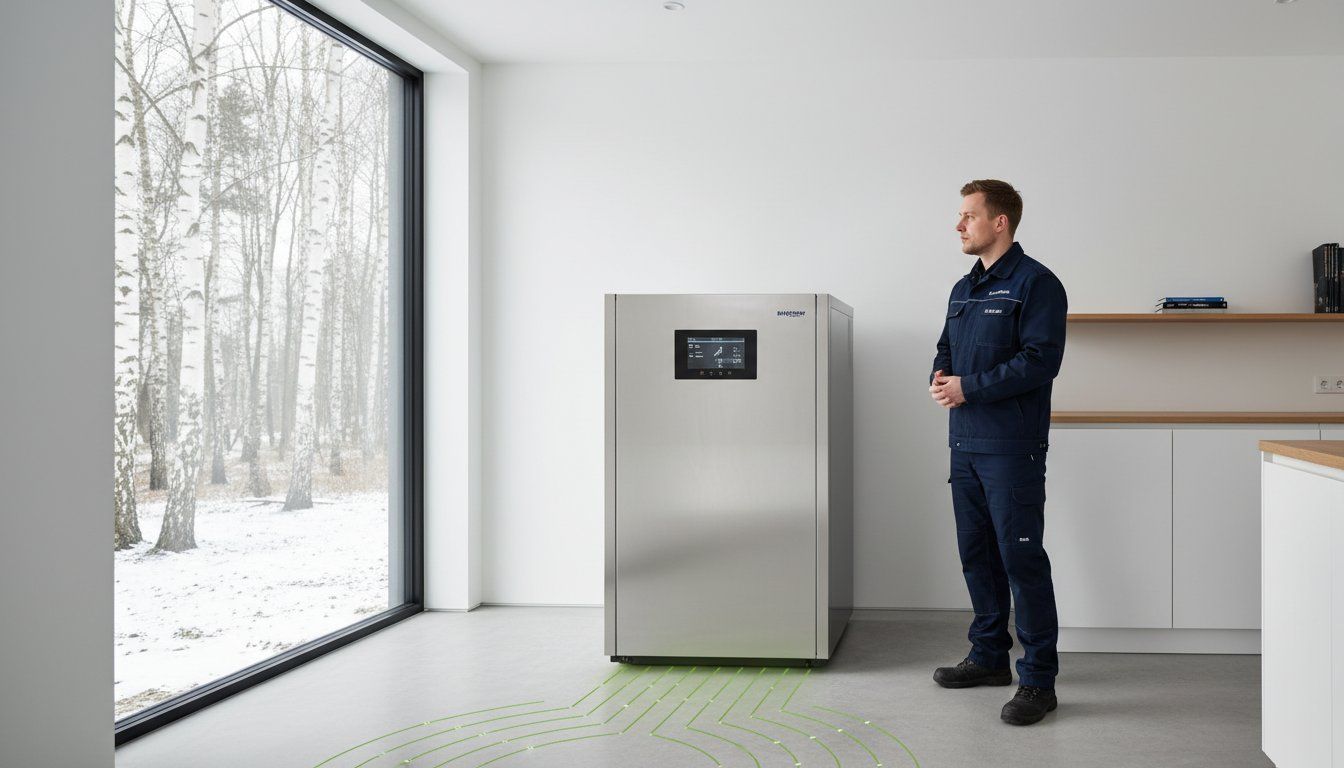
Did you know that even the most modern inverter-type heat pump can consume 30% more electricity if its hydraulic integration has been carried out imprecisely? Many homeowners are justifiably concerned that the complex process of connecting a heat pump to underfloor heating could result in a system that does not heat evenly or generates unexpectedly high costs. We at the Commodus team believe that everyone deserves a home where warmth is a given, and in this guide we share our experience to help you avoid mistakes and unnecessary stress.
You will certainly agree that the best heating system is one that works autonomously while you enjoy your leisure time or an active lifestyle. In this article we will look at how to correctly connect a heat pump to floor collectors to achieve maximum efficiency and ensure the unit pays for itself within 5 to 7 years. We will also explain why the EKII support programme available since 1 April 2026 is advantageous specifically for your project and how our joint efforts will ensure low costs and warm rooms even in the coldest winter months.
Key Takeaways
- Find out why low heat carrier temperatures provide the highest heat pump efficiency (COP) and how the floor's thermal inertia helps keep your home warm for longer.
- Discover how correct step-by-step connection of a heat pump to underfloor heating avoids unnecessary heat losses and ensures the system pays for itself within 5-7 years.
- Understand the importance of hydraulic balancing to maintain even heat in every room and allow the heating system to operate autonomously without your constant intervention.
- Identify the most common installation mistakes, such as insufficient pipe diameter or air locks, and learn practical ways to avoid them already in the design phase.
- Discover how an individual engineering approach helps adapt the heating system to Latvia's climate, guaranteeing peace of mind and low bills in the long term.
The Synergy of a Heat Pump and Underfloor Heating: Why is it the Best Choice for a Home?
The synergy of a heat pump and underfloor heating is not merely a term invented by engineers; it is a law of physics that allows your home to become a model of energy efficiency. In 2026, air-to-water systems have become the Latvian standard, as they provide independence from the volatile prices of fossil fuels. The main secret lies in the temperature difference. A heat pump works most efficiently when it does not have to expend enormous power to heat water to boiling point. This is precisely why connecting a heat pump to underfloor heating has become the most popular choice in new projects and renovation works where owners think about long-term benefits.
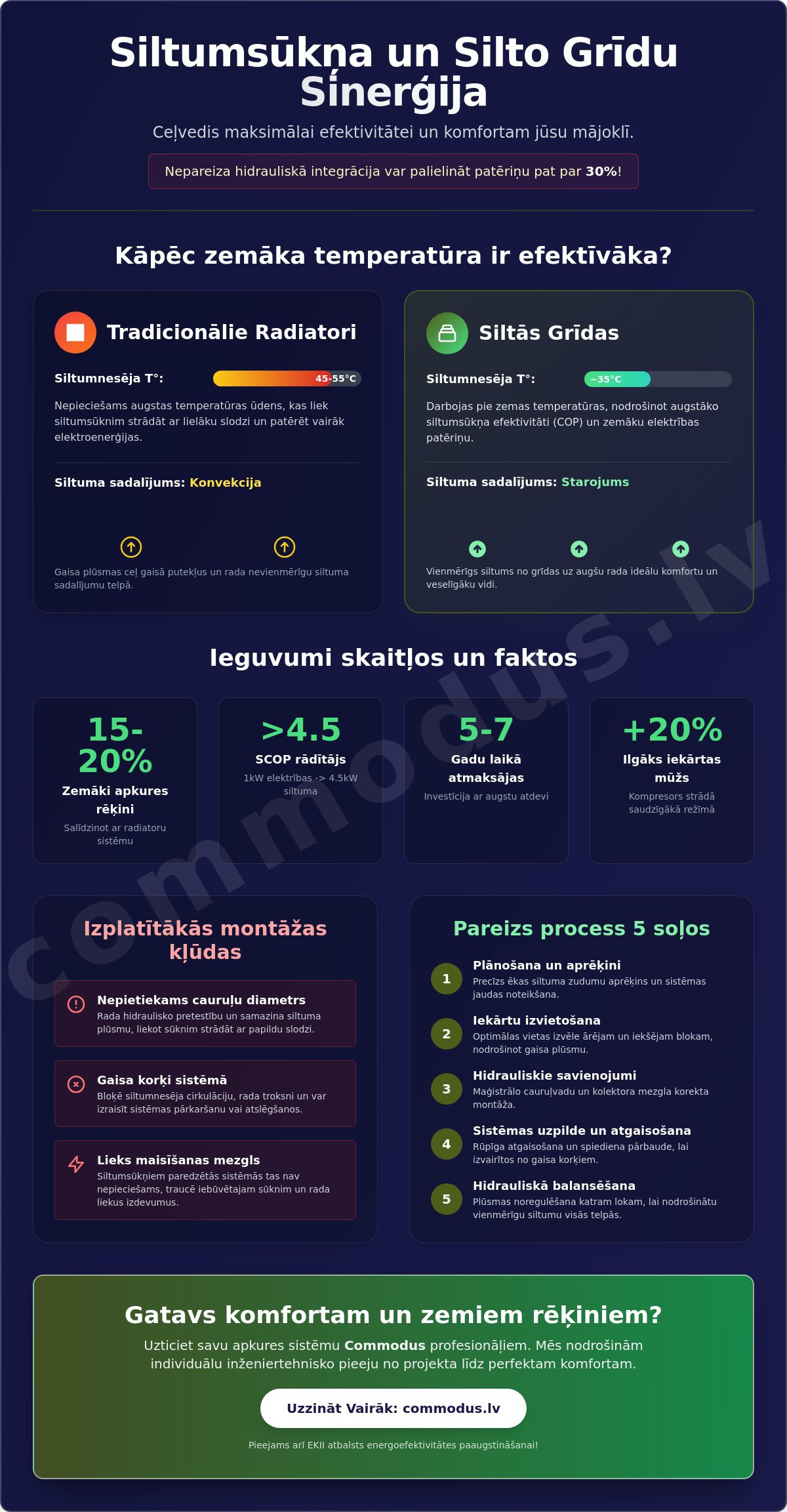
Unlike traditional radiators, which require hot water at 45 to 55 degrees, underfloor heating systems function perfectly at 35 degrees. This small difference significantly affects the unit's efficiency coefficient or COP. The lower the required flow temperature, the less electricity the compressor consumes to "transfer" heat from the outdoor air to your home. Furthermore, underfloor heating acts as a giant heat accumulator. Thanks to the thermal inertia of the pipes embedded in the concrete, the floor heats up more slowly but also releases heat for hours after the unit has switched off, providing a stable climate without temperature spikes.
Advantages of Low-Temperature Heating
By maintaining a flow temperature of around 35°C, we not only save money but also protect the equipment. The compressor's service life is extended by approximately 20%, as it does not have to operate at the limits of maximum output. In terms of comfort, underfloor heating is unrivalled. Heat rises from below, providing a pleasant sensation for the feet while the air at head level remains fresh and cooler. This is the physiologically most correct heat distribution in a room. Such a system also minimises dust circulation. Radiators create strong air flows or convection, which raises dust into the air; underfloor heating warms by radiation, creating a healthier environment for allergic people and children.
Economic Justification and SCOP Indicators
Numbers do not lie. Engineering calculations show that each degree of temperature above 35°C increases electricity consumption by approximately 2-3%. This means that by switching from radiators to underfloor heating, you can reduce your bill by 15-20%. The seasonal efficiency coefficient or SCOP in such systems often exceeds 4.5. This means that from one kilowatt of electricity consumed, you receive 4.5 kilowatts of heat. A correctly built system in Latvian conditions usually pays for itself within 5 to 7 years. Let us not forget that since 1 April 2026, the new EKII support programme has opened, which allows you to receive state co-financing for increasing energy efficiency. We at the Commodus team help push this challenge forward from the first consultation all the way to document submission, so that your investment is safe and well-considered.
Connecting a Heat Pump to Underfloor Heating: A Step-by-Step Process
Installing a heat pump is not just the mechanical placement of a unit on a wall. It is a precise engineering process in which every detail affects the system's longevity. Everything begins with careful planning. Before installation, we carry out a precise thermal output calculation, taking into account the building's heat losses and area. Equally important is the choice of location for the outdoor unit to ensure free airflow and avoid noise impact on neighbours or the bedroom windows. The indoor unit is usually located in a technical room, where the main pipework is installed between the heat pump and the collector cabinet.
Once the main nodes are in place, the electrical installation and control cable connections follow. Modern energy-efficient heat pumps require precise sensor placement so that the automation can respond to changes in outdoor temperature. After completing the hydraulic connections, the system is filled with treated water or heat carrier. At this stage, degassing and the initial pressure check are critical. Any air bubble in the system can create noise or even stop heat exchange. If you are planning your project, our specialists will help you choose the most suitable heat pumps and their accessories so that installation goes without a hitch.
Collector Node Configuration
A common mistake we see on sites is attempting to use the principles of old radiator systems. A heat pump does not require an additional mixing node with a pump at the collector if the system is designed exclusively for underfloor heating. An additional pump can even interfere with the operation of the heat pump's built-in circulation pump, creating unnecessary turbulence. Instead, we install precise flow meters or rotameters for each floor circuit. This allows the flow to be adjusted so that each room receives exactly as much heat as needed. The diameter of the main pipes must be sufficiently large (usually at least 28-35 mm) to ensure a large flow volume at low temperature.
The Role of Buffer Tanks and Accumulation
Many installers err by not including a buffer tank in the system, but connecting a heat pump to underfloor heating without one is risky. The buffer tank serves as an energy reserve during the defrost cycle. When the outdoor unit frosts over in winter, the heat pump reverses its direction of operation for a few minutes to defrost itself. This requires immediate heat from inside. If all the floor loops are closed with thermostatic heads at that moment, there may not be sufficient water volume in the system and the unit will stop with an error message.
We usually recommend a parallel connection that fully hydraulically separates the heat pump from the floor circuits. This prevents compressor "cycling" or too-frequent switching on and off, which is the main cause of premature wear. The minimum water volume in the system ensures smooth unit operation. It is like driving on a motorway with cruise control, rather than constantly pressing the accelerator and brakes in city traffic jams. This approach guarantees that your investment will work efficiently for decades.
Hydraulic Balancing and System Optimisation
Imagine this situation: the living room is so hot you want to open the window, but the children's room still requires a blanket. This is a classic sign that the system lacks hydraulic balancing. Many think that it is sufficient to simply switch the unit on, but connecting a heat pump to underfloor heating must be completed by adjusting each circuit individually. Balancing ensures that the heat carrier reaches the furthest corners of the house at the correct flow rate. Without it, the pump will waste extra energy trying to heat the "cold zones" while other rooms are overheated.
The circulation pump's output must be adapted to the longest floor circuit to overcome hydraulic resistance. Equally important is setting the heating curve. This determines how hot the water the pump prepares will be depending on the outdoor temperature. Modern heat pump systems are smart enough to automatically reduce output when it gets warmer outside, thereby protecting the compressor from unnecessary switching cycles. A properly balanced system works evenly, which directly extends the service life of the expensive compressor by at least 15-20%.
Smart Control and Automation
Latvia's weather conditions are unpredictable; mornings can be below zero while afternoon sunshine already warms the windows. In 2026, smart control is no longer a luxury but a necessity. By integrating room thermostats with the heat pump's control unit, the system responds to the microclimate of each room. Through a smartphone app, you can not only monitor consumption but also prepare the system for smart grids (Smart Grid Ready). This will allow the heating intensity to be automatically adjusted in the future to times when electricity exchange prices are lowest. If you are looking for a solution that thinks for you, take a look at our smart control modules.
Thermal Inertia and Its Management
Underfloor heating is like a large ship; it gathers speed slowly and stops slowly. On average, a 6-8 cm thick concrete layer takes several hours to heat up and cool down. This is why we do not recommend rapidly changing the temperature during the day. If you reduce the temperature by 5 degrees in the evening, you will only feel the real effect in the morning when you are already about to leave. Instead, it is smarter to use the concrete's inertia as a battery. By setting a slightly higher temperature during night-time hours when electricity is often cheaper, the floor accumulates heat that it slowly releases throughout the day. This strategy allows you to work much more efficiently, reducing overall costs without losing comfort.
Most Common Installation Mistakes and How to Avoid Them
Even the most expensive unit will not be able to deliver the promised efficiency if seemingly minor mistakes are made during installation. One of the most critical problems is insufficient diameter of the main pipes. If connecting a heat pump to underfloor heating is carried out with pipes that are too narrow, the system cannot deliver the required flow volume. This forces the circulation pump to operate with excessive load. The result is increased electricity consumption and unnecessary noise in the pipework. We recommend using pipes with a diameter of at least 28 mm or 35 mm depending on the system's output.
Air locks are the silent killer of efficiency. If the system is not properly degassed, the heat carrier does not circulate fully, and certain floor zones remain cold. Equally dangerous is a superficial attitude towards insulation. If an adequate thermal insulation layer is not laid under the floor circuits (in Latvia's climate that means at least 100 mm EPS), you are literally heating the ground beneath the house. This can increase heating bills by 15% to 25%. The location of the outdoor unit also matters. It must not be placed close to the ground or in areas where snow accumulates, as in winter this promotes ice formation and interferes with the defrost cycle.
Technical Solutions for Safety
A magnetic dirt separator is a mandatory requirement in any modern system. It captures metal particles and deposits, protecting the heat pump's expensive heat exchanger from clogging. For monoblock systems, anti-freeze valves are critically important. If the electricity suddenly cuts out in winter, these valves automatically release water from the external circuit before it has time to freeze and split the unit. Saving money on such safety elements means risking an investment worth thousands of euros. We always install a full safety group so that the client can sleep peacefully.
When is Professional Help Needed?
DIY connection of a heat pump to underfloor heating frequently ends in the loss of the manufacturer's warranty. Poor-quality installation can be recognised by uneven pressure, strange sounds in the compressor or excessively frequent unit starts. Commodus experts not only install new systems but also carry out audits of existing systems. We help sort out the hydraulics and set up the automation so that everything works like clockwork. If you want to be confident in the quality of your heating system, choose professional heat pump installation services and together we will see this through to the end.
Commodus Engineering Solutions: From Project to Comfort
We at the Commodus team believe that successful collaboration begins at the moment when we and the client start working together towards the same goal. Our approach is not copying standard solutions, but individually immersing ourselves in each site, regardless of its scale. Since 2010 we have accumulated experience that allows us to state with confidence: quality connection of a heat pump to underfloor heating requires not only good equipment but also knowledgeable minds and skilled hands. We choose only those manufacturers whose units have proven themselves in Latvia's harsh winters, ensuring stable operation even at -25 degrees. Our goal is to create a system that works for you, not the other way around.
Our full service cycle includes everything necessary. It starts with the first draft and receiving technical regulations, continues with precise installation and concludes with long-term technical support. We are not just retailers; we are engineers who care about the end result and your peace of mind. That is why we offer not only air-to-water or ground source heat pumps, but also their full integration with other systems, such as heat recovery or solar panels. This comprehensive approach ensures that your home becomes an energy-efficient and autonomous environment.
Our Experience and Warranties
Our team includes certified engineers and technicians who have honed their professionalism over more than 15 years. During this time we have learned that equipment is only one part of the equation. The other part is human responsiveness and the ability to find a solution where others see problems. In completed projects we have seen everything – from small 80 m² houses to huge industrial sites. Why choose us?
- We have knowledge of the local market and solid experience since 2010.
- We provide fast response and service throughout Latvia.
- We carry out individually tailored engineering calculations for each project.
- Our technicians are energetic doers who are not afraid of technical challenges.
The warranties we provide are not just paper; it is a promise of 24/7 technical support. If questions arise or maintenance is needed, our team will be there to help, because we understand how important home warmth is in the middle of winter.
How to Start Collaboration?
Taking the first step towards efficient heating is very simple. It all starts with a free consultation and an on-site inspection of your property. We believe in transparency, which is why our website has a practical heating calculator that will help you get an initial idea of the necessary investment and potential savings. Remember that correct connection of a heat pump to underfloor heating is an investment in your comfort and the long-term increase in your home's value.
We will help you navigate the wide range of manufacturers and choose the solution most suitable for your building and budget. Contact Commodus specialists and apply for your system project! We will be by your side at every stage, ensuring that your home is always filled with cosiness and warmth, no matter how fiercely Latvia's winter tries to make itself felt outside.
Your Path to a Warm and Energy-Efficient Home in 2026
Efficient heating is not a matter of chance, but a set of thoughtful decisions. Correct connection of a heat pump to underfloor heating combined with precise hydraulic balancing allows heating costs to be achieved that are 20% lower than with incorrectly configured systems. Remember that a 35-degree flow temperature and quality insulation are the foundation for your investment to pay for itself within the promised 5 to 7 years. We are here to help you avoid air locks, incorrect pipe diameter or unsuitable outdoor unit placement.
The Commodus team provides full service throughout Latvia, from the first draft to unit commissioning. Our experience since 2010 and certified installation specialists are a guarantee that peace and warmth will prevail in your home. Whether you are planning new construction or renovation, we will find a solution that works autonomously and reliably.
Take the first step towards peace of mind and lower bills today. Apply for a free heat pump installation consultation and let us take care of your comfort. Together we will see this through to the end, creating a cosy atmosphere that it will be a pleasure to come home to every day.
Frequently Asked Questions About Heat Pumps and Underfloor Heating
Can a Heat Pump Provide Sufficient Heat Through Underfloor Heating at -25°C?
Yes, modern inverter-type heat pumps are fully suitable for operation in Latvia's climate even at -25°C. In such extreme conditions, the unit automatically activates the integrated electric heater to help maintain the required heat carrier temperature. It is important to understand that the heat pump's efficiency decreases at extreme cold, but a correctly designed system ensures constant comfort indoors. We always choose units with a power reserve so that you feel confident even on the coldest winter nights.
How Much Does it Cost to Connect a Heat Pump to an Existing Underfloor Heating System?
Connecting a heat pump to an existing underfloor heating system is an individual process whose total costs are determined by the necessary additional components and the scope of system modification. Usually a buffer tank, magnetic filter and new control unit need to be installed so that the existing collectors can effectively cooperate with the new heat source. We prepare a precise work estimate after a free on-site inspection, as every home and its existing hydraulics is unique. Such a solution is always cheaper than building a completely new heating network.
Is it Permitted to Combine Underfloor Heating with Radiators in One Heat Pump System?
Yes, such a combination is possible and frequently found in renovated homes, but it requires the creation of two separate heating circuits. Underfloor heating is sufficient with a 35°C temperature, while radiators usually need at least 45°C to be able to release sufficient heat. In such a case we install a mixing node that automatically adjusts the temperature for each zone. It should be noted that the presence of radiators slightly reduces the system's overall energy efficiency compared to homes that have only underfloor heating.
How Often is Maintenance Required for a Heat Pump Connected to Underfloor Heating?
Heat pump maintenance should be carried out once a year, and it is best to do this before the start of the heating season in September or October. During maintenance, our specialists clean the magnetic filter, check the pressure in the expansion vessel and verify the cleanliness of the outdoor unit's heat exchanger. Regular inspection guarantees that the connection of the heat pump to underfloor heating will operate with maximum efficiency. This is a simple way to protect your investment and avoid unpleasant surprises at the moment when the first frost begins outside.
What is the Optimal Thermal Insulation Thickness Under Underfloor Heating?
The optimal thermal insulation thickness on the ground floor above the subsoil is at least 100 mm of expanded polystyrene or EPS 100 sheets. This layer is critically important to prevent the heat pump from heating the ground beneath the house, which can increase consumption by 15% to 20%. In intermediate floor slabs, 30 to 50 mm thick insulation is usually sufficient, which also serves as sound insulation. If the insulation is inadequate, the heat pump will be forced to operate at higher output, which directly increases your monthly electricity bills.
Can a Heat Pump Also Cool Rooms Through the Floors in Summer?
Yes, most modern air-to-water heat pumps offer a cooling function by circulating cool water through the floor pipes. This method can lower the room temperature by approximately 3 to 4 degrees, creating a pleasant coolness without draughts. It is important to use smart automation with dew point control to prevent condensation forming on the floor surface. Although this is not as intensive a solution as an air conditioner, it provides a very high level of comfort and an even temperature distribution throughout the home.
How Long Does System Installation and Commissioning Take?
Standard heat pump installation and complete system commissioning usually takes 2 to 4 working days. In the first phase, our technicians carry out equipment installation and connection to existing engineering networks, while on the last day the system is filled, degassed and the automation is programmed. We always take time to train the client to use the system and set the desired temperature schedules. Once the work is completed, the system is fully ready for autonomous operation without your constant supervision.
Comments