Costs of installing a ground heat pump: Full guide in 2026
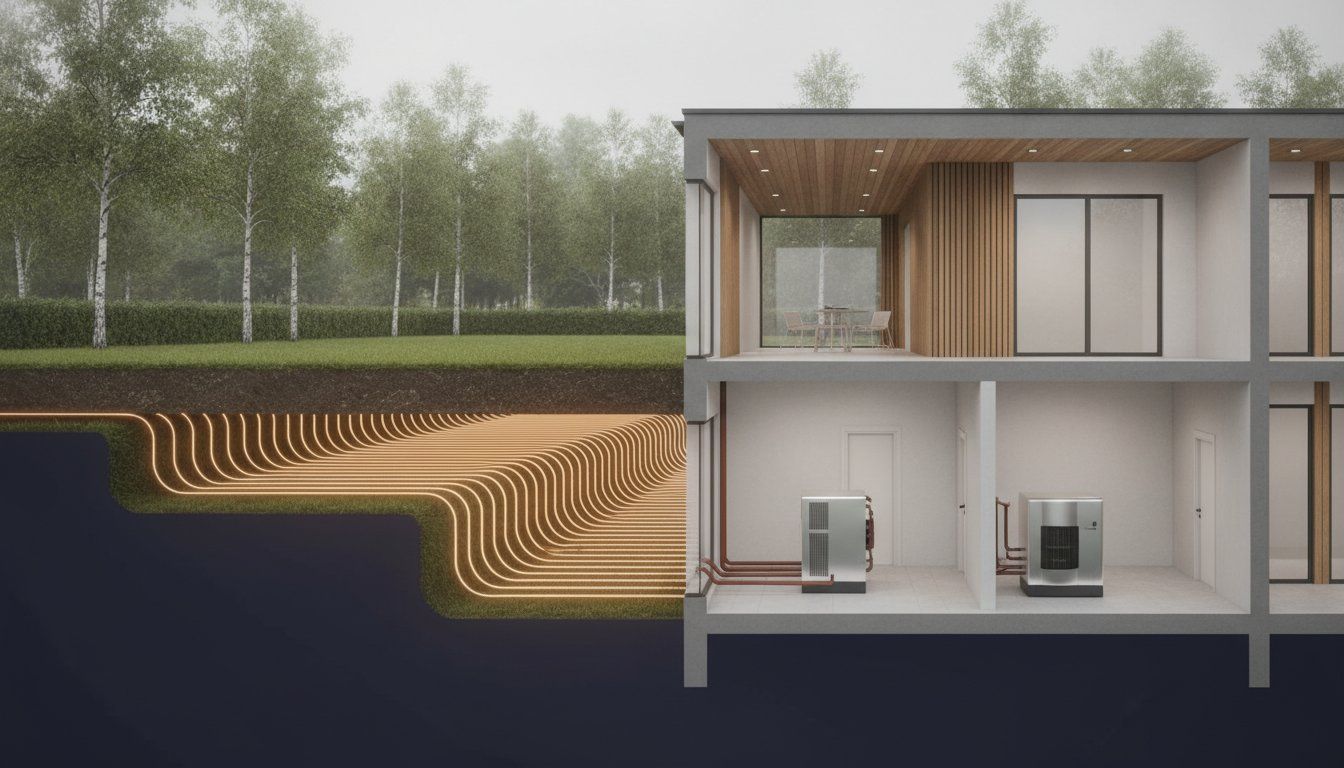
Did you know that the heat pump of the earth is the only heating system that literally turns your home garden into a personal and inexhaustible energy bank? We understand perfectly that the idea of ambitious land works and complex technical harmonisation can cause a great deal of excitement. Most owners of houses agree that it is precisely the uncertainty about hidden expenses and the volume of excavations that is the main obstacle to achieving real energy independence.
In this article, we will explain openly and intelligibly how we are developing costs of installing a ground heat pump In 2026, so that you can make a valid decision based on facts rather than guessing. Our goal is to provide you with a clear road map showing each position, from the choice of the equipment to the state support. You will learn how to distinguish between long-term and high-quality assembly from cheap temporary solutions and how to successfully use state support programmes to recover a significant part of the investment. Get ready to know everything you need to make your home a warm, safe and economic shelter for decades.
What is the cost of installing the ground heat pump?
When installing a modern heating system, the total estimate is made from several interrelated stages. It is impossible to simply buy the equipment and connect it to the socket. costs of installing a ground heat pump Not only does it include the aggregate itself, but also large-scale land work, engineering engagement and legal reconciliation. Each of these positions is essential for the system to function smoothly for decades.
Choice of equipment: brand and capacity effects
The heat pump power is the first criterion that determines the price. It is mistaken to believe that "more is better" is. Too powerful equipment costs more expensive and more often closes inside and outside, which is faster to wear off the compressor. Quality pays off in the long term. CTC heat pumps, you pay for engineering accuracy and reliability. Premium class units usually already have built-in high quality boilers and smart control systems. Such solutions initially require higher investment, but they significantly reduce the installation time and additional material costs in the premises.
Assembly works and hydraulic connection
Professional assembly shall ensure that: ground heat pump working with maximum return. An important position is hydraulic attachment, which includes circulators, expansion vessels and specific heat transfer fluid. The cost structure varies depending on the type of collector chosen:
- Horizontal collector: cheaper to build, but requires a large area of land without building.
- Vertical boreholes: more expensive technology, which provides stable efficiency even in the harshest winters and takes minimal space.
Also, the cost is influenced by the integration of the system with the type of heating of the house. Warm floors are the ideal partner for the heat pump, because they require lower temperatures than radiators. Finally, the estimate is complemented by design works and coordination within public institutions, which is a necessary precondition for later public support and putting the building into operation.
Horizontal collector versus vertical borehole: Price comparison
The choice between the horizontal collector and the vertical borehole is the most important decision that directly affects costs of installing a ground heat pump. It is not just a financial question, but a precise engineering calculation based on the geology of your property and the available area. Before any digging or drilling work starts, it is critical to carry out a ground research. It makes it possible to understand how much energy your land can actually give up and which method will be more effective in the long term.
Horizontal collector: when is it the most advantageous solution?
This method is financially more attractive if you own a large plot of land and do not plan to plant a dense garden. The main factor here is soil composition and humidity. Wet clay heat is driven by much better than dry sand. This means that in sandy soils it will be necessary to lay significantly longer pipes to achieve the same capacity. On average, the horizontal collector needs to take into account 3 to 4 square metres of free land for each square meter of domestic heating. It should be borne in mind that above the collector there will be no construction, paved fields or large trees with a strong root system.
The advantages of boreholes and the investment rationale
Vertical drilling is a technologically more advanced and stable solution that does not take place in your garden. Since the temperature is constant at the depths, the system works with evenly high efficiency even in the most finite winters. Our team has a lot of experience in performing For a current exceeding 2 A but not exceeding 63 A in different regions of Latvia, where geological conditions differ dramatically. In the process of drilling we use modern technologies that protect the environment. It is important to plan time in time, because coordination with the state services and obtaining licences may take from one to three months. Support programme of the Ministry of Climate and EnergyIf you are not sure which solution is more appropriate for your property, we will help you to assess the potential of the land and prepare a precise estimate.
Factors determining the total return on investment
The energy efficiency of the building is the first step that significantly affects your wallet. For new houses, since early 2026, requirements are 20% stricter and it directly reduces the required heat pump capacity. The better insulation of the house, the smaller the initial insulation will be costs of installing a ground heat pump, because you can choose a more compact and cheaper unit. Investment pays the fastest if the system is precisely aligned with the real energy consumption and heat loss of the building.
State aid and financing
In 2026 the amount of state support can be reached from 4400 to 6000 euros. The main conditions are clear: the new installation must have at least A++ energy efficiency label and the property must be officially put into operation. We not only install the machinery, but also personally help our partners to arrange all the necessary documents to get this money in real terms into their bank account.
Heat pump and solar panels: perfect pair
By combining the heat of the earth with solar energy, you get maximum energy autonomy. Solar electricity helps to cover the running costs of the heat pump, which vary from 50 to 90 euros per month on average depending on the area of the building. We recommend to explore this Other, of a thickness of A guide to understand how this combination helps to achieve zero-energy housing status. With state aid, the payback period for such a combined system is usually 4 to 6 years.
Ground heat pumps with SCOP index 5.0 or higher are significantly more efficient than air-water equipment, especially in harsh winters. This means that every euro invested in energy is turned into five times your home's heat. If you want to calculate the potential of your home precisely and learn more about the choice of equipment, please log in for consultation about CTC heat pump installation of our knowledgeable masters.

Why professional design saves your money?
Many house owners mistakenly believe that design is just an unnecessary bureaucracy or extra stack of paper. In fact, it is precisely the precise engineering plan that is the main tool that helps to significantly optimize costs of installing a ground heat pump without a detailed calculation of heat loss there is a huge risk of overpayment for an unnecessarily powerful equipment or, on the contrary, to choose a system too weak to heat the house in colder nights. A professional project is your insurance against unexpected expenses in the future.
Engineering Design Kommodus
Our engineers approach each project individually, because each house is unique. We do not use "averages" but we analyse the building's specific envelopes, window areas and even the location of the house against the sky. For a voltage exceeding 1000 VIn choosing the full service cycle from one partner, you avoid situations where different workers shift responsibility to each other. We guarantee that the project's intended efficiency will be achieved in reality.
Maintenance and Service: How to Maintain Effectiveness?
Even the most advanced and expensive technique requires professional care. Regular maintenance, which usually costs between 100 and 150 euros per year in Latvia, is a small investment compared to the sudden repair costs in the middle of winter. During the preventive inspection, our masters control system pressure, clean filters and check automatic settings to prevent the lowest loss of efficiency. This ensures that your investment continues to work with maximum return year after year, keeping the operating costs low.
Commodus technical support is available throughout Latvia, regardless of your location. We are not only installing high-class CTC heat pumps, but also take full responsibility for their operation throughout the life of the equipment. Professional service gives peace of mind, knowing that in any situation you are surrounded by a knowledgeable master who knows the specifics of your heating system to the last bolt.
Your path to a warm and energy-dependent future
The ground heat pump is a long-term investment that pays off not only in the figures in your bank account, but also in daily comfort and peace of mind. We have seen that costs of installing a ground heat pump affects both the chosen collector type and the energy efficiency of the building and the available state support. Remember that the precise engineering design and qualitative assembly is the only way to ensure the system's efficiency for decades.
Commodus team with more than 15 years of experience in the Latvian market offers a full cycle, from professional boreholes to the last radiator or warm floor in your room. Our certified CTCs and other leading brands installers will ensure that each technical solution is tailored to the specific needs of your home. We believe that personal attitude and technical excellence are the basis for successful cooperation.
Get an individual land heat pump estimate from Kommodus experts!
Start your transition to green energy today and enjoy a true independence from energy price fluctuations. We will be your reliable and knowledgeable partner at every stage of this exciting process.
Frequently asked questions about ground heat pumps
How much does the average cost of installing a ground heat pump for private houses in Latvia?
Costs of installing a ground heat pump In the case of 150 square meters house, the average value of the building varies from 13 000 to 18 000 euro. This amount includes the installation itself, the installation and the construction of the collector or boreholes. The exact amount depends on the complexity of the chosen brand and the ground works. Although the initial investment is higher than for other heating types, the lower operating costs in the long term fully compensate for this difference.
Is a construction permit necessary for the installation of a ground heat pump?
The process of horizontal collectors is simpler, but also here, if the works are related to engineering communications. We recommend that we entrust the documentation to experienced professionals who know all the current requirements and will help to avoid bureaucratic obstacles.
What is the difference between the cost of installing the ground heat pump and air-water heat pump?
Land system installation is usually between 6,000 and 8,000 euros more expensive than air-water solutions. The main difference is the ground works and the construction of the collector, which increases costs of installing a ground heat pumpHowever, this system provides more stable efficiency and higher SCOP rates, which exceed 5.0. Investment pays off with smaller electricity bills in the coldest winter months, when the efficiency of other systems is reduced.
How much land is required for a horizontal collector?
The horizontal collector requires approximately 3 to 4 square meters of free land area per square meter of house to be heated. This means that 150 square meters of house will require about 450 to 600 square meters of undeveloped area. In this area, no construction, paving or planting of large trees is planned. If the area of the plot is limited, vertical boreholes are a more appropriate choice, as they take minimal space.
Does the State aid also cover the costs of ground work and boreholes?
State aid programmes such as EQF and Altum cover the total eligible project costs, which include both installation and installation and ground works. House owners can recover up to 50% of the investment within the defined ceiling of between 4400 and 6000 euros. To receive the support, the system must meet at least the energy efficiency class A++ and only certified specialists can perform the works.
How many years does the installation of a ground heat pump pay off?
With the support of the state, the investment usually pays off within 4 to 6 years. Without co-financing this period may extend to 8 or 10 years. The exact time depends on the previous type of heating and current electricity prices. Considering that the life of the equipment is 20 to 25 years, the ground collector serves up to half a century, it is still the most financially advantageous heating solution in the long term.
Comments