Heat Pump for a 100m2 House: How to Choose the Right Solution in 2026?
Did you know that bigger is not always better when it comes to the warmth of your home? Many homeowners mistakenly believe that the most powerful heat pump for a 100m2 house is the safest choice, but in reality an incorrectly chosen output only needlessly empties your wallet and reduces the unit's lifespan. You certainly want even the coldest January nights, when the temperature drops to -25°C, to be pleasantly warm indoors while the monthly bill does not cause unnecessary stress. We at the Commodus team understand these concerns, which is why we are ready to tackle this challenge together with you and find the solution that is most suitable and economical for your specific home.
In this article, find out how to precisely calculate the required output, compare system types and take advantage of 2026 state support. This year the EKII programme continues to support the replacement of fossil fuels, while the new Modernisation Fund with a total budget of €26.8 million begins accepting applications on 1 April 2026. We will look at current market prices, such as MIDEA Solstice 7kW models at €890, and help you understand whether an air-to-air or air-to-water system will suit your home better. Prepare yourself for a clear action plan that will ensure cheap and efficient heating for your 100m2 home in the long term.
Key Takeaways
- Choose the precise output (kW) to avoid system cycling and excess electricity consumption, which is the most common mistake in small-scale homes.
- Find out why a heat pump for a 100m2 house is the most advantageous solution, comparing the efficiency and installation speed of air-to-water and air-to-air systems.
- Learn about 2026 state support programmes, such as the Modernisation Fund, which allows a significant reduction in initial investment for replacing fossil fuel heating.
- Understand the relationship between the building's thermal performance and heating bills to ensure home warmth even at -25°C without overpaying for an overly powerful unit.
- Discover how Commodus experience and a personal approach will help you confidently move from the first output calculation to regular unit maintenance.
Why is a Heat Pump the Best Choice for a 100m2 House in Latvia?
In Latvia's climatic conditions, where winter temperatures can fluctuate from unexpected thaws to severe frost, choosing the right heating system is the foundation of peace of mind and financial stability. If your property is a compact single-storey or two-storey building, then a heat pump for a 100m2 house is not only a modern but also an economically sound decision. To better understand the fundamentals and operating principles of this technology, it is useful to know what a heat pump is and how it can convert environmental energy into home warmth. Unlike traditional wood or pellet boilers, this system operates fully autonomously, providing consistent comfort without the need to become a "stoker" every day.
One of the most important indicators that determines a unit's efficiency is the energy efficiency coefficients COP and SCOP. If a modern unit has a SCOP rating of 5.0, it means that on average during the season, 5 kWh of heat is produced from every 1 kWh of electricity consumed. For a 100m2 area, such efficiency means minimal operating costs. Furthermore, this is an ecologically clean choice with zero emissions in the home. You need not worry about smoke, soot or CO2 leaks, as a heat pump simply moves energy. Many of our clients choose air-to-water systems because in one compact unit they combine both room heating and hot water preparation for the entire family.
Comfort and Automation Without Unnecessary Concerns
We at the Commodus team know that time is the most precious resource, which is why emphasis on automation is our priority. Heat pump control via a smartphone allows you to regulate the temperature at home while at work or travelling, which is ideally suited to the modern pace of life. You no longer need a special fuel storage room, such as a pellet warehouse or firewood shed, which in a 100m2 home allows you to save valuable space for other purposes. Modern units operate at very low noise levels, so they do not disturb the peace of the home even when installed close to a bedroom or terrace. This is a solution that allows you to forget about the start of the heating season, as the system adapts by itself to outdoor temperature fluctuations.
An Investment That Increases Property Value
A heat pump for a 100m2 house is an investment that pays off not only through lower bills but also increases the market value of the property itself. Buildings with high energy efficiency certificates are more in demand, and in 2026 this trend is becoming even more pronounced. A 100m2 area is financially more rewarding because the required unit output is relatively small, which means lower initial installation costs compared to large private homes. Heat pumps have a service life of 15 to 25 years, and their maintenance is simple, usually limited to an annual inspection carried out by our experienced technicians. By choosing this solution, you gain a safe and predictable heating system for decades to come.
What Output (kW) Should You Choose for 100m2?
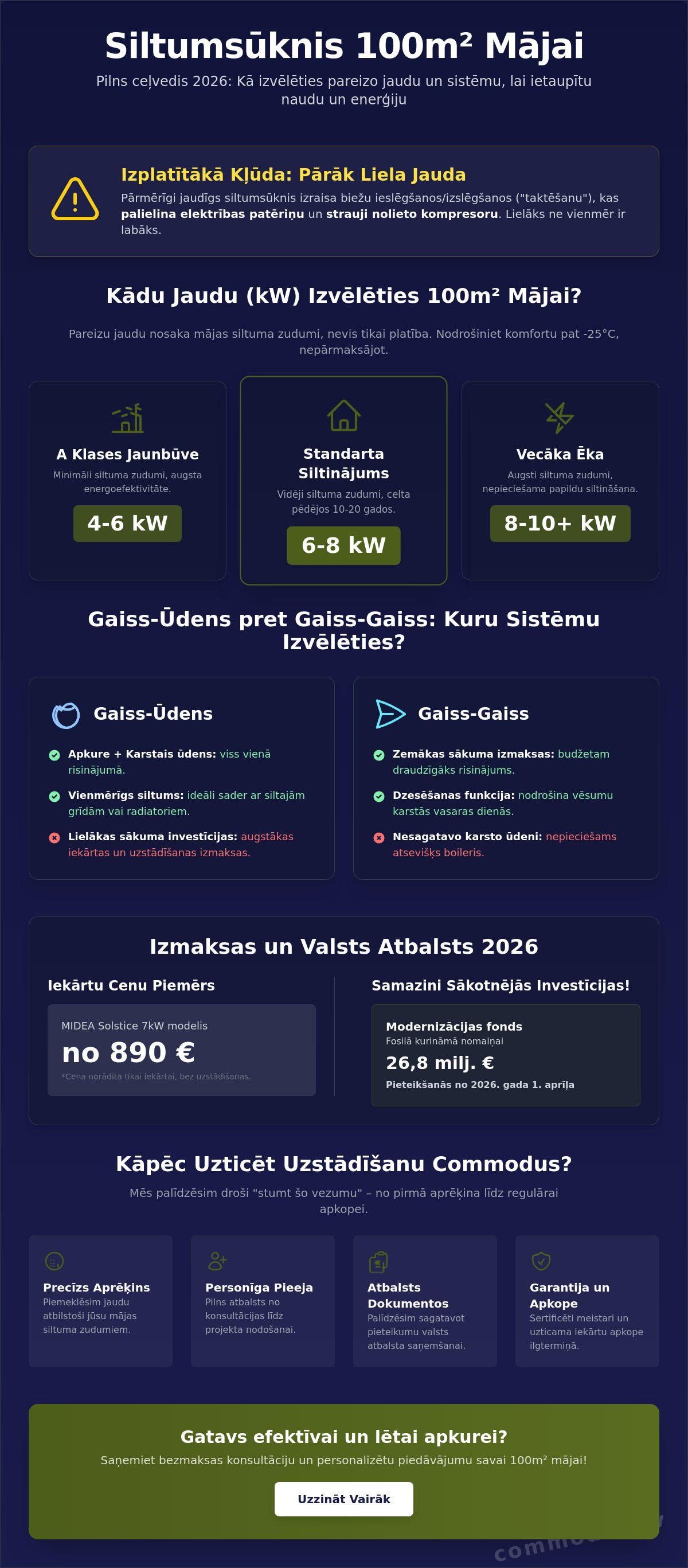
When choosing a heating system, bigger does not always mean better. A heat pump for a 100m2 house must be chosen with jeweller's precision, as an error in output calculations can lead to inefficient operation and unnecessary costs. The key indicator here is not the home's square metres but its heat losses. If the unit is too weak, it will not be able to heat the rooms in severe frost. But an overly powerful unit is even more dangerous, as it causes so-called cycling. This is a situation where the heat pump switches on and off too frequently because it produces more heat than the house can absorb. This mode rapidly wears the compressor and increases electricity bills, which is why we at Commodus always emphasise that output balance is the most important factor.
An important concept is the bivalence point. This is the temperature threshold, usually around -7°C to -15°C, at which the heat pump can no longer provide the necessary heat on its own and the built-in electric heating element or heater comes to its aid. A correctly chosen heat pump for a 100m2 house will operate efficiently for most of the winter, and the additional heater will only switch on during the coldest nights. This approach is economically justified, as there is no point in buying an expensive, enormous-output unit just for two very cold weeks a year. Correct output selection is also an essential prerequisite for receiving state support for heat pumps, as efficiency indicators must meet certain standards.
Output Calculation Depending on Insulation
The home's energy efficiency is the main variable in the output formula. New builds constructed to A-class standards usually make do with a 4-6 kW solution, as heat losses are minimal. Standard insulated homes built in the last 15 years are best served by 6-8 kW heat pumps. Older-type homes with average insulation may require even 8-10 kW output to ensure comfort. A precise picture can be obtained using the knowledge of our specialists, so feel free to apply for a consultation so we can help find the golden mean.
Factors That Affect Output Choice
In addition to insulation, the specifics of the rooms and the habits of the occupants must also be taken into account. High ceilings exceeding the standard 2.7 metres, and large panoramic windows, significantly increase the heated volume and heat losses. The number of family members should also be assessed, as greater hot water consumption requires a more powerful system to prepare it. The existing heating system is no less important. Underfloor heating works at a lower temperature than radiators, which allows the heat pump to operate more efficiently and often means choosing a slightly lower-output model compared to homes with classic radiators.
Air-to-Water vs Air-to-Air: Which Wins in a 100m2 Home?
When choosing the most suitable solution, a heat pump for a 100m2 house can be of two types, and each has its own role in ensuring your comfort. An air-to-water system is a full-featured heating hub that heats both rooms and bathroom water. An air-to-air unit, often called a heat pump air conditioner, is an excellent aid for cooling in summer or quickly raising the temperature in individual zones. A 100m2 area is the point at which both options are technically feasible, but they offer drastically different quality of life and long-term costs.
We at the Commodus team often see clients initially looking only at the lowest price but forgetting about everyday practicality. An air-to-air system cannot provide hot water, which means you will still need a separate boiler. An air-to-water system, on the other hand, provides a complete cycle, from underfloor heating to a hot shower after a long working day. In 2026, when energy efficiency requirements are becoming stricter, state support for heat pump installation helps cover a significant portion of the costs of a more powerful system, making comfort more accessible.
Advantages of an Air-to-Water Heat Pump
The greatest benefit is even warmth without air flows. Air-to-water systems work best with underfloor heating, ensuring the same temperature in every corner of every room. In renovation projects, this heat pump for a 100m2 house allows the existing radiator system to be retained, simply replacing the old gas or wood boiler with a modern unit. You will not have to listen to fan humming in the bedroom, as the entire heat exchange process takes place through water circulation, creating a cosy and quiet atmosphere.
When to Choose an Air-to-Air Solution?
This option is "emergency aid" for homes that do not have a water heating system installed and where there are no plans to build one. If your 100m2 home has an open-plan layout, an air-to-air heat pump can effectively distribute heat throughout the main zones. It is indispensable when the priority is cooling rooms during hot summer months. Many of our clients choose it as supplementary heating so that in autumn and spring they do not have to deal with stoking a wood stove. Its installation takes only a few hours and does not require complex reconstruction work in your interior.
Ultimately the choice depends on your goals and budget. An air-to-water system provides higher property value and complete independence, while air-to-air is a budget-friendly solution with a cooling bonus. If you are unsure which challenge is most appropriate for you specifically, feel free to contact us so we can together assess your home's layout and thermal engineering indicators.
Costs and State Support for Heat Pumps in 2026
Investing in a heating system is one of the most serious decisions in home improvement. A heat pump for a 100m2 house in 2026 has become a more accessible solution, thanks both to technological development and targeted state support. Looking at specific figures, a quality air-to-water heat pump, such as the MIDEA M-Thermal 6kW model, currently costs around €2,740, while premium segment units like the DAIKIN Altherma 3 6kW are available for approximately €4,679. These prices refer to the units themselves, but for precise project planning we recommend using our heating calculator, which will help you understand the full project estimate including installation materials and labour.
We at the Commodus team believe that no client should feel lost in a sea of documents, which is why we are ready to help with bureaucracy matters too. Spring 2026 brings a new wave of support. The Modernisation Fund with a total budget of €26.8 million begins accepting applications on 1 April 2026 and runs until 1 June. It is important to remember that the EKII programme this year prioritises specifically the replacement of fossil fuel heating systems such as natural gas, coal or diesel. If your 100m2 home still has an old gas boiler, this is the right time to act to receive subsidies that can cover a significant portion of the costs.
EKII and Altum Programmes: Step by Step
To apply for support, the unit must meet strict efficiency criteria. The heat pump must have the appropriate certification and COP ratings that confirm its performance in Latvian winter conditions. The application process will require a building energy certificate, a technical project or confirmation card, and an acceptance-handover certificate prepared by the installer. The most common mistake due to which support is refused is poor-quality documentation or a choice of unit that does not comply with the programme's regulations. Our specialists will ensure that all technical data is correct at the very first submission.
Operating Costs and Savings
Compared to 2026 gas and pellet prices, a heat pump for a 100m2 house provides more stable and predictable costs. The average payback period with state support usually ranges from 3 to 5 years. Savings can be increased further by combining the heating system with a solar panel package, which allows the energy generated in summer months to be used for hot water preparation and cooling. Remember that regular maintenance once a year is critically important to keep the unit operating at high efficiency and bills remaining low even after ten years of operation.
Why Entrust Heat Pump Installation to Commodus?
When choosing a heating system, you are not choosing just an iron box on the wall. You are choosing people who will take care of it for years to come. Since 2010 we have installed thousands of units throughout Latvia, and this experience allows us to state with confidence that we know how to make heat work for your benefit. A heat pump for a 100m2 house requires a considered approach, as in such a compact space every detail matters to overall efficiency. We not only sell units but also tackle the challenge together with you, providing a full service cycle from the first project sketch to regular maintenance after ten years. Our goal is to create a cosy and safe atmosphere in which technology works imperceptibly.
Engineering design is our strength and the foundation of your peace of mind. Each site is evaluated individually to prevent the cycling problems or insufficient output at severe frost mentioned in previous sections. Our engineers carry out precise calculations so that your investment is justified and the system serves for at least two decades. We are not afraid of challenges, regardless of whether it is a new A-class building or a renovated historic property. Professional service and personal responsibility for every screw is what distinguishes us from ordinary retailers.
Our Team – Your Safety Guarantee
Our installation specialists are certified professionals who regularly update their knowledge with the world's leading manufacturers. We believe in complete transparency, which is why you will not find hidden costs or sudden additional works mid-process in our prepared estimates. Every heat pump for a 100m2 house is installed with the same care we would devote to our own homes. This personal approach and human responsiveness is what our clients value most. We never leave the homeowner alone with unfamiliar technology, but always explain the system's operation and settings in understandable language. We provide both warranty and post-warranty service so that you feel confident in any season.
Start With a Free Consultation
There is no point in guessing when you can know precisely. Our work begins with an in-depth conversation and site inspection to understand your home's real situation and thermal performance. We will help you choose between different models, taking into account both your budget and comfort requirements and hot water consumption. Our specialists will carry out precise heat loss calculations to ensure the proposed output is perfectly balanced for your needs. Apply for a consultation and receive a quote! – this is the first step towards a sense of warmth and security in your home for the long term. We will take care of all the technical execution so that you can simply enjoy cosiness and low bills.
Time to Secure Your Home's Warmth and Peace of Mind
Choosing the right heating system is one of the most valuable investments you can make in your home's comfort. As we have established, a precisely chosen heat pump for a 100m2 house not only reduces monthly bills but also protects against unnecessary investment in overly powerful units. By taking advantage of the 2026 state support programmes and the opportunities provided by the Modernisation Fund, the transition to ecological heating is currently more financially advantageous than ever. You no longer need to worry about sourcing fuel or unpredictable energy prices, as modern technology will take care of everything in your place.
We at Commodus are ready to be your trusted partner on this journey. With more than 15 years of experience in the Latvian market and as a certified Panasonic and Midea partner, we provide not only quality installation but also full service maintenance throughout Latvia. We believe that tackling challenges together produces the best results, which is why we are here to help you make a considered decision and provide support at every stage.
Use the Commodus heating calculator and find out the precise costs!
Take the first step towards a warmer and more economical heating season today. We will be glad to help find a solution that will provide comfort and peace of mind in your home for decades.
Frequently Asked Questions About Heating
Can a Heat Pump Fully Heat a 100m2 House Without Additional Heating?
Yes, a modern heat pump for a 100m2 house is designed as a full-featured primary heating system capable of operating autonomously all year round. It is important to precisely calculate the building's heat losses and choose the appropriate output so that the unit can cope with the load even at -25°C frost. Our experience shows that in a well-insulated home, an additional heating boiler is not necessary, as the electric heating elements built into the system serve as a safety guarantee in the most extreme winter moments.
How Much Electricity Does a Heat Pump Consume Monthly in a 100m2 House?
Electricity consumption is directly dependent on the home's thermal performance and the chosen model's efficiency or SCOP rating. On average for a 100m2 area during heating season months, consumption can range from 300 to 600 kWh, taking into account outdoor air temperature fluctuations. If the house has high energy efficiency, costs will be even lower. Remember that precise data can be obtained after the first year of operation, when the system has fully adapted to your family's habits and needs.
Do I Need New Electrical Installation for Heat Pump Installation?
In most cases it is necessary to create a separate connection in the electrical distribution panel with a fuse of appropriate capacity. The heat pump's indoor and outdoor units require a stable power supply, so we always check the existing installation before work begins. If your home's electrical network is outdated, for safety reasons it is advisable to run new cables directly to the heating hub. This will prevent system overload and ensure the unit's sustainable operation without unexpected interruptions.
How Long Does a Modern Air-to-Water Heat Pump Last?
The average service life of a quality air-to-water heat pump is 15 to 25 years. This period is directly linked to regular technical maintenance and correct output selection, which prevents excessive compressor wear. We at the Commodus team install only tried-and-tested brand equipment that is adapted specifically to Northern Europe's harsh climate. By investing in a reliable unit, you secure your home's warmth for an entire generation, avoiding frequent and costly repairs.
What is the Minimum Outdoor Temperature at Which a Heat Pump Still Operates?
Modern heat pumps efficiently produce heat even when the outdoor temperature drops to -25°C or even -30°C. Although at such minuses the unit's efficiency decreases, it continues to heat the home using the energy present in the surrounding air. If the temperature drops even lower, the bivalence source or built-in electric heater automatically connects. This guarantees that your family will not be left in the cold even in Latvia's harshest winter, maintaining a consistent comfort level indoors.
Is a Construction Project or Approval Required for Heat Pump Installation?
If heat pump installation does not change the building's facade architectural design or the basic structure of engineering networks, a complex construction project is usually not required. However, to receive state support in 2026, a confirmation card or explanatory note approved by the local building authority is necessary. We help our clients navigate these requirements and prepare all necessary documents. This ensures that the installation is legal and that you can confidently apply for the available subsidies.
How Often Should Heat Pump Technical Maintenance Be Carried Out?
Technical maintenance is recommended once a year, ideally before the start of the heating season in autumn. During this inspection our technicians clean the filters, check refrigerant pressure and verify the correct operation of electronic components. A regular service visit not only maintains the manufacturer's warranty but also ensures that the heat pump for a 100m2 house operates with maximum efficiency. Preventive maintenance is cheaper than an unexpected repair in the middle of winter when technician workload is at its highest.
Can I Install a Heat Pump Myself to Save Money?
DIY installation is not recommended and is often contrary to legislation, as working with refrigerants requires a special certificate. Furthermore, by installing the unit yourself, you automatically lose the manufacturer's warranty and the right to state support. Professional installation guarantees that the system is airtight and set up for an optimal operating mode. By entrusting this work to us, you gain peace of mind and confidence that the heating will operate safely and efficiently from the very first day.
Comments