Heat pump or pellet boiler: Which heating system should be chosen in 2026?
What if the cheapest solution on paper turns out to be the most expensive in everyday life? This is the question of many Latvian house owners, when it comes to deciding: a heat pump or a boiler boiler. Both systems are the most popular alternatives to the old model of gas or electrocatalyst, but their operational logic, costs and daily comfort vary significantly.
We understand that the choice is not easy. Electricity prices are worrying, the supply of granules and ash cleaning takes time, and one unpleasant question sits in the mind: will the heat pump really be able to cope when the thermometer falls below -20°C? These concerns are justified and should be considered honestly.
In this article, you will get an objective, quantified comparison between the two heating types in the climate of Latvia. We will look at the amount of investments, the costs of operation, the level of comfort and the situation in which each solution works best, so that you can make a decision with a clear mind and without any unnecessary guessing.
Heating selection in Latvian climate: Heat pump against pellet boiler
Two technologies, two completely different philosophies. Heat pump or pellet boiler is not just a technical question, it is a question of what lifestyle you want to make daily. To make the right choice, first understand how each system actually works.
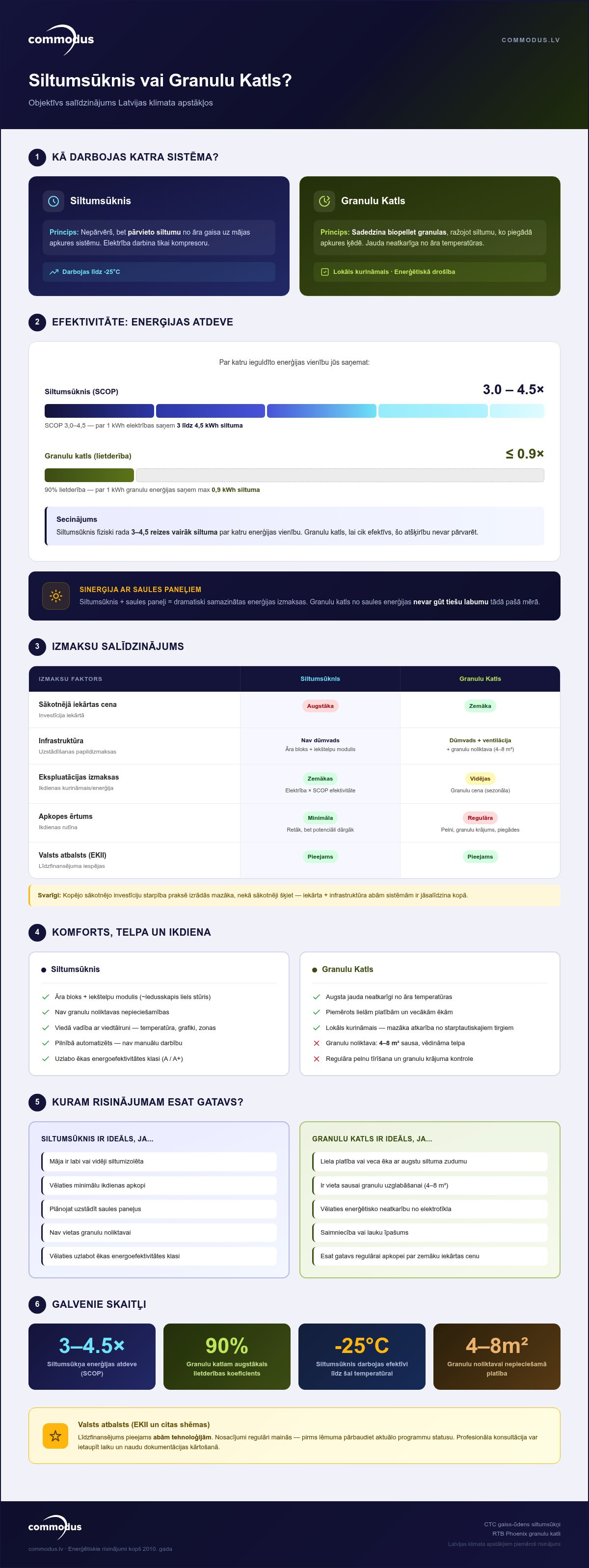
The boiler burns the pellets of biopellet, creating the heat that the system delivers to the heating chain. The heat pump works differently: it does not generate heat, but transported it from outdoor air to home heating system, consuming electricity for operation of compressor only. This difference is principled and directly affects both costs and comfort.
Heat pump: Modern comfort and smart control
Modern CTC air-water heat pumps can work effectively even at -25°C, which completely refutes the myth that the winters of Latvia are harsh. Technology has developed rapidly, and what was a limit ten years ago is no longer relevant today. A serious plus is smart control: temperature, graphics and even heating of certain areas can be regulated by smartphone, integrating the system into the wider home automation ecosystem. This means that the house can be warm to you even if you have gone over the weekend.
The heat pump also directly affects the energy efficiency class of the building. A house with air-water heat pump and good insulation has a real opportunity to reach class A or even A+, which significantly affects the value of the real estate.
Granule boiler: Verified power and energy security
Large areas of buildings or older buildings with high heat loss in the pellet boiler are still a very sensible solution. It is able to provide high power regardless of the outdoor temperature, which is an essential argument in farms or homes with poorer insulation. RTB Phoenix pellet boilers The system has a compact design and high efficiency, while self-cleaning systems have significantly reduced daily maintenance load compared to older generation models. Manual operation and frequent ash cleaning are no longer the norm.
Energy security here is the key word: pellets are locally produced fuels, and their price is not as closely linked to international energy markets as electricity.
Efficiency and Cost: What is more beneficial in the long term?
The initial price and real costs are often two completely different figures. The boiler usually requires less initial investment in the plant, but additional infrastructure is needed: the construction of the pellet storage, the flue-gas system and adequate ventilation. The heat pump in turn has a higher price of the plant, but the installation is often simpler because there is no need for a flue. The difference in the total initial investment in practice turns out to be smaller than initially seems.
The cost of operating the plant is what makes the image more interesting.Pulp prices on the Latvian market depend on seasonal, supplier and quality of the pellet. Heat pump costs are directly linked to the electricity tariff. None of these factors can be fully controlled, but the heat pump has one serious spring, for which competitors are silent.
SCOP and efficiency: what do they mean for your wallet?
SCOP or seasonal efficiency ratio shows how much heat the heat pump generates from one unit of electricity consumed throughout the heating season. CTC air-water heat pumps SCOP value usually varies from 3,0 to 4.5, which means that for each unit of electricity you get three to four and a half times more heat. A boiler of pellets with a 90% efficiency is an excellent machine in its category, but it is not able to change physics: it still generates less heat than the energy consumed by fuel.
This difference becomes particularly significant when the heating system is connected to For solar panels. It is a synergy that most cost comparisons simply ignore. The heat pump, which operates on its own solar energy during the day, significantly reduces the dependence on network tariffs. The boiler of pellets from solar panels is not able to directly benefit to the same extent. This combination is changing the rules of the game in 2026.
Maintenance costs for both systems are proportionate, but differ in nature. The boiler requires regular ash cleaning and annual maintenance. The maintenance of the heat pump is less frequent, but its costs may be higher if compressor problems occur. In both cases professional maintenance is an investment rather than an edition.
State aid and financing in 2026
When choosing between a heat pump or a boiler, state aid programmes can have a significant impact on the final decision. EQF and other support schemes provide for co-financing of both technologies, but the conditions and amount of funding available regularly change. Before taking a decision, please check the status of the current programmes, as this is one of the factors that should not be guessed. Expert consultation can save both time and money.
Practical choice: Room, comfort and cooling
Technical specifications and cost tables are one thing, but everyday life is completely different. Heat pumps or pellet boilers"The question of location, routine and comfort often decides the decision as effectively as any number.
The boiler requires more than just a space in the cot. The storage space of the pellet is usually 4 to 8 square meters depending on the size of the house and the frequency of delivery. The room must be dry, well ventilated and accessible so that the pellets can be conveniently filled at the time of delivery. The heat pump only needs an outdoor block, which is located on the building wall, and an indoor hydraulic module, which takes approximately a refrigerator large corner.
Life-style effects on heating choices
Here is the honest question: are you ready to regularly carry out ashes, control the pellet stock and organise seasonal deliveries? Modern pellet boilers with self-cleaning systems have reduced this load considerably, but it is not zero. The heat pump works according to the "shock and forget" principle: the temperature can be set from a smartphone and the system itself adapts to outdoor conditions. In terms of air quality, the heat pump is a clear winner, because the combustion process in the house has no space, which means less dust and combustion products.
Cooling function: advantage that competitors are silent
CTC air-water heat pump In summer, it works in reverse mode, providing home cooling without purchasing a separate conditioner. It is a specific financial and practical benefit for which the suppliers of the pellet boiler can not offer anything. The boiler is a heating device and only a heating device.
Renovation against new construction: technical constraints
In new constructions with heated floors, the heat pump is almost the ideal solution: low-temperature heating system corresponds exactly to the heat pump's most efficient operating range. In renovation projects with an existing radiator system, the situation is more complicated. If the radiators are not replaced for larger models, the heat pump can work with lower efficiency. RTboiler (5616) is a pragmatic solution, as they provide a high water temperature and are well compatible with older heating systems without additional investment in infrastructure.
The fire protection requirements for pellet systems include an appropriate flue that has to be checked once a year. This is both a matter of time and money, which should be included in the overall calculation.
If you are not sure which solution fits your home's technical conditions, Contact Commodus specialistswhich offers both solutions and provides an objective assessment without interest on either side.
Commodus Recommendation: How to make the right decision?
The observation of the object is not a formality. It is the basis on which everything else rests. Besides the precise calculation of the power, which takes into account the insulation of the house, the heating area, the existing heating system and even the orientation of the building towards the sky, any recommendation is just a guess. Kommodus specialists have seen enough cases of improperly selected power means either insufficient heat on a cold day or unnecessarily high operating costs for years.
The question of Heat pumps or pellet boilers often resolves themselves as soon as there is clear data, not when ten internet discussions are read.
Professional installation and guarantee
A handy assembly or cheap brigade working without experience with the particular equipment can be expensive. Incorrectly connected heat pump loses efficiency, an incorrect installed pellet boiler poses fire risks. Commodus provides a full service cycle in Latvia, from design and installation to regular maintenance. This means one contact point, not three different companies who are rebugging for each other if something is not working.
Summary: Who wins your house?
Quick checklist to make the final decision:
- New building or renovated house with warm floors: CTC air-water heat pump there is a logical choice, especially in combination with solar panels.
- Parent house with existing radiator system and high heat loss: RTB pellet boiler provide the necessary capacity without additional infrastructure investment.
- Important comfort and minimal daily engagement: The heat pump wins with smart control options and cooling function in summer.
- Priority shall be given to energy independence from the grid: The Commission notes that the Commission has already established that the aid is compatible with the internal market pursuant to Article 107 (3) (c) of the Treaty.
Commodus offers both solutions, so the consultation is objective. There is no motivation to recommend one or the other without a basis. Use the digital calculation tools on the Commmodus site to get a more accurate cost forecast for your particular situation, and then contact the team to convert the numbers into a warm house.
The warm house starts with the right decision today
Choice between Heat pumps or pellet boilers is not universal, and that is why there is no single correct answer for all. What works in a new, well-heated house with warm floors may not be optimal in the oldest building with high heat loss. The main thing this article hopes to put forward is simple: the decision should be based on your home data rather than on your neighbor's experience or Internet forums.
Commodus team has been working in the Latvian market since 2010, offering both solutions and certified assembly specialists throughout the country. This means that consultation is objective and the full service cycle from project to regular maintenance remains in one hand.
The next step is simple. Get a free heating system calculation from Kommodus experts and get a clear idea of which solution your house will work best. A warm house is not a dream, it is a good decision.
Frequently asked questions about the heat pump and the pellet boiler
Will the heat pump be able to provide sufficient heat at -30 degrees?
Modern air-water heat pumps are designed to work at -25°C or even lower temperatures, but at -30°C efficiency is decreasing and the equipment can be switched to a stand-by heating mode. In Latvia, this temperature is a rare phenomenon, and in most cases the system is managed without problems. To be safe, the specialist calculates the reserve capacity for the particular house, so this risk is manageable and not ignored.
How often should a modern pellet boiler be cleaned?
Modern RTB Phoenix pellet boilers with self-cleaning systems require ash cleaning approximately once every one to two weeks depending on the quality of the pellet and the load of the boiler. Full maintenance is recommended once a year before the start of the heating season. Compared to older generation models, daily load is significantly lower, but not fully active.
Can the heat pump be installed in a house with old radiators?
The heat pump works in the most efficient low temperature heating systems, which means that the old, smaller space radiators may not be enough to transfer heat. Before installation, the specialist evaluates the existing radiators and calculates whether they need to be replaced or supplemented. In some cases, partial replacement of the radiators is sufficient, in other cases, the pellet boiler is a more pragmatic solution without additional investment in infrastructure.
What is the average cost of pellets for a 150 m2 house in the heating season?
We cannot specify specific costs because prices of pellets in the Latvian market vary depending on season, supplier and quality of pellets, while insulation of the house and heating habits affect consumption as much as the area. Heat pumps or pellet boilers, it is recommended to request an individual cost forecast based on your home specific data rather than general averages.
How long does the installation of the heat pump pay off compared to the heating of the pellets?
The repayment period depends on several variables: the amount of the initial investment, the state aid, the power and pellet price ratios available, as well as the home consumption profile. The heat pump, combined with solar panels, can significantly shorten the repayment time, as part of the electricity is produced on its own. A precise forecast can only be provided after the site has been inspected, and the Kommodus specialists do this by offering both solutions without any interest on one side.
Comments