Selection of the power of the boiler: How to calculate and not to make mistakes in 2026?
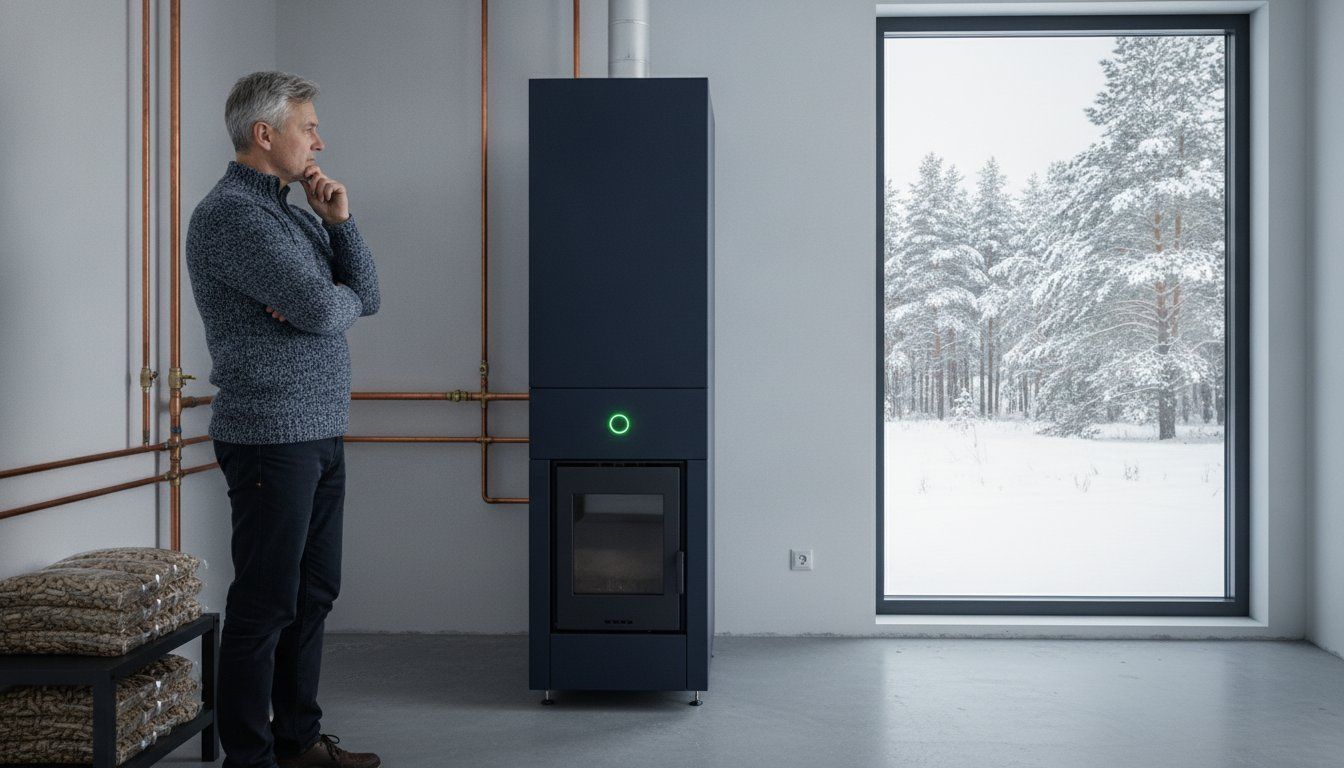
A larger pellet boiler does not mean a warmer house; in fact, an over-powering plant is one of the most common reasons why the owners overpay for fuel and face technical damage. We in Commodus often see that fear of freezing on a large island makes you choose the seemingly safest and most powerful option, but the inaccuracy of the boiler's power leads to the fact that the boiler is constantly closing inside and out. It not only damages the technique, but also significantly increases the consumption of the pellets, which in 2026, when prices have climbed by almost 40% compared to the last summer, is an unacceptable luxury.
We understand that technical terms and formulas can create confusion, but making the right decision is the key to a peaceful winter and peace of mind about the bills. In this article you will find out how to precisely determine your home's needs to ensure maximum efficiency and heat without unnecessary spending. We will look at how heat losses affect the required kilowatts, why modern power modulation is more important than the maximum figure on paper and how the new state aid programmes, which now cover up to 85% of the cost, can help you get to a modern heating system.
What is the capacity of the pellet boiler and why is its precise choice so important?
The power is measured in kilowatts (kW) and it describes the ability of the unit to produce a certain amount of heat in one hour. Simply put, it is the engine power that drives the heat through your radiators or warm floors. Granule boiler technology has developed to the extent that modern equipment can adapt very precisely to the demand for heat of the house, but the basic calculation is still critical. If you choose to be a weak boiler, the house will simply not warm to the desired temperature on the coldest days of January. This means discomfort and constant stress on weather forecasts.
The more common error is the purchase of an over-powering boiler. When the boiler is too big, it starts to "act.". This term means that the plant turns on, produces too much heat quickly, which the house cannot absorb, and then turns off again. This jerky rhythm is ineffective. The burning process is not complete, the consumption of granules increases, and the mechanical components wear out much faster. The Commission considers that the aid is compatible with the internal market pursuant to Article 107 (3) (c) of the Treaty. ensure a smooth operation, which is a key prerequisite for the long life of the installation and for low operating costs.
Myth about the power reserve: why is a larger boiler not better?
Many buyers still believe that a 20 or 30 percent capacity reserve is a safety guarantee. In fact, such an approach often spoils the efficiency of the entire system. RTboiler (5616) and other modern equipment is designed to work most effectively at its nominal power. If the boiler is too large, it never reaches its optimum operating temperature. It is similar to driving a powerful sports car only in the first gear; the engine is in the woes, consuming a lot of fuel, but the point is little.
Our experience since 2010 shows that the exact calculation gives the peace of mind that customers seek. You do not have to pay for a larger equipment at the time of purchase and do not spend excess money on fuel every month. The Commission considers that the aid is compatible with the internal market pursuant to Article 107 (3) (c) of the Treaty. allows the boiler to work quietly, stable and reliable, becoming a seamless but reliable component of the house in the long term.
Main factors determining the amount of kW required
However, in 2026 when energy efficiency requirements and fuel prices have grown, this approach may prove to be a costly mistake. For a modern A+ class house, the capacity required may be even half that of an old, unheated building. The main indicator is not only the floor area, but the space space and the ability to keep the heat inside. If your house has a high ceiling, the boiler will have to heat a much larger volume of air, which is not taken into account in the normal calculations of square meters.
The area of windows and their quality are another critical factor. Even the most modern glass windows are removed by the heat faster than the heated wall. The more glazed surfaces, the larger the heat losses will be, which the boiler has to compensate for. The Commission considers that the aid is compatible with the internal market pursuant to Article 107 (3) (c) of the Treaty. is an individual process in which we evaluate each detail in the Commodus team, from the thickness of the roof insulation to the seal of the external doors.
Heat losses √ starting point of calculation
We do not measure only the area, we measure the energy that "flows" from the house. Heat losses through walls, roof and foundations determine how hard the boiler will have to work. If your home is exceptionally warmed and energy consumption is minimal, maybe traditional pellet heating is not the only option. In such cases, air-water heat pump could prove a more effective alternative worth considering before a final decision is taken.
The effect of hot water consumption
If you plan to heat water with the same boiler, you need to include extra power in the calculation. A four-person family with a 200-litre boiler usually has to add at least 2 to 3 kW to the total power. This guarantees that at the moment someone enjoys a hot shower, the house heating system does not remain "baby." RTboiler (5616) is equipped with smart automation that can divide priorities, but a physical power reserve for hot water preparation is necessary for stability. If you are not sure about the technical parameters of your home, our engineers will be happy to help you make accurate measurements so that your new heating system works with maximum returns.
How to calculate power: from simple formulas to accurate audit
We often say that the heart of the heating system is a boiler, but its mind is an accurate calculation. The Commission considers that the aid is compatible with the internal market pursuant to Article 107 (3) (c) of the Treaty. is successful, you have to pass through four important steps. First you need to understand the energy efficiency class of the building. A new class A+ house has enough to have 30 to 40 watts per square metre (W/m2), whereas an old unheated stone building can reach 100 W/m2. The next step is an accurate calculation of the volume of the premises, as the air must be heated throughout the height of the room, not just on the floor.
In the third step, we add power to the hot water preparation, which is usually 2 to 3 kW for the average family. Finally, the fourth and most important steps are to evaluate the range of boiler modulation. It will determine how flexible your heating system will be in changing weather conditions when full power is not needed. This process helps to avoid situations when the equipment is working under excessive load or, on the contrary, is constantly shutting out.
Modulation √ pellet boiler "speed frame"
Modulation is the ability of the boiler to automatically reduce or increase its capacity depending on the needs of the moment. RTboiler (5616) are the indisputable leaders, because they can work efficiently at 10 to 20 percent of their maximum power. Imagine it as a car's gearbox; if a boiler can drive slowly and smoothly during spring days, it does not spend any extra pellets and does not spare its own mechanisms.
Obsolete formulas vs. modern reality
The formula "1 kW per 10 square meters" in 2026 is no longer critical. It was created in times when insulation standards were much lower and fuel cost the cappeik. Nowadays, when the prices of the granules have grown and we are striving for maximum economy, this approach leads to inefficient and expensive systems. Modern capacity calculation is a precise engineering task in which each incorrectly accepted watts turns into excess of euros. If you want to be absolutely sure of your choice, apply for consultation with Kommodus engineerswho will make precise calculations for your project.
Kommodus solutions: RTB pellet boilers and professional installation
When the theoretical calculations are completed, the time to focus on the practical performance. The Kommodus' offered RTB and RTB Phoenix series boilers are created for those who seek a balance between excellent efficiency and ease of use. These equipment are not simply metal boxes with a burner; they are high-tech products designed to make your daily life as easy as possible. Our team provides full service throughout Latvia, from engineering design to regular maintenance, guaranteeing that your heating system will work smoothly for many years.
We believe that modern heating is a complex solution. Therefore, we offer our customers more and more often to integrate the boilers with solar panels. This combination allows us to further reduce total energy costs and increase the value of the house. Our experience since 2010 allows us not only to install equipment, but also to become a reliable partner, providing technical support at any time.
Why is RTB a smarter choice than standard boilers?
The main advantage of RTB is full process automation. These boilers are equipped with self-cleaning functions for both the burner and the heat exchanger, which means minimal human intervention. You can monitor all system operation on your smartphone by changing settings even if you are not at home. Thanks to the unique modulation ability, RTboiler (5616) helps save up to 15% of fuel compared to conventional plants. This is a significant saving, especially in the market conditions of 2026 when each tonne of pellets is valuable.
Start with consultation √ this is the first step to a warm house
To The Commission considers that the aid is compatible with the internal market pursuant to Article 107 (3) (c) of the Treaty. We recommend that you apply for free consultation and for the inspection of the object. Our engineers will come to you, evaluate the technical condition of the building and make precise calculations to find the right power for your house. This is the safest way to avoid mistakes and unnecessary spending in the future. We in the Kommodus team are confident that personal approach and professional audit are the basis for long-term cooperation and peace of mind throughout the heating season.
Invest wisely: Your path to an efficient and warm dwelling
Exact The Commission considers that the aid is compatible with the internal market pursuant to Article 107 (3) (c) of the Treaty. We have looked at why old formulas can no longer be relied on and how crucial it is for the equipment to modulate its capacity depending on the real heat loss. By choosing a modern heating system, you not only gain comfort, but also protect yourself from excessive spending at a time when energy prices are becoming increasingly unpredictable.
As the official representative of RTB in Latvia, we provide a full service cycle, from engineering design to regular maintenance of equipment. Our goal is to give you peace of mind and confidence that the chosen solution is technically sound and economically viable in the long term.
Do not wait for the next heating season to start planning changes. Apply for free consultation on the selection of the pellet boiler! Our engineers will help you make a balanced decision, creating a cozy and safe atmosphere for your family.
Frequently asked questions about the capacity of the pellet boiler
What capacity boiler for a 150 m2 house?
The capacity of 150 m2 of the house depends most on the insulation and ceiling height of the building. A new A+ class house will have 6 to 8 kW of equipment, while a renovated stone house will require about 10 to 12 kW. In non-heated buildings, the capacity can reach up to 15 kW. The precise selection of the boiler capacity should start with real estimates of the heat loss, and not just the counting of square meters to avoid overpayment.
Is it worth buying a more powerful boiler for "every occasion"?
Buying a more powerful boiler "reserve" is not sensible, as it leads to inefficient operation and higher bills. Too large a unit cannot work evenly and starts to "act" or to switch off too often. It greatly increases the consumption of pellets and unnecessarily loads ignition elements and engines. Modern RTB boilers have a wide range of modulation, so the best results are precisely tailored to their power.
How much kW of power is used for hot water heating?
For the hot water preparation of the average family of four people, 2 to 3 kW is usually added to the total heating power. It is enough to let a 200 liter boiler warm up within a reasonable time without affecting the temperature of the room even on colder days. If the house has a large bath or several showers used at the same time, our engineers can recommend smart management of priorities, which allows efficient heat distribution between the heating system and the water heater.
How do I understand that my current boiler is too powerful?
The main feature is the shrinking rhythm even in cold weather. If the boiler quickly reaches the set temperature and immediately turns off, it means that the amount of heat produced is too much for the home. This is also reflected in inadequately high pellet consumption and incomplete combustion, which is manifested in a lot of ash or soot in the burner. In such situations the plant wears out much faster than a properly adapted model.
Does the quality of the granules affect the actual capacity of the boiler?
Yes, the quality of the granules directly affects the actual efficiency of the plant and the heat output per hour. Low quality pellets have less calorific value and often a higher moisture content, so the boiler has to work more intensively and burn more fuel to achieve the same result. The Commission considers that the aid is compatible with the internal market pursuant to Article 107 (3) (c) of the Treaty. will be justified by stable operation, lower ash and expected costs throughout the whole season.
Comments