Installation of solar panels: Full guide to Latvian households in 2026
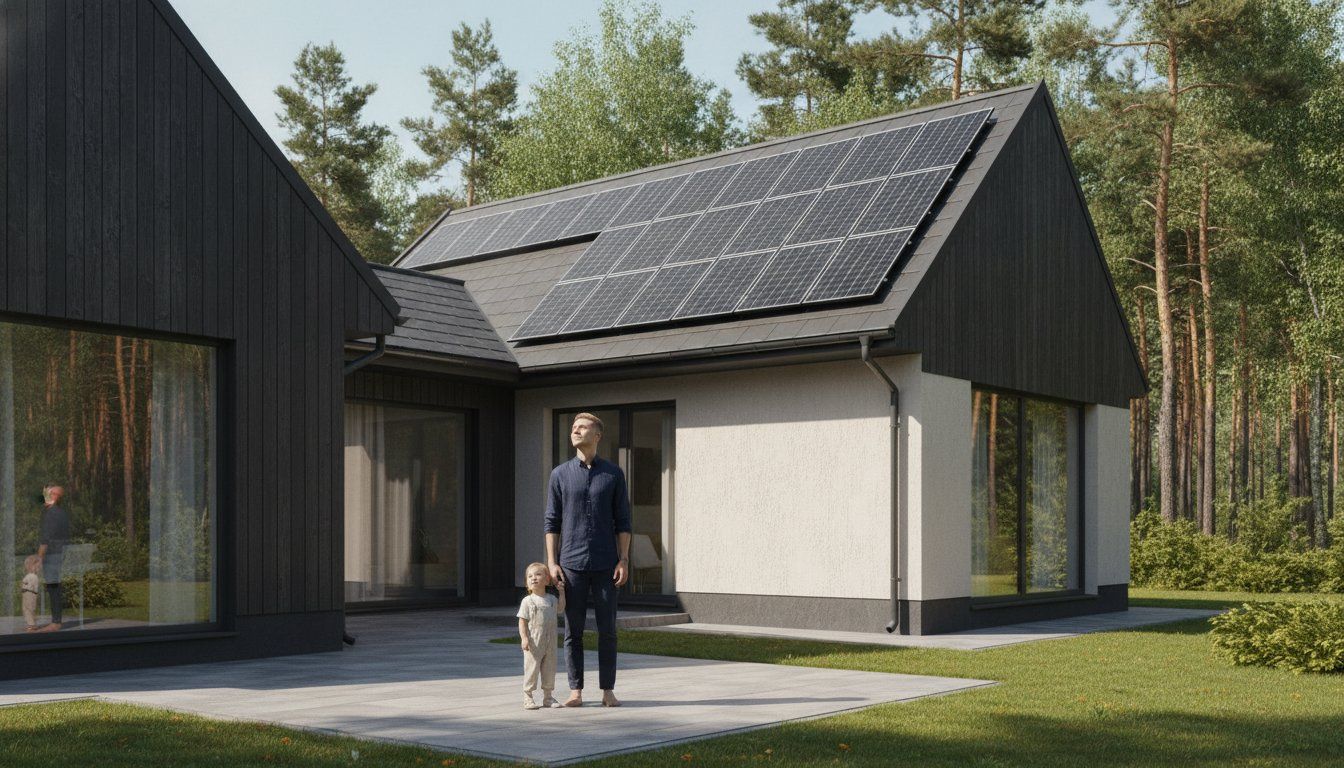
Did you know that in June 2026 solar energy became the first source of electricity in Latvia's history, providing more than 55% of all the country's production? This clearly confirms that solar panel installation is no longer just an experiment for enthusiasts, but a well-considered and financially justified decision for each household. We see in the Kommodus team every day that interest grows, but therefore there is growing concern about complex coordination with the Sadales network or fear of error in choosing unverified assembly solutions.
You will probably agree that home energy efficiency is a long-term investment that has no place in the future. Therefore, we have prepared this guide to help you navigate into current EQF support programmes that allow you to receive co-financing of up to EUR 6500 in 2026 for a package of panels and batteries. In this article, we will explain the whole process from the first project to the moment your meter starts working for you. Learn how to sort out documentation step by step why the sun is worth combining with a heat pump and how to achieve maximum independence from fluctuating exchange prices in Latvia.
Why installation of solar panels is beneficial in Latvia in 2026?
The record reached in June, when solar stations produced 274 GWh, proves that the sun has become our main resource. Energy security is no longer just a political term. It is an opportunity for every homeowner to become an independent manufacturer. The trends in the real estate market are clear.
The new net settlement system has changed the rules of the game significantly. Unlike the old system, we now operate with the value of euro rather than the accumulated kilowatt hours. This means that solar panels must be combined with smart electricity use at times when stock exchange prices are high or production is most active. To understand the basics of the system, it is worth exploring, how solar panels work and how they turn light into direct financial gain.
Economic rationale and return on investment
The main engine is increasing self-consumption. If you use a house for heating, you can get back to the market. Air-to-water heat pumpsThe average payback time for private homes varies from 5 to 8 years. This depends on the state support used and the consumption habits of your family.
Solar potential in Latvian latitude
The myth that there is too little sun in Latvia has been dispelled. The data we have shows that the level of insulation is sufficient to work with high efficiency from March to October. In winter months production is really minimal. However, the total annual cut is what determines the system's meaning. In mid-2026 total installed capacity in Latvia reached 1000 MW. This is the best proof of technology suitability for our climate.
Step by step steps: Solar panel assembly and harmonization process
The installation of solar panels is not only a technical work on the roof. It is a precise engineering process, which starts with a thorough energy audit of the object. We always emphasize that the calculation of the required capacity must be accurate. Too small a system will not deliver the expected savings, but too large an increase in the time of return of the investment will be unduly extended. After the audit, the development of a technical project that chooses the most appropriate type of construction is followed by a technical design. This depends on the specifics of your roofing or the area of free land, if the panels are planned to be located in the yard.
Alignment with 'Sadales network'
The way to energy freedom leads through the digital portal of "Sadales tīkls" AS. To obtain permission to connect a micro generator, the application must be prepared without errors. We see the mist with inadequate inverter power in relation to the home inlet protection device. State aid programme, because the accuracy of the documentation is crucial for obtaining funding. If it seems difficult to do so, we will be happy to take this care for you.
Technical assembly: on what should not be saved?
Once all the permits are received, the practical part begins. At this stage quality is your safety guarantee. Never choose the cheapest fastenings or cables. Latvian storms and changing weather conditions require maximum durability. Special attention must be paid to the location of the inverter. This requires natural cooling and protection from direct sunlight so that the device does not overheat. After installation we perform testing and putting into service the system. If you consider how to optimize the cost of the house, look at our Air-to-water heat pumps, which is the ideal partner for solar energy.
State aid and financing of solar panels
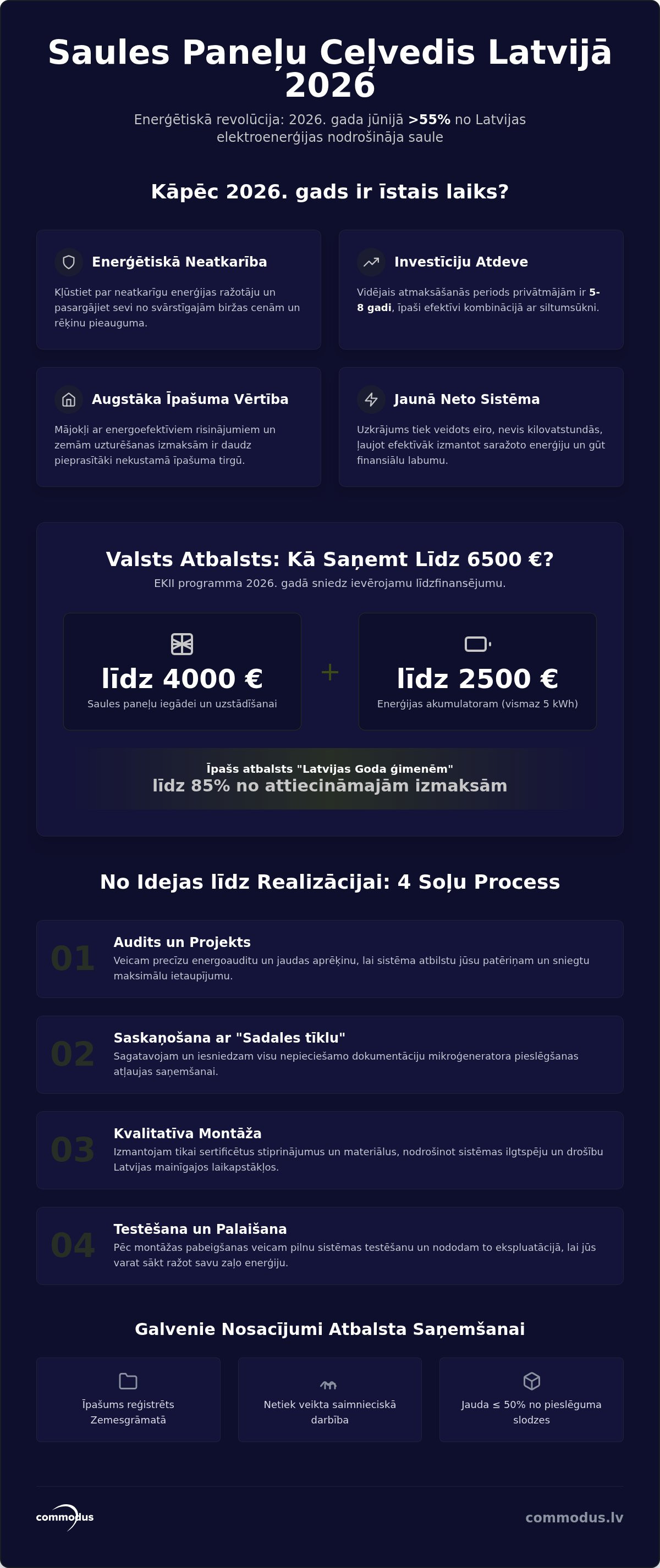
The financial support is one of the main reasons why the installation of solar panels in Latvia is booming. In 2026, households have access to several instruments that significantly reduce initial investment. The main pillar is the EQF programme managed by the Environmental Investment Fund. It provides up to 4000 euros in support of the purchase of panels and a further 2500 euros in energy storage batteries, if their capacity is at least 5 kWh. Total support for one project can reach 6500 euros, which is a significant amount for any family budget.
Current State support programmes for solar panels Since May 2026, "Latvian Honorary Families" has been able to receive support of up to 85% of eligible costs. In addition to state grants, Latvian banks offer "green loans" at lower interest rates. These loans are particularly advantageous because they do not require additional collateral and are aimed at introducing sustainable solutions, making solar energy available to a wider population.
Support environment in 2026
Although the popular Altum programme for new applications has been closed in previous years, the energy efficiency market has successfully adapted to the EQF conditions. The main requirements remain unchanged: the housing must be registered in the Land Register, it must not carry out economic activities, and the installed capacity must not exceed 50% of the connection load. Support is paid after installation of the system and submission of all documents, so it is important to follow the deadlines and requirements accurately.
Keeping documentation down without stress
We know that bureaucracy is often the biggest obstacle. Therefore, Kommodus offers a full service cycle, taking on the entire process of coordination for you. By choosing a partner who knows all the details of the support programs, you protect yourself from mistakes that might prevent you from receiving funding. Our experience shows that a well-prepared contract and technical documentation is the key to successful implementation of the project. If you want to know what amount of support is due to you, apply for consultation with our experts and we will help to prepare all the necessary applications.
Why is Commodus the right choice for solar panels?
We have been working on the engineering system market since 2010. In more than 15 years we have seen that each house is a unique ecosystem. Installation of solar panels is not just a technical task or an assembly on the roof. It is a story of your family's peace of mind and financial independence in the long term. Whether you plan to equip a small summer house or a large farm, our team is looking for a solution that will be as effective in your property conditions as possible.
Heat pump and solar panels: Perfect pair
The biggest benefit for the household comes when different energy-efficient systems work in a single team. Solar energy is able to cover a significant part of the electricity consumed by your heating equipment. We recommend to look at the energy efficiency of the household. CTC air-water heat pumps, designed to work seamlessly with renewable resources. ventilation ensure that the heat produced does not extract into the air by further optimising the overall energy consumption.
Long-term cooperation and service
Our work does not end when the panels are connected to the network. Regular maintenance is crucial to maintain high productivity of the system for decades. We provide operational technical support and guarantee throughout Latvia. With remote monitoring systems, you can follow your production on the phone at any time of the day. If you want to go into details about different equipment options, find out more In the guide to solar panel setsWe will be your trusted master and partner, who is not afraid of the challenges and always will find a solution.
Start your way to energy independence today
2026 has clearly confirmed that the sun has become the main ally of Latvian households. Using generous EQF support and smartly combining technologies, you are not only getting immediate lower bills, but also a stable peace of mind about the future of your family. Installation of solar panels is a strategic long-term investment, the effectiveness of which depends directly on the competence of the chosen partner and precise engineering calculations.
We are ready to share our experience with the Commodus team, which we have accumulated since 2010. Our professional masters provide a full service cycle, taking on the whole process from the initial project development to the final assembly and operational support for state funding. You do not have to lose out on the complicated bureaucratic corridors or worry about technical harmonisation details, because we will take care of every detail in your place.
Apply for free consultation and receive an individual solar panel project!
Take the first step towards a greener, more independent and more economically profitable daily life in your property. We will be truly happy to become your trusted guide to this change process, creating a safe and energy efficient environment for your home for many years ahead.
Frequently Asked Questions about Solar Energy
Is there a construction project for solar panels?
When private houses install panels on the roof to a certain capacity, a full construction project is not usually necessary. It is enough to match the "Sadales tīkls" portal and the engineering solution. However, if the installation on the ground is planned or the building's supporting structures are significantly affected, a simplified explanatory memorandum may be required in the local construction board. We always recommend that these nuances be specified before the work begins, and our specialists will help to arrange all necessary documentation.
How long do solar panels pay off in Latvia's climate?
The average return on investment in Latvia currently varies from 5 to 8 years. This period depends directly on whether state co-financing is used and how efficient the household can consume the energy it produces immediately. Installation of solar panels becomes even more advantageous if the system is combined with a heat pump. This way you maximise self-consumption and significantly reduce monthly heating and electricity bills.
What happens to the energy produced if I do not consume it right away?
The unused energy is transferred to the total electricity grid, where it is accounted for according to the principles of the net settlement system. Since May 2024, the transferred energy is allocated a value of money in euros, which can be used later to cover the electricity bill. The second option is to install a battery block that allows the accumulated capacity to be used in the evening or at night. This allows further increase of its independence from the exchange price fluctuations.
Do solar panels produce electricity in winter and cloudy weather?
Yes, solar panels produce electricity also in cloudy days, because modern technology reacts to light, not to direct heat. However, the productivity in such conditions is lower than in direct sunlight. In winter months, production in Latvia is minimal due to short daylight time and low sun angle. Therefore, the overall contribution of the system is assessed in the annual section, where the main power is provided by spring and summer seasons.
What is the amount of state support for solar panels in 2026?
In 2026 the EQF programme allows households to receive support of up to 4000 euro for the purchase of solar panels. If an additional battery system with a capacity of at least 5 kWh is installed, the co-financing of 2500 euros is available. The total state grant for one project can reach up to 6500 euros. Such support greatly facilitates initial costs and speeds up the payback time for each owner of the house.
Comments