What Documents Are Needed for Solar Panel Installation in 2026: Complete Guide
Did you know that by the end of 2024, almost 13,000 Latvian households had already successfully received state support for solar panels? Many of our customers admit that uncertainty about what documents are needed for solar panel installation, and fear of issues such as the 80% self-consumption rule, have been the biggest obstacles on the path to energy independence. We fully understand these concerns; the language used by institutions can be complicated, but in reality everything is manageable if you have a clear plan at hand.
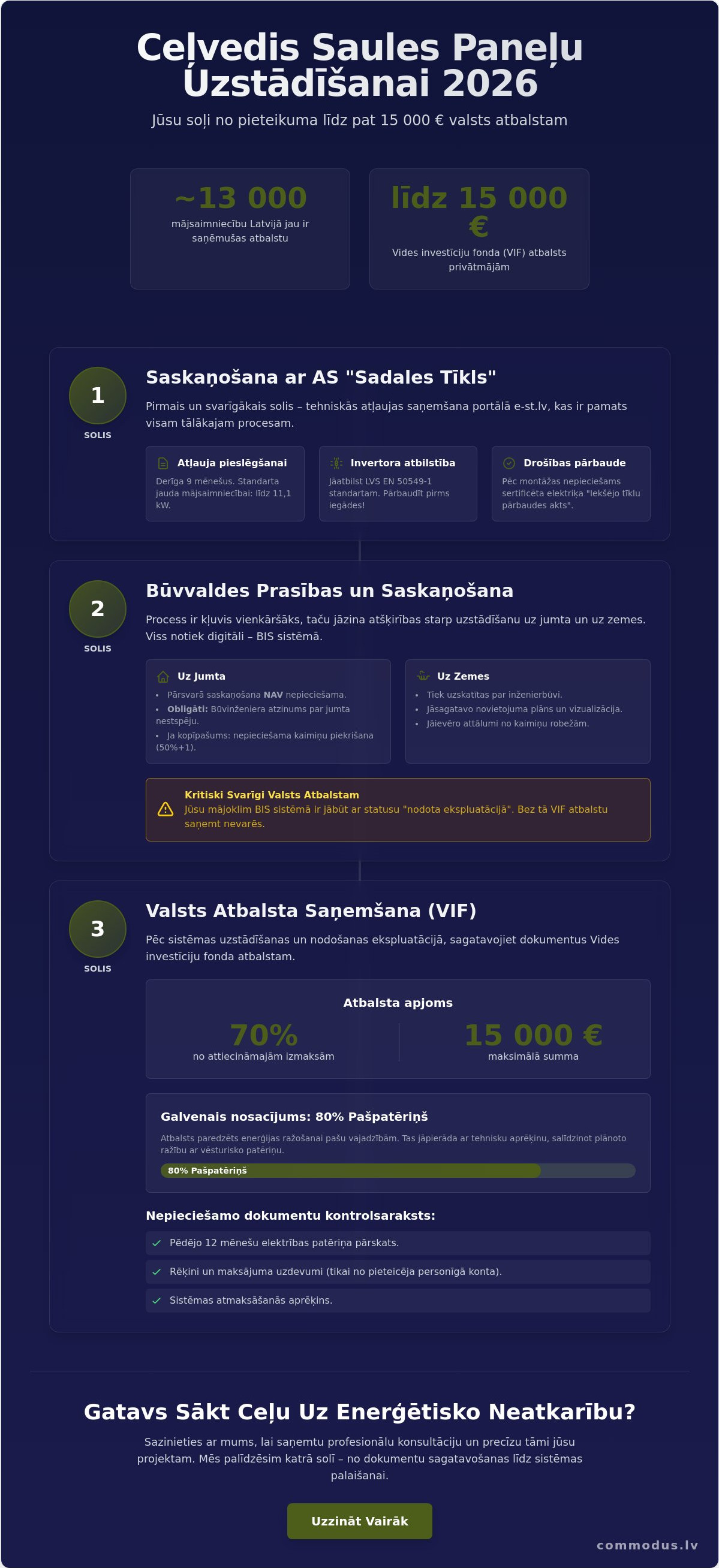
We are here to make this process simple and human. In this guide, you will learn the exact list of required documents and the steps needed to successfully coordinate system installation in 2026 and apply for Environmental Investment Fund support of up to EUR 15,000. We will walk you through the entire process, covering both "Sadales tīkls" requirements and building authority conditions, giving you full confidence in compliance with state programmes and long-term peace of mind.
First steps: Permits and coordination with Sadales tīkls
The path to your own solar power station always begins with one specific website: the e-st.lv customer portal. Before you start working with screws or lifting panels onto the roof, you must obtain a "Permit for connecting a microgenerator". This document is critical because it confirms that the national electricity grid can accept the energy you produce. Energy in Latvia is changing rapidly, and as the number of microgenerators grows, available grid capacity is becoming a valuable resource. Coordination is the first practical step in understanding whether your plan is technically feasible without additional investment in grid reconstruction.
During the application process in the e-st.lv portal, you will need to specify the inverter's rated power and the desired connection load. It is important to remember that in 2026, for a standard household connection (three-phase system), microgenerator capacity must not exceed 11.1 kW. If you are planning a more powerful system, the requirements become more complex. Once the application is approved, the received permit is usually valid for nine months. This is enough time to calmly complete the installation and prepare the remaining paperwork.
Choosing an inverter and technical parameters
The inverter is the "brain" of the entire system, and AS "Sadales tīkls" pays the greatest attention to it. To know precisely what documents are needed for solar panel installation, you should start with the inverter conformity certificate. The equipment must comply with the LVS EN 50549-1 standard. Our experience shows: never buy an inverter before receiving ST approval. If your chosen model is not on the list of certified equipment, coordination will be rejected, causing unnecessary costs and delays.
Communication with Sadales tīkls
Sometimes the grid capacity at your address is insufficient. In such a situation, ST may offer grid reconstruction, which can be an expensive and time-consuming process. Another essential document is the internal network inspection report. It is prepared by a certified electrician after the system has been installed, but before it is commissioned. This report confirms that your home's electrical installation is safe and ready for the new load. If you have doubts about the technical side, we always recommend consulting a specialist before submitting the application to avoid unexpected refusals.
Building authority requirements and the coordination process
Many homeowners are afraid of the Building Authority, imagining long queues and months of waiting. The good news is that in 2026 the process has become significantly simpler, especially if you plan to place panels on the roof. In most municipalities, including Riga, coordination is not required if the panels are located on a roof not facing a public outdoor space, or in a courtyard outside the historic centre. However, when understanding what documents are needed for solar panel installation, it is important to know that all communication now takes place digitally through the Construction Information System (BIS).
If your project involves changes to a building façade visible from the street or installation in a historic zone, an "explanatory memorandum" will be required. One of the most important documents at this stage is a technical inspection opinion from a certified structural engineer on the load-bearing capacity of the roof. This is not just a bureaucratic burden; it is your peace of mind that the structure will withstand the additional load and wind gusts. If you plan to install panels on a jointly owned roof, written consent from neighbours will also be required (50% plus one vote).
Solar panels on the roof vs. on the ground
The documentation differs depending on the chosen location. For ground-mounted systems, the process is slightly more complicated because they are considered engineering structures. You will need to prepare a site plan to scale and a visualisation, as well as follow the required distances from neighbouring land plot boundaries. If you plan to place the system closer than four metres from the boundary, the neighbour's signature on the plan is a mandatory prerequisite.
Building commissioning
This is a critical point for those who want to receive state support. The conditions of the Environmental Investment Fund programme require the house status in the BIS system to be "commissioned". If your home is still under construction, you will be able to receive the grant only after the building has been officially accepted for operation. For those thinking about full energy independence, it is worth considering how CTC air-to-water heat pumps can work in tandem with solar energy, optimising self-consumption from day one.
Remember that Building Authority coordination and the engineer's opinion are the foundation for avoiding problems later with insurance or selling the house. Once all technical and legal matters with the municipality have been arranged, you can safely move on to the next stage: preparing the state support application.
Documentation for receiving state support (Altum and VIF)
In 2026, the main support driver for private homes is the Environmental Investment Fund (VIF) programme, which allows you to recover up to 70% of the investment, up to a limit of EUR 15,000. Although the Altum programme for private individuals is no longer available for new applications, knowing what documents are needed for solar panel installation and for receiving support remains critically important, because VIF requirements are strict and precise. Everything begins with your household electricity consumption statement for the last 12 months, which you can easily download from your electricity trader's portal.
One of the biggest concerns for new system owners is the so-called 80% self-consumption rule. State support is intended for your own needs, not for commercial electricity production. To prove this, you do not need to write long explanations; a technical calculation is enough, comparing the system's planned production with your historical consumption. If you plan to buy a more powerful system because an electric car or heat pump is planned in the future, these plans must be justified in the application to avoid rejection of the grant.
Nuances of completing an Altum application
Although the focus has shifted to VIF, many still make mistakes that were also common during the Altum period. The most frequent stumbling block is incorrectly prepared invoices and payment orders. Remember: all payments must be made from the applicant's personal bank account. Cash transactions are not accepted. The application must also precisely state the system payback calculation, which is best prepared together with an experienced installer so the data are realistic and convincing.
Documents after installation
When the panels are already shining on the roof, the final document package must be prepared. You will need an acceptance and handover certificate signed by both parties, as well as a certified electrician's opinion on the safety of the system. This opinion is mandatory for "Sadales tīkls" to allow the system to be connected for parallel operation with the common grid. If you want to understand in greater depth what is included in a high-quality equipment set, our article will be useful: Solar Panel Kits: Complete Guide to Energy Independence in 2026.
To ensure the process runs smoothly and you receive the maximum possible support, choose ready-made and tested solar panel kits whose documentation has already been prepared in line with the requirements of state institutions.
System commissioning and legal use
When the panels are already shining on the roof, the final but very important stage begins: system legalisation. First, you must submit a notification to AS "Sadales tīkls" that the works have been completed. This is the moment when all the previously mentioned papers and specialist opinions are finally checked. If your property does not yet have a smart electricity meter, ST will usually install one so that both energy delivered to the grid and energy received from it can be measured accurately. When you understand what documents are needed for solar panel installation, you will see that this last step is the dot on the "i" that officially makes you an electricity producer.
The next step is to sign a new agreement with your electricity trader. In 2026, most new connections use the net billing system, in which the surplus produced energy is accumulated as a virtual value on your bill. A professional installer is indispensable at this stage; they will help organise the warranty document folder and user manuals that will be needed for long-term system maintenance and peace of mind. A well-organised document folder is also valuable if you decide to sell the house in the future, because it confirms the origin and quality of the equipment.
Net billing system documentation
To export surplus electricity to the grid, you will need an active agreement with a trader that defines the billing methodology. In 2026, it is important to choose a flexible plan that adapts to exchange prices if your self-consumption is uneven. The key documents at this stage are the trader's confirmation of participation in the net system and the certificate issued by ST confirming that the equipment is ready for parallel operation with the common grid.
Commodus support in handling documents
We know that bureaucracy can feel intimidating, so our team provides full support throughout the entire process. We help prepare everything needed to receive the grant, from engineering design to system commissioning. Our specialists make sure that all data are accurate and comply with the requirements of state institutions, guaranteeing safe and legal system operation. If you want to learn more about what documents are needed for solar panel installation for your specific home, contact Commodus experts for a free consultation about your solar panel project.
Start your path to energy independence today
Solar panel installation is not just a technical challenge; it is a legal process that requires precision and patience. Now you know what documents are needed for solar panel installation, from "Sadales tīkls" coordination to the Environmental Investment Fund application. Although digital tools such as BIS and e-st.lv have made the process more transparent, every detail in the engineer's opinion or inverter certificate is decisive for successfully receiving state support and ensuring long-term system safety.
The Commodus team has more than 15 years of experience in engineering systems, and we have completed hundreds of successfully coordinated projects across Latvia. We offer a full-service cycle, taking responsibility for the entire process from design to receiving the grant in your account. You do not need to spend your valuable time navigating bureaucratic twists and turns; we will make sure your system is fully legal and operates at maximum efficiency.
Apply for a free consultation and we will help with all the documents!
Energy freedom and peace of mind are within reach. With a reliable partner, document handling becomes a simple formality on the path to greener and cheaper electricity for your home.
Frequently asked questions about document handling
Can I install solar panels myself without coordination?
No, installing solar panels without coordination is illegal and dangerous. Even if you plan to install the system yourself, to connect it to the common electricity grid you must obtain permission from AS "Sadales tīkls" and prepare documentation signed by a certified specialist. DIY installation without the appropriate qualification and coordination prevents you from receiving state support and can also cause serious problems with property insurance.
How long does document coordination with Sadales tīkls and the Building Authority take?
Document coordination usually takes from a few days to a couple of months, depending on project complexity. AS "Sadales tīkls" usually approves a microgenerator application within 1 to 5 working days. Building Authority coordination, if an explanatory memorandum is required, may take up to 30 days. On average, the whole process from the first consultation to a fully legal system takes about 4 to 8 weeks.
Can state support be received if the house has not been commissioned?
No, the conditions of the Environmental Investment Fund programme state that the building must be commissioned at the time the application is submitted. If the house is still under construction, you may install the system, but you will be able to submit the grant application only after the building has been officially accepted for operation. This is an important point when planning what documents are needed for solar panel installation and for receiving financial support.
What are the requirements for an inverter to be allowed to connect to the common grid?
The inverter must comply with the European standard LVS EN 50549-1 and be included in the list of equipment recognised by AS "Sadales tīkls". This certificate confirms that the equipment is safe, can automatically disconnect in the event of a grid fault and will not cause disturbances to neighbours. We recommend choosing equipment only from well-known manufacturers whose compliance with Latvian grid parameters has already been previously checked and accepted.
Do I have to pay for smart meter installation after panel installation?
Smart meter installation for microgeneration customers is usually a free service provided by AS "Sadales tīkls". Once installation works have been completed and ST has received a certified electrician's confirmation that the system is ready, operational staff plan the meter replacement. This meter is necessary so that your electricity trader can accurately account for the energy delivered to the grid and apply the benefits of the net billing system.
Comments