Solar Panel Installation on a Flat Roof: A Complete Guide for 2026
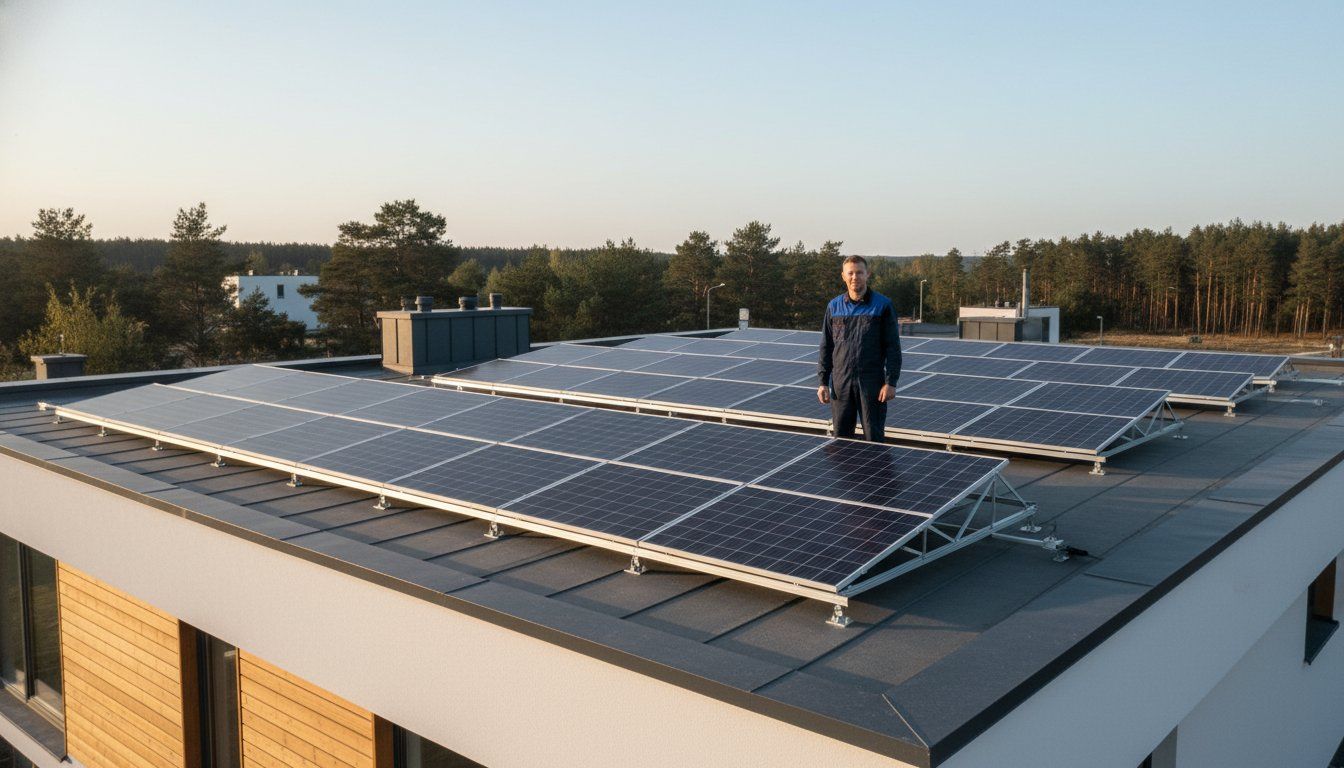
Many people think a flat roof is the most difficult obstacle to generating solar energy, but in reality it is a strategic advantage for your home. We know very well the uneasy thoughts that appear when solar panel installation on a flat roof is being considered. Will the roof covering start leaking after the work, and will the first strong gust of wind blow the whole system into the neighbour's garden? These concerns are completely justified, because no one wants to damage their property while trying to become more independent from electricity prices.
The good news is that properly planned installation can achieve even higher efficiency than on pitched roofs, because we can freely choose the ideal panel angle toward the sun. In this guide, we will help you understand how to make the most of a flat roof's potential while avoiding technical mistakes and unnecessary structural reinforcement. You will gain confidence in the system's safety in Latvian weather and learn what state support options are available in 2026. From modern mounting methods to the new net billing system, we will give you a clear action plan for your peace of mind and savings.
Why is a flat roof suitable for solar panel installation?
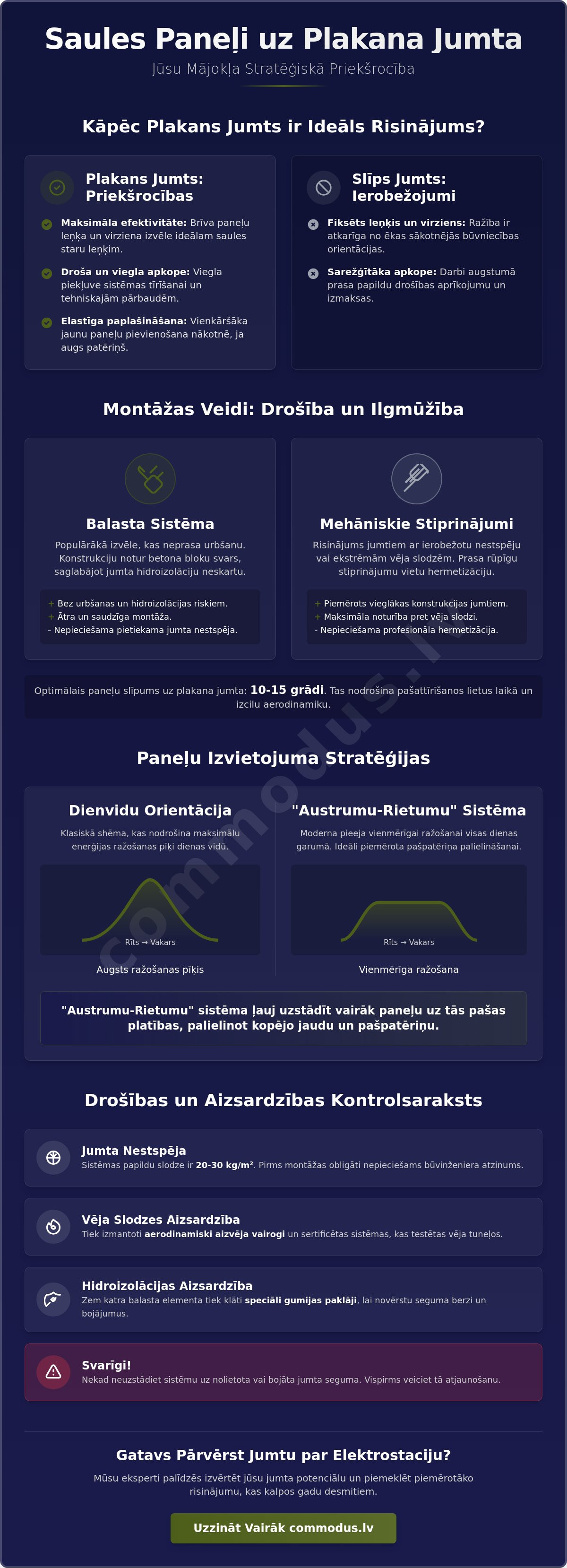
A flat roof is not just a modern design element; it is a practical foundation for your energy freedom. In the context of solar energy, we consider a flat roof to be a surface with a slope of no more than 10 degrees. The main reason why solar panel installation on a flat roof is so beneficial lies in complete freedom of action. You are not tied to the roof pitch or direction chosen when the building was constructed, which is often the main obstacle to maximum output on pitched roofs.
Safety and accessibility are another important benefit appreciated by both homeowners and installers. Unlike steep pitched roofs, where work requires specific equipment and greater caution, a flat surface allows maintenance to be carried out quickly and safely. Removing dust or visually inspecting the system on a flat surface is a simple task that does not require acrobatic tricks. In 2026, this approach has become a standard for energy-efficient buildings, because it allows a powerful solar power plant to be combined with modern architecture without losing a single drop of efficiency.
Many of our clients appreciate that a system on a flat roof can be expanded gradually. If, after some time, you realise that more capacity is needed, changing the panel layout or adding new rows is technically simpler. This provides reassurance that your investment is flexible and adaptable to future needs. We see that this flexibility is the decisive factor when choosing solar panel kits for new home projects.
Maximum efficiency through free orientation
A pitched roof often limits panel output if the house is not oriented precisely to the south. A flat roof solves this problem completely, because we can freely choose the ideal azimuth and tilt angle. Using special solar panel mounting systems, the panels can be positioned so they capture every ray of sun as efficiently as possible. This means that we can obtain more kilowatt-hours from the same area than on a restricted pitched roof.
The "East-West" configuration has become especially relevant in 2026. It allows panels to be placed closer to one another, making maximum use of every square metre and ensuring even electricity production from early morning until sunset. This type of solar panel installation on a flat roof helps increase self-consumption, because energy is produced exactly when households use it most, reducing dependence on grid fluctuations.
Mounting methods and optimal panel layout
Once you have understood the advantages of a flat roof, it is time to move on to the practical part - exactly how the panels will stay on the surface. The most popular choice in Latvia is ballast systems. They use the weight of concrete blocks or steel trays to keep the structure in place without drilling a single hole in the roof covering. This kind of solar panel installation on a flat roof is critically important for preserving the integrity of the waterproofing and avoiding unnecessary worries about leaks in the future. It is a safe and gentle way to turn a roof into a power plant.
In cases where the roof's load-bearing capacity is limited or wind loads are extreme, mechanical fasteners are used. Here, special attention must be paid to sealing with dedicated sleeves and mastics. Specialists often refer to best practice guidelines documentation, which emphasises that safety and longevity begin with precise material compatibility and load calculations. On a flat roof, the optimal panel tilt is usually between 10 and 15 degrees. This angle is sufficient for rain to wash away dust, while at the same time maintaining excellent aerodynamics and reducing wind load on the entire structure.
South-facing vs. East-West layout
The classic south-facing orientation remains popular because it delivers the maximum amount of energy from each individual panel. However, more and more homeowners today choose an East-West system. It provides more even electricity production throughout the day, which is ideal for covering self-consumption. You generate energy during your morning coffee and continue doing so when you return home in the evening. In addition, this layout allows more panels to be installed on the same area because large gaps between rows are not needed to avoid shading.
Structural materials and durability
High-quality solar panel installation on a flat roof is impossible without anodised aluminium or stainless steel fasteners. They are not afraid of corrosion for decades. Another essential element is wind deflectors, which redirect airflow and prevent the wind from "lifting" the panels like sails. If you are planning your project, we recommend looking at our offered solar panel kits solutions, where every detail has been tested in Latvia's harsh wind and snow conditions.
Safety, wind loads, and roof protection
Safety is the first issue we discuss with clients when solar panel installation on a flat roof is being planned. There is no room for guesswork here. The total system weight consists of the panels themselves, aluminium structures, and ballast, which is usually concrete blocks. This additional load can reach 20 to 30 kilograms per square metre. To make sure your roof feels secure, we use only certified systems that have passed wind tunnel tests. This guarantees that even in the strongest storms, aerodynamic closures will keep the panels in place and prevent the wind from lifting them.
One of the biggest myths is the fear of damaging the roof waterproofing. To prevent this, special rubber mats are always placed under each ballast foot. They serve as a protective layer that prevents the structure from rubbing mechanically against the roof covering under the influence of temperature changes. However, remember: never install solar panels on worn or damaged covering. If your roof covering has reached the end of its service life, renew it first to avoid dismantling the system after a couple of years.
Assessing the roof's load-bearing capacity
Before work begins, a civil engineer's assessment is critically important. Latvian winters can be unpredictable, and the engineer must calculate the cumulative effect created by the weight of the solar panels together with the maximum possible snow load. We want you to sleep peacefully even when there is a blizzard outside, knowing that the building structures are ready for this challenge. A professional assessment is the only way to preserve the building warranty and protect yourself against unpleasant surprises.
Fire safety and electrical installation
Electrical installation on a flat roof requires particular care. Cables are placed in special UV-resistant trays or conduits, protecting them from sun, rain, and mechanical damage. The integration of the lightning protection system with the solar panel frames is just as important. This is not just a formality, but real protection for your property and equipment. If you want to make sure your project meets all safety requirements, choose high-quality solar panel kits solutions installed by experienced specialists.
The installation process and state support in Latvia
Once you have decided in favour of solar energy, the process itself is surprisingly clear and smooth. Everything starts with a site survey, during which we assess the condition of the roof covering and calculate potential energy efficiency. Thanks to the simplified construction rules adopted in 2022, solar panel installation on a flat roof in most cases does not require complicated approval from the Construction Board, as long as the building's load-bearing structures are not affected. The main step is project approval with AS "Sadales tīkls", which usually takes a couple of weeks, while the installation itself on a flat roof requires only 1 to 3 working days.
2026 is an excellent time to invest, because state support is still available and has become even more targeted. The Environmental Investment Fund programme for microgenerator installation will run until the end of 2029. Households can receive support of up to 4,000 euros for systems with a capacity from 10 to 11.1 kW. The new net billing system allows the energy produced to be converted into monetary value at Nord Pool exchange prices, which you can use to pay bills or even at your other properties. In 2026, apartment building residents have access to a special 10 million euro programme that covers up to 70% of installation costs.
Synergy with other systems
Solar energy works best as part of a team. High-quality solar panel kits are an ideal addition to the heat pumps we install, because they significantly reduce heating and cooling costs. In 2026, hybrid systems with battery storage are becoming increasingly popular. The state currently also supports battery purchases with co-financing of up to 2,500 euros, allowing you to store your self-generated electricity for evening use and further increase your independence from grid fluctuations.
Commodus promise: Quality and a personal approach
Our team has extensive experience working with a wide range of flat roof coverings - whether bitumen, PVC, or an EPDM membrane. We know how to approach each material with care in order to preserve its longevity. Our cooperation does not end with the last screwed-in detail. We provide full after-sales service and warranty maintenance because your long-term peace of mind matters to us. If you are planning your path to energy efficiency, contact Commodus experts today. We will help with accurate estimates and find the best solution for your home.
Your path to energy independence starts today
A flat roof is not a limitation, but a great opportunity to precisely control your home's energy production. We have explained how a properly selected mounting system and orientation can significantly increase system output while fully protecting the roof covering. The 2026 state support programmes and the new net billing system make this investment more financially attractive than ever before, allowing you to recover a significant part of the investment.
High-quality solar panel installation on a flat roof requires knowledge and precision, so entrust it to professionals. With more than 14 years of experience in engineering systems, we at Commodus provide a full service, from individual project development to installation by certified specialists throughout Latvia. Our goal is your peace of mind and safety, so we use only proven solutions adapted to our weather conditions and wind loads.
Apply for a free solar panel calculation and consultation! Take the first step toward greener and cheaper energy right now; we will be by your side to help at every stage and ensure the best result for your home.
Frequently asked questions about solar panels on a flat roof
Can solar panels damage the waterproofing of my flat roof?
No, correctly performed solar panel installation on a flat roof does not endanger the waterproofing, because ballast systems are most often used. This solution does not require drilling into the roof covering, thereby fully preserving its tightness. Under each structural foot, we always place special rubber mats that serve as a protective layer, preventing mechanical rubbing and protecting the covering from damage caused by temperature changes.
How much additional weight do solar panels add to a flat roof?
The total system weight usually ranges from 20 to 30 kilograms per square metre. This load consists of the panels themselves, aluminium structures, and concrete ballast needed for stability against wind. Before installation, it is essential to calculate the roof's load-bearing capacity to be fully confident that the building will safely withstand both the system weight and the possible snow load during Latvia's winter months.
Do panels installed on a flat roof need to be cleaned more often?
Yes, panels with a low tilt angle may require slightly more regular maintenance because rainwater does not wash them as effectively as it does on steep pitched roofs. Dust or tree leaves can accumulate faster on a flat surface, so we recommend visually checking the condition of the panels at least twice a year. Usually, simple rinsing with water is enough to restore the system's maximum output.
What is the optimal panel tilt angle on a flat roof in Latvia?
In Latvian conditions, the optimal tilt for flat roof structures is 10 to 15 degrees. This angle is sufficient to ensure good energy yield and natural self-cleaning from precipitation, while also maintaining excellent aerodynamics. A lower tilt helps avoid excessive wind impact, which is critically important so that solar panel installation on a flat roof is safe in the long term.
Do I need a building permit to install solar panels on the roof?
In most cases, a building permit is not required, as long as the building's load-bearing structures are not affected or reinforced. According to the current rules, installing a microgenerator on a roof is a simplified process in which the main approval takes place with AS "Sadales tīkls". However, if your home is located in the historic centre of Riga or its protection zone, simplified approval from the city development department may be required.
Comments