How to Choose an Air Conditioner for Your Home: Complete Guide for 2026
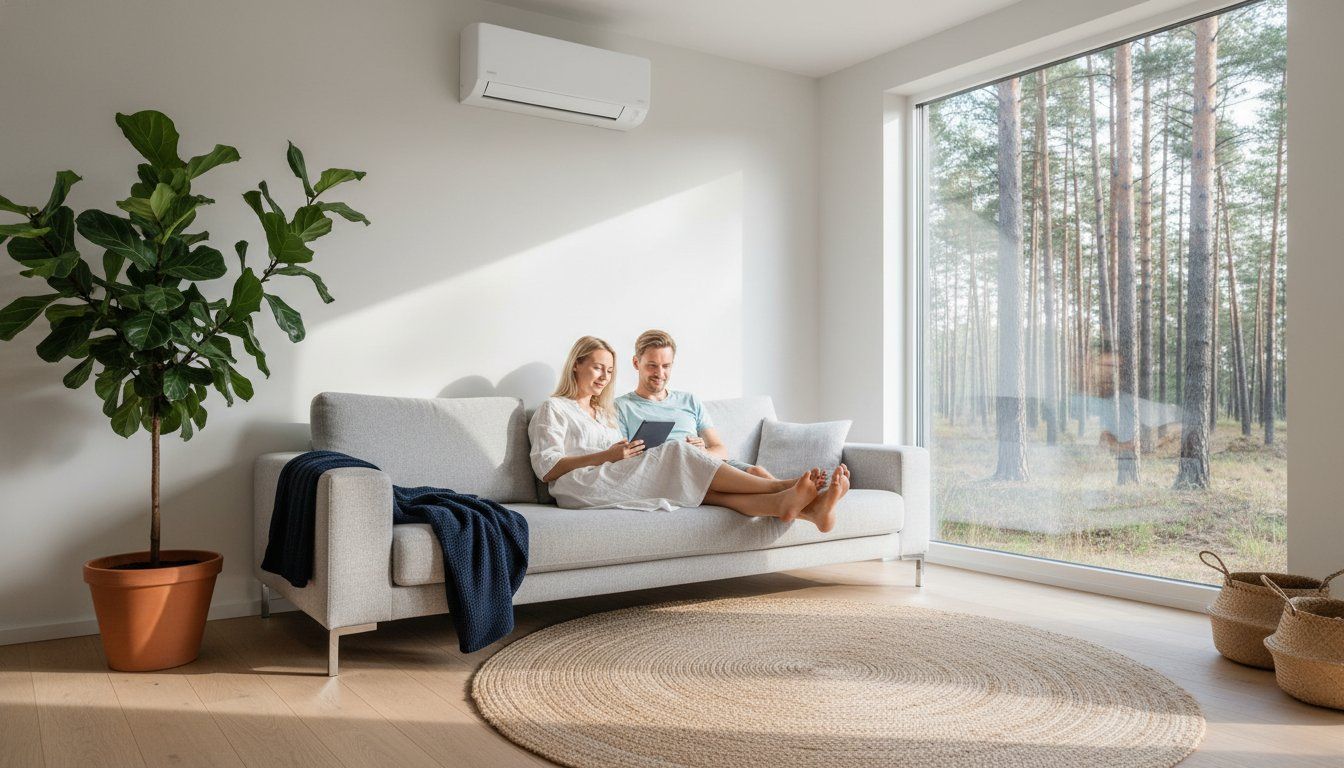
Did you know that a poorly chosen air conditioner can not only create unnecessary expenses, but even spoil your home's microclimate with constant drafts? Many people make the mistake of thinking that the cheapest model or a rough capacity guess is enough, but in 2026 air cooling has become a precise branch of engineering. It is hard to enjoy well-deserved rest when the rooms are filled with exhausting stuffiness, while concerns about installation complexity and fear of choosing the wrong capacity make you hesitate. We understand these doubts, because every home is unique.
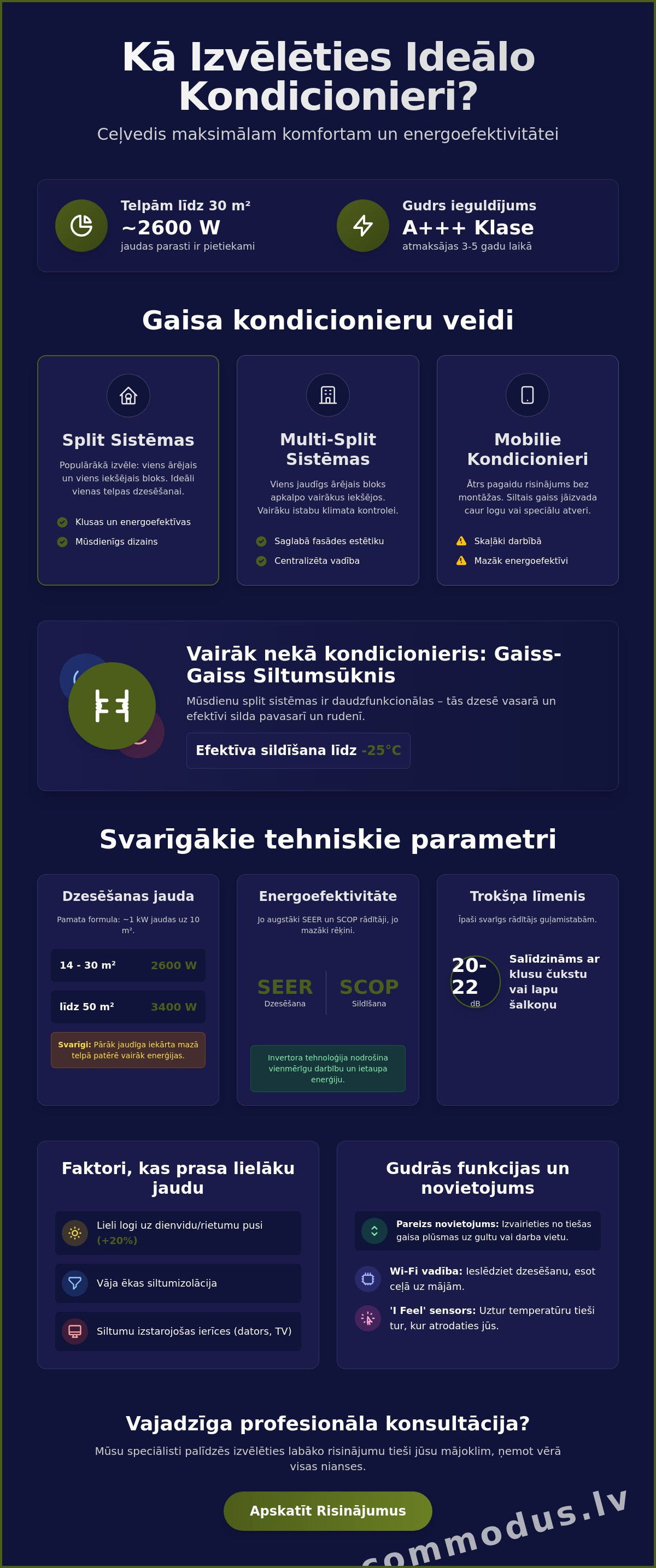
This guide will give you a clear answer to how to choose an air conditioner for your home so it provides maximum comfort and energy efficiency all year round. You will learn why a room of up to 30 square meters usually needs 2600 W of cooling capacity, and why an A+++ class unit is the smartest long-term investment. We will explore everything from smart Wi-Fi functions to Latvian building authority requirements and neighbor approvals, helping you make a considered decision that brings cool, fresh air without unnecessary stress.
Types of air conditioners: Which solution is best for your home?
An air conditioner is not just a fan with a cooling function. It is a complex unit that controls temperature, humidity levels and air cleanliness in your home. When choosing the right equipment, it is important to understand that different types of air conditioners serve different needs and home characteristics.
The most popular choice in Latvian households is split systems. They consist of two parts: one outdoor unit and one indoor unit, usually mounted on the wall. This solution is quiet, energy-efficient and modern. If you plan to cool several rooms, multi-split systems will be more suitable. In that case, several indoor units can be connected to one powerful outdoor unit. This keeps the building facade tidy and does not take up extra space in the yard or on the balcony.
Sometimes a situation calls for immediate action, and mobile air conditioners can help. This is a quick, temporary solution without complex installation. However, you should expect them to be louder and less efficient, because warm air must be vented through a window. Unlike outdated window air conditioners, which can still be seen in old films, modern split systems operate almost unnoticed. When thinking about how to choose an air conditioner for your home, first assess your room layout and how important complete quiet is to you at night.
Air conditioner or air-to-air heat pump: What is the difference?
Many of our clients are pleasantly surprised to learn that modern high-quality split systems are essentially the same air-to-air heat pumps. This means the unit can work in both directions. In summer it cools, while on chilly spring and autumn evenings, when central heating has not yet been turned on, it heats rooms quickly and efficiently.
This function is a major benefit in Latvia's changeable weather. You do not need to buy separate electric heaters that consume a lot of energy. Instead, you can use the same unit to create pleasant warmth within a few minutes. If you would like to see specific examples of such dual-function devices, we recommend viewing AlpicAir air heat pumps, which combine power with reasonable operating costs. Once you understand this nuance, the question of how to choose an air conditioner for your home becomes a decision about all-season climate control, not only relief from summer heat.
Technical parameters that determine comfort and bill size
Once you have chosen the most suitable system type, it is time to look more closely at the numbers. Correctly selected technical parameters are a guarantee that the unit will serve for a long time and electricity bills will not bring unpleasant surprises. One of the first steps is determining cooling capacity. In Latvian conditions, a room from 14 to 30 square meters usually needs 2600 W of capacity. If the room is larger, for example up to 50 square meters, approximately 3400 W will be required. It is important to remember that “more” does not always mean “better”. A unit that is too powerful for a small room will often switch on and off, increasing mechanical wear and consuming more electricity.
Today, the question of how to choose an air conditioner for your home is impossible to imagine without inverter technology. Unlike older on/off units, an inverter works smoothly, precisely adapting output to the actual need. This means less noise and a more stable temperature without sharp fluctuations. If you plan to install the device in a bedroom, noise level is a critical indicator. In the highest-quality models it is below 20-22 dB, comparable to a quiet whisper or leaves rustling in the garden.
When looking at the device label, pay attention to the SEER and SCOP coefficients. SEER indicates efficiency in cooling mode, while SCOP describes heating efficiency over the whole season. The higher these numbers are, the less you will pay for each kilowatt of cooling or heat you receive. If you want to find the most efficient solution for your area, see our range of AlpicAir air heat pumps, which stand out for high efficiency indicators and reliable operation.
Energy efficiency and the Latvian climate
An investment in an A+++ class unit may seem larger at the start, but with Latvian electricity prices it usually pays back within 3 to 5 years. This is especially important if you also plan to use the air conditioner for heating. Our winters can be unpredictable, so it is essential that the unit maintains high efficiency even at sub-zero temperatures. Quality systems can heat even when the outdoor temperature drops to -25°C, providing an extra sense of security in your home. That is why, when thinking about how to choose an air conditioner for your home, always evaluate its performance in both modes, not only cooling capacity during summer heat.
A practical guide to calculating capacity and choosing the location
Many homeowners ask how to choose an air conditioner for their home based only on room square meters. The basic formula is quite simple: 1 kW of capacity for every 10 square meters, if ceiling height does not exceed 2.5 meters. In real life, however, everything is a little more complex. If your living room has large south- or west-facing windows, the room heats up much faster. In this case, it is recommended to increase the required capacity by about 20%. Poor thermal insulation or electrical appliances in the room, such as a powerful computer or a large television, also release additional heat that the unit will need to overcome.
Choosing the right location is just as important as capacity. The indoor unit should not be installed directly opposite a bed or desk. This will help avoid direct airflow, which can cause discomfort or even a cold. As this complete guide for 2026 notes, modern technologies offer smart solutions. Wi-Fi control lets you switch on cooling while you are still on your way home, while the 'I Feel' sensor in the remote control ensures that the desired temperature is maintained exactly where you are, not only near the ceiling.
Do not forget air quality either. Air ionization and modern filters help clean the room of dust and allergens, creating a healthier microclimate for your family. If you are looking for a reliable unit with these functions, choose AlpicAir air heat pumps, a proven and energy-efficient value among our customers. Once you understand these nuances, the question of how to choose an air conditioner for your home becomes a simple and logical process.
Checklist before making a purchase
- Measure the room area and ceiling height accurately to determine the base capacity.
- Assess window orientation; south and west-facing rooms require a more powerful model.
- Check whether there is enough space on the building facade or balcony for the outdoor unit and whether special permits are needed.
Why are professional installation and service critically important?
Once you understand how to choose an air conditioner for your home and have found the model best suited to your home, the work is not yet finished. Even the most expensive and modern unit will work inefficiently or fail prematurely if it is installed carelessly. Certified technicians are not just “men with drills”. They are specialists who understand the nuances of refrigerant (freon) pressure and the importance of checking system tightness. Self-installation not only puts your safety at risk, but also automatically voids the manufacturer's warranty, which is too high a price for an attempt to save money.
A professional installation process includes several essential stages. After a hole has been drilled in the facade and copper pipes have been routed, vacuuming the system is a mandatory step. This process removes air and moisture from the pipes, ensuring that only clean freon remains in the system. If this is not done, moisture can damage the compressor during the very first season. Our Commodus team provides the full cycle, from the first consultation to precise installation and warranty service throughout Latvia. We believe that personal attention and a technician's experience are what create long-term peace of mind.
Regular maintenance is another cornerstone of the unit's longevity. Cleaning the filters at least once a year is mandatory not only for the equipment, but also for your health. Dirty filters accumulate dust and bacteria, which are distributed throughout the room during cooling. Professional maintenance helps detect microscopic freon leaks in time, preventing larger repairs in the future.
Air quality and ventilation synergy
It is important to remember that a standard air conditioner only cools the existing indoor air; it does not bring in fresh air from outside. To always have fresh, oxygen-rich air at home without the need to open windows, it is worth considering a heat recovery ventilation system. It works hand in hand with cooling equipment, ensuring a complete microclimate.
Modern units offer various filters for reducing allergies:
- HEPA filters, which capture even the finest dust particles.
- Carbon filters for neutralizing unpleasant odors.
- Catechin filters, which help fight bacteria.
If you are looking for a solution that combines high air filtration quality with reliable operation, we recommend choosing AlpicAir air conditioners. They have proven themselves as an excellent choice for Latvian households that care about both comfort and health. Ultimately, the question of how to choose an air conditioner for your home is always about caring for your family's well-being.
Create the ideal climate in your home today
When choosing an air conditioner, you are not just buying equipment; you are investing in your family's well-being and peace at home. In this guide, we looked at why accurate capacity calculation and the right unit location are the foundation for coolness without drafts. Remember that a modern split system is a smart tool that will provide comfort not only in summer heat, but also on chilly autumn evenings.
Once you understand how to choose an air conditioner for your home, the safest next step is to take it together with a trusted partner. We, the Commodus team, with more than 15 years of experience in the Latvian market, know every nuance of this industry. As official representatives of AlpicAir and CTC, we offer only proven values installed by our certified installation specialists.
Receive a free consultation and an accurate estimate for your home here!
May your home always have freshness and a pleasant temperature, regardless of what is happening outside the window. We are here to help you make it happen and create a safe, cozy atmosphere in your home.
Frequently asked questions
Does an air conditioner consume a lot of electricity?
Modern inverter-type air conditioners are surprisingly economical and energy-efficient. Unlike old units, they do not constantly switch on and off, but smoothly adapt output, consuming exactly as much energy as needed to maintain the temperature. By choosing an A++ or A+++ class model, cooling costs will be very small compared with the comfort it provides on hot summer days.
How often should air conditioner maintenance be performed?
Professional technical maintenance is recommended at least once a year, preferably in spring before the active cooling season begins. During this visit, the technician will check refrigerant pressure, system tightness and disinfect the indoor unit. The homeowner, in turn, is advised to rinse the air filters once every two or three months to ensure free airflow and cleanliness.
Can I install an air conditioner myself?
Self-installation of an air conditioner is not permitted and is not recommended for several reasons. Latvian legislation states that work with refrigerants may be performed only by certified specialists in order to prevent freon leaks into the environment. In addition, the manufacturer's warranty is valid only if installation has been carried out by a professional. When thinking about how to choose an air conditioner for your home, always plan for professional installation as well.
What is the difference between an air conditioner and an air cooler?
An air conditioner is a complex unit with a compressor that actually lowers the room temperature by removing heat outside the building. Air coolers, by contrast, operate on the principle of water evaporation and only slightly refresh the air in their immediate vicinity. An air conditioner is the only effective solution that can control the temperature throughout the room and reduce air humidity at the same time.
Does an air conditioner help with indoor humidity?
Yes, air dehumidification is a natural side process that occurs during cooling. When warm indoor air meets the cold heat exchanger, excess moisture condenses and is drained outside through the drainage pipe. Many models even have a separate “Dry” or dehumidification mode, which is very useful in Latvia's humid summers because it helps prevent mold risk and the feeling of stuffiness.
Comments