Choosing a Solar Panel Inverter: A Complete Guide to a Smart Investment in 2026
Would you entrust the energy heart of your home to a device whose operating principles feel like a complicated foreign language? We know that choosing a solar panel inverter can create a real headache, especially when you have to deal with terms such as MPPT, hybrid systems, or phase distribution. It is completely understandable that the new net settlement system, where energy is accounted for in euros, and changing tariffs make you wonder whether the investment will really pay back as quickly as planned.
In this article, we will clear up these concerns and show you how to choose the most suitable inverter to maximize energy efficiency and compatibility with your home's engineering systems. Our goal is to give you confidence that the chosen technology will be a reliable ally for many years, not just another box on the wall.
You will get a clear action plan for making the choice, understand how an inverter can work intelligently together with a heat pump, and learn about the current state support opportunities in 2026. Together, we will arrange the technical details so that your path to energy independence is transparent, safe, and economically justified.
What is a solar panel inverter, and why is it the system's "heart"?
Imagine solar panels as the muscles that collect energy, while the inverter is the heart and brain that makes the whole system work in harmony. To understand the basic principles, we first need to define what a solar panel inverter is and what role it plays in the overall setup. Its main task is to convert the direct current (DC) produced by the panels into the alternating current (AC) that we all understand and use. Without this process, your electrical appliances and heat pump simply could not operate.
A smart solar panel inverter choice will determine how steadily the system works over the next ten years. An inverter is not just a passive converter. It continuously monitors grid voltage and takes care of the safety of the entire system. When choosing a device, the efficiency coefficient is a critical indicator. Even a seemingly minor 1% difference in efficiency can mean hundreds of euros lost over 20 years in the form of unused energy. In Latvia's changing weather conditions, the enclosure protection class, usually IP65, and a high-quality cooling system are especially important. This ensures that the device does not shut down under heavy load on a hot summer day.
How does the inverter affect the payback of a solar panel system?
Choosing the right solar panel inverter directly affects how quickly your investment starts earning. The key role here belongs to MPPT, or maximum power point tracking technology. It ensures that the panels work at maximum output even when a small shadow falls on them or the weather is cloudy. It is worth remembering that the manufacturer's warranty is often 5 or 10 years, but a high-quality unit will serve significantly longer if it is properly cooled and maintained.
Smart functions: monitoring and remote control
Today, an inverter is a smart device connected to the internet. Through a mobile app, you can follow production in real time and adjust appliance consumption, for example by switching on underfloor heating at the moment when the sun is shining most intensely. The system reports errors itself, allowing service specialists to diagnose the situation remotely before you have even noticed a problem. This approach gives peace of mind and lets you fully control your energy management.
Inverter types: grid-tied, hybrid, and off-grid solutions
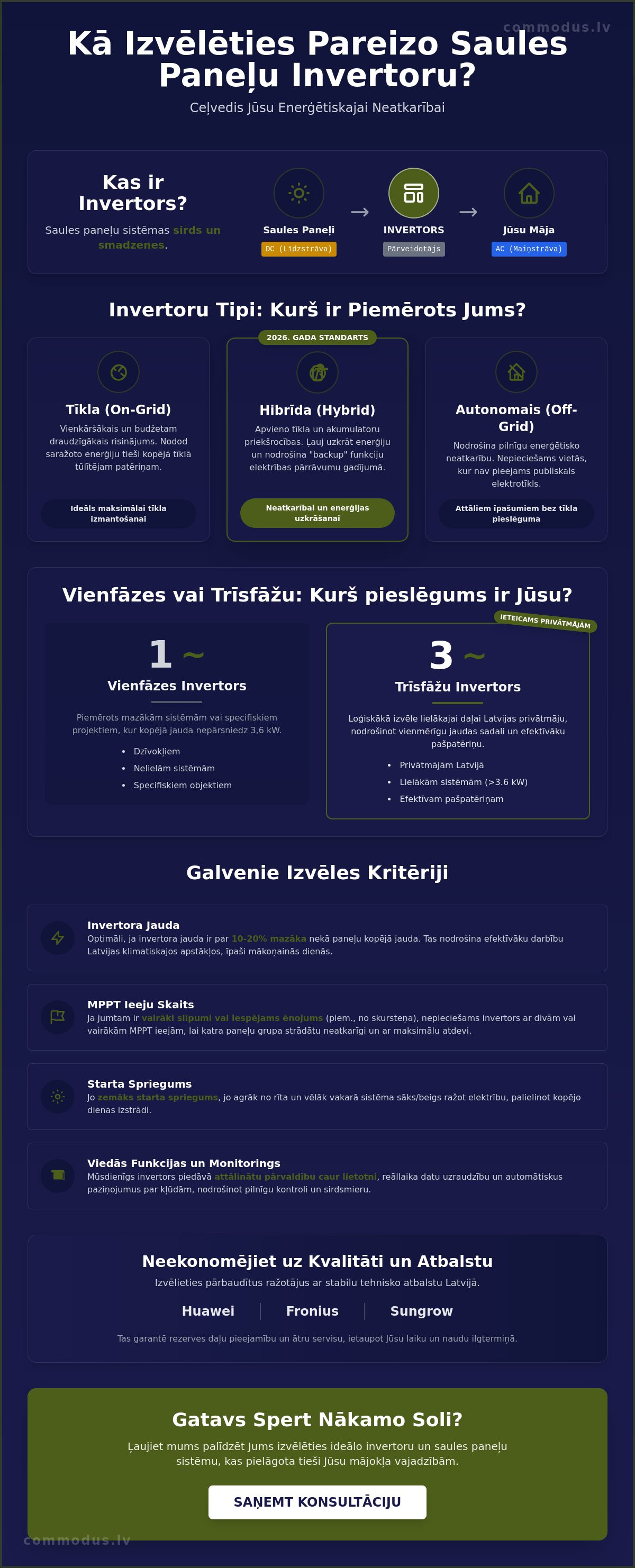
Choosing the right solar panel inverter starts with clearly defining your goals, because each device type serves different needs. Grid-tied, or on-grid, inverters are still the simplest and most budget-friendly solution. They are designed for direct connection to the public electricity grid, sending produced energy for immediate consumption or to "Sadales tīkls". Off-grid inverters, on the other hand, are indispensable in places with no connection at all, such as remote garden houses or forest properties. If your roof configuration is complex, with many slopes or potential shading, it is worth considering microinverters or power optimizers, which allow each panel to work independently.
Modern equipment has become incredibly intelligent. Thanks to smart technologies, the inverter is no longer just passive hardware, but an active grid support tool that can communicate with other home engineering systems. It ensures stable voltage and protects your electrical appliances from fluctuations, which is essential for long-term safety.
Why is a hybrid inverter the 2026 standard in Latvia?
The net settlement system in force in Latvia since May 2024 has significantly changed priorities. Since exported energy is accounted for in euros rather than kilowatt-hours, it is more profitable to consume as much electricity as possible immediately or store it in batteries. A hybrid inverter is the "golden middle", because it allows a battery block to be added at any time. Such a system also provides a backup function. If voltage disappears from the grid, the lights in your home will stay on and the refrigerator will continue operating. To ensure maximum efficiency, a hybrid system can be excellently combined with a CTC air-to-water heat pump, which will automatically consume solar energy for heating at the moments when it is most abundant.
Single-phase or three-phase inverter: which should you choose?
The choice between one or three phases is not just a matter of preference, but a technical necessity that must be matched to your home's connection. Most private houses in Latvia have a three-phase connection, so a three-phase inverter will also be the most logical choice. It allows the generated power to be distributed evenly across all phases, covering self-consumption more effectively. Single-phase solutions are usually used for smaller systems or specific apartment projects where the total power does not exceed 3.6 kW.
Criteria for the right choice: power, MPPT, and compatibility
Choosing a solar panel inverter is not just about comparing numbers in tables. It is a story about how intelligently your home will be able to use every ray of sunshine. One of the most common myths is the belief that inverter power must exactly match panel power. In reality, the inverter can be 10 to 20 percent "smaller". In Latvia's climate, panels rarely reach their theoretical maximum, so a slightly smaller inverter starts working at a lower voltage and operates more efficiently even on grey autumn days.
The number of MPPT inputs is another critical factor to consider. If your roof has several slopes or a chimney casts shade on the panels for part of the day, you will need at least two or more MPPT inputs. This allows each group of panels to work independently. It is also worth evaluating the start-up voltage. The lower it is, the earlier in the morning your system will "wake up" and start producing electricity. Do not forget the noise level either. If you plan to install the device next to living spaces, choose models with passive cooling that operate in complete silence.
Quality and brand choice: where should you not economize?
We recommend staying with proven values. Huawei, Fronius, and Sungrow are manufacturers that not only offer high efficiency, but also provide stable technical support right here in Latvia. This is essential because, in the event of any technical fault, the availability of spare parts and local service will save your time and peace of mind. By choosing the cheapest unknown-brand unit, you risk being left without help at the moment when you need it most.
Compatibility with future expansions
Think one step ahead. Perhaps today a 6 kW system is enough for you, but in two years there may be an electric car in your yard or your home may need more powerful heating. By choosing an inverter that is compatible with electric vehicle charging stations and allows additional batteries to be added easily, you protect yourself from rebuilding the entire system in the future. Smart energy management means that you can direct solar power to heating as well, so take a look at our CTC air-to-water heat pumps, which are perfectly suited for integration with a smart solar energy system.
Inverter integration with a heat pump and smart technologies
A modern energy-efficient home is impossible to imagine without coordinated system operation. The inverter is no longer just a device that produces electricity; it is a smart manager that literally talks to other equipment. Choosing the right solar panel inverter in 2026 means looking for a solution that can communicate directly with your heating system. For example, a modern air-to-water heat pump can receive a signal from the inverter that free solar energy is currently available and automatically increase the temperature in the buffer tank.
This process is enabled by the so-called SG Ready function. It allows the heat pump to work more intensively precisely at the moments when the sun is producing the most. In this way, you literally preserve solar heat in your home's floors or hot water boiler instead of sending it to the grid at a lower price. Commodus experience shows that this kind of integrated approach allows significantly greater savings than using each system separately. We develop solutions where every element complements the next, creating a safe and predictable environment for your family.
Smart energy management at home
A smart home starts with setting clear priorities. The inverter first supplies electricity to your home's appliances, then directs power to the heat pump, and only after that charges the battery or sends surplus energy to the grid. In this setup, solar panel kits become the main source of hot water preparation from spring until late autumn. It is a simple and understandable way to reduce monthly bills without losing even a bit of comfort.
Why choose full service from Commodus?
We believe that the client is our equal partner, so we offer not just equipment, but long-term peace of mind. By choosing full service from us, you receive a guarantee that the inverter will be fully compatible with all your home's engineering systems. Our team will help not only with installation, but also with professional consultation for receiving state support, making your investment even more advantageous. We are knowledgeable specialists who care about every project, regardless of its scale. From design to the last screw; we are beside you so that everything works flawlessly.
Your path to energy independence starts with a smart choice
A smart solar panel inverter choice is the foundation for a home that can take care of its own warmth and comfort. We have looked at why the inverter is the heart of the system and how hybrid solutions help make the most of every generated euro cent in the new net settlement system. Remember that technology compatibility with a heat pump is not just an extra function, but a critical prerequisite for your investment to pay back as quickly as possible.
The Commodus team has more than 14 years of experience developing energy-efficient solutions, and our certified installation specialists work across all of Latvia. We provide full service, from a precise project to regular maintenance, so you can enjoy peace of mind and warmth without unnecessary worries. We believe every home is unique, so our specialists will help find the technical solution that matches your exact needs.
Apply for a free consultation and find the right inverter for your home with Commodus experts!
Take the first step toward smart energy management today. We will be glad to become your trusted partner in this process of change.
Frequently asked questions about inverters
Can an inverter be installed outdoors?
Yes, most modern devices can be installed outdoors if they have the appropriate protection class, usually IP65 or higher. This means that the equipment is fully protected against dust and rainwater. However, we recommend choosing a place protected from direct sunlight and excessive heat to prevent electronics from overheating and to ensure maximum long-term efficiency.
How long does a solar panel inverter last?
Choosing a high-quality solar panel inverter usually means planning for a service life of 10 to 15 years, which is slightly shorter than the lifetime of the panels themselves. Since an inverter is a complex electronic device that continuously works under high load, its components wear over time. Most manufacturers offer a 5 to 10 year factory warranty, but with proper installation and good cooling, the device can serve even longer.
What is the difference between a string inverter and a microinverter?
A string inverter is one central device to which the entire row of panels is connected, and it is the most suitable option for simple roofs without shading. By contrast, microinverters are installed separately at each panel, allowing each one to work independently. This is the best solution for complex roof structures with several slopes, because shading or dirt on one panel does not affect the total energy production of the entire system.
Can a hybrid inverter work without a battery?
Yes, a hybrid inverter can operate fully without a battery, performing all the functions of a regular grid-tied inverter. Choosing this type of solar panel inverter is a forward-looking decision, because it allows you to install the system now and add a battery block later, when the need arises. This provides flexibility and allows your home's energy system to grow and develop together with your family's needs.
How can I know whether the inverter is working correctly?
The simplest way to check the device's operation is to follow the manufacturer's mobile app or look at the light indicators on the device housing. A green light usually indicates stable operating mode, while red or flashing indicators signal an error. Modern smart systems automatically send a notification to your smartphone if any deviations from the norm are detected, allowing you to react quickly and prevent disruptions.
Comments