Solar Panel Efficiency in Cloudy Weather: Do They Really Pay Off in Latvia?
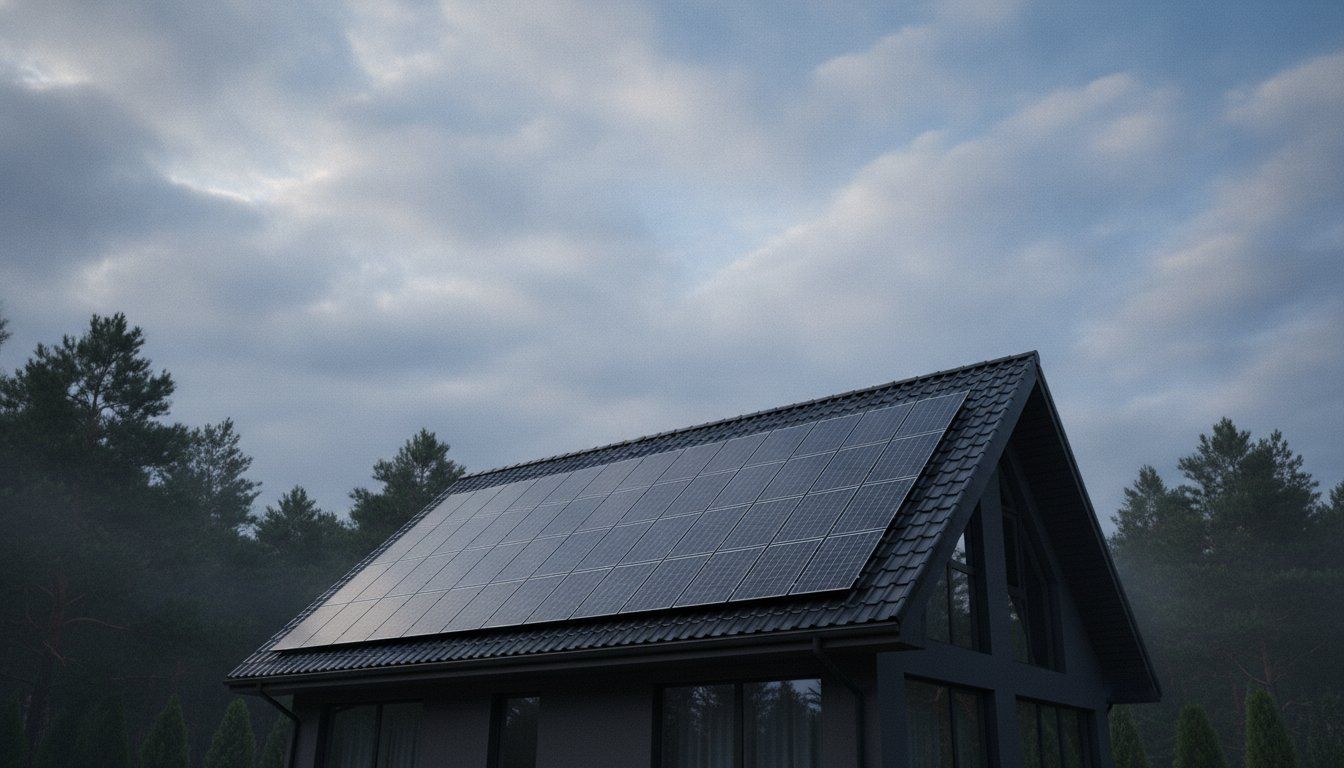
Did you know that solar panels do not actually need blazing sunshine to produce valuable energy? Many people in Latvia still believe that our grey skies are a verdict on whether solar energy makes sense, but the reality is very different. It is completely understandable that in autumn, looking out at low clouds, reasonable doubts arise. No one wants to invest in technology that seems not to work for half the year, which is why solar panel efficiency in cloudy weather is a topic our installers are asked about at almost every site.
In this article, we will dispel the myths and show how modern technologies turn diffuse daylight into electricity even on the gloomiest days. You will learn why panels keep working through cloud cover and how the new net billing system helps convert that output into a real euro balance in your account. We will give practical insight into optimising a system for Latvia's climate, so you can feel confident about the payback of the investment and enjoy peace of mind about your home's energy efficiency and independence for many years.
Do solar panels work in cloudy weather? Myths and reality
There is a popular myth that solar panels are like picky holidaymakers who work only when the sky is perfectly clear. In reality, modern solar panel efficiency in cloudy weather is high enough for the system to continue producing energy even on a typical grey Latvian day. Photovoltaic cells respond to a wide spectrum of light and to photons, not only to a direct, unobstructed solar disc. This means energy generation does not stop the moment the sun hides behind the edge of a cloud.
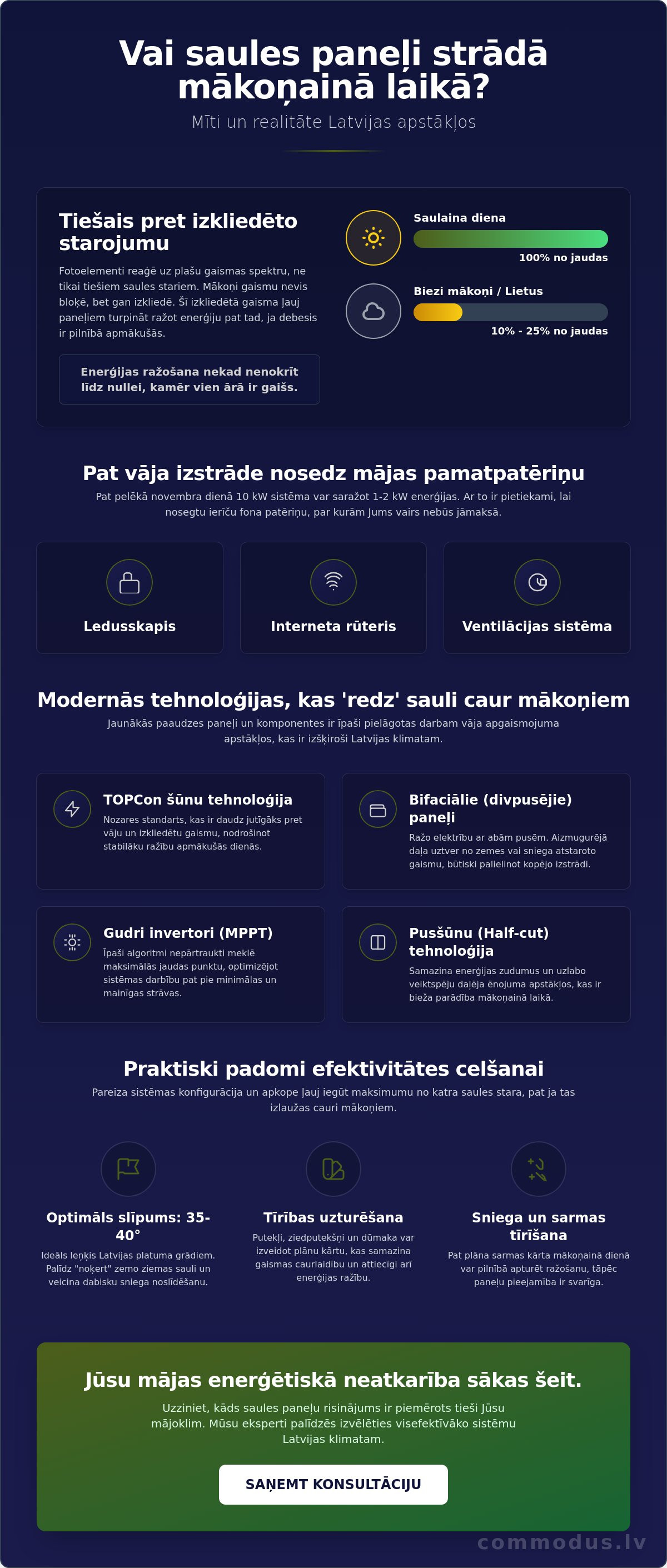
The scientific basis for how solar panels generate electricity is the photovoltaic effect. Even if we cannot see the sun, daylight still reaches the ground. Of course, output decreases, but it never falls to zero as long as it is light outside. Our experience shows that under thick rain clouds, panels usually retain around 10 to 25 percent of their maximum power. That may sound modest, but it is often enough to keep basic household functions running free of charge.
Direct vs diffuse radiation: What happens behind the clouds?
Clouds act like a huge natural light diffuser. When sunlight meets moisture and atmospheric particles in clouds, it does not disappear; it scatters in all directions. This process is called diffuse radiation. It is precisely this diffuse light that allows panels to produce energy even when they are not facing the sun directly or when the sky is completely overcast. Interestingly, light cloud cover can sometimes even help cool the panels. This improves their operating efficiency, because excessive heat usually reduces production rather than increasing it.
The impact of low light on household self-consumption
Why are these 10 to 25 percent of power so important? Even on a grey November day, a 10 kW system can produce 1 or 2 kW of energy. This amount is fully sufficient to cover a home's background consumption, such as a refrigerator, internet router or ventilation system. In this way, you still save money, because this energy does not have to be bought from the public grid. In Latvia's conditions, the ability to capture weak light efficiently is exactly what determines how quickly the system pays for itself in the long term.
Modern technologies that 'see' the sun through clouds
Our team sees every day that the technological leap in solar energy over recent years has made it a stable solution for Latvia's latitude. The main player in this change is TOPCon cell technology, which has become an industry standard in 2026. Compared with older models, TOPCon panels are much more sensitive to weak light. This ensures that solar panel efficiency in cloudy weather does not fade even when the sky is covered by an even grey blanket that would previously have significantly slowed production.
TOPCon and bifacial panels: Favourites for Latvia's climate
Bifacial, or double-sided, panels are especially suitable for Latvia's changeable weather. Their uniqueness lies in their ability to generate electricity from both sides. While the front side captures direct light, the rear side collects radiation reflected from the ground, the roof covering or even snow. Modern technologies for increasing efficiency allow these panels to produce significantly more energy than standard solutions. This is especially noticeable on days when light comes from all directions thanks to scattering caused by clouds.
System components that optimise weak current
The panels themselves are only one part of the story. To "catch" every watt they produce on a grey afternoon, the inverter and its MPPT algorithms play a decisive role. These algorithms work like an intelligent controller that continuously adjusts the system so that even with minimal current it operates at the highest possible efficiency. Our installers always emphasise that wattage on paper is only the beginning; real performance depends on how intelligently the system can handle weak current and partial shading, which half-cut cell technology helps to solve.
This considered approach to component selection guarantees that the system is not just sitting on the roof, but genuinely working for you every day. If you are considering how these technologies could complement your home's energy efficiency, we recommend exploring how solar energy combines with modern heating solutions such as CTC air-to-water heat pumps, which allow you to use your own generated electricity efficiently for heating.
Practical tips for improving efficiency in Latvian conditions
Technology is only half the victory. For solar panel efficiency in cloudy weather to reach its maximum, the system needs the right configuration and a little regular attention. Our installers' experience shows that even seemingly small details during installation can significantly affect how many euros you save over the course of a year. A properly arranged system works for you even when the sky is completely grey.
- Optimal tilt: 35–40 degrees is the ideal balance between summer production and the ability to capture the low winter sun.
- Keeping panels clean: Dust, pollen and autumn haze can create a film that blocks photons exactly when there is least light available.
- Snow and frost removal: Even a thin layer of frost on a cloudy day can completely stop production, so access for panel maintenance is important.
The importance of tilt angle at Latvia's latitude
Latvia's geographical position dictates its own rules. A steeper panel angle approaching 40 degrees helps not only to capture more diffuse light in cloudy conditions, but also to encourage natural snow shedding. This is critically important. In Latvia, the sky is often overcast exactly in the months when the sun is lowest above the horizon. When designing a system, we always consider local cloudiness statistics so that in autumn and spring you get the maximum return from every installed square metre.
Monitoring: how not to lose the energy you produce
Modern digital tools allow you to follow each panel's operation in real time. Commodus experts recommend checking the mobile app at least once a month to make sure all components are working together correctly. By identifying efficiency drops early, you avoid situations where one dirty panel or an inverter setting error reduces the output of the whole system. If you are planning to improve your home's energy efficiency, take a look at our ventilation solutions, which together with solar energy will create a truly economical and comfortable home.
Remember that a properly maintained system pays for itself much faster. If you have questions about improving an existing system or installing a new one, our team is always ready to help with personal and practical advice. We invite you to contact us and work together to find the best solution for your home on the Commodus website.
Solar panels and heat pump synergy: Energy self-sufficiency
We often say that one smart system is good, but two coordinated systems are excellent. When it comes to home energy efficiency, combining solar panels with heat pumps is the most logical step toward independence. Even when solar panel efficiency in cloudy weather is lower, it still provides enough energy to run the control units and circulation pumps of air-to-water heat pumps. This grey light captured by modern panels turns into real savings; every watt you generate yourself does not have to be bought from the grid at the exchange price.
The net billing system introduced in May 2024 has significantly changed the rules of the game. Now the surplus produced in summer is accumulated as monetary value in euros, which you can use to cover heating bills during the darker months of the year. Smart control allows solar production to be synchronised with the home's ventilation needs, automatically increasing air exchange precisely when the panels are producing most actively, even if the sky is covered with clouds.
Why are solar panels the best partner for a heat pump?
A heat pump is very efficient, but it needs electricity to power the compressor and pumps. The energy produced by solar panels in cloudy weather is excellent for covering these background costs. To get a complete picture of how these technologies work together, we recommend reading our air-to-water heat pump guide. It will help you understand how to achieve the maximum return from every euro invested in the system.
The path to energy independence in Latvia
Our goal is to help you create a unified and efficient network in which every component supports the others. By combining solar energy with modern heating solutions, you gain peace of mind and predictable costs for decades. If you are ready to take the next step, we invite you to a consultation about installing a solar panel kit. Our team will help choose the solution best suited to your home and consumption habits, so clouds never become an obstacle to your comfort.
Start producing your own energy regardless of the weather
Solar energy in Latvia is no longer just a summer experiment; it is a stable and well-planned solution for every household. We have established that solar panel efficiency in cloudy weather, thanks to TOPCon and bifacial technologies, allows valuable energy to be obtained even on grey days. By combining this with smart system planning and heat pump synergy, you create a secure foundation for your family's energy independence and predictable costs for many years.
With more than 15 years of experience in Latvia's energy-efficiency market, our team will help you make a balanced and safe decision. Commodus certified installation specialists work throughout Latvia, ensuring high-quality installation, while our engineers will carry out individual power calculations based on real Latvian meteorological data. Apply for a free consultation on solar panel installation on the Commodus website and find out how to make your home more efficient today.
We will be with you at every stage of the project to ensure that your new system works flawlessly and delivers the expected peace of mind, no matter how cloudy the weather is outside.
Frequently asked questions about solar panel operation
Do solar panels generate electricity when the sky is completely overcast?
Yes, solar panels continue to generate electricity even when the sky is completely covered with clouds. They use diffuse solar radiation that passes through the cloud layer and reaches the photovoltaic cells. Although power output in such conditions is lower than in direct sunlight, it is often enough to cover a home's basic electricity consumption. This ensures that your home energy system never stops, even on the greyest autumn afternoon.
How much does solar panel efficiency decrease in rainy weather in Latvia?
In rainy and heavily overcast conditions, solar panel efficiency usually drops to around 10–25% of maximum power. However, rain also has a positive effect because it washes away dust and dirt that would otherwise hinder light absorption. As a result, solar panel efficiency in cloudy weather improves immediately after downpours, when the air becomes clearer and the panel surface is clean. This helps keep the system in good working order without extra effort from you.
Which solar panels are best suited to Latvia's cloudy climate in 2026?
In 2026, TOPCon technology panels and bifacial, or double-sided, panels are the most suitable for Latvia's climate. These models are specifically designed to capture weak and diffuse light more effectively, which is common at our latitude. Bifacial panels also produce extra energy from light reflected from the roof or ground surface. Our installers recommend this combination because it provides the highest return precisely in changeable weather, ensuring a steadier energy flow throughout the day.
Is it worth clearing snow from panels on a cloudy winter day?
Yes, snow clearing is strongly recommended because even a thin layer of snow completely blocks light from reaching the photovoltaic cells. If the panels are clean, they can produce a small amount of electricity even on a grey winter day. This is important for keeping the system operating and not losing even those few kilowatts provided by the short daylight hours. In addition, a clean surface allows the panels to warm up faster when the first sun rays appear, helping the remaining ice melt naturally.
How does cloudy weather affect the payback period of solar panels in Latvia?
Local weather conditions are carefully included in the initial payback calculations, so cloudy days are not an unexpected obstacle to system profitability. Thanks to state support programmes and the new net billing system, the investment still pays back on average within 6 to 9 years. Solar panel efficiency in cloudy weather has improved in recent years thanks to technological progress, making this period even more predictable. The key is to choose high-quality components that can make the most of every available ray of light.
Comments